💥Mains Ready By December. Smash Mains & Smash PYQ Admissions Open

GS Paper: GS1-01.Indian Culture- Salient aspects of Art Forms, Literature and Architecture from ancient to modern times.

  • Supreme Court allows bullock cart races in Maharashtra

    The Supreme Court has allowed Maharashtra to hold bullock cart races in the state till the pendency of the matter before the Constitutional Bench of the apex court.

    Allowing bullock-cart races

    • The SC observed that the validity of the amended provisions of the Prevention of Cruelty to Animals Act, 1960 and the rules framed by Maharashtra provided for bullock cart race in the State.
    • Such races would operate during the pendency of the petitions as the entire matter has been referred to a constitution Bench.
    • The state govt has cited examples as the same is being conducted in the states like Tamil Nadu and Karnataka.

    Why was there a ban on the bullock cart races?

    Ans. Ban on Jallikattu, then

    • Bullock cart races were banned in Maharashtra after the Supreme Court declared that the race as violative of the provisions of the central act in 2014.
    • It then had observed that bulls were not anatomically designed to participate in races/taming and would be subjected to cruelty if used as a performing animal.

    How did Maharashtra respond?

    Ans. Bringing in a law to prevent pain or sufferings to the animals

    • In April 2017, the Maharashtra assembly had passed legislation for resumption of bullock cart races across the state.
    • The Bill titled ‘The Prevention of Cruelty to Animals (Maharashtra Amendment) Bill’ was passed unanimously with the support of all parties.
    • As per the amendment, bullock cart races could be held with the prior permission of the district collector concerned by ensuring that no pain or suffering would be caused to the animal.

    Why did the Maharashtra government go to SC?

    Ans. Blanket ban by Bombay HC

    • Even after this law, the Bombay High Court refused to vacate stay on the bullock cart races.
    • Hence it got to approach the SC.

    Proving the running ability of a bull

    • In November 2017, the Maharashtra government set up a committee to study the running capacity of various breeds of bulls and bullocks in comparison to horses.
    • The committee was asked to study physiological and biochemical changes during the running of the bulls, bullocks and horses.
    • A report titled ‘Running ability of bull’ was prepared in two months by the government to justify allowing the bullock cart races.
    • Subsequently, the Maharashtra government challenged the Bombay HC’s order.

    Back2Basics: Jallikattu Debate

    • It is a bull-taming sport and a disputed traditional event in which a bull such is released into a crowd of people.
    • Multiple human participants attempt to grab the large hump on the bull’s back with both arms and hang on to it while the bull attempts to escape.
    • Participants hold the hump for as long as possible, attempting to bring the bull to a stop. In some cases, participants must ride long enough to remove flags on the bull’s horns.
    • It is typically practised in the state of Tamil Nadu as a part of Pongal (harvest) celebrations in January.

    Issue with the sport

    An investigation by the Animal Welfare Board of India concluded that “Jallikattu is inherently cruel to animals”.

    • Human deaths: The event has caused several human deaths and injuries and there are several instances of fatalities to the bulls.
    • Manhandling of animals: Animal welfare concerns are related to the handling of the bulls before they are released and also during the competitor’s attempts to subdue the bull.
    • Cruelty to animal: Practices, before the bull is released, include prodding the bull with sharp sticks or scythes, extreme bending of the tail which can fracture the vertebrae, and biting of the bull’s tail.
    • Animal intoxication:  There are also reports of the bulls being forced to drink alcohol to disorient them, or chilli peppers being rubbed in their eyes to aggravate the bull.

    Arguments in favour

    • Native breed conservation: According to its protagonists, it is not a leisure sport available but a way to promote and preserve the native livestock.
    • Cultural significance: Jallikattu has been known to be practiced during the Tamil classical period (400-100 BCE) and finds mention in Sangam texts.
    • Man-animal relationship: Some believe that the sport also symbolizes a cordial man-animal relationship.


    UPSC 2022 countdown has begun! Get your personal guidance plan now! (Click here)

  • Tamil Nadu brings in State Song

    The Tamil Nadu Government has declared the Tamil Thai Vaazhthu as State Song.

    The decision came after the Madras High Court ruling that there is no statutory or executive order requiring the attendees to stand up when Tamil Thai Vaazhthu is sung.

    Tamil Thai Vaazhthu

    • A part of the verses under the title ‘Tamil Dheiva Vanakkam’ from Manonmaniam, penned by Manonmaniam Sundaranar and published in 1891, eventually came to be known as the Tamil Thai Vaazhthu.
    • In 1913, the annual report of the Karanthai Tamil Sangam made the demand for singing the song at all functions.
    • The Tamil Thai Vaazhthu is being sung at Karanthai Tamil Sangam since 1914.
    • It is also being sung at all Tamil Sangams associated with the Karanthai Tamil Sangam.
    • The Karanthai Tamil Sangam had appealed to the then Chief Minister, C.N. Annadurai, to declare Tamil Thai Vaazhthu the State song.

    What was the Madras HC observation?

    • There is no statutory or executive order requiring attendees to stand up when it was being sung.
    • The court, however, ruled that Tamil Thai Vaazhthu “is a prayer song and not an Anthem”.
    • While the “highest reverence and respect ought to be shown”, it was not necessary to stand for it.
    • The song is sung at the commencement (and not at the end) of all functions organized by government departments, local bodies and educational institutions.

    What about National Anthem?

    • In the Bijoe Emmanuel vs. State of Kerala (1986) Case, the Supreme Court ordered the readmission to school of three children who had been expelled for refusing to sing the national anthem.
    • It was then noted by the SC that there is no provision of law which obliges anyone to sing the National Anthem.
    • Again, the Supreme Court had, in Shyam Narayan Chouksey v. Union of India (2017), directed that all cinema halls shall play the national anthem before the film and all present are obliged to stand.

    What is the state directive?

    • TN CM has issued a directive that everyone who is present during the rendition of the song, barring differently-abled persons, should remain standing.
    • The song should compulsorily be sung at the beginning of events organized by all educational institutions, government offices and public sector undertakings, among other public organizations.
    • The song should be sung in 55 seconds in Mullaipaani Ragam (Mohana Raagam) in the thisra thaalaa.
    • At public functions, the playing of the song with musical instruments/recordings is to be avoided, and trained singers should sing it.

    Point of discussion: Is it a case of Sub-nationalism?

    • There has been an intensification of sub-nationalism in India by highlighting the greatness of their state, language or historical state icons.
    • This pride has, at times, led to unimaginable actions. The latest issue of contention was regarding a separate State flag for Karnataka.
    • India also witnesses shocking developments showing the ugly face of provincialism in the North-East.

    Issues with such tendencies

    • Overambitious aspirations: As much as it is a matter of pride it remains a matter of concern when regional aspirations become too strong.
    • Secessionist tendencies: India has already faced partition due to rising religious motives and has been plagued by secessionism in J&K and Nagaland based on regional identities.
    • National Unity: It can be argued that subnationalism emphasizes aggressively on its regional identities then it can break the sensitive thread through which India remains a nation.
    • Communalism: It should be critically studied that whether the state’s assertions are to freely exercise their own culture and language or to belittle and suppress others.

    Affirmations to offer

    • Pluralism: An optimistic view emerges which characterizes subnationalism as the strength of a multi-cultural nation such as India.
    • Socio-economic solidarity: Subnationalism encourages social development as the level of solidarity is high in a state under such motives of state song, flag etc.
    • Unification: State symbols means that a region becomes more and more homogenous and dedicated for welfare under cultural and linguistic symbolization.

    Conclusion

    • As long as subnationalism is not secessionist in nature or is aimed towards other communities, it might become a positive force in India.
    • It will help in re-establishing the nature of the pluralistic society of India amidst the growing manufactured rhetoric of nationalism being falsely related exclusively with religious nationality.


    UPSC 2022 countdown has begun! Get your personal guidance plan now! (Click here)

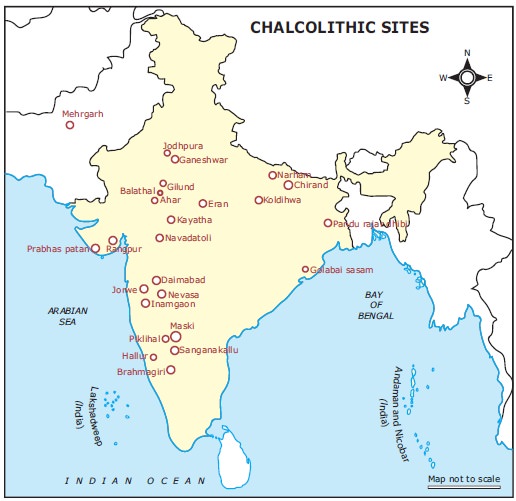
  • [pib] Chalcolithic sites in news: Eran and Tewar

    The Chalcolithic cultures of Central India are adequately investigated and studied informed the Ministry of Culture in particular reference to the sites of Eran and Tewar.

    Major sites in Central India

    [1] Eran (Dist. Sagar, MP )

    • Eran (ancient Airikina) is situated on the left bank of the Bina (ancient Venva) river and surrounded by it on three sides.
    • The recent excavation has unearthed a variety of antiquities including a copper coin, an iron arrowhead, terracotta bead, stone beads along with copper coins, stone celt, beads of steatite and jasper, etc.
    • The occurrence of few specimens of plain, thin grey ware is noteworthy.
    • The use of iron was evidenced by few metallic objects at the site.

    [2] Tewar (Dist. Jabalpur, MP)

    • Tewar (Tripuri) village is located 12 km west of Jabalpur district on Jabalpur – Bhopal highway.
    • This excavation did not reach the natural soil and revealed four folds of cultural sequences i.e. Kushana, Shunga, Satvahana, and Kalachuri.
    • Antiquarian remains in this excavation include viz remains of sculptures, hopscotch, terracotta balls, Iron nails, copper coins, terracotta beads, implements of Iron and terracotta figurine, ceramics red ware etc.
    • It also revealed structural remains consist of brick wall and structure of sandstone columns.

    Back2Basics: Chalcolithic Culture in India

    • A completely different kind of culture known as Chalcolithic Culture was developed in central India and Deccan region by the end of the Neolithic period.
    • It is characterized by the use of both stone and bronze implements.

    Major Chalcolithic complexes in India

    1. Ahar culture c. 2,800-1,500 B.C.
    2. Kayatha culture c. 2,450-700 B.C.
    3. Malwa culture c. 1,900-1,400 B.C.
    4. Savalda culture c. 2,300-2,000 B.C.
    5. Jorwe culture c. 1,500 -900 B.C.
    6. Prabhas culture c. 2,000-1,400 B.C.
    7. Rangpur culture c. 1,700-1,400 B.C.

    Important features

    • The people of Chalcolithic culture had used unique painted earthenware usually black-on-red.
    • The use of copper and bronze tools also evidenced on a limited scale.
    • The economy was largely based on subsistence agriculture, stock-raising, hunting, and fishing.
    • They, however, never reached the level of urbanization in spite they were using metal.
    • They were contemporary of the Harappan culture, but some other were of later Harappan age.

    Their locations

    • The centers of Chalcolithic cultures flourished in semi-arid regions of Rajasthan, Madhya Pradesh, Gujarat, and Maharashtra.
    • The settlements of Kayatha culture were mostly located on the Chambal River and its tributaries.
    • The settlements of Malwa culture are mostly located on the Narmada and its tributaries.
    • The three best known settlements of Malwa culture are at Navdatoli, Eran, and Nagada.
    • Navdatoli was one of the largest Chalcolithic settlements in the country spread in almost 10 hectares.
    • The settlements of Rangpur culture are located mostly on Ghelo and Kalubhar rivers in Gujarat.
    • More than 200 settlements of Jorwe culture are known. Greater numbers of these settlements are found in Maharashtra.
    • The best known settlements of Jorwe culture are Prakash, Daimabad, and Inamgaon. Daimabad was the largest one that measured almost 20 hectares.

    Development of Agriculture

    • They cultivated both Kharif and Rabi crops in rotation and also raised cattle with it.
    • They cultivated wheat and barley in Malwa region. Rice was cultivated in Inamgaon and Ahar.
    • They also cultivated jowar, bajra, kulth, ragi, green peas, lentil, and green and black grams.
    • Largely, the Chalcolithic cultures flourished in the black cotton soil zone.

    Trade and Commerce

    • The Chalcolithic communities traded and exchanged materials with other contemporary communities.
    • A large settlement serves as the major centers of trade and exchange.
    • Some of them were Ahar, Gilund, Nagada, Navdatoli, Eran, Prabhas, Rangpur, Prakash, Daimabad, and Inamgaon.
    • The Ahar people settled close to the copper source and were used to supply copper tools and objects to other contemporary communities in Malwa and Gujarat.
    • Identical marks embedded on most of the copper axes found in Malwa, Jorwe, and Prabhas cultures that might indicate that it may be the trademarks of the smiths who made them.
    • It is found that Conch shell for bangles was traded from the Saurashtra coast to various other parts of the Chalcolithic regions.
    • Gold and ivory come to Jorwe people from Tekkalkotta in Karnataka and semiprecious stones may have been traded to various parts from Rajpipla in Gujarat.
    • Wheeled bullock carts were used for long distance trade, besides the river transport. The drawings of wheeled bullock carts have been found on pots.

    Try this PYQ from CSP 2019. It is dicey, but you cannot escape such questions.

    Q. Which one of the following is not a Harappan site?

    (a) Chanhudaro

    (b) Kot Diji

    (c) Sohgaura

    (d) Desalpur


    [wpdiscuz-feedback id=”meqr233gpf” question=”Please leave a feedback on this” opened=”1″]Post your answers here.[/wpdiscuz-feedback]


    UPSC 2022 countdown has begun! Get your personal guidance plan now! (Click here)

  • [pib] Durga Puja gets UNESCO Intangible Cultural Heritage tag

    UNESCO has inscribed ‘Durga Puja in Kolkata’ on the Representative List of Intangible Cultural Heritage of Humanity.

    What is Intangible Cultural Heritage (ICH)?

    • ICH means the practices, representations, expressions, knowledge, skills – as well as the instruments, objects, artefacts and cultural spaces associated with them that communities, groups and, in some cases, individuals recognize as a part of their cultural heritage.
    • Furthermore, its importance is not in the cultural manifestation itself, but in the wealth of knowledge, know-how and skills that are transmitted from one generation to the next.

    About Durga Puja

    • Durga Puja, also known as Durgotsava or Sharodotsava, is an annual Hindu festival that reveres and pays homage to the goddess Durga.
    • It is an important festival in the Shaktism tradition of Hinduism.
    • It is celebrated because of Durga’s victory over Mahishasur.
    • It is particularly popular and traditionally celebrated in the Indian states of West Bengal, Bihar, Jharkhand, and Odisha among other states.
    • It is a ten-day festival, of which the last five are of the most significance.

    Citation for the UNESCO tag

    • The UNESCO Committee commended its initiatives to involve marginalized groups, and individuals as well as women in their participation in safeguarding the element.
    • The festival is also marked by scripture recitations, performance arts, revelry, gift-giving, family visits, feasting, and public processions.
    • Durga Puja not only is a celebration of the feminine divinity but is a consummate expression of dance, music, crafts, rituals, practices culinary and cultural aspects.
    • The festival transcends the boundaries of caste, creed and economic classes and joins the people together in its celebration.

    Also read: National List for Intangible Cultural Heritage (ICH)

    Other ICH in India

    • With the inscription of Durga Puja in Kolkata, India now has 14 intangible cultural heritage elements on the prestigious UNESCO Representative List of ICH of Humanity.
    • In recent years, the ICH elements that saw inscriptions are Kumbh Mela (inscribed 2017), Yoga (inscribed 2016) among others.
    • Also, India is a SIGNATORY of the 2003 UNESCO Convention which aims for the Safeguarding of the Intangible Heritage along with traditions and living expression.


    UPSC 2022 countdown has begun! Get your personal guidance plan now! (Click here)

  • Tribes in news: Konyak

    An angry mob allegedly vandalized an Assam Rifles camp and the office of the Konyak Union in Nagaland’s Mon district.

    Konyak Tribe

    • With a population of roughly 3 lakh, the area inhabited by the Konyaks extends into Arunachal Pradesh, with a sizeable population in Myanmar as well.
    • They are known to be one of the fiercest warrior tribes in Nagaland.
    • The Konyaks were the last to give up the practice of head-hunting – severing heads of enemies after attacking rival tribes – as late as the 1980s.

    Significance in Naga Peace Process

    • Mon is the only district in Nagaland where the separatist group has not been able to set up base camps, largely due to resistance from the Konyaks.
    • The Konyaks therefore, are imperative for a smooth resolution of the peace talks, as well as the post-talk peace process in the state.

    Also read:

    Naga Peace Accord


    UPSC 2022 countdown has begun! Get your personal guidance plan now! (Click here)

  • Who was St. Francis Xavier?

    The Prime Minister has greeted the people of Goa on the day of the Feast of St. Francis Xavier.

    St. Francis Xavier (1506-1552)

    • Francis Xavier venerated as Saint Francis Xavier, was a Catholic missionary and saint who was a co-founder of the Society of Jesus.
    • He was born in Javier, Kingdom of Navarre (in present-day Spain), he was a companion of Ignatius of Loyola and one of the first seven Jesuits.
    • He led an extensive mission into Asia, mainly in the Portuguese Empire of the time and was influential in evangelization work, most notably in India.

    His works

    • He has asked for a special minister to the king of Portugal whose sole office would be to further Christianity in Goa.
    • He also was the first Christian missionary to venture into Japan, Borneo, the Maluku Islands, and other areas.
    • In those areas, struggling to learn the local languages and in the face of opposition, he had less success than he had enjoyed in India.
    • Xavier was about to extend his missionary preaching to China when he died on Shangchuan Island.
    • Known as the “Apostle of the Indies” and “Apostle of Japan”, he is considered to be one of the greatest missionaries since Paul the Apostle.

    Try this question from CSP 2021

    Q. Consider the following statements:

    1. Francis Xavier was one of the founding members of the Jesuit Order.
    2. Francis Xavier died in Goa and a church is dedicated to him there.
    3. The Feast of St. Francis Xavier is celebrated in Goa each year.

    Which of the statements given above are correct?

    (a) 1 and 2 only

    (b) 2 and 3 only

    (c) 1 and 3 only

    (d) 1, 2 and 3


    [wpdiscuz-feedback id=”bxt6o52qk5″ question=”Please leave a feedback on this” opened=”1″]Post your answers here.[/wpdiscuz-feedback]


    UPSC 2022 countdown has begun! Get your personal guidance plan now! (Click here)
  • [pib] Scheme for Protection and Preservation of Endangered Languages of India (SPPEL)

    The Government of India has initiated a Scheme known as “Scheme for Protection and Preservation of Endangered Languages of India” (SPPEL) informed the Minister of Culture and Tourism.

    About SPPEL

    • The Scheme was instituted by Ministry of Human Resource Development in 2013.
    • The sole objective of the Scheme is to document and archive the country’s languages that have become endangered or likely to be endangered in the near future.
    • The scheme is monitored by the Central Institute of Indian Languages (CIIL) located in Mysuru, Karnataka.
    • The CIIL has collaborated with various universities and institutes across India for this mission.
    • University Grants Commission (UGC) is also providing financial assistance for the creation of centres for endangered languages at Central and State Universities.

    What are Endangered Languages?

    • At the moment, the languages which are spoken by less than 10,000 speakers or languages that are not been linguistically studied earlier are considered endangered language.

    Present status of the scheme

    • Presently, 117 languages have been listed for the documentation.
    • Documentation in the form of grammar, dictionary and ethno-linguistic profiles of about 500 lesser known languages are estimated to be accomplished in the coming years.


    UPSC 2022 countdown has begun! Get your personal guidance plan now! (Click here)

  • Were there domestic horses in ancient India?

    A group of researchers has been able to collect bones and teeth samples of over 2,000 such ancient specimens from regions from where domestic horses could have originated.

    Research on horse domestication

    • The research has studied fossils from the Iberian Peninsula in the southwestern corner of Europe, or the western-most edge of Eurasia (Spain and its neighbours), Anatolia (modern Turkey), and the steppes of Western Eurasia and Central Asia.
    • These collective data have led them to decide that until about 4200 BCE, many distinct horse populations inhabited various regions of Eurasia.

    Key findings of the research

    • A similar genetic analysis has found that horses with the modern domestic DNA profile lived in the Western Eurasian Steppes, particularly the Volga-Don River region.
    • By around 2200–2000 BCE, these horses spread out to Bohemia (the Czech Republic of today and Ukraine), and Central Asia and Mongolia.
    • These horses were bred by breeders from these countries to sell them to countries that demanded them.
    • Riding on horses became popular in these nations by around 3300 BCE, and armies were built using them, for example, in Mesopotamia, Iran, Kuwait and the ‘Fertile Crescent’ or Palestine.
    • The first spoke-wheeled chariots emerged around 2000-1800 BC.

    Indian story

    • Horses were never native to India.
    • The only animals native to India were the Asian elephant, snow leopard, rhinoceros, Bengal tiger, Sloth bear, Himalayan wolf, Gaur bison, red panda, crocodile, and the birds peacock and flamingo.
    • Thus, it seems clear from these sources that horse is not native to India.
    • Horses must have come into India through inter-regional trading between countries.
    • Indians might have traded their elephants, tigers, monkeys, birds to their neighbours and imported horses.

    When did India get its horses?

    • Horse-related remains and artefacts have been found in Late Harappan sites (1900-1300 BCE).
    • Horses did not seem to have played an essential role in the Harappan civilization.
    • This is in contrast to the Vedic Period, which is a little later (1500-500 BCE).
    • The Sanskrit word for horse is Ashwa, which is mentioned in the Vedas and Hindu Scriptures.
    • These are roughly towards the end of the late Bronze Age.

    Try this PYQ:

    Q. With reference to the difference between the culture of Rigvedic Aryans and Indus Valley people, which of the following statements correct?

    1. Rigvedic Aryans used the coat of mail and helmet in warfare whereas the people of Indus Valley Civilization did not leave any evidence of using them.
    2. Rigvedic Aryans knew gold, silver and copper whereas Indus Valley people knew only copper and iron.
    3. Rigvedic Aryans had domesticated the horse whereas there is no evidence of Indus Valley people having been aware of this animal.

    Select the correct answer using the code given below:

    (a) Only 1

    (b) 2 and 3 only

    (c) 1 and 3 only

    (d) 1, 2 and 3


    [wpdiscuz-feedback id=”in2agsa14u” question=”Please leave a feedback on this” opened=”1″]Post your answers here.[/wpdiscuz-feedback]


    UPSC 2022 countdown has begun! Get your personal guidance plan now! (Click here)

  • [pib] Who was Lachit Borphukan?

    The Prime Minister has paid tributes to Lachit Borphukan on Lachit Diwas.

    Who was Lachit Borphukan?

    • The year was 1671 and the decisive Battle of Saraighat was fought on the raging waters of the Brahmaputra.
    • On one side was Mughal Emperor Aurangzeb’s army headed by Ram Singh of Amer (Jaipur) and on the other was the Ahom General Lachit Borphukan.
    • He was a commander in the Ahom kingdom, located in present-day Assam.
    • Ram Singh failed to make any advance against the Assamese army during the first phase of the war.
    • Lachit Borphukan emerged victorious in the war and the Mughals were forced to retreat from Guwahati.

    Lachit Diwas

    • On 24 November each year, Lachit Divas is celebrated statewide in Assam to commemorate the heroism of Lachit Borphukan.
    • On this day, Borphukan has defeated the Mughal army on the banks of the Brahmaputra in the Battle of Saraighat in 1671.
    • The best passing out cadet of National Defence Academy has conferred the Lachit gold medal every year since 1999 commemorating his valour.

    Try this PYQ:

    Q.What was the immediate cause for Ahmad Shah Abdali to invade and fight the Third Battle of Panipat:

    (a) He wanted to avenge the expulsion by Marathas of his viceroy Timur Shah from Lahore

    (b) The frustrated governor of Jullundhar Adina Beg khan invited him to invade Punjab

    (c) He wanted to punish Mughal administration for non-payment of the revenues of the Chahar Mahal (Gujrat Aurangabad, Sialkot and Pasrur)

    (d) He wanted to annex all the fertile plains of Punjab upto borders of Delhi to his kingdom

    [wpdiscuz-feedback id=”cm8azvlxsr” question=”Please leave a feedback on this” opened=”1″]Post your answers here.[/wpdiscuz-feedback]


    UPSC 2022 countdown has begun! Get your personal guidance plan now! (Click here)

  • Puri Heritage Corridor Project

    Odisha CM will lay the foundation stone of the much-awaited Puri Heritage Corridor.

    Puri Heritage Corridor Project

    • Conceived in 2016, the Puri Heritage Corridor Project was unveiled in December 2019 to transform the holy town of Puri into an international place of heritage.
    • The project includes redeveloping major portions of the holy town and in the vicinity of the temple for visitors and tourists.

    About Jagannath Temple

    • The Jagannath Temple is an important Vaishnavite temple dedicated to Jagannath, a form of Sri Krishna in Puri in Odisha.
    • The present temple was rebuilt from the 10th century onwards, on the site of an earlier temple, and begun by Anantavarman Chodaganga Deva, the first king of the Eastern Ganga dynasty.
    • The Puri temple is famous for its annual Ratha Yatra, or chariot festival, in which the three principal deities are pulled on huge and elaborately decorated temple cars.

    Its architecture

    • With its sculptural richness and fluidity of the Oriya style of temple architecture, it is one of the most magnificent monuments of India.
    • The huge temple complex covers an area of over 400,000 square feet and is surrounded by a high fortified wall.
    • This 20 feet high wall is known as Meghanada Pacheri.
    • Another wall known as kurma bedha surrounds the main temple.

    The temple has four distinct sectional structures, namely:

    1. Deula, Vimana or Garba griha (Sanctum sanctorum) where the triad deities are lodged on the ratnavedi (Throne of Pearls). In Rekha Deula style;
    2. Mukhashala (Frontal porch);
    3. Nata mandir/Natamandapa, which is also known as the Jagamohan (Audience Hall/Dancing Hall), and
    4. Bhoga Mandapa (Offerings Hall)


    UPSC 2022 countdown has begun! Get your personal guidance plan now! (Click here)