Mains Ready By December. Smash Mains & Smash PYQ Admissions Open

GS Paper: GS3-17.Awareness in the fields of IT, Space, Computers, Robotics, Nano-technology, Bio-technology and issues relating to Intellectual Property Rights.

  • What is the Hayflick Limit?

    Why in the News?

    Leonard Hayflick, the renowned biomedical researcher who made a discovery about the limits of cell division in somatic cells (Hayflick Limit) has passed away at 98.

    What is the Hayflick Limit?

    • In the early 1960s, Hayflick discovered that somatic (non-reproductive) cells have a finite number of divisions, typically between 40-60 times.
    • This phenomenon, the ‘Hayflick limit’ suggests that aging occurs because cells eventually stop dividing.
      • This leads to the accumulation of senescent cells that contribute to the aging process.
    • The “ultimate Hayflick limit” for humans is estimated to be around 125 years.
    • Beyond this, no amount of lifestyle changes or medical interventions can extend the human lifespan.
    • Hayflick’s discovery has been applied to cells from various animals, revealing different Hayflick limits based on species’ lifespans.
    • Ex. Galapagos turtles, have cells that can divide approximately 110 times, whereas laboratory mice have a much lower limit of around 15 divisions.

    Broader Implications and Research

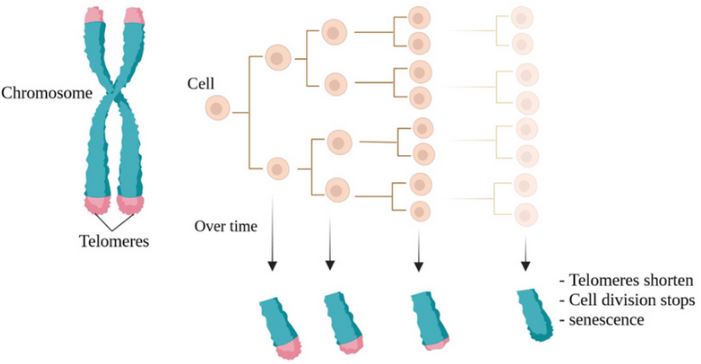
    • Hayflick’s discovery led to the discovery of telomeres in the 1970s.
      • Telomeres are protective DNA sequences at the ends of chromosomes, which shorten with each cell division.
    • When telomeres reach a critical length, cell division stops, which correlates with the Hayflick limit.
    • In the 1980s, scientists discovered telomerase, a protein capable of replenishing telomeres, which is naturally active in cancer cells, allowing them to bypass the Hayflick limit.

    PYQ:

    [2011] Regular intake of fresh fruits and vegetables is recommended in the diet since they are a good source of antioxidants. How do antioxidants help a person maintain health and promote longevity?

    (a) They activate the enzymes necessary for vitamin synthesis in the body and help prevent vitamin deficiency

    (b) They prevent excessive oxidation of carbohydrates, fats and proteins in the body and help avoid unnecessary wastage of energy

    (c) They neutralize the free radicals produced in the body during metabolism

    (d) They activate certain genes in the cells of the body and help delay the ageing process

  • What are Deceptive Dark Patterns?

    Why in the News?

    The Advertising Standards Council of India (ASCI) has released a report highlighting the use of deceptive dark patterns in Indian apps.

    Key highlights of the ASCI Study:

    • The ASCI report aims to raise awareness among marketers and designers about the ethical implications of these deceptive patterns.
    • The study analyzed 12,000 screens across 53 leading Indian apps in 9 different industries.
    • The report identified the use of one or more of 12 deceptive patterns in most of these apps.

    What are Deceptive Dark Patterns?

    • These practices use elements of digital choice architecture, particularly in user interfaces.
    • The goal is to manipulate or impair consumer autonomy, decision-making, or choice.
    • These patterns are often subtle, directing users toward decisions that may not align with their true preferences.
    • As a result, they compromise the ability of users to make informed choices.

    Examples of Deceptive Patterns:

    Description Example
    Interface Interference Directs users to specific choices using visual tricks. Highlighting preferred options with bright colors.
    Confirm Shaming Uses guilt to push users toward certain actions. Options like “Upgrade now” vs. “I don’t want a smarter software.”
    Basket Sneaking Adds unwanted items to cart without consent. Automatically adding a donation to the shopping cart.
    Privacy Deception Tricks users into sharing more personal data. Requiring unnecessary personal info during signup.
    Drip Pricing Reveals extra fees late in the purchase process. Adding hidden charges at checkout.
    Subscription Trap Leads to unintended subscriptions without clear notice. “Free trial” that auto-renews to a paid plan.

    Importance of Ethical Design

    • Raising Awareness: Marketers are encouraged to study the guidelines issued by ASCI and the Department of Consumer Affairs to avoid unethical practices.
    • Conscious Patterns Website: Marketers can use resources like the Conscious Patterns website to test their apps and obtain a “conscious score” to ensure that their apps balance business needs with user interests.
    • Digital Responsibility: As the digital world evolves, ethical design practices are crucial for building and maintaining trust with customers.
    • Marketer and Designer Roles: Both marketers and app designers need to be vigilant about pursuing ethical design to create safe and trustworthy online environments.

    PYQ

    [2015] What are the impediments in marketing and supply chain management in developing the food processing industry in India? Can e-commerce help in overcoming this bottleneck?

  • Reshape the governance structures of AI companies      

    Why in the News?

    Recently, corporations adopting stakeholder capitalism are focusing on products like Generative AI, which require governance models that balance profit-making with broader social responsibilities, reflecting a shift in corporate priorities.

    Data Access Issues

    1. Dependence on Data for AI Development: The advancement of AI technologies necessitates access to vast amounts of data, including personal and sensitive information. This reliance raises significant privacy concerns, as improper handling of this data can lead to breaches of privacy rights.
    2. Regulatory Scrutiny: Companies like Meta have faced regulatory challenges regarding data usage for AI training. For example, Meta was asked to pause its plans to train large language models using public content from Facebook and Instagram due to privacy concerns raised by regulators, highlighting the tension between data access and compliance with privacy laws.
    3. Algorithmic Bias: AI systems can perpetuate existing biases present in the data they are trained on, leading to discriminatory outcomes. For instance, Amazon discontinued a recruiting algorithm that displayed gender bias.

    Purpose vs. Strategy

    1. Conflict Between Purpose and Profit: Many companies, including OpenAI, initially adopted governance structures aimed at public benefit but faced challenges when profit motives clashed with their social objectives. The dismissal of CEO Sam Altman over concerns about prioritizing commercialization over user safety exemplifies this conflict.
    2. Shareholder Primacy: Despite the adoption of alternative governance models, the underlying shareholder primacy often prevails. The pressure to generate profits can overshadow the intended social benefits, leading to a situation where public good becomes secondary to financial gains.
    3. Corporate Governance issue: The governance issues faced by OpenAI, particularly the internal conflict that led to Altman’s firing, raise questions about the effectiveness of public benefit corporate structures in balancing profit and purpose, especially in tech companies reliant on investor capital.
    4. Potential Shift to For-Profit Structures: Rumors about OpenAI considering a transition to a for-profit governance model indicate a trend where companies may abandon their social objectives in favour of profit maximization.

    Workable Strategy (Way forward)

    1. Framing Ethical Standards: Developing comprehensive ethical guidelines for AI product companies is crucial. These standards should address data privacy, algorithmic fairness, and accountability, ensuring that AI technologies are developed responsibly and equitably.
    2. Incentivizing Public Benefit Objectives: Corporations should be incentivized to adopt public benefit purposes that align with their business strategies. This could involve financial incentives for companies that demonstrate long-term profit gains from socially responsible practices.
    3. Reducing Compliance Costs: To encourage adherence to public benefit objectives, it is essential to lower the compliance costs associated with implementing ethical practices.

    Mains PYQ:

    Q The emergence of the Fourth Industrial Revolution (Digital Revolution) hasinitiated e-Governance as an integral part of government”. Discuss. (UPSC IAS/2020)

  • Indian Astronomers discover new method for Solar Cycle Amplitude Prediction

    Why in the News?

    • Astronomers from the Indian Institute of Astrophysics (IIA) have developed a new method to predict the amplitude of the upcoming solar cycle.

    What is Space Weather?

    • Space weather refers to the varying conditions within the solar system and its heliosphere, influenced by the Sun and solar wind.
    • The main components of space weather include: solar wind, coronal mass ejections, and solar flares.
    • These components can compress the Earth’s magnetosphere, triggering geomagnetic storms.
    • This can disrupt communication, power transmission, damage spacecraft electronics, and pose threats to astronauts.

    Solar Cycle and Its Importance

    • The activity of the Sun follows an approximately 11-year periodic cycle, marked by variations in the number of sunspots on the Sun’s surface.
    • This solar cycle influences space weather, Earth’s atmosphere, and climate variations.
    • Predicting the amplitude of the solar cycle is a major challenge in astrophysics, as it directly affects related phenomena and space weather.

    Research Findings

    • IIA researchers discovered that the width of supergranular cells on the solar surface during the minimum year of the solar cycle is correlated with the number of sunspots observed during the subsequent solar cycle maximum.
    • This simple method can be used to predict the strength of the upcoming solar cycle, which is valuable for space weather forecasting.

    What are Supergranular Cells?

    • Supergranular Cells are large convective cells on the Sun’s surface, with diameters of about 30,000 km.
    • These cells are part of the solar convection zone where hot plasma rises, cools as it reaches the surface, and then sinks back down in a continuous cycle.
    • Characteristics:
      • Supergranular cells are larger than granules, another type of convective cell on the Sun. Its borders, known as supergranular lanes, are about 5,000 km thick.
      • Plasma within these cells moves from the center of the cell toward the edges, where it sinks back into the Sun’s interior. This movement creates a network of lanes that can be observed on the solar surface.
      • Supergranular cells are associated with the magnetic field concentrations on the Sun’s surface, often where sunspots and other magnetic features appear.

    PYQ:

    [2022] If a major solar storm (solar flare) reaches the Earth, which of the following are the possible effects on the Earth?

    1. GPS and navigation systems could fail.
    2. Tsunamis could occur at equatorial regions.
    3. Power grids could be damaged.
    4. Intense auroras could occur over much of the Earth.
    5. Forest fires could take place over much of the planet.
    6. Orbits of the satellites could be disturbed.
    7. Shortwave radio communication of the aircraft flying over pola-regions could be interrupted.

    Select the correct answer using the code given below:

    (a) 1, 2, 4 and 5 only
    (b) 2, 3, 5, 6 and 7 only
    (c) 1, 3, 4, 6 and 7 only
    (d) 1, 2, 3, 4, 5, 6 and 7

  • What is the drug Captagon?

    Why in the News?

    Captagon, the “poor man’s cocaine,” has become increasingly popular among young adults in the Middle East and North Africa.

    What is the Drug Captagon?

    • Captagon is a synthetic drug that was originally developed in Germany in the 1960s and 1970s.
    • It was initially created as a pharmaceutical treatment for attention deficit disorders, narcolepsy, and sometimes depression.
    • The primary active ingredient in Captagon is fenethylline, a compound that, once ingested, is metabolized into two powerful stimulants: amphetamine and theophylline.
    • These substances stimulate the central nervous system, leading to increased alertness, reduced fatigue, and a sense of euphoria.

    How Addictive is Captagon?

    • Captagon is highly addictive due to its powerful effects on the brain and body.
    • As a psychostimulant, Captagon significantly impacts the central nervous system, leading to a range of effects that can make it very difficult for users to stop taking the drug once they start.
    • It is also reportedly used by fighters in conflict zones to enhance their endurance and suppress fatigue.
    • The primary effects of Captagon include:
    1. Euphoria: Users often experience an intense feeling of happiness or well-being.
    2. Increased Wakefulness: The drug reduces the need for sleep, keeping users awake and alert for extended periods.
    3. Enhanced Physical and Mental Performance: Users may feel stronger, more focused, and more capable of performing both physically and mentally demanding tasks.
    • However, the heavy use of Captagon comes with serious risks such as cognitive impairment, cardiovascular issues, and risk of addiction.

    Where is Captagon Made?

    • In recent years, Syria the “narco state” of Middle East has emerged as the largest producer of Captagon.
    • Its production increased after 2011 Arab Spring protests, which led to civil unrest and conflict in the region.

    PYQ:

    [2019] Consider the following statements:

    1. The United Nations Convention against Corruption (UNCAC) has a ‘Protocol against the Smuggling of Migrants by Land, Sea and Air’.
    2. The UNCAC is the ever-first legally binding global anti-corruption instrument.
    3. A highlight of the United Nations Convention against Transnational Organized Crime (UNTOC) is the inclusion of a specific chapter aimed at returning assets to their rightful owners from whom they had been taken illicitly.
    4. The United Nations Office on Drugs and Crime (UNODC) is mandated by its member States to assist in the implementation of both UNCAC and UNTOC.

    Which of the statements given above are correct?

    (a) 1 and 3 only
    (b) 2, 3 and 4 only
    (c) 2 and 4 only
    (d) 1, 2, 3 and 4

  • Extremophile bacteria have learnt to survive microwaves

    Why in the News?

    Researchers have isolated extremophile bacteria from harsh environments like volcanic vents, permafrost, acid mines, deep-sea hydrothermal vents, and lakes beneath polar ice caps.

    What are Extremophiles?

    • Extremophiles are microorganisms that thrive in extreme environmental conditions where other life forms typically cannot survive.
    • For example: Volcanic vents, Permafrost, Acid mines, Deep-sea hydrothermal vents, dark lakes buried beneath polar ice caps, on the exteriors of spacecraft, around nuclear waste storage sites.

    Adaptation and Evolution:

    • Extremophiles have developed unique biological and biochemical processes over millions of years to adapt to diverse habitats.
    • Unlike more complex life forms, which have one set of proteins, extremophiles have multiple sets of proteins, each adapted to specific environmental conditions.
    • These proteins are ‘activated’ based on the surrounding environment, enabling survival during extreme conditions like high temperatures, lack of water, or high acidity.
    • Significance: Some scientists believe that life on Earth may have begun as an extremophile in extreme environmental niches before spreading and adapting to more temperate ecosystems.

    About the ‘Earth Microbiome Project’

    • It is a global initiative aimed at mapping, organising, and understanding the diversity of microbial life across different environmental niches on Earth.
    • The project was founded in 2010.
    • Objective: 
      • To sequence 200,000 genetic samples from diverse environments.
      • To assemble 500,000 microbial genomes, creating a comprehensive map of microbial diversity on Earth.
    • Significance:
      • The project is part of broader efforts to understand the microbial world, which is still in its infancy.
      • It is related to other significant projects like the ‘Earth Biogenome Project,’ which aims to sequence the genomes of all eukaryotic organisms on the planet.
      • Understanding microbial diversity has numerous biological and industrial applications, such as developing new enzymes for molecular biology or finding new ways to adapt organisms to challenging environments.


    PYQ:

    [2017] With reference to agriculture in India, how can the technique of ‘genome sequencing’, often seen in the news, be used in the immediate future?

    1. Genome sequencing can be used to identify genetic markers for disease resistance and drought tolerance in various crop plants.

    2. This technique helps in reducing the time required to develop new varieties of crop plants.

    3. It can be used to decipher the host-pathogen relationships in crops.

    Select the correct answer using the code given below:

    (a) 1 only

    (b) 2 and 3 only

    (c) 1 and 3 only

    (d) 1, 2 and 3

  • WHO declares Mpox as Public Health Emergency of International Concern

    Why in the news?

    The World Health Organization (WHO) has declared mpox as a “public health emergency of international concern” (PHEIC).

    What is a PHEIC?

    • A PHEIC is a formal declaration by the WHO under the International Health Regulations (IHR), 2005.
    • It refers to an “extraordinary event” posing a public health risk through the international spread of disease, potentially requiring a coordinated global response.
    • Criteria for PHEIC:
      • Serious and unusual event: Poses a significant public health risk.
      • Cross-border implications: Affects more than one country.
      • International response needed: Requires immediate global coordination.
    • Purpose: Mobilizes resources, raises awareness, and coordinates efforts to manage and contain the threat.

    What is Mpox?

    • Mpox is a disease caused by the orthopoxvirus, related to the smallpox virus.
    • First detected in humans in 1970, it is endemic in central and West Africa.
    • Transmission: Spread from animals to humans (zoonotic) and between humans via close contact, respiratory droplets, or contaminated materials.
    • Symptoms: Fever, rash, swollen lymph nodes; can lead to severe complications or death.
    • Vaccination: WHO recommends vaccines, widely used in Nigeria and the Democratic Republic of the Congo (DRC) to control outbreaks.

    Recent Developments: 

    • In recent years, there has been an increase in mpox cases, including the emergence of new strains such as clade 1b, which has spread to countries outside of its typical endemic regions.
    • This led to the declaration of mpox as a Public Health Emergency of International Concern (PHEIC) due to its potential for widespread impact.


    PYQ:

    [2014] Consider the following diseases

    1. Diphtheria

    2. Chickenpox

    3. Smallpox

    Which of the above diseases has/have been eradicated in India?

    (a) 1 and 2 only

    (b) 3 only

    (c) 1, 2 and 3

    (d) None

  • What is KAVACH Collision Avoidance System (CAS)?

    Why in the News?

    Indian Railways expects to launch Kavach CAS on Mumbai-Delhi-Kolkata routes by March 2025.

    About Kavach Train Collision Avoidance System (TCAS)

    Details
    Development
    • Development started in 2011 by Indian Railways and Research Designs & Standards Organisation (RDSO).
    • Key developer: B. Rajaram, known for the Skybus Metro system.
    • Field trials began in 2014, and final approval was granted in 2019.
    Safety Parameters Certified for Safety Integrity Level 4 (SIL-4) operations
    Working Mechanism
    • Components: Trackside RFID tags, onboard locomotive equipment, radio infrastructure.
    • Functionality: Real-time monitoring, driver alerts, and automatic braking to prevent collisions.
    • Data Inputs: Location, direction, time.
    • Event Recorders: Retain records for post-incident analysis.
    Collision Prevention
    • Alert Mechanism: Alerts the locomotive pilot if a ‘red signal’ is missed.
    • Automatic Braking: If speed exceeds 15 kmph after a red signal, Kavach applies brakes to halt the train.
    Issues
    • High Cost: ₹50 lakh per kilometer for deployment.
    • Low Coverage: Covers only 1,500 kilometers out of the total 68,000-kilometer rail network (as of November 2023).

    How does CAS work in ships and aircraft?

    Key Systems Functions
    Ships AIS (Automatic Identification System) Sends and receives data on location, speed, and direction between ships and land-based stations.
    LRIT (Long Range Identification and Tracking)
    • Requires ships to report location, time, and equipment every 6 hours to authorities.
    • Data shared with contracting governments and rescue operators via International LRIT Data Exchange.
    Aircraft Transponders Respond to radio-frequency pings to build a 3D view of surrounding air traffic.
    Alerts and Resolution Issues alert if another aircraft is within 48 seconds (traffic advisory) or 30 seconds (resolution) of a collision.
    Radar Altimeters and Obstacle Detection Monitors distance to the ground and alerts pilots about tall obstacles like towers.


    PYQ:

    [2015] With reference to bio-toilets used by the Indian Railways, consider the following statements:

    1. The decomposition of human waste in the biotoilets is initiated by a fungal inoculum.
    2. Ammonia and water vapour are the only end products in this decomposition which are released into the atmosphere.

    Which of the statements given above is/are correct?

    (a) 1 only
    (b) 2 only
    (c) Both 1 and 2
    (d) Neither 1 nor 2

  • Hidden dangers of irrational use of antibiotics on microbiome    

    Why in the news?

    While vital for treating infections, antibiotics can disrupt the microbiome by indiscriminately killing both harmful pathogens and beneficial gut bacteria, especially broad-spectrum types.

    Various roles played by Antibiotics (Applications):  


    Treatment of Infections

    Antibiotics are essential for treating bacterial infections, significantly reducing mortality rates associated with infectious diseases

    For example, penicillin and other antibiotics, the mortality rate from strep throat dropped dramatically from 1% to less than 0.1%.

    Preventing Disease Spread 

    Treating bacterial infections, antibiotics can prevent the spread of disease to other individuals

    For instance, during the 2009 H1N1 influenza pandemic, antibiotics were used to treat secondary bacterial pneumonia, which was a major cause of death.

    Reducing Complications

    Antibiotics can reduce the risk of serious complications from bacterial infections.

    For instance, In the case of urinary tract infections (UTIs), untreated infections can lead to kidney damage or life-threatening conditions like sepsis. However, with prompt antibiotic treatment, the risk of complications is greatly reduced

    Supporting Medical Procedures

    Antibiotics are used prophylactically to prevent infections before certain medical procedures

    For example in surgery

    Concerning Aspects of Antibiotic Use

    • Dysbiosis: The disruption of the microbiome, known as dysbiosis, can lead to severe health issues, including inflammatory bowel disease (IBD) and irritable bowel syndrome (IBS). 
    • Increased Infection Risk: Antibiotics can reduce colonization resistance, which is the microbiome’s ability to prevent pathogenic microorganisms from establishing infections. This reduction increases the risk of infections by harmful bacteria, such as Clostridioides difficile.
    • Antimicrobial Resistance (AMR): Overuse of antibiotics contributes to the development of antimicrobial resistance, making it more challenging to treat infections. The global crisis of antibiotic resistance is exacerbated by the enrichment of antibiotic resistance genes within the gut microbiota due to antibiotic exposure.
    • Long-term Health Consequences: Repeated antibiotic use can prevent full recovery of the microbiome, leading to chronic health issues. Research shows that children who receive multiple courses of antibiotics are at higher risk for developing conditions like IBD later in life.
    • Impact on Other Organ Systems: Dysbiosis can affect various organ systems through gut-organ axes, influencing conditions such as mental health disorders (via the gut-brain axis), liver diseases (via the gut-liver axis), and skin conditions (via the gut-skin axis) due to altered immune responses and increased permeability.

    Government initiatives: 

    1. The Indian Council of Medical Research (ICMR) has initiated an antibiotic stewardship program (AMSP) on a pilot basis in 20 tertiary care hospitals across India to control the misuse and overuse of antibiotics in hospital wards and ICUs.
    2. ICMR collaborated with the Indian Council of Agriculture Research, Department of Animal Husbandry, Dairy and Fisheries, and the Drugs Controller General of India (DCGI) to ban the use of Colistin as a growth promoter in animal feed in poultry.
    3. The Government of India launched the National Action Plan on Antimicrobial Resistance (NAP-AMR) in April 2017, focusing on a One Health approach.

    Way forward: 

    • Antibiotic Stewardship Programs: Implement and promote antibiotic stewardship programs in healthcare settings to ensure antibiotics are prescribed only when necessary and with the appropriate dosage and duration.
    • Probiotic Supplementation: Encourage the use of probiotics alongside antibiotic treatments to help maintain a healthy microbiome and mitigate the risks of dysbiosis and related health issues.

    Mains PYQ: 

    Q Can overuse and free availability of antibiotics without Doctor’s prescription, be contributors to the emergence of drug-resistant diseases in India? What are the available mechanisms for monitoring and control? Critically discuss the various issues involved. (2014)

  • India to roll out BPaL Regimen for Drug-Resistant TB

    Why in the News?

    India is preparing to introduce the BPaL (bedaquiline, pretomanid, and linezolid) regimen for all patients with multi/extensively drug-resistant tuberculosis (M/XDR-TB).

    What is BPaL Regimen? 

    Details
    Purpose
    • Treatment for multi-drug resistant (MDR) and extensively drug-resistant (XDR) tuberculosis (TB).
    • Provides a potent, shorter, and more effective treatment option for patients resistant to standard TB drugs.
    Components of the regimen Bedaquiline (Bdq):

    • Targets ATP synthase enzyme in Mycobacterium tuberculosis, disrupting energy production.
    • Key drug in combating drug-resistant TB.
    Pretomanid (Pa):

    • Inhibits bacterial cell wall synthesis and kills bacteria under anaerobic conditions.
    • Enhances effectiveness when combined with other TB drugs.
    Linezolid (Lzd):

    • Inhibits protein synthesis, stopping bacterial growth.
    • Effective against MDR and XDR TB strains.


    Significance of BPaL Regimen

    • Studies and trials have shown that the BPaL regimen has higher success rates in treating MDR and XDR TB compared to older regimens.
    • It reduces treatment duration for MDR/XDR-TB from the traditional 18-24 months to 6 months approx.  
    • It is entirely oral with NO injectable, making it easier for patients to adhere to the treatment.
    • It reduces number of drugs patients need to take daily from up to 14 to just 3.

    PYQ:

    [2014] Can overuse and free availability of antibiotics without Doctor’s prescription, be contributors to the emergence of drug-resistant diseases in India? What are the available mechanisms for monitoring and control? Critically discuss the various issues involved.