Mains Ready By December. Smash Mains & Smash PYQ Admissions Open

GS Paper: GS2-18.Bilateral, regional and global groupings and agreements involving India and/or affecting India’s interests.

  • The challenges for BRICS

    Why in the News

    India hosts the 18th BRICS Summit in New Delhi on 12 and 13 September, twenty years after the grouping was formalised in 2006. The grouping now accounts for a larger share of world output than the G7 and has grown from four members to eleven. Expansion has made agreement harder rather than easier. The foreign ministers’ meeting earlier in 2026 closed without a joint declaration after two members on opposite sides of an active conflict clashed. The economic project shows the same gap, with the idea of a single BRICS currency shelved in favour of settling bilateral trade in national currencies.

    How did BRICS grow from a four country dialogue into an eleven member bloc?

    1. Origin in a growth forecast: BRIC began in 2006 with Brazil, Russia, India and China, following a Goldman Sachs projection identifying these economies as future engines of global growth.
    2. From ministers to leaders: The format moved from a foreign ministers’ dialogue to a leaders’ forum, and the first summit was held at Yekaterinburg in Russia in 2009.
    3. First enlargement: South Africa joined in 2010, and the grouping took its present name.
    4. Second enlargement: Egypt, Ethiopia, Iran, Saudi Arabia and the UAE were added in 2024, and Indonesia became the eleventh full member in January 2025.

    How does BRICS now compare with the G7 in economic weight?

    1. The position in 2000: The four original members together accounted for roughly 23% of global GDP on a purchasing power parity (PPP) basis, which compares economies using what a currency actually buys at home rather than at market exchange rates. The G7 held nearly 52%.
    2. The position in 2024: The eleven member grouping accounted for approximately 36.8% of global GDP (PPP), and the G7 share fell below 29%.
    3. Growth differential: BRICS economies are projected to grow by an average 3.8% in 2025 and 3.7% in 2026, more than three times the G7 average.
    4. Prosperity tells a different story: Per capita GDP averages around $53,000 in the G7 against roughly $8,200 in BRICS.
    5. What drives the aggregate: The bloc’s weight comes from population and resource scale rather than from individual prosperity.

    Why has the grouping’s original grievance survived twenty years?

    1. The founding complaint: Global institutions have not kept pace with the redistribution of economic and political power.
    2. What the first summit asked for: Reform of the international financial institutions and of the United Nations, greater energy security, and a more democratic multipolar world order.
    3. Still unmet: Those demands remain the grouping’s central agenda two decades later, which is why an economic forum has turned into a geopolitical one presenting itself as a voice of the Global South.

    What does BRICS do for India’s strategy of multi alignment?

    1. Membership without alliance: India participates simultaneously in BRICS, the G20, the Quad and the Shanghai Cooperation Organisation (SCO) without accepting alliance commitments.
    2. The purpose of that spread: Multi alignment rests on strategic autonomy and is about creating room for manoeuvre rather than choosing between competing power centres.
    3. The grouping is not anti Western by origin: BRICS emerged during an early phase of convergence between India and the United States on strategic questions.
    4. India’s institutional contribution: India proposed a development bank at the 2012 New Delhi summit, and that proposal became the New Development Bank (NDB).
    5. What the bank has done: By mid 2026 the NDB had approved approximately $44 billion across 141 projects.

    What divides the members over what BRICS is for?

    1. The Chinese and Russian reading: Both increasingly position the grouping as a counterweight to Western dominance and a platform to challenge United States led institutions and the dollar’s hegemony.
    2. Beijing’s stake in size: China drove the enlargement, treating a larger grouping as a vehicle to project leadership of the Global South.
    3. Moscow’s stake in survival: Excluded from the SWIFT messaging network that banks use to send cross border payment instructions, and facing sweeping sanctions, Russia treats BRICS as an economic lifeline.
    4. The Indian and Brazilian reading: Both view BRICS primarily as an economic and reform oriented grouping.
    5. Where the divergence became explicit: Russia demanded in 2023 that India pay for oil in yuan, and India refused, insisting on dollars or rupees only.

    Why has expansion made consensus harder to reach?

    1. The visible fault line: The BRICS Foreign Ministers’ meeting in New Delhi in May 2026 failed to agree on a joint declaration.
    2. What caused the breakdown: Two member states on opposite sides of an active conflict, Iran and the UAE, confronted each other directly.
    3. What the chair issued instead: India recorded a chair’s statement acknowledging “differing views among some members regarding the situation in West Asia”.
    4. The structural point: BRICS operates on consensus, and every added member adds another veto on any text touching a geopolitical crisis.

    What has replaced the idea of a single BRICS currency?

    1. The currency idea is shelved: The United States President has threatened 100% tariffs on BRICS nations if they created a new currency or backed another currency to replace the dollar, and a single BRICS currency has largely been dropped.
    2. Bilateral settlement instead: Members have moved to settling trade in national currencies, a decentralised route that needs no common institution. Russia and China now settle over 90% of their bilateral trade in ruble and yuan.
    3. The India cases: Roughly 90% of direct payments between Russia and India have moved to national currencies through Special Rupee Vostro Accounts, which are rupee accounts that a foreign bank holds with an Indian bank, authorised by the Reserve Bank of India (RBI). India has run a rupee and dirham settlement system with the UAE since July 2023 and a rupee and rupiah framework with Indonesia since July 2026.
    4. A payments layer, not a currency: BRICS Pay, to be unveiled at the 2026 summit, links national payment rails including Russia’s SPFS, China’s CIPS, India’s UPI and Brazil’s Pix, so members can settle trade without routing through dollar correspondent banks.
    5. India’s own preference: India pushes interoperable central bank digital currencies (CBDCs), meaning sovereign digital money that can move across systems, rather than a supranational currency.

    How far has the dollar’s position actually weakened?

    1. Reserve holdings barely moved: The dollar still accounted for 57.13% of global central bank reserves in the first quarter of 2026.
    2. No member is building an alternative reserve: No BRICS member is accumulating rupee, yuan or rand reserves at meaningful scale.
    3. The Western assessment: Western countries treat the grouping not as an immediate replacement for the existing international order, but as a platform capable of gradually reshaping the distribution of geopolitical power.

    Challenges to BRICS

    1. No permanent secretariat or charter: The grouping has no treaty, no standing staff and no institutional memory, so follow up on a summit commitment depends on whichever member holds the rotating chair. Eg. Implementation is tracked through each chair’s own sherpa arrangements rather than by a standing body.
      The Fix: Create a small permanent secretariat with a published implementation review against each summit declaration.
    2. Unsettled disputes between members cap cooperation: India and China remain in an unresolved boundary dispute, which limits how far either will accept the other’s leadership of the bloc. Eg. The Galwan Valley clash of 2020 froze wider cooperation between the two for years.
      The Fix: Ring fence bilateral disputes into a separate channel so bloc business is not suspended whenever a member pair falls out.
    3. The bank depends on the market it wants to bypass: The NDB raises much of its capital in dollar markets, so lending to a sanctioned member threatens its own credit standing and funding cost. Eg. The bank suspended new transactions in Russia in 2022 to protect its market access.
      The Fix: Expand local currency lending and local currency bond issuance so project finance does not rest on dollar funding.
    4. Enlargement without an entry standard: Membership now spans oil exporters, sanctioned economies and aid recipients with little shared trade interest, which weakens any common negotiating position. Eg. Argentina abandoned its accession after being invited to join in 2023.
      The Fix: Publish objective accession criteria covering intra bloc trade share and acceptance of the reform agenda before any further enlargement.

    Conclusion

    BRICS has accumulated weight faster than it has accumulated agreement. Its economic case is largely settled and its political case is not. The marker to watch at the New Delhi summit is whether the chair closes with a text every member has signed or with a statement of its own. A second marker is whether the payments platform moves from launch to measurable settlement volume, since that is where the grouping’s stated ambition meets the actual behaviour of its members.

    Back2Basics: New Development Bank

    1. Founding instrument: The bank was established by an agreement signed at the 2014 BRICS summit in Fortaleza, Brazil, and began operations in 2015.
    2. Headquarters: It is based in Shanghai, with its first regional office in Johannesburg.
    3. Voting design: The five founding members hold equal shareholding, unlike the weighted voting used in the Bretton Woods institutions.
    4. Membership beyond the founders: Bangladesh, the UAE, Egypt and Algeria have been admitted as members, so the bank’s membership is wider than the grouping itself.

    Matching Previous Year Question

    “[2026, GS2, 10 marks] “BRICS acts as a powerful counterweight in global governance, actively amplifying the voice and influence of the Global South.” Explain the role of BRICS in projecting itself as an alternative to other groupings.”

  • Rude lessons

    Why in the News

    Trade relations between the United States (US) and Canada have fallen to a new low despite decades of deep integration. Canada pulled out of negotiations over a new tariff deal, citing last minute insertions by the US side, and the US has made the same allegation in return. Statements by the US President have not been conciliatory. The breakdown raises the question of what a signed trade agreement is actually worth to a partner such as India.

    How deep was the integration that has now broken down?

    1. Automobile trade: Free trade in automobiles and their parts was established between the two countries in 1965.
    2. Free Trade Agreement: A comprehensive free trade agreement followed in 1989.
    3. NAFTA: That agreement was expanded into the North American Free Trade Agreement (NAFTA) about five years later.
    4. Mutual benefit: Integration continued steadily and by most accounts served both economies well.
    5. Economies of scale: Canada’s aim was to achieve economies of scale by producing very large volumes of a few products.

    What does Canada’s place in US supply chains show about the stakes?

    1. Crude oil supply: Canada accounts for 70% of the oil refined in the American Midwest, on an estimate by the Nobel laureate economist Paul Krugman.
    2. Aluminium supply: Canada supplies 60% of American aluminium requirements.
    3. Lumber supply: Canada supplies nearly all the types of lumber used in American residential construction.

    How far has the relationship actually been rolled back?

    1. Reciprocal tariffs: Canada levied reciprocal tariffs of up to 50% in answer to the 50% tariffs the US imposed on imports from Canada.
    2. Outright import bans: From 29 September the US will ban certain Canadian alcoholic spirits, some dairy goods and motorcycles.

    What are the three lessons the episode holds for India?

    1. No assured preference: The country being treated this way is a neighbour, an alliance member and a trade partner of long standing, so India has no stronger claim to preferential handling.
    2. Speed of negotiation: Malaysia backed out of an agreement it had already signed with the US, arguing that once the reciprocal tariff system was held illegal, the gains no longer covered the cost of opening its market.
    3. Reversal after signature: A concession is only as durable as the other side’s continuing willingness to honour it.

    Why is an agreed tariff number not the end of the pressure?

    1. The February 2026 agreement: The February 2026 agreement set tariffs of 18% on imports from India, and the US has pressed on with forced labour and excess capacity investigations that could take the effective level past it.
    2. India’s negotiating condition: India’s stated position is that no deal will be struck until its advantage over competing suppliers is clear.
    3. Record of other pacts: India’s recent trade pacts have worked, and the same weighing of gains against costs still has to be applied to this partner.

    Challenges to India’s bilateral trade strategy with the United States

    1. Trade remedy investigations sit outside the deal: A negotiated tariff line does not restrain separate inquiries that can raise the effective duty on the same goods. Eg. Antidumping and countervailing duty cases against Indian steel and shrimp exports have run independently of tariff talks.
      The Fix: Insist on a standstill clause covering fresh investigations for the life of any agreed tariff schedule.
    2. Agriculture and dairy access is the concession India cannot give: Opening those markets touches a very large number of small producers, so what the other side wants most is the hardest thing to offer. Eg. Dairy market access was the sticking point that kept India out of the Regional Comprehensive Economic Partnership in 2019.
      The Fix: Offer tariff rate quotas on a narrow list of products instead of broad access, so the exposure stays bounded and measurable.
    3. No working appellate remedy: A bilateral dispute has nowhere binding to go for as long as the multilateral appeal mechanism stays non functional. Eg. The World Trade Organization’s Appellate Body has been unable to hear appeals since 2019 for want of members.
      The Fix: Write a standing bilateral arbitration panel with fixed timelines into the text of every new agreement.
    4. Concentration in one market magnifies a reversal: A large share of exports going to a single destination turns one tariff decision there into an economy wide shock. Eg. The US is India’s largest single destination for merchandise exports.
      The Fix: Front load market access negotiations with other large blocs, so the export base is not hostage to one partner’s politics.

    Conclusion

    The durability of a trade agreement rests on the other party’s continuing interest in it rather than on its text. For India that argues for negotiating slowly, keeping concessions reversible, and measuring any offer against what a competing supplier is being given. The tension stays unresolved, because a deal is the only route to predictable access and the deal itself has become the least predictable part of the arrangement. The thing to watch is whether the investigations still running against Indian goods close within the tariff level already conceded.

    Back2Basics: North American Free Trade Agreement

    1. Formation: NAFTA came into force in 1994 among the United States, Canada and Mexico.
    2. Mandate: It removed trade barriers and eased the cross border movement of goods and services among the three.
    3. No institutional seat: It is a trade agreement rather than an organisation, so it has no permanent headquarters.
    4. Successor: It was replaced by the United States Mexico Canada Agreement (USMCA) in 2020.

    Matching Previous Year Question

    “[2025, GS3, 10 marks] What are the challenges before the Indian economy when the world is moving away from free trade and multilateralism to protectionism and bilateralism? How can these challenges be met?”

  • India and Morocco hold inaugural Joint Defence Committee meeting

    Why in News

    1. First committee meeting: The inaugural Joint Defence Committee (JDC) meeting between India and Morocco was held in New Delhi on 8 September 2026.

    Core facts

    1. Administering body: The Ministry of Defence hosted the meeting.
    2. Co-chairs by position: India’s Joint Secretary in the Ministry of Defence and Morocco’s 2nd Bureau Chief co-chaired the session.
    3. Domains discussed: training and education, peacekeeping operations, military exercises, medical cooperation, cyber defence and defence industries.
    4. Industrial cooperation: Both sides agreed to explore joint production, joint ventures, technology collaboration, and maintenance and sustainment.
    5. Visit dates: The Moroccan delegation visited India from 7 to 10 September 2026.
    6. Institutional origin: The JDC was created by a defence cooperation Memorandum of Understanding (MoU) signed in September 2025.
    7. Milestone ahead: The two countries mark the 70th anniversary of diplomatic ties in 2027.

    Static Context

    1. Morocco is a North African kingdom on the Atlantic and Mediterranean coasts. It borders the Strait of Gibraltar.
    2. A Joint Defence Committee is a standing bilateral mechanism. It institutionalises regular defence dialogue between two states.
    3. India and Morocco established diplomatic relations in 1957.

    Prelims angle

    1. Location of Morocco: North West Africa, near the Strait of Gibraltar.
    2. Mechanism: The India and Morocco Joint Defence Committee as a bilateral defence institution.

    Mains angle

    1. GS2, international relations: A question can assess India’s deepening defence diplomacy with African states and its strategic value in the western Indian Ocean and Atlantic approaches.

    Matching Previous Year Question

    “No direct PYQ traced in the provided files. Closest Microtheme: Bilateral Relations (International Relations).”

  • At BRICS, India’s task is to keep the Ukraine peace process moving

    Why in the News

    The Prime Minister has again urged the Russian President to end the war in Ukraine, at their meeting in Bishkek on the sidelines of the Shanghai Cooperation Organisation (SCO) summit. Two envoys of the U.S. President travelled to Moscow and Kyiv over the same weekend carrying fresh peace proposals, and the guns briefly fell silent during that visit. The U.S. President has followed with a call to the Russian President asking for a swift end to the war so that U.S.-Russia ties can be restored. After more than four and a half years, the war is edging towards the negotiation of an endgame. India chairs BRICS this year, the grouping of Brazil, Russia, India, China and South Africa now expanded to eleven members, and hosts its summit in New Delhi this weekend. The settlement itself will be written elsewhere.

    Where does the American peace track stand?

    1. The 2025 process paused rather than ended: The Alaska process of 2025 produced the Anchorage summit, successive plans and counter-plans, and negotiating rounds at Geneva and Abu Dhabi.
    2. Six months of lost momentum: The American initiative stalled as Washington’s attention was taken up by Iran. The U.S. was drawn into the West Asian theatre as a belligerent.
    3. The file has been reopened: The U.S. President’s follow-up call to the Russian President confirms the return to Ukraine. A plan or at least a ceasefire may now emerge from a trilateral seating the U.S., Russian and Ukrainian Presidents in one room.

    Why did the last bargain collapse?

    1. The reported “3+2” formula: Circulating accounts described the Russian President reducing Moscow’s demands to Crimea, Donetsk and Luhansk, with Zaporizhzhia and Kherson beyond that.
    2. The Donbas is the sticking point: Russia holds Crimea and insists on the whole of the Donbas, including ground it has not taken.
    3. The trade that was offered: Russia offered to let Kyiv keep the parts of Kherson and Zaporizhzhia it could not capture, against an easing of sanctions.
    4. Kyiv refused: The U.S. Secretary of State has admitted that Ukraine would not agree. Washington can keep the parties in the room. It cannot make Kyiv cede the Donbas, nor make Moscow accept less than it believes it has won.

    What has India actually done, and on what reasoning?

    1. A shuttle inside the American track: The External Affairs Minister travelled from Moscow to Kyiv days before the American envoys set out, urging dialogue and diplomacy and carrying a message between the two capitals.
    2. No branded Indian plan: China, Switzerland and Turkey each proposed peace frameworks of their own and each effort stalled. India worked inside the existing U.S. peace track instead, offering to help only if both belligerents asked and keeping the Americans informed.
    3. The energy position: India holds that cutting oil imports will not stop the war, that its citizens’ energy security is not negotiable, and that sanctions for their own sake are no substitute for diplomacy.
    4. The growth argument: Conflict anywhere threatens the growth trajectory on which India expects to reach developed economy status within two decades.

    Why does the Global South claim a stake in ending this war?

    1. Energy and food costs travelled outward: The war raised energy prices and struck the security of food and fertiliser supplies well beyond the theatre.
    2. Balance sheet damage in uninvolved states: It fed inflation and sovereign debt stress in countries with no part in the fighting.
    3. Institutional erosion: It frayed the multilateral institutions that smaller states depend on for dispute settlement and finance.
    4. Peace as a global public good: Nations with no soldiers near the Dnieper have paid a heavy price, and that gives them standing to press for a settlement.

    What can a BRICS chair actually deliver?

    1. India will not be in the room: The settlement will be authored in Washington, Moscow and Kyiv, and sealed in a trilateral of the three Presidents.
    2. Representation rather than mediation: India’s nudge is an act of representation for a constituency that is watching, is affected, and wants the guns silenced. It is not a claim to a mediator’s role.
    3. The summit seats belligerents and no mediator: The New Delhi summit will seat Russia from the European war and Iran from the West Asian one, and neither the United States nor any other mediator.
    4. The deliverable is a text: India’s task is to steer a summit declaration that reflects the reality of these conflicts, does not echo the case of any single party, and carries a collective call for peace.

    Challenges to the Ukraine peace process

    1. A ceasefire needs monitoring that nobody has agreed to provide: A line of contact running over a thousand kilometres cannot be policed by a declaration. Eg. The Minsk agreements of 2014 and 2015 were monitored by an unarmed Organization for Security and Co-operation in Europe (OSCE) mission that logged violations without being able to stop them.
      The Fix: Settle the verification mechanism, its mandate and its funding in the same document that fixes the ceasefire line.
    2. Security guarantees for Kyiv have no agreed form: A guarantee that is political rather than legal collapses at the moment it is needed. Eg. The Budapest Memorandum of 1994 gave Ukraine assurances in exchange for surrendering Soviet-era nuclear weapons, and those assurances carried no enforcement obligation.
      The Fix: Write any guarantee as a treaty with named guarantors and a stated trigger for action.
    3. Sanctions relief and territory move on different clocks: Sanctions can be reimposed and ceded territory cannot be recovered, so the sequencing decides who carries the risk. Eg. Under the Joint Comprehensive Plan of Action of 2015, relief was staged against verified nuclear steps, and the U.S. exit in 2018 showed how fast staged relief reverses.
      The Fix: Tie each stage of relief to a verified and reversible step, with a dispute mechanism agreed before the first stage begins.
    4. Europe funds the outcome without negotiating it: The party carrying reconstruction and refugee costs has no seat in the trilateral that would settle them. Eg. European Union states have hosted over four million Ukrainians under temporary protection since 2022.
      The Fix: Seat the parties that will fund reconstruction and enforce sanctions in the negotiation that creates those obligations.

    Conclusion

    Wars end at a table, and the immediate question is whether one is kept standing. The chair of a plurilateral grouping cannot summon belligerents, and India has not claimed that it can. What a chair can do is put the cost borne by uninvolved states on the record of a summit that both a European and a West Asian belligerent will attend. Watch whether the New Delhi text speaks for the affected rather than for a party.

    About BRICS

    1. What it is: BRICS is a plurilateral grouping of major emerging economies that coordinates positions on global governance. It began as an investment category and became a geopolitical bloc.
    2. Origin and evolution: The acronym “BRIC” was coined in 2001 by a Goldman Sachs economist. Foreign Ministers first met on the margins of the UN General Assembly in 2006, and the first Leaders’ Summit was held at Yekaterinburg in 2009.
    3. Membership: South Africa joined in 2011. Expansion was agreed at the Johannesburg summit of 2023, with Egypt, Ethiopia, Iran and the United Arab Emirates joining in 2024 and Indonesia in 2025, taking full membership to eleven. Saudi Arabia participates with its formal status left nuanced, and a “Partner Country” category was introduced in 2024 for states such as Malaysia, Thailand and Nigeria.
    4. Weight: The grouping holds over 45 percent of the world’s population, about 37 percent of global GDP in purchasing power parity terms, ahead of the G7’s share, and roughly 42 percent of global oil production and exports.

    Institutional Initiatives of BRICS

    1. New Development Bank: Headquartered in Shanghai, it lends for infrastructure and sustainable development in member and partner states, and has approved over $35 billion in loans.
    2. Contingent Reserve Arrangement: A $100 billion facility that provides short-term liquidity support to a member under balance of payments pressure.
    3. BRICS Pay: A cross-border payment system in pilot stage, intended to settle trade outside the SWIFT messaging network.
    4. Partnership on New Industrial Revolution: A cooperation track on artificial intelligence, digitalisation and green technology. A BRICS Space Council was added in 2025 to coordinate deep-space and lunar research.
    5. BRICS Vaccine Research and Development Centre: Set up during the pandemic to support technology transfer and vaccine access across members.

    Challenges in BRICS

    1. Internal rivalries block strategic cohesion: Two of the largest members carry an unresolved bilateral dispute into every common position. Eg. The India-China boundary dispute has kept security cooperation within the grouping nominal.
      The Fix: Prioritise health, space and education cooperation, where a common position is available without settling the political disputes first.
    2. Members run incompatible political systems: Joint declarations cannot carry a common position on human rights or democratic norms. Eg. India and Brazil sit as electoral democracies alongside Russia, China and Iran.
      The Fix: Confine declarations to areas where a shared position genuinely exists, and record differences rather than negotiating the text down to nothing.
    3. Slow de-dollarisation: The shift to local currency trade is far behind the rhetoric around it. Eg. The U.S. dollar still settles over 80 percent of global trade.
      The Fix: Deepen bilateral local currency settlement in trade flows that are already balanced, such as rupee-rouble and rupee-dirham arrangements, before attempting a common unit.
    4. Expansion risks a talk shop: A wider membership lowers the common denominator of any agreed text. Eg. The Non-Aligned Movement widened steadily and lost the ability to produce decisions.
      The Fix: Formalise admission criteria for Partner Countries, so entry follows economic synergy rather than geopolitical alignment.
    5. No charter and no permanent secretariat: The grouping runs on an annual rotating chair and its summit declarations, with nothing tracking implementation between them. Eg. The European Union operates through standing institutions and binding instruments, and BRICS has neither.
      The Fix: Create a small standing secretariat to carry implementation of declarations across chairs.

    Matching Previous Year Question

    “[2026, GS2, 10.0 marks] “BRICS acts as a powerful counterweight in global governance, actively amplifying the voice and influence of the Global South.” Explain the role of BRICS in projecting itself as an alternative to other groupings.”

  • [9th September 2026] The Hindu OpED: India-Japan defence cooperation breaks new ground

    [9th September 2026] The Hindu OpED: India-Japan defence cooperation breaks new ground

    Question (2019, GS2 – 10 Marks): “‘The time has come for India and Japan to build a strong contemporary relationship, one involving global and strategic partnership that will have a great significance for Asia and the world as a whole.’ Comment.
    Linkage: This question directly evaluates the transition of India-Japan ties into a robust “Special Strategic and Global Partnership”. It challenges candidates to analyze whether political mechanisms (like the 2+2 Ministerial Dialogues and institutional agreements) are producing meaningful regional and global security outcomes

    Mentor comment

    India and Japan have announced a new maritime cooperation framework, joint work on naval shipbuilding and design, and early implementation of the transfer of Japan’s UNICORN integrated communications antenna system. The agreements came out of a visit to India by Japan’s Defence Minister in August 2026. They follow more than a decade of institution building through annual dialogues, the 2+2 mechanism that brings the two countries’ foreign and defence ministers to a single table, joint exercises, logistics arrangements and defence technology discussions. That machinery has not produced matching operational or industrial output. The contest is whether a relationship rich in declarations of strategic convergence can now deliver usable capability.

    Why do further declarations of convergence add little?

    1. The convergence is already established: Both countries share concerns about coercive attempts to alter the status quo, the security of the maritime commons and the growing militarisation of the Indo-Pacific.
    2. Declarations now carry diminishing returns: The partnership has been more developed institutionally than operationally, so another statement of shared assessment changes nothing about what the two forces can do together.
    3. The test is joint operating capacity: The unmet task is converting shared assessments into arrangements that improve the two countries’ ability to operate together.

    What does the new maritime framework try to fix?

    1. Information sharing is the core: The framework places its emphasis on information sharing and Maritime Domain Awareness, the continuous picture of shipping, naval movement and activity in a maritime area assembled from radar, satellite, aircraft and vessel tracking inputs.
    2. The two sit at opposite ends of one theatre: Japan’s immediate security concerns are concentrated in the East China Sea and the waters surrounding Taiwan. India’s geographical position gives it a central role in the Indian Ocean maritime space.
    3. A single picture across two spaces: A closer information sharing architecture would build a more continuous strategic picture across these interconnected maritime spaces.
    4. The stated objective is operational: The aim is greater awareness, interoperability and operational familiarity between the two major maritime powers.

    What is being attempted in defence industry?

    1. Joint work on naval shipbuilding: The two sides are exploring joint development in naval shipbuilding and design, combining Japanese technological expertise with Indian production capabilities.
    2. Japanese use of Indian capacity: There was agreement to deepen discussions on Japan’s use of Indian production capabilities under the ‘Make in India’ framework.
    3. Reciprocal ship repair: The two sides agreed to move towards reciprocal arrangements for ship repair facilities.
    4. This is the weakest leg of the relationship: Defence industrial cooperation has consistently lagged behind strategic and political convergence.

    Why does the UNICORN transfer matter, and why is it not new?

    1. What the system is: UNICORN is an integrated communications antenna system that houses a warship’s antennas within a single composite mast, which reduces the ship’s radar signature.
    2. Described as a first, but already under way: Japan’s Ministry of Defence describes UNICORN as the first defence equipment transfer project between the two countries. A memorandum of understanding for the co-development of UNICORN masts, involving Bharat Electronics Limited, was signed in November 2024.
    3. The meeting advanced implementation: The August meeting represented a further step towards implementation rather than the initiation of a new project.
    4. The record it has to beat: New Delhi and Tokyo have struggled to convert their 2015 agreement on defence equipment and technology transfer into concrete outcomes.
    5. Research agencies are being linked: There are plans to deepen cooperation between India’s Defence Research and Development Organisation (DRDO) and Japan’s Acquisition, Technology and Logistics Agency (ATLA), the Japanese Defence Ministry body that runs procurement and technology development.
    6. Credibility now rests on delivery: The commitment to early implementation reflects a recognition that credibility depends on delivering projects rather than identifying possibilities.

    What do the exercises signal?

    1. Japanese fighters are flying in India: Japan’s fighter aircraft are participating in the Veer Guardian exercise in India from 9 to 22 September 2026, for the first time.
    2. Greater complexity by agreement: The two sides agreed to increase the complexity of bilateral exercises and to integrate unmanned systems.
    3. Short notice activation: They agreed to explore exercises organised at short notice, which tests readiness rather than choreography.
    4. Beyond the navies: They discussed cooperation between special operations forces, and with India’s future integrated theatre commands.

    Why does the western seaboard visit matter?

    1. The itinerary moved west: Before travelling to New Delhi, Japan’s Defence Minister visited the Western Naval Command in Mumbai and INS Chennai.
    2. Past the usual geography: The visit extended beyond the familiar strategic geography of the Bay of Bengal and the Strait of Malacca.
    3. What the western seaboard carries: It is central to India’s wider maritime interests, encompassing critical sea lanes, energy flows and India’s growing responsibilities in the western Indian Ocean.

    Is this a China-centric partnership?

    1. The message was sent without the name: The joint statement reiterated opposition to unilateral actions that impede freedom of navigation or seek to alter the status quo through force or coercion. Neither country named China.
    2. The value lies in going past China: The significance of India-Japan cooperation lies in its ability to move beyond a China-centric agenda.
    3. A wider agenda is already forming: Maritime security, resilient supply chains, defence industrial capacity, logistics and third country cooperation are becoming components of a wider regional security architecture.
    4. The civil side moved first: The July 2026 Annual Summit expanded cooperation across economic security, critical technologies and resilient supply chains, and the defence engagement followed it.

    Challenges

    1. Transfer agreements have not produced serial equipment flows: Named projects have repeatedly stalled between agreement and production. Eg. Negotiations on the US-2 amphibious search and rescue aircraft ran for years without producing a contract.
    2. Japan’s export control framework limits what can move: Japan’s post-war pacifist constitutional settlement and its restrictive export rules keep advanced and dual-use defence technology outside most transfer categories. Eg. The Three Principles on Transfer of Defence Equipment and Technology, adopted in 2014, replaced a near-total export ban but still confine transfers to defined categories.
    3. Habitual joint operation is still shallow: Interoperability is built by repetition, and the bilateral exercise tempo remains thin against the range of services involved. Eg. Japan first joined the Malabar naval exercise in 2007 and became a permanent participant only in 2015.
    4. Defence industrial cooperation remains below potential: Defence industrial cooperation has consistently lagged behind strategic and political convergence.
    5. Strategic alignment is not identical: Japan’s Indo-Pacific approach is closely coordinated with the United States and the G7. India retains strategic autonomy and stays in groupings Japan is not part of. Eg. India’s participation in the Vostok exercises in Russia sits awkwardly with Tokyo’s position.

    Way Forward

    1. Convert agreements into deliverables: Attach dated production milestones and named Indian production partners to defence transfers so that agreements move from signing to implementation.
    2. Work within Japan’s export framework: Concentrate joint projects on permitted categories such as sensors, communications, surveillance and rescue platforms.
    3. Build sustained interoperability: Establish a standing annual calendar covering naval, army and air exercises, with a short-notice activation slot.
    4. Deepen defence industrial cooperation: Move from individual technology transfers towards joint development, co-production and reciprocal maintenance, combining Japanese technological expertise with Indian manufacturing capacity.
    5. Strengthen maritime information sharing: Develop a more integrated Maritime Domain Awareness architecture and improve information sharing between the two countries’ maritime forces.
    6. Institutionalise strategic consultation: Establish a standing consultation mechanism on third-country engagements so that differences arising from India’s strategic autonomy do not become unexpected diplomatic surprises.
    7. Measure the partnership by outcomes: The ultimate benchmark should be delivered equipment, operational capability and functioning industrial partnerships, rather than another round of declarations.

    Back2Basic: About India-Japan Relations

    1. A Special Strategic and Global Partnership: The relationship was upgraded to this status in 2014, covering political, economic and security cooperation.
    2. Indo-Pacific convergence: India’s Act East Policy and its Indo-Pacific Oceans Initiative (IPOI) align with Japan’s Free and Open Indo-Pacific (FOIP) vision, and the two also work together within the Quad.
    3. Economic weight: Japan is the fifth largest investor in the Indian economy, with 6.6 per cent of India’s total foreign direct investment inflows. Bilateral trade stood at USD 25.17 billion in 2024-25.
    4. Development footprint: The Mumbai-Ahmedabad High Speed Rail project is the flagship connectivity work, and Japan is the only country undertaking development work in India’s Northeast, through the India-Japan Act East Forum.

    Initiatives and Agreements in India-Japan Cooperation

    1. Comprehensive Economic Partnership Agreement (CEPA), 2011: It covers trade in goods and services, investment and intellectual property rights.
    2. India-Japan Industrial Competitiveness Partnership, 2021: It works on India’s manufacturing base and on supply chain resilience.
    3. Acquisition and Cross-Servicing Agreement, 2020: It allows reciprocal provision of supplies and services between the two countries’ defence forces.
    4. Agreement for Cooperation in the Peaceful Uses of Nuclear Energy, 2017: It provides the legal basis for Japanese civil nuclear cooperation with India.
    5. Supply Chain Resilience Initiative: Run with Australia, it seeks to diversify supply chains away from dependence on a single country.
    6. Asia-Africa Growth Corridor: It aims to link East Asia, Southeast Asia and South Asia more closely with Africa.

    Key Facts about India-Japan Relations

    1. Joint exercises: JIMEX is the bilateral naval exercise and Dharma Guardian the army exercise. Both countries also take part in the Malabar and Milan multilateral exercises.
    2. The G4 grouping: India and Japan work with Brazil and Germany in the G4 to press for expansion of the United Nations Security Council.
    3. India Vision 2025: It frames the development of India’s Northeast as the convergence point between the Act East Policy and Japan’s Indo-Pacific vision.
  • A possible G3 is casting a shadow over BRICS

    A possible G3 is casting a shadow over BRICS

    Why in the News

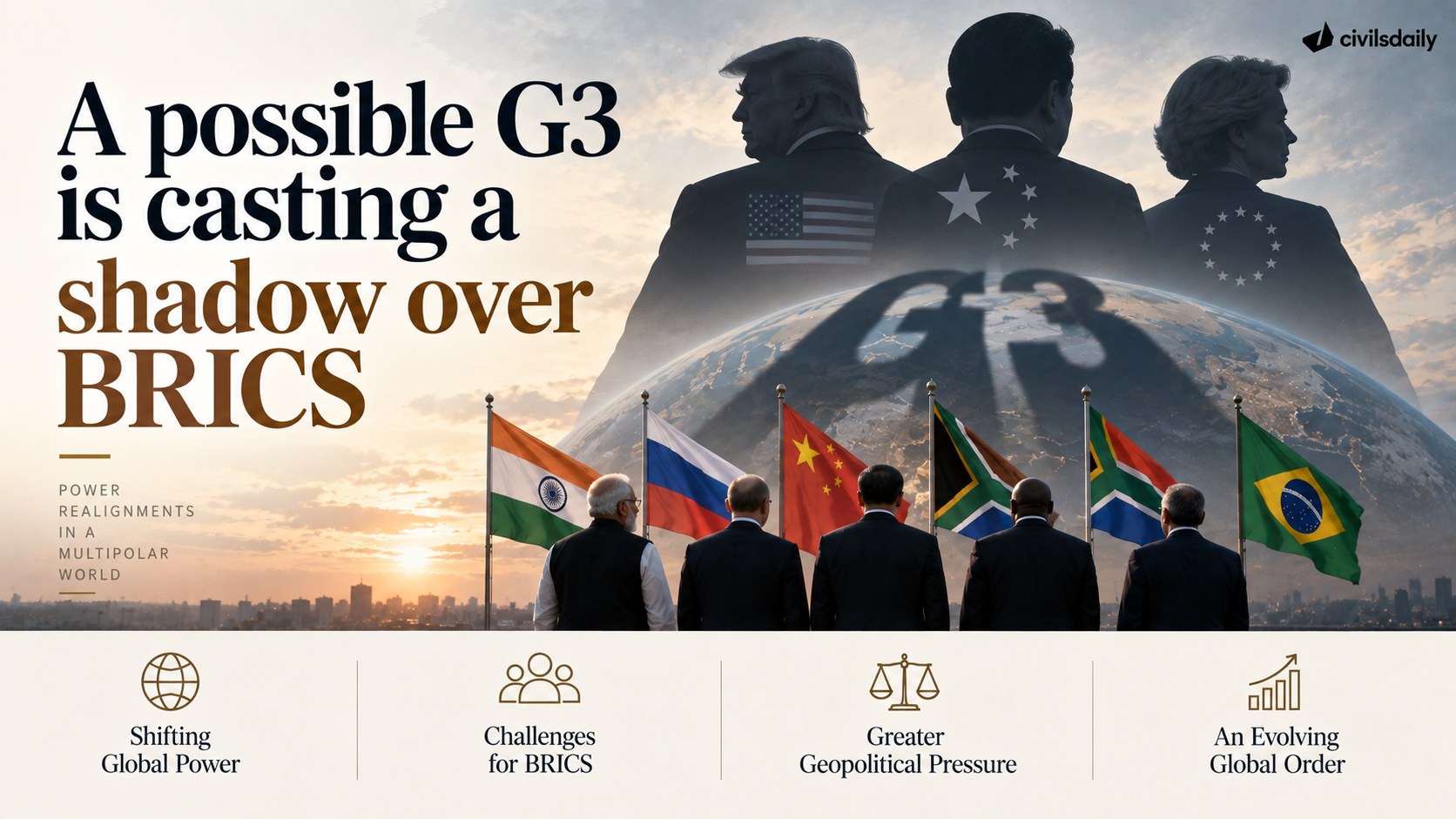
    BRICS leaders meet in Delhi this week to add further layers of cooperation, ranging from agriculture, health to digitalisation. The grouping’s two principal driving forces, Russia and China, are at the same time exploring separate and joint accommodations with the United States, whose domination of the world order BRICS exists to counter.

    What will the Delhi summit actually produce?

    1. More layers, slowly added: The summit will extend cooperation into agriculture, health and digitalisation.
    2. The declaration is not the draw: The last summit, at Rio de Janeiro, issued a declaration of 126 paragraphs without changing anything in the international system.
    3. The attraction is attendance: International interest is focused on the presence of the leaders of China, Russia and Iran.
    4. One bilateral carries the weight: The Chinese President is visiting India for the first time since 2019, and the two leaders are expected to stabilise the boundary situation and reset economic relations.

    Why has BRICS become less coherent?

    1. Expansion cut both ways: Enlargement added weight to the grouping and subtracted coherence from it.
    2. The Iran war split two members: The conflict opened a sharp divide between Tehran and Abu Dhabi, now fellow members of the grouping.
    3. Two incompatible asks: Iran wants BRICS to condemn American and Israeli military action. The United Arab Emirates, which suffered Iranian attacks and disruption to commerce through the Strait of Hormuz, stresses sovereignty, protection of civilian infrastructure and freedom of navigation.
    4. It has already cost an outcome: Those differences prevented the BRICS foreign ministers from issuing a consensual joint statement in Delhi in May.

    Why is a G3 conceivable now?

    1. A leader driven American approach: The US President has long held that good personal relations with the Russian and Chinese leaders could reduce global strategic tensions and produce major political and economic deals.
    2. Domestic and allied resistance: That instinct has repeatedly encountered resistance from the American foreign policy establishment, Congress and US allies.
    3. European and Asian fears differ: The Europeans worry that an accommodation with Moscow could be made at their expense. Asian allies fear that a bargain with Beijing could weaken American commitments to regional security.
    4. Nothing has been transformed yet: Neither relationship has been changed, and the preference for leader driven diplomacy keeps the possibility of movement open.
    5. The idea has been tested before: The possibility of such a meeting was explored last summer, during the 80th anniversary of the end of the Second World War.

    What does Russia bring to that table?

    1. The war has not been won: Four and a half years of fighting have produced no decisive victory, and the front remains costly and difficult to move.
    2. A channel has reopened: Shuttle diplomacy by American envoys between Moscow and Kyiv has reopened the diplomatic channel, without any sign that the fundamental differences between Russia and Ukraine are narrowing.
    3. Both sides hedge: Moscow and Kyiv are supporting the American peace initiative and preparing for escalation at the same time.
    4. European security could become a chip: Russian security questions could be treated by Washington as part of a larger bargain with Beijing.

    What does China bring?

    1. It negotiates from strength: China approaches Washington from a stronger position than Russia does.
    2. A sequenced diplomatic run: Its journey from the Shanghai Cooperation Organisation summit at Bishkek, through Cairo and Delhi, to the White House later this month presents China as the leader of the Global South and as a co-equal manager of the international order at the same time.
    3. What a second summit could yield: An extension of the trade truce, additional Chinese purchases from the United States and negotiations over technology restrictions are the available deliverables.
    4. The differences are structural: Washington accuses China of relying on subsidised exports and industrial overcapacity. Beijing uses rare earths, market access and its control of important supply chains as leverage.
    5. Taiwan is the standing ask: China will continue to press for a reduction in American support for Taiwan.

    Can anti-Western rhetoric and a seat at the American table hold together?

    1. Alignment and hedging run together: Russia and China are closer to each other than ever and share concerns about the United States. Both also seek a workable relationship with Washington.
    2. Both claim the high table: For all their anti-Western rhetoric, each claims a place at the high table with the United States.
    3. The claim has history: Russia was once part of the G8, the group of Western industrial states, and engaged directly with NATO. China now sees itself as America’s peer.
    4. What a trilateral would signify: Both lay claim to shaping the global order established after 1945, and a summit of the three leaders would mark the beginning of triangular global leadership as a successor to the Yalta System.
    5. It is not imminent: A global directorate of three is not close, and the idea remains an exploration rather than a plan.

    What are India’s three answers?

    1. Build national power first: The first answer is internal reform and accelerated economic development.
    2. Separate multipolarity from anti-American bloc politics: Russia and China use BRICS to expand their diplomatic options and to preserve the freedom to negotiate with Washington. India must approach the emerging order with the same realism.
    3. Widen the partnership base: India must intensify bilateral and minilateral cooperation with the Anglosphere, Brazil, Europe, Japan, Korea and other middle powers that have no enthusiasm for a G3 world.

    Challenges to BRICS

    1. Internal rivalry limits cohesion: Friction between the two largest Asian members prevents a common strategic position inside the grouping. Eg. The unsettled India-China boundary has kept the two from a shared security line inside the same forum.
    2. Consensus across incompatible political systems: The membership spans vibrant democracies and autocracies, which makes agreement on human rights or democratic norms unreachable in joint declarations. Eg. The entry of Iran and Ethiopia alongside Brazil and India widened that political range further.
    3. De-dollarisation is slower than the rhetoric: Local currency settlement has grown, and the US dollar still settles the overwhelming share of global trade. Eg. Rupee-rouble and rupee-dirham settlement covers only a fraction of India’s external trade.
    4. There is no permanent secretariat: The grouping has no charter and no standing institution, so continuity depends entirely on the annual chair. Eg. Each presidency resets the agenda, and commitments lapse when the chair changes.
    5. Intra-group trade stays low: Members continue to rely on G7 markets for high technology imports and services exports. Eg. Most members source advanced semiconductors and aerospace components from the United States, Europe and Japan.
    6. Expansion risks dilution: A larger BRICS+ risks becoming a discussion forum that produces no decisions. Eg. The Non-Aligned Movement grew past 120 members and lost the ability to reach operative positions.

    Way Forward

    1. Focus on areas of common interest: Confine joint positions to areas where members already agree, such as development finance and public health, rather than seeking a security consensus that does not exist.
    2. Adopt variable geometry: Move towards a variable geometry model in which subsets of members can sign issue specific instruments without binding the whole group.
    3. Strengthen payment infrastructure: Target payments infrastructure that lowers settlement cost and time, rather than focusing primarily on the displacement of the US dollar as a reserve currency.
    4. Create a permanent institutional mechanism: Establish a small standing secretariat with a limited mandate to track implementation of past declarations and maintain institutional continuity.
    5. Promote intra-BRICS supply chains: Direct the New Development Bank towards financing intra-group industrial supply chains, particularly in strategic sectors such as advanced technology and manufacturing.
    6. Formalise expansion criteria: Establish clear entry criteria for partner countries, ensuring that future expansion is based on economic complementarity rather than political alignment.

    Conclusion

    Multipolarity has always had two possible shapes: one distributes power across many capitals; the other concentrates it among a handful and calls the result a balance. BRICS rests on the first assumption; its two strongest members hedge towards the second. For India the operative question is not whether a three cornered directorate forms, which it may not, but whether Indian diplomacy is organised for a world in which its two largest partners in the grouping negotiate separately with Washington. That answer will show up in what India builds outside the room, not in what the room declares.

    About BRICS

    1. What it is: BRICS is an informal grouping of major emerging economies that coordinates political and economic positions outside Western led institutions, without a founding treaty.
    2. Membership: Its full members are Brazil, Russia, India, China, South Africa, Egypt, Ethiopia, Indonesia, Iran, Saudi Arabia and the United Arab Emirates, with Saudi Arabia participating without having formalised its status.
    3. Its weight: The grouping accounts for over 45 per cent of the world’s population, about 37 per cent of global output measured at purchasing power parity, which exceeds the G7’s share, and roughly 42 per cent of global oil production and exports.
    4. Its stated objectives: Reform of the United Nations Security Council, the International Monetary Fund and the World Bank for more equitable representation, a multipolar order, and reduced reliance on the US dollar and on SWIFT, the messaging network banks use to instruct cross border payments.

    Key Facts about BRICS

    1. The acronym predates the grouping: ‘BRIC’ was coined in 2001 by a Goldman Sachs economist to identify high growth emerging economies.
    2. From officials to leaders: The first meeting of foreign ministers was held on the margins of the United Nations General Assembly in 2006. The first formal Leaders’ Summit was held at Yekaterinburg in Russia in 2009.
    3. How it grew: South Africa joined in 2011. Expansion was decided at the 2023 Johannesburg Summit, with Egypt, Ethiopia, Iran and the United Arab Emirates joining in 2024 and Indonesia in 2025.
    4. A partner tier: A ‘Partner Country’ category was introduced in 2024 to engage states such as Malaysia, Thailand and Nigeria without granting full membership.

    Initiatives under BRICS

    1. New Development Bank: Headquartered in Shanghai, it has approved over USD 35 billion in infrastructure lending.
    2. Contingent Reserve Arrangement: A USD 100 billion fund providing short term liquidity support to members.
    3. BRICS Pay: A cross border payment system in pilot stage, intended to work around SWIFT.
    4. BRICS Vaccine Research and Development Centre: Set up during the pandemic for technology transfer and vaccine equity.
    5. Remote Sensing Satellite Constellation: Six satellites contributed by member states, sharing data for disaster management.
    6. Partnership on New Industrial Revolution (PartNIR): Cooperation on artificial intelligence, digitalisation and green technology.
    7. BRICS Space Council: Established in 2025 to coordinate deep space exploration and lunar research.

    Back2Basics: The Yalta System

    • Why the term recurs: ‘Yalta System’ is used as shorthand for an international order settled among a small number of great powers rather than by the wider membership.f BRICS in projecting itself as an alternative to other groupings.”
    • Where the term comes from: The Yalta Conference of February 1945 brought together the leaders of the United States, the United Kingdom and the Soviet Union to settle the shape of the post-war order.
    • What it settled: It fixed the occupation and reorganisation of Europe and confirmed agreement on creating the United Nations.
    • The concert it produced: It led to a Security Council with permanent seats and a veto for five powers, entrenching great power management of international peace.

    [2026, GS2, 10.0 marks] “BRICS acts as a powerful counterweight in global governance, actively amplifying the voice and influence of the Global South.” Explain the role of BRICS in projecting itself as an alternative to other groupings.

  • India’s carbon credit scheme receives U.K. official recognition

    Why in the News

    The United Kingdom has recognised India’s Carbon Credit Trading Scheme (CCTS) as a qualifying overseas carbon pricing scheme for the purpose of carbon price relief. The recognition was conveyed by His Majesty’s Treasury to the Bureau of Energy Efficiency (BEE) under the Ministry of Power. The scheme has been placed on the United Kingdom’s published indicative list of overseas carbon pricing schemes assessed as meeting the qualifying criteria under the Carbon Border Adjustment Mechanism (Calculation of CBAM Rate and Determination of Carbon Price Relief) Regulations 2026. A carbon border adjustment mechanism (CBAM) charges an imported good the gap between the carbon price paid where it was made and the price the importing country’s own producers pay. The recognition therefore lets a carbon price already paid in India be set off, lowering the effective CBAM liability on Indian goods. The relief is calculated on the price a tonne of carbon actually fetches in India, so a domestic market still in its early compliance cycles decides how much of the British levy an exporter escapes.

    What is the Carbon Credit Trading Scheme?

    1. Statutory basis: The scheme rests on the Energy Conservation Act, 2001, as amended by the Energy Conservation (Amendment) Act, 2022. It is administered by the Bureau of Energy Efficiency under the Ministry of Power.
    2. Compliance mechanism: Obligated entities in notified industrial sectors receive greenhouse gas emission intensity targets, stated as emissions per unit of output. An entity that beats its target earns carbon credit certificates, and one that misses it must buy them.
    3. Offset mechanism: An entity outside the compliance list can register an emission reduction project voluntarily. It earns certificates once the reduction is verified.
    4. Trading venue: Certificates are traded on the power exchanges. That trade is what produces a domestic price for a tonne of carbon dioxide equivalent.

    How does the recognition change the cost of exporting to the United Kingdom?

    1. Carbon price relief: The British levy is charged on the embedded emissions of an imported good at a British carbon rate. A carbon price already paid in the country of production is deducted from that rate where the paying scheme qualifies.
    2. The indicative list is the administrative gate: Placement on the list is what makes the deduction available to goods produced under the scheme. The list is indicative, so it fixes eligibility rather than the final rate an exporter pays.
    3. Exposed sectors: The United Kingdom’s mechanism applies from 1 January 2027 to imports of aluminium, cement, fertiliser, hydrogen, iron and steel. Indian steel and aluminium shipments are the largest exposures within that set.
    4. The obligation on the exporter survives: Recognition attaches to the scheme, not to any single firm. Each consignment must still be accompanied by emissions data for the goods concerned.

    Challenges to the Carbon Credit Trading Scheme

    1. A weak price yields a weak set off: The deduction is worth only what a carbon credit certificate sells for in India, so a low clearing price transfers most of the levy to the British exchequer anyway. Eg. Energy saving certificates under the Perform, Achieve and Trade scheme, the country’s earlier market based instrument, cleared at prices too low to change investment behaviour.
      The Fix: Set a floor price for compliance certificates, so the market cannot clear below the level at which abatement becomes worth financing.
    2. Target setting is based on intensity, not absolute emissions: An obligated entity meets its target by cutting emissions per tonne of output while expanding total output, so national emissions can rise inside a compliant market. Eg. Cement plants raise clinker substitution to cut intensity while adding fresh capacity.
      The Fix: Convert the compliance mechanism to a declining absolute cap once the first two cycles have established a reliable emissions baseline.
    3. Narrow coverage of the emitting base: The compliance mechanism reaches only large notified industrial sectors, leaving out transport, buildings and the bulk of smaller industrial units. Eg. Foundries and re-rolling mills in industrial clusters sit outside the obligated list despite being coal fired.
      The Fix: Extend the offset mechanism with sector specific methodologies for small units, so a cluster level project can be registered rather than a single plant.
    4. Measurement and verification capacity is thin: Credits are only as sound as the emissions data behind them, and accredited carbon verifiers in India are few relative to the number of obligated entities. Eg. Voluntary carbon markets globally have been discredited by projects whose claimed reductions could not be reproduced on audit.
      The Fix: Accredit and licence verification agencies ahead of the compliance deadline, with random re-audit of a fixed share of issued certificates.
    5. Overlap with earlier instruments confuses the signal: Renewable energy certificates and energy saving certificates already price parts of the same abatement, so a firm can face several partially overlapping obligations. Eg. A cement plant may hold energy saving certificates for efficiency gains that also lower its greenhouse gas emission intensity.
      The Fix: Publish a single conversion and transition schedule that folds legacy certificates into the carbon credit market on a stated date.

    Conclusion

    Recognition removes a trade barrier only to the extent that the domestic carbon market becomes real. The set off is a pass through of a price India charges itself, so the instrument that protects exporters is the same one that has to discipline them. What to watch is the clearing price at the first compliance cycle auctions and whether the European Union grants an equivalent recognition, since the European market absorbs a far larger share of Indian steel and aluminium than the British one.

    Back2Basics: Bureau of Energy Efficiency

    1. Statutory body: The Bureau was set up in 2002 under the Energy Conservation Act, 2001, and functions under the Ministry of Power.
    2. Mandate: It is charged with reducing the energy intensity of the Indian economy, meaning energy consumed per unit of gross domestic product.
    3. Standards and labelling: It runs the star rating programme for appliances and the Energy Conservation Building Code for commercial buildings.
    4. Market instruments: It designed and administers the Perform, Achieve and Trade scheme and now the carbon credit market, making it the nodal agency for India’s carbon pricing architecture.

    “[2023] Consider the following statements :

    Statement-I: Carbon markets are likely to be one of the most widespread tools in the fight against climate change.

    Statement-II : Carbon markets transfer resources from the private sector to the State.

    Which one of the following is correct in respect of the above statements?

    (a) Both Statement-I and Statement-II are correct and Statement-II is the correct explanation for Statement-I

    (b) Both Statement-I and Statement-II are correct and Statement-II is not the correct explanation for Statement-I

    (c) Statement-I is correct but Statement-II is incorrect

    (d) Statement-I is incorrect but Statement-II is correct

  • India’s opportunity to put BRICS back together

    Why in the News

    The 18th BRICS Summit is to be held in New Delhi on 12 and 13 September 2026 under India’s chairship. The grouping now carries 11 members and 10 partner countries after an expansion India and Brazil both resisted. Its founding practice of adopting documents only by consensus has been bypassed more than once since 2020, most recently at the BRICS Foreign Ministers’ meeting held in New Delhi in May 2026. The contest is over what the group is for: a reform coalition of emerging economies working inside existing institutions, or a bloc defined by opposition to the West. The summit is the point at which the chair can push that choice one way or the other.

    What is BRICS?

    1. What it is: BRICS is a grouping of Brazil, Russia, India, China and South Africa, formed to give the emerging economies a greater voice in global governance and institutions, particularly financial and economic ones, and to work towards a more equitable multilateral order.
    2. How it works: It has no treaty and no binding decision procedure. It operates by consensus, and its output is a summit declaration adopted by all members.
    3. What it has built: Its principal institution is the New Development Bank, the multilateral development bank established by the members to lend for infrastructure and sustainable development.

    What did India originally want from BRICS?

    1. A vehicle for reform: India was an enthusiastic early participant, treating the group as a means of securing genuine reform of multilateral institutions.
    2. The first Indian-hosted summit: The fourth BRICS summit, held in India in 2012, took the theme “Global Stability, Security and Prosperity”, which tacitly reflected a much broader geopolitical canvas than economics alone.
    3. What the Indian presidency produced: It helped lead to the establishment of the New Development Bank. Other Indian initiatives followed, including the integration of a counter-terrorism architecture into the group’s work.
    4. The current chairship’s framing: This year’s theme rests on four pillars, Resilience, Innovation, Cooperation and Sustainability, and draws on the Prime Minister’s “Humanity First” vision and a “people-centric” approach to BRICS cooperation.

    How did China’s use of BRICS diverge from the reform agenda?

    1. A different purpose from the start: China saw the group as a counterpoise to Western domination, a view India also shared initially in the specific context of reform.
    2. Why China needed the platform: A group of emerging economies accounting for nearly 20 per cent of world GDP in 2010 could amplify Chinese global ambitions in a way China could not do alone.
    3. The outreach mechanisms carried the design: BRICS-Plus and BRICS Outreach were used to reach the Global South and consolidate its profile as a second pole in a future bipolar world.
    4. Reform support proved selective: China resisted supporting the bids of India, Brazil and South Africa for permanent seats on the United Nations Security Council. India then shifted its own effort towards consolidation and intra-BRICS matters to resist Chinese grandstanding.

    What has happened to the consensus principle?

    1. Consensus is what held the group together: It is the practice that prevents a majority from binding the rest, and its erosion changes what membership is worth.
    2. The 2019 summit was the high point of restraint: The Brasilia summit was held with no invited guest countries at all, only the five original members.
    3. The first breach came in 2020: Under the Russian presidency a chair’s statement on COVID-19 was issued without consensus, probably the first such document in the group’s history.
    4. It has become routine: Non-consensus documents were resorted to again at the Foreign Ministers’ meeting in May 2026, because the new members could not agree.
    5. The failure model already exists: The danger is that BRICS goes the way of the Shanghai Cooperation Organisation (SCO), where a majority can bulldoze its view through.

    What has expansion done to the group’s cohesion?

    1. China pushed it and India resisted: China pressed first for expansion of the New Development Bank and then for expansion of BRICS itself. India and Brazil both resisted and were overruled.
    2. The size now: The group has 11 members following the addition of Egypt, Ethiopia, Iran, Saudi Arabia, the United Arab Emirates and Indonesia, along with 10 partner countries.
    3. The original five manage their differences: Some of those differences are serious, and the five handle them with the maturity that keeping the group intact requires.
    4. The new members do not: They carry their bilateral conflicts into the group and are subverting it through them.
    5. The regional precedent: The South Asian Association for Regional Cooperation (SAARC) is the case of a grouping paralysed by the bilateral disputes of its own members.

    Is BRICS non-West or anti-West?

    1. India’s line is “non-West”: India has worked to keep the group non-West against pressure from some members to turn it explicitly anti-West.
    2. Events push the other way: China is competing with the United States for global leadership, Russia is at war with Ukraine with the full backing of Europe, and Iran is being bombarded by the United States and Israel.
    3. Two members are under direct pressure: Brazil and India have both been subjected to punitive tariffs by the U.S. President, and the U.S. Congress is considering legislation empowering the President to levy punitive tariffs on countries importing Russian oil.
    4. India’s other options are weakening at the same time: The Quad is being emasculated by the United States, India-U.S. relations are under great pressure, Pakistan is being courted by the United States at India’s expense, and global institutions are being made dysfunctional by the West.
    5. The restraint has support inside the group: Many members share India’s effort to prevent an anti-Western drift, since they gain from engaging actors in different camps in their own national interest. They want change without geopolitical realignment behind China and Russia.

    Why is de-dollarisation not moving as China wants?

    1. The parallel currency proposal has stalled: The push for de-dollarisation through the establishment of a BRICS currency is receiving a lukewarm response.
    2. The reason is who would dominate it: Members are uncomfortable with a currency dominated by the renminbi.
    3. What they will accept instead: The preference is for interlinking payment systems, central bank digital currencies and transactions settled in national currencies.
    4. China is proceeding on its own track: After a successful pilot, it is formally launching mBridge, an alternative cross-border financial payment system.
    5. What India is guarding against: An alternative Bretton Woods system dominated by China is the outcome India least wants.

    What parallel orders are being built outside BRICS?

    1. Both major powers are writing their own rules: The United States and China are enunciating parallel visions of the world and playing by rules of their own rather than internationally negotiated ones.
    2. The contested areas are new ones: Parallel structures and standards are being set in artificial intelligence, digital and Internet governance, data ownership, state control, 5G and 6G telecom, satellite navigation and electric vehicles.
    3. China has added an institution: It has set up a World AI Cooperation Organisation in Shanghai.
    4. The financial architecture already has a rival: The Asian Infrastructure Investment Bank, the Belt and Road Initiative and the Digital Silk Road challenge the Bretton Woods institutions and their governance and financing models.
    5. Neither power wants reform: Both are building around the existing institutions rather than seeking to change them, and both see BRICS as one vehicle for those broader goals.

    What is “reformed multilateralism” and why does India want it back?

    1. Where it came from: The Prime Minister first articulated the vision of “reformed multilateralism” at the leaders’ retreat of the 2018 BRICS Summit in South Africa.
    2. How it became group language: By 2019 it had found its way into the summit document at Brasilia, with India, Brazil and South Africa pushing for it.
    3. What it commits the group to: Changing the governance of existing institutions rather than replacing them, which is the opposite of building parallel structures.
    4. Why it matters now: Reviving it makes BRICS a strong voice for the non-West middle powers and, by extension, for the Global South.

    Can BRICS be an organisation of Global South middle powers?

    1. A Global South middle power is a different thing: The middle powers described at Davos by the Canadian Prime Minister are broadly West-centric, and a Global South middle power does not share that anchoring.
    2. BRICS is the only credible platform: If there is a credible organisation of Global South middle powers, it is BRICS.
    3. Its largest member does not fit the description: China is hardly a middle power and holds disproportionate influence within the group.
    4. The India-China relationship is the constraint: The two need greater synergy on emerging global issues even as their bilateral differences are being contained.
    5. The composition is incomplete: Some middle powers that ought to be in the group are not represented in it, which limits what it can claim to speak for.

    Challenges to BRICS

    1. De-dollarisation is rhetorical rather than operational: The share of world trade actually settled outside the dollar has barely moved despite a decade of declarations. Eg. The US dollar is still used in over 80 per cent of global trade settlement.
      The Fix: Set a measurable target for local-currency settlement of intra-group trade and report performance against it at each summit.
    2. Intra-group trade is thin: Members trade far more with the G7 than with each other, so the group’s combined economic weight does not convert into bargaining leverage. Eg. Most members still rely on G7 markets for high-technology imports and services exports.
      The Fix: Negotiate a tariff-preference arrangement covering a limited list of goods, rather than a full trade agreement the membership cannot agree on.
    3. There is no permanent secretariat or charter: Work does not carry between summits, so each chair restarts the agenda and commitments lapse without anyone recording that they have. Eg. The New Development Bank remains the only permanent institution the group has built since its first summit.
      The Fix: Create a small standing secretariat with the single mandate of tracking summit commitments and reporting compliance.
    4. Sanctions constrain the group’s own bank: Western sanctions on Russia limit the New Development Bank’s ability to lend for certain projects, which weakens the alternative it was built to be. Eg. The bank put new transactions in Russia on hold in 2022.
      The Fix: Raise the share of local-currency lending and widen the capital base to more Global South members, so exposure to one jurisdiction’s sanctions falls.
    5. The political systems diverge too far for common positions on norms: The membership spans established democracies and autocracies, so joint declarations cannot carry commitments on rights or governance standards. Eg. Group declarations avoid the language on domestic governance that G7 communiqués routinely carry.
      The Fix: Confine collective positions to the areas where interests genuinely converge, namely institutional reform, development finance and technology standards.

    Conclusion

    BRICS is now being asked to do two jobs that pull against each other. One is to press for reform of institutions that its largest member has no interest in reforming. The other is to hold an enlarged membership carrying live bilateral quarrels inside a body that can only decide unanimously. The Delhi outcome will indicate which job the group has chosen. The specific marker is whether the summit closes on a declaration adopted by every member or on a chair’s statement issued over the heads of some.

    Global South Plurilateral Groupings in India’s Foreign Policy

    1. About: A plurilateral grouping is a small, issue-focused coalition of states that operates outside a formal treaty organisation. Its instruments are summit declarations and working groups rather than binding law.
    2. Why India uses them: They allow India to pursue different interests with different partners at the same time, which is what multi-alignment means in operation.
    3. The spread in practice: India sits in BRICS and the SCO alongside Russia and China, and in the Quad and the I2U2 grouping alongside the United States, without either set of memberships cancelling the other.
    4. What they are measured by: Their output is agenda-setting and coalition building, not enforceable commitment, so their value lies in shifting what larger institutions are willing to discuss.

    Key Facts about BRICS and Global South Groupings

    1. The name: The acronym BRIC was coined in 2001 by a Goldman Sachs economist to group high-growth emerging economies. The first Foreign Ministers’ meeting was held on the margins of the United Nations General Assembly in 2006.
    2. The first summit: The first leaders’ summit was held at Yekaterinburg in Russia in 2009, and South Africa joined in 2011 to make the grouping BRICS.
    3. Current weight: The enlarged grouping accounts for over 45 per cent of the world’s population, about 3.6 billion people, and roughly 37 per cent of global GDP measured at purchasing power parity, ahead of the G7 share.
    4. Energy: It controls roughly 42 per cent of global oil production and exports.
    5. New Development Bank: Headquartered at Shanghai, it has approved over $35 billion in infrastructure lending since it began operations.
    6. Contingent Reserve Arrangement: A $100 billion pool providing short-term liquidity support to members facing balance of payments pressure.
    7. Other Global South platforms: IBSA, the India-Brazil-South Africa Dialogue Forum, was formed in 2003. The G-77 was formed at the United Nations in 1964 with 77 founding members and now carries over 130.

    Matching Previous Year Question

    “[2026, GS2, 10 marks] “BRICS acts as a powerful counterweight in global governance, actively amplifying the voice and influence of the Global South.” Explain the role of BRICS in projecting itself as an alternative to other groupings.”

  • ‘Working together, combining resources, talent, scale, we think India and Canada can be world beaters’

    ‘Working together, combining resources, talent, scale, we think India and Canada can be world beaters’

    Why in the News

    Canada’s High Commissioner to India has set out the instruments now in place to rebuild the bilateral relationship, and has stated confidence that the Comprehensive Economic Partnership Agreement (CEPA) will be concluded by the end of the year.

    How has the relationship been rebuilt since the 2023 rupture?

    1. Leader-level contact restored: The two Prime Ministers have met four times over the past year. New envoys were announced in June last year after the reset was agreed.
    2. Security channels reopened: Security officials on both sides are now in regular contact over practical cooperation. The stated purpose is that neither side is surprised by the other’s statements or actions.
    3. A terrorist entity listing: Canada has listed the Bishnoi gang as a terrorist entity and launched a financial crimes commission. The stated trigger is extortion pressure on the Indian community in Canada from such gangs.
    4. The separatism question remains open: Canada’s position is that political expression is protected in a democracy, so it will not restrict views it disagrees with. Its intelligence agency’s report tabled before Parliament refers to Khalistan actors and to the Air India bombing.

    What does Canada offer India on energy and critical minerals?

    1. Scale in hydrocarbons: Canada ranks fourth in oil reserves and production, fifth in natural gas production, fifth in liquefied petroleum gas production and sixth in nuclear power.
    2. Export capacity is being built out: By 2030 Canada expects to export 50 million tonnes of natural gas through its West Coast ports, with a 400 per cent increase in liquefied petroleum gas export capacity. A newly announced pipeline will allow the export of two million barrels of oil, against a production of five to six million barrels a day.
    3. India’s import volume matches that scale: India imports crude oil at roughly the level Canada produces each day. Canada has never sold India oil, gas or liquefied petroleum gas.
    4. Minerals are in the ground, not in production: Canada holds rare earths, lithium and graphite, and 20 per cent of the world’s tungsten reserves. It has no active tungsten mine, and opening one takes three to five years.

    How central is nuclear cooperation to the relationship?

    1. A concluded contract: A uranium sale worth $2.3 billion for India’s reactors was concluded during the Canadian Prime Minister’s visit.
    2. The installed base is Canadian in origin: Eighteen of India’s 24 existing reactors are based on CANDU technology.
    3. Canada’s new policy is export-facing: A newly announced nuclear policy looks to build up to 10 more reactors in Canada, and is focused on working with other countries on building their nuclear capacity.
    4. Small modular reactors are the proposed next step: Powering the full electrification of India’s railway system has been floated as an application for small modular reactors.

    What does the trade track now involve?

    1. A dated target: The CEPA is targeted for conclusion by the end of the year, with both Prime Ministers having repeatedly committed to it.
    2. The record it is measured against: The previous attempt at a bilateral trade agreement ran 12 years without getting far. Canada concluded a comparable agreement with the United Arab Emirates in 47 days.
    3. A trade volume commitment: The two Prime Ministers committed to double bilateral trade by 2030. Current trade is described as nowhere near where it should be.
    4. A business delegation follows: A large Canadian trade delegation is due in India in October.

    What is the defence and maritime component?

    1. A partnership already announced: A maritime security partnership was announced in March, covering defence material cooperation. The joint statement provides for a defence dialogue between the two governments.
    2. An information-sharing framework is being negotiated: A joint security of information agreement is under work, to give companies on both sides a framework for handling sensitive information.
    3. The procurement number is large: About $180 billion of Canada’s $500 billion defence outlay to 2035 is procurement, with the remainder on dual-use infrastructure.
    4. Canada’s constraint is scale, not technology: A population of 42 million cannot absorb the cost of defence products alone, and Canada has agreed with European partners to develop 12 submarines. Its stated specialisations include optics, driven by rising access to the Arctic.

    What is the state of the student and visa channel?

    1. The numbers are substantial: There are 400,000 Indian students in Canada, alongside a diaspora of almost two million people.
    2. Caps were a housing response: Study permit caps were imposed because intake outran available housing. Some colleges were found to be delivering no real education.
    3. Reputation is the cost being carried: The tightening left a perception in India that Canada had closed itself to students. The visa system is under review to correct processing.

    Why is Canada turning to India now?

    1. Trade talks with the United States have collapsed: Canada walked away from the negotiation over demands it judged to lie beyond normal trade talks, including impositions on its cultural sovereignty. Tariffs are being imposed dollar for dollar in response.
    2. Diversification is stated as the primary plan: Canada describes building its own economy and external partnerships as plan A rather than a fallback. Investment is being directed into domestic resources and capacity.
    3. China remains the larger relationship: Canada’s economic relationship with China is bigger than the one with India and has been put back on an even keel. It is described as different in quality and character from the Indian relationship.

    Challenges to the India-Canada reset

    1. The criminal case is still live: A finding in the Canadian courts on the 2023 killing can reopen the political dispute the reset was built to contain. Eg. The allegation in October 2023 produced tit-for-tat expulsions and the withdrawal of most Canadian diplomats from India.
      The Fix: Keep the security dialogue and the economic track under separate institutional mandates, so a judicial outcome suspends neither.
    2. Distance works against Canadian energy: Freight cost and voyage time from the Pacific coast disadvantage Canadian cargoes against short-haul Gulf suppliers. Eg. Iraq, Saudi Arabia and the United Arab Emirates supply the bulk of India’s crude on far shorter sea routes.
      The Fix: Anchor Canadian supply in long-term contracts and upstream equity rather than spot cargoes, so volume rather than delivered price carries the relationship.
    3. Nuclear liability law blocks reactor sales: Foreign vendors have resisted India’s supplier recourse provision, which is why cooperation has stayed at the fuel supply stage. Eg. Section 17(b) of the Civil Liability for Nuclear Damage Act, 2010 has held up foreign reactor contracts for over a decade.
      The Fix: Settle supplier recourse terms in a bilateral protocol before any reactor negotiation opens.
    4. Critical mineral reserves are not supply: Reserves without processing capacity cannot displace the existing source of refined material. Eg. China refines the majority of the world’s rare earths and graphite.
      The Fix: Co-invest in Canadian separation and refining plants under a shared offtake agreement, rather than contracting for unmined ore.

    Conclusion

    The relationship is being rebuilt instrument by instrument rather than by settling what broke it. That design holds only as long as both governments treat the court’s eventual finding as a legal outcome and not a diplomatic one. Everything else listed so far is either a contract or an announcement. The trade agreement is the first thing the two governments have set themselves to close, and whether they close it is the marker to watch.

    Back2Basics

    1. CANDU reactor: Short for CANada Deuterium Uranium, a pressurised heavy water reactor design developed in Canada.
    2. Fuel and moderator: It runs on natural uranium and uses heavy water as both moderator and coolant, so it needs no uranium enrichment.
    3. On-power refuelling: Fuel bundles are replaced while the reactor is running, which raises availability and removes the need for shutdown refuelling.
    4. The Indian link: India’s pressurised heavy water reactor programme began with Rajasthan Atomic Power Station Unit 1, built with Canadian collaboration and commissioned in 1973.

    [2019, GS2, 15 marks] “What introduces friction into the ties between India and the United States is that Washington is still unable to find for India a position in its global strategy, which would satisfy India’s National self-esteem and ambitions” Explain with suitable examples.

  • As yoga and Ayurveda become part of India’s global health diplomacy

    As yoga and Ayurveda become part of India’s global health diplomacy

    Why in the News

    India’s recent trade agreements now carry written commitments on traditional medicine. The India-Oman Comprehensive Economic Partnership Agreement (CEPA), operationalised in June 2026, carries what the government describes as its first comprehensive commitment on traditional medicine across all modes of supply. The India-New Zealand Free Trade Agreement (FTA) adds a dedicated health and traditional medicine annex. Together these agreements move Ayurveda, Yoga and Naturopathy, Unani, Siddha, Sowa-Rigpa and Homoeopathy (AYUSH) from a cultural export to a formalised health services opportunity. Practitioners of these systems now have a treaty basis for licensing, standards and mobility abroad. The contest is over what that basis is worth, since formal recognition converts into market access only where evidence, regulation and practitioner quality satisfy the host regulator.

    What have India’s recent trade agreements committed on traditional medicine?

    1. The Oman agreement sets the benchmark: The India-Oman CEPA carries the government’s first comprehensive commitment on traditional medicine covering all modes of supply. It came into operation in June 2026.
    2. The New Zealand agreement creates a mobility route: The India-New Zealand FTA carries a dedicated health and traditional medicine annex covering AYUSH practices. It provides a structured mobility pathway with a dedicated visa quota for AYUSH practitioners.
    3. The European Union agreement goes furthest on qualifications: The India-European Union FTA, signed in January 2026, allows AYUSH practitioners to use their Indian qualifications in member countries that have no regulatory framework of their own. It also provides for AYUSH wellness centres and clinics.
    4. The common obligations are regulatory, not promotional: All three agreements carry measures to ease licensing, develop standards and facilitate the movement of AYUSH practitioners and instructors. The New Zealand agreement additionally institutionalises cooperation on education, training, standards development and wellness services.

    What carries the strategy outside the trade agreements?

    1. A dedicated visa category: The AYUSH visa was introduced in 2023 for foreign nationals travelling to India for treatment under these systems. Between January 2023 and December 2025, 3,375 people travelled on AYUSH or e-AYUSH visas and another 579 on attendant visas.
    2. The earlier reported count: The Ministry of AYUSH had previously reported 1,646 AYUSH visas issued to nationals of 75 countries between January 2024 and February 2025.
    3. An education channel: Under the AYUSH Fellowship Scheme, 260 students from 32 countries were studying these systems in Indian institutions. Education operates as a channel of influence alongside treatment.
    4. Overseas programming: The Ministry’s international cooperation programmes fund training, seminars, conferences and knowledge exchange. These include yoga instruction and education delivered overseas.

    Why can the return on these commitments not be measured?

    1. The growth figure is not an AYUSH figure: Foreign medical arrivals in India rose from 1.83 lakh in 2020 to 6.44 lakh in 2024. That count covers medical travel of every kind and not AYUSH patients specifically.
    2. No country-wise ranking is published: The government does not publish a current consolidated country-wise ranking of AYUSH patients. The named markets are Bangladesh, Nepal, Sri Lanka, the United Arab Emirates, the United States, Germany, Russia, Malaysia, Mauritius and Saudi Arabia.
    3. The market share is unknown: The absence of consolidated data makes it impossible to assess what share of India’s medical value travel market AYUSH actually holds. A negotiator therefore cannot state the value of the access being sought.
    4. The expert objection is about inputs, not demand: Credible standards, an evidence base, regulation, practitioner quality and patient safety are named as the preconditions for these systems to establish themselves in regulated healthcare markets.

    Challenges to AYUSH market access abroad

    1. Host country law decides the right to practise: Destination markets license practitioners under their own medical statutes, so an Indian qualification carries no automatic right to treat patients. Eg. Ayurveda is recognised in law as a practising profession in only a small set of jurisdictions, Hungary and Switzerland among them.
      The Fix: Negotiate mutual recognition annexes that name the qualifying degree and the permitted scope of practice, rather than a general commitment to cooperate on standards.
    2. A thin clinical evidence base: Regulators in evidence-driven markets ask for trial data that most classical formulations do not carry. Eg. The World Health Organization opened its Global Centre for Traditional Medicine at Jamnagar in 2022 to build exactly this evidence and data base.
      The Fix: Fund registered controlled trials on a shortlist of high-volume formulations and publish the protocols, so a foreign regulator can audit the method.
    3. Product safety findings block entry: Heavy metal content in some traditional preparations has drawn regulatory action in importing countries. Eg. The United States Food and Drug Administration has issued import alerts against Ayurvedic products over lead and mercury contamination.
      The Fix: Make batch-level heavy metal testing and certification mandatory before export, with the results carried on the product label.
    4. Domestic advertising undercuts the regulatory case: Cure claims made without trial evidence at home weaken the argument for recognition abroad. Eg. The Supreme Court held Patanjali Ayurved in contempt in 2024 over advertisements claiming cures for named diseases.
      The Fix: Enforce the Drugs and Magic Remedies (Objectionable Advertisements) Act, 1954 against AYUSH advertising and publish the penalty orders.

    Conclusion

    The commitments are in force and the harder work now sits inside India. What a foreign regulator will ask for is what a practitioner has been trained to and what a preparation contains, and neither is currently documented to an auditable standard. India also cannot count its own AYUSH patients separately from medical travellers, so it has no way to report what any of these annexes has delivered. The first practitioner registered abroad on an Indian qualification, and the first published count of AYUSH-specific arrivals, are the two markers that will show whether this is trade access or an announcement.

    Back2Basics

    1. Ministry of AYUSH: Formed in November 2014 by upgrading the Department of AYUSH, which itself succeeded the Department of Indian Systems of Medicine and Homoeopathy set up in 1995.
    2. Mandate: It administers education, research, drug standardisation and practice regulation for the six recognised systems.
    3. Education regulators: The National Commission for Indian System of Medicine and the National Commission for Homoeopathy, both created by 2020 statutes, regulate education and registration in place of the earlier central councils.
    4. Drug regulation: AYUSH medicines are regulated under the Drugs and Cosmetics Act, 1940 and the rules made under it.

    [2026] The Chancellor of Germany visited India in January 2026. Which of the following is/are NOT correct in terms of outcomes?

    1. MoU between All India Institute of Ayurveda and University of Hamburg

    2. MoU on Youth Hockey Development between Hockey India and German Hockey Federation

    3. Establishment of a bilateral dialogue mechanism on the Indo-Pacific

    4. Opening of an Honorary Consul of Germany in Lucknow

    (a) 2 and 3 (b) 1 and 4 (c) 3 and 4 (d) 1 only