Mains Ready By December. Smash Mains & Smash PYQ Admissions Open

GS Paper: GS3-18.Conservation, Environmental Pollution and Degradation, Environmental Impact Assessment.

  • Conquering the green frontier

    Context

    India has to forge a different development model -one that will shift India’s workforce from agriculture to globally leading, resource-efficient businesses.

     How India can deliver sustainable prosperity?

    • The two intertwined forces: Just as liberalisation and globalisation transformed the economy in the past, two different yet intertwined forces will likely transform the economy in the future.
    • First–High competitiveness: India must have globally leading companies across a range of key sectors such as financial services and manufacturing.
      • Global productivity frontier: These super competitive businesses should define the global productivity frontier so that they can surpass the production processes of the best companies in the world.
    • Second-Long term sustainability: India must also adopt a resource-efficient, low-carbon development pathway to utilise scarce natural resources effectively. There is no other way.
      • Apocalyptic air pollution.
      • Dire water shortages.
      • Rising temperatures and-
      • Extreme climate events- have already brought us to the brink of an environmental crisis.
      • The need for India’s leadership for achieving the target: Moreover, note that the world needs India’s leadership to achieve the 2 degree Celsius global warming target.
      • In short, India’s growth has to be green.
    • What is the problem in achieving these goals?
      • No nation has ever attempted these twin transformations — high competitiveness and long-term sustainability — simultaneously.
      • The traditional development model: The traditional development model has been a farm-to-factory development model with economies transitioning from traditional agriculture to resource-intensive, urban manufacturing.
      • India has to forge a different development model — one that will shift India’s workforce from agriculture to globally leading, resource-efficient businesses.
      • Also, these companies must use the most advanced green technologies and business models.
      • India’s development model will, therefore, need to take the Indian economy from “the farm-to-green frontier”.

    Three focus area for green transformation

    • The productivity transformation driven by super competitive businesses is well underway.
      • We now need to consider a comprehensive policy package that will enable us to simultaneously undertake a green transformation.
      • Global best practices and India’s own experiences suggest three focus areas for such a transformation.
    • India has the third-largest start-up ecosystem in the world and our larger companies are also pursuing innovation-driven growth.
    • Specific and stable policy goals
      • Specific and stable policy goals need to be established to set detailed green targets for various sectors.
      • A macro-economic model that factors in-
      • Current skills.
      • Sectoral connections.
      • Relative emission and-
      • Financial constraints are necessary to inform such targets going forward.
      • Such a model can then be used to evaluate various green growth scenarios.
      • Decarbonisation approaches in the green frontier scenario will drive the growth of green industries, green jobs, green skills, green entrepreneurs and green finance.
    • Pursuing the policy goals: Global and Indian experience highlights that green targets will have to be pursued in a stable manner across decades.
      • Most large emitters and pollutants are associated with long-lived (20-30 plus years useful life) assets.
      • The basic requirement for investment in green assets: Investments in green assets will only be possible if there is the sanctity of contracts, pricing stability, and consistent policies that are backed up by the full force of law.
      • Implementation: Finally, these specific and stable policy goals need to be implemented urgently to avoid lock-in with high-carbon assets.
    • Revamp the institutional framework: India may need to revamp its existing institutional framework for environmental governance in order to align it with the country’s green transformation.
      • Four levels of institutional structure: As demonstrated by global best practices, a comprehensive institutional framework could include four levels — super sovereign, sovereign, state/province and city.
      • Council for monitoring: An independent council or board may also be required to monitor, report, and verify green targets.
    • Appropriate financing capacity: Indian policymakers and entrepreneurs will unleash market forces that will drive the growth of waste management, solar panels, electric vehicles, super-efficient appliances, recyclable food packaging, clean coal, etc.
      • These green industries will require massive investments and appropriate financing capacity will have to be created to support their growth.
      • Preliminary estimates suggest that India’s green transformation may require an average investment of $95 billion to $125 billion per year, aggregating over $1 trillion in the next decade.
      • A “green super fund” could be established to jumpstart green investments by pooling together international and domestic capital.
      • Dual roles of financial institution: Such a financial institution could play a dual role in mediating and mitigating risk for global capital, as well as identifying sectoral project pipelines.
      • The success of financial institution: Indian financial institutions have been very successful in building up new industries such as microfinance, EdTech, and affordable healthcare, which have delivered both financial and social returns; however, financial support for green industries will have to be orders of magnitude larger.
      • Moreover, the “green super fund” may have to be able to invest across the capital structure (debt plus equity) as well as across the company lifecycle (early stage, growth capital, infrastructure investments, and so on).

    Conclusion

    Our future depends on how we resolve our environmental challenges. Further, we are the world’s third-largest carbon emitter and will play a crucial role in getting the planet to a low-carbon trajectory. Simply put, we must urgently transform our economy to get to the green frontier.
  • [pib] International protection for Great Indian Bustard, Bengal Florican and Asian Elephant

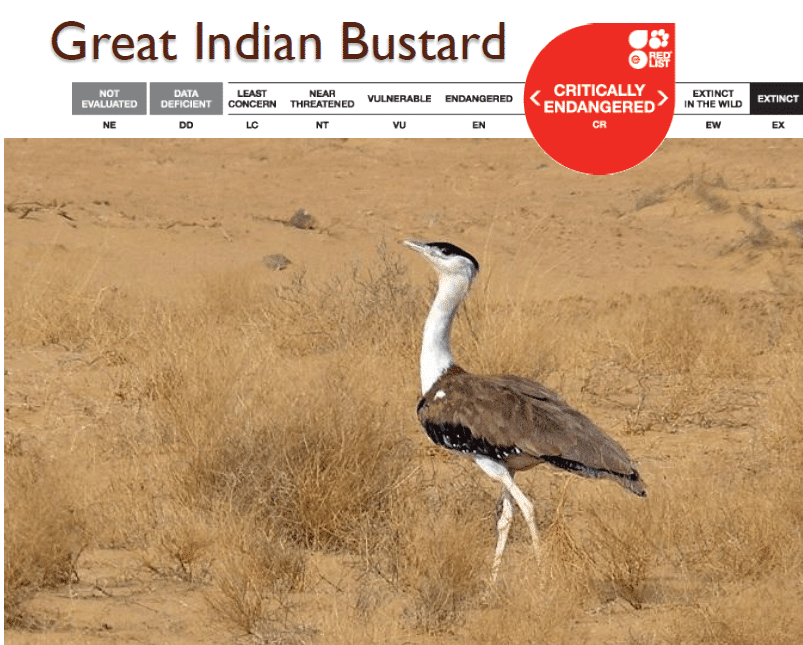
    India’s proposal to include Great Indian Bustard, Asian Elephant and Bengal Florican in Appendix I of UN Convention on migratory species was unanimously accepted at the undergoing CMS CoP in Gandhinagar.

    Great Indian Bustard

    • The Great Indian Bustard, an iconic, critically endangered and conservation dependent species, exhibits transboundary movements, and its migration exposes it to threats such as hunting in the boundary area of Pakistan-India and power-line collisions in India.
    • Inclusion of the species in Appendix I of CMS will aide in transboundary conservation efforts facilitated by International conservation bodies and existing international laws and agreement.

    Asian Elephant

    • The Government of India has declared Indian elephant as National Heritage Animal. It is also provided with the highest degree of legal protection by listing it in Schedule I of the Wildlife (Protection) Act, 1972.
    • The Great Indian Bustard is a Critically Endangered species with a small population of about 100–150 individuals that is largely restricted to Thar desert in Rajasthan, India.
    • The species has disappeared from 90% of this range; their population has reduced by 90% within 50 years (six generations), and their threats are expected to increase in future.

    Bengal Florican

    • The Bengal Florican an iconic, critically endangered species of topmost conservation priority, exhibits transboundary movements, and its migration exposes it to threats such as land-use changes, collision with power transmission line at the boundary area of India-Nepal and probable power-line collisions.
    • Inclusion of the species in Appendix I of CMS will aid in transboundary conservation efforts facilitated by International conservation bodies and existing international laws and agreement.
    • It populations has declined as a result of habitat loss, hunting and the species no longer breeds outside Protected Areas in the Indian subcontinent, except in a few areas of Assam.
  • State of India’s Birds 2020 (SoIB) Assessment


    State of India’s Birds 2020 (SoIB) assessment was recently released.

    Highlights of the report


    • The SoIB was produced using a base of 867 species (among 1,333 birds ever recorded in India), and analysed with the help of data uploaded by birdwatchers to the online platform, eBird.
    • Adequate data on how birds fared over a period of over 25 years (long-term trend) are available only for 261 species.
    • Current annual trends are calculated over a five-year period.

    Alarming declines

    • The SoIB assessment raises the alarm that several spectacular birds, many of them endemic to the sub-continent, face a growing threat from loss of habitat due to human activity, widespread presence of toxins including pesticides, hunting and trapping for the pet trade.
    • Diminishing population sizes of many birds because of one factor brings them closer to extinction because of the accelerated effects of others, the report warned.
    • Over a fifth of India’s bird diversity, ranging from the Short-toed Snake Eagle to the Sirkeer Malkoha, has suffered strong long-term declines over a 25-year period.
    • More recent annual trends point to a drastic 80% loss among several common birds.

    Various species mentioned

    • Of 101 species categorised as being of High Conservation Concern — 59 based on range and abundance and the rest included from high-risk birds on the IUCN Red List.
    • Endemics such as the Rufous-fronted Prinia, Nilgiri Thrush, Nilgiri Pipit and Indian vulture were confirmed as suffering current decline.
    • And all except 13 had a restricted or highly restricted range, indicating greater vulnerability to man-made threats.
    • Peafowl, on the other hand, are rising in numbers, expanding their range into places such as Kerala, which is drying overall, and areas in the Thar desert where canals and irrigation have been introduced. Stricter protection for peacocks under law also could be at work.
  • National Groundwater Management Improvement Programme

    The Government of India and the World Bank have signed a $450 million loan agreement to support the national programme to arrest the country’s depleting groundwater levels and strengthen groundwater institutions.

    About the Programme

    • The World Bank-supported programme will be implemented in the states of Gujarat, Maharashtra, Haryana, Karnataka, Rajasthan, Madhya Pradesh, and Uttar Pradesh and cover 78 districts.
    • These states span both the hard rock aquifers of peninsular India and the alluvial aquifers of the Indo-Gangetic plains.
    • They were selected based on several criteria, including degree of groundwater exploitation and degradation, established legal and regulatory instruments, institutional readiness, and experience in implementing initiatives related to groundwater management.
    • This programme will contribute to rural livelihoods and in the context of climatic shifts, build resilience of the rural economy.

    Objectives

    The programme will, among others, enhance the recharge of aquifers and introduce water conservation practices; promote activities related to water harvesting, water management, and crop alignment; create an institutional structure for sustainable groundwater management; and equip communities and stakeholders to sustainably manage groundwater.

    Particulars of the programme

    • The programme will introduce a bottom-up planning process for community-driven development of water budgets and Water Security Plans (WSPs).
    • Water budgets will assess surface and groundwater conditions (both quantity and quality) and identify current and future needs.
    • The WSP, on the other hand, will focus on improving groundwater quantity and incentivize selected states to implement the actions proposed.
    • Such community-led management measures will make users aware of consumption patterns and pave the way for economic measures that reduce groundwater consumption.
    • Crop management and diversification will be the other focus areas.
  • Species in news: Indian Pangolin


    The Madhya Pradesh forest department has radio-tagged an Indian Pangolin (Manis crassicaudata) for the first time.

    Pangolins

    IUCN status: Endangered

    • India is home to two species of pangolin.
    • While the Chinese Pangolin (Manis pentadactyla) is found in northeastern India, the Indian Pangolin is distributed in other parts of the country as well as Sri Lanka, Bangladesh and Pakistan.
    • Both these species are protected and are listed under the Schedule I Part I of the Wild Life (Protection) Act, 1972 and under Appendix I of the Convention on International Trade in Endangered Species (CITES).
    • Commonly known as ‘scaly anteaters’, the toothless animals are unique, a result of millions of years of evolution.
    • Pangolins evolved scales as a means of protection. When threatened by big carnivores like lions or tigers they usually curl into a ball.
    • The scales defend them against dental attacks from the predators.

    Why this radio-tagging?

    • The radio-tagging aims to know its ecology and develop an effective conservation plan for it.
    • The radio-tagging is part of a joint project by the department and non-profit, the Wildlife Conservation Trust (WCT) that also involves the species’ monitoring apart from other activities.

    Why protect Pangolins?

    • Pangolins are currently the most trafficked wildlife species in the world.
    • These Scales has now become the main cause of the pangolin’s disappearance.
    • The scales are in high demand in China, where they are used in traditional Chinese medicine.
    • Pangolin meat is also in high demand in China and Southeast Asia.
    • Consequently, pangolins have seen a rapid reduction in population globally. The projected population declines range from 50 per cent to 80 per cent across the genus.
  • Towards a new world order

    Context

    Social inequalities and the grim problems of stark and continuing poverty are at the epicentre of the new world.

    The ugly face of capitalism and growing inequalities

    • The concentration of the health: The latest Oxfam Report presented at Davos points out that 2,153 billionaires have more wealth than 4.6 billion people.
    • Rising poverty: The emergence of billionaires and oligarchs in different parts of the world coincides with increased poverty among the already poor people, especially children.
    • Concept of stakeholder’s capitalism: These realities make observers question the tenability of stakeholder capitalism as a concept.
    • Faults in the capitalism on display in 2008: The ugliest face of this capitalism was visible during the 2007-2008 economic crisis, first in the U.S. and thereafter across the European Union.
      • At that time, it appeared as if the global economy was on the verge of collapse.

    Intensification of energy use and sustainability

    • The relation between growth and energy: One of the chief characteristics of economic development is the intensification of energy use.
      • There is an unprecedented concentration of high energy density in all economic development strategies.
    • Use of non-renewable sources: The bulk of the energy continues to be generated from non-renewable sources.
    • Developing world capturing energy-generating sources: The developed world’s, and China’s, central objective is to capture energy-generating resources from across continents and put them to use to push GDP growth to greater heights.
      • In the process, sustainability is becoming a casualty.
    • Higher waste generation: The higher the use of energy, the larger the amount of waste generated. Entropy, like time, is always unidirectional, it only goes forward.

    Disposal of e-waste

    • High energy consumption and disposal of waste: Egregious consumption of energy by the developed world has been accompanied by the disposal of residual products (‘e-waste’) on the shores of many African and Asian countries.
    • Impact on the developing world: As a result of the disposal, the poor in the developing world are, unwittingly, drawn and exposed to toxic, hazardous materials like lead, cadmium and arsenic.
      • Hence, the ‘globalisation’ phenomenon has turned out to be nothing other than the exploitation of the developing world, with most countries being treated as a source of cheap labour and critical raw material.

    Unfairness involved in the Globalisation

    • Increasing consumption in the developing world: Countries in the developed world, and China, are ferociously using up finite raw materials without care or concern for the welfare of present and future generations.
    • Bright and the dark side of the development: Certainly, there has been significant technological progress which has brought about a revolution in the fields of healthcare and communications, but there is also a dark side to this.
    • System loaded in the favour of the rich: High expenses and Intellectual Property Rights load the system further in favour of the rich.
      • Pernicious system of carbon credit: To demonstrate how unfair the system is, one can look at the pernicious plan to set up a carbon credit system.
      • Under this, countries with high energy consumption trends can simply offset their consumption patterns by purchasing carbon credits, the unutilised carbon footprint, from poor developing countries.

    Understanding the Nordic Economic Model

    • ‘Nordic Economic Model’: It pertains to the remarkable achievements of the Scandinavian countries comprising Denmark, Finland, Iceland, Sweden, Norway, and allied territories. They also have-
      • Large public sector enterprises.
      • Extensive and generous universal welfare systems.
      • High levels of taxation.
      • And considerable state involvement in promoting and upholding welfare states.
      • Among the happiest countries: UN reports also indicate that the Nordic countries are the happiest countries in the world. The U.S., in contrast, is in 19th place.
      • The total population of the Nordic countries is estimated at almost 27 million people.
      • Among the richest countries: These nations are among the richest in the world when measured in terms of GDP per capita.

    Enlightened Global Order

    • Taking the Nordic model as a template, there are some ingredients that could be part of a new ‘enlightened global order’.
    • What does the Global Order include? These should include-
      • Effective welfare safety nets for all.
      • Corruption-free governance.
      • A fundamental right to tuition-free education including higher education.
      • And a fundamental right to good medical care.
      • Shutting of tax havens.
      • Tax structure: In Nordic countries, personal and corporate income tax rates are very high, especially on the very rich. If a just, new world order is to arise, taxes everywhere should go up.
    • Holding companies responsible: When it comes to the corporate sector, there are some new perspectives.
      • Changing the parameters of profit: In traditional business accounting, ‘bottom line’ refers to the financial year’s profit or loss earned or incurred by the company on pure financial parameters.
      • The four ‘Ps’: Following vigorous debates, a new format has emerged under which a company’s performance is measured through four ‘Ps’.
      • The first is ‘P’ for ‘profit’.
      • The second ‘P’ is for people — how the company’s actions impact not only employees but society as a whole.
      • The third ‘P’ is for the planet — are the company’s actions and plans sensitive to the environment?
      • The fourth ‘P’ is for purpose, which means the companies and individuals must develop a larger purpose than ‘business as usual’. They must ask: what is the larger purpose of the company, apart from generating profits?
      • Using performance in terms of four ‘P’s: Using big data and text analytics, a company’s performance can be measured in terms of all the four ‘P’s and a corporate entity can be thus held accountable. Market capitalisation need not be the only way to measure the value of a company.

    Conclusion

    Much work is yet to be done to uplift the global economic order, but the important point is that new tools are now emerging. What is required is a global consensus and the will to make the planet more sustainable, so that all individuals can live with justice and equality, ensuring that not a single child is hungry or seriously unwell because of poverty or lack of affordable medical help.


  • Global cost of air pollution from fossil fuels


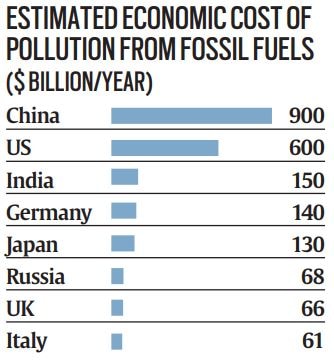
    A new Greenpeace report has estimated the global cost of air pollution from fossil fuels at around $2.9 trillion per year, or $8 billion per day — 3.3% of the world’s GDP.

    Cost of air pollution

    India is estimated to bear a cost of $150 billion, or 5.4% of the country’s GDP, which is the third-highest absolute cost from fossil fuel air pollution worldwide.

    China and the US are estimated to bear the highest absolute costs from fossil fuel air pollution, respectively at $900 billion and $600 billion.

    Loss of lives

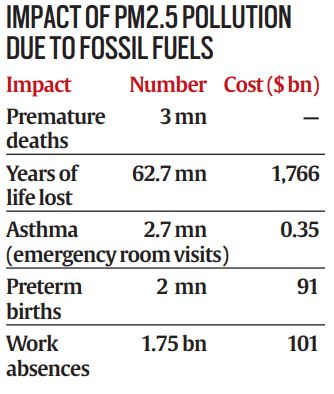
    • Globally, air pollution is estimated to cause 4.5 million premature deaths each year.
    • This includes 3 million deaths attributable globally to PM2.5, which is one of the principal pollutants in northern Indian cities including Delhi.
    • Globally, PM2.5 is also estimated to cause the loss of 62.7 million years of life, 2.7 million emergency room visits due to asthma, 2 million preterm births and 1.75 billion work absences.
    • The 2 million preterm births include 981,000 in India and over 350,000 in China.

    Economic cost

    In India, exposure to fossil fuels also leads to a loss of around 490 million workdays, the report said.

  • [pib] 13th COP of the Convention on the Conservation of Migratory Species of Wild Animals (CMS)


    The 13th Conference of Parties (COP) of the Convention on the Conservation of Migratory Species of Wild Animals (CMS) is going to be hosted by India at Gandhinagar in Gujarat.

    13th COP of CMS

    • The theme of CMS COP13 in India is, “Migratory species connect the planet and we welcome them home.
    • The CMS COP 13 logo is inspired by ‘Kolam’, a traditional artform from southern India.
    • In the logo of CMS COP-13, Kolam art form is used to depict key migratory species in India like Amur falcon, humpback whale and marine turtles.
    • The mascot for CMS COP13, “Gibi – The Great Indian Bustard” is a critically endangered species which has been accorded the highest protection status under the Wildlife Protection Act, 1972.

    About CMS

    • CMS is an international treaty concluded under aegis of UN Environment Programme (UNEP), concerned with conservation of wildlife and habitats on a global scale.
    • It is commonly abbreviated as Convention on Migratory Species (CMS) or the Bonn Convention.
    • It aims to conserve terrestrial, marine and avian migratory species throughout their range.
    • It was signed in 1979 in Bonn (hence the name), Germany and entered into force in 1983.
    • Its headquarters are in Bonn, Germany.
    • CMS is only global and UN-based intergovernmental organization established exclusively for conservation and management of terrestrial, aquatic and avian migratory species throughout their range.

    Prospects for India

    • As the host, India shall be designated the President for the next three years.
    • India is Signatory to the CMS since 1983.
    • India has been taking necessary actions to protect and conserve migratory marine species.
    • Seven species that include Dugong, Whale Shark, Marine Turtle (two species), have been identified for preparation of Conservation and Recovery Action Plan.

    Other facts

    • The Indian sub-continent is also part of the major bird flyway network, i.e, the Central Asian Flyway (CAF) that covers areas between the Arctic and Indian Oceans, and covers at least 279 populations of 182 migratory water bird species, including 29 globally threatened species.
    • India is home to several migratory species of wildlife including snow leopard, Amur falcons, bar headed Geese, black necked cranes, marine turtles, dugongs, humpbacked whales, etc.
    • It has signed non legally binding MOU with CMS on the conservation and management of Siberian Cranes (1998), Marine Turtles (2007), Dugongs (2008) and Raptors (2016).
  • [pib] Regulation of Bio-Medical Waste


    The State Pollution Control Boards (SPCBs) / Pollution Control Committees (PCCs) have recently published the details of State/UT-wise quantum of bio-medical waste generation (during 2016-18) in the country.

    Bio-Medical Waste

    Biomedical waste/hospital waste is any kind of waste containing infectious materials.  It may also include waste associated with the generation of biomedical waste that visually appears to be of medical.

    • Hospital waste refers to all waste, biological or non‐ biological that is discarded and not intended for further use.
    • Bio-medical waste means any waste, which is generated during the diagnosis, treatment or immunization of human beings or animals or in research activities pertaining thereto or in the production or testing of biological and including categories mentioned in Schedule I, of the BMW rules, 2016.

    Who deals with Bio-medical wastes in India?

    • Central Pollution Control Board has been following up with all SPCBs/PCCs to ensure effective management of biomedical waste in States/UTs.

    Collection and disposal

    • The collection and disposal is treated and disposed as per the specified methods of disposal prescribed under Schedule I of the Rules.
    • Bio-medical waste generated from the hospitals shall be treated and disposed by Common Bio-medical Waste Treatment and Disposal Facility.
    • In case there is no common facility in the reach of a healthcare facility, then such healthcare facility should install captive treatment and disposal facility.
    • There are 200 authorized Common Bio-medical Waste Treatment and Disposal Facilities (CBWTFs) in 28 States for environmentally safe disposal of biomedical waste.
    • Remaining 7 States namely Goa, Andaman Nicobar, Arunachal Pradesh, Lakshadweep, Mizoram, Nagaland and Sikkim do not have CBWTFs.

    Categorization

    As informed by CPCB and as per Bio-medical Waste Management Rules, 2016, Bio-medical waste is required to be segregated in 4 color coded waste categories.

    • Common methods of treatment and disposal of bio-medical waste are by incineration/plasma pyrolysis/deep-burial for Yellow Category waste;
    • Autoclaving/microwaving/chemical disinfection for Red Category waste;
    • Sterilization and shredding, disinfection followed by burial in concrete pit/recycling through foundry/encapsulation for White Category sharps waste; and
    • Washing, disinfection followed by recycling for Blue Category glass waste.
  • Energy stored in wastewater

    The world generates about 380 trillion litres (tl) wastewater every year. These stores vast amounts of energy, nutrients for fertilizers besides, of course, water, according to recent study by the UN Institute for Water Environment and Health (UNU-INWEH).

    Energy in wastewater

    • In principle, nutrients such as nitrogen, phosphorous and potassium recovered from wastewater produced annually can offset 13.4 per cent of global demand to produce fertilizers.
    • Assuming full-energy recovery, the study estimated, current wastewater volume could provide enough methane fuel to power 196 million households by 2030 and 239 million households by 2050.
    • Usable water reclaimed from wastewater can irrigate up to 31 million hectares (mha) of land, the study claimed.
    • The volume of wastewater being generated is projected to rise roughly 24 per cent by 2030 to 470 tl and 51 per cent by 2050 to 574 tl.
    • Treating wastewater efficiently can go a long way in achieving the UN-mandated sustainable development goals (SDG).

    About UNU-INWEH

    • UNU-INWEH acts as the “UN Think Tank on Water” and contributes to the resolution of the global water challenge through a unique programme of applied research and education.
    • It conceives, develops, and manages water initiatives that help developing countries build their capacity for lasting improvements in human and ecosystem health, and overall reduction in poverty.
    • The  University is not a traditional university in the sense of having a faculty, campus, or students.
    • They respond directly to the regional and global water crisis and facilitate efforts to meet UN Development goals by providing a scientific evidence base.
    • UNU-INWEH carries out its work in cooperation with other research institutions, international organizations, individual scholars, and scientists throughout the world.