💥Join UPSC 2027,2028 Mentorship (August Batch) + XFactor Notes & Microthemes PDF

GS Paper: Governance, Transparency & Accountability, Citizens Charters

  • Cop out in Delhi

    Context

    Political parties across the spectrum escape the blame for continuing to use the police as an instrument to further their political agenda.

    The backdrop of violence in protest against CAA in Delhi

    • The culmination of dithering by police: It was the culmination of weeks of dithering and selective action on the part of the Delhi Police in dealing with those agitating against the Citizenship Amendment Act (CAA).
    • No preventive action is taken: No preventive action appears to have been taken, and when the national capital was rocked by agitators in different areas the police appeared to have been caught by surprise.
    • Hesitation in acting against the rioters: There appeared to be hesitation on the part of the police in taking firm action against the rioters who continued to be on the rampage, destroying public and private property.
      • There was a disturbing scene of a rioter openly brandishing his firearm at a policeman.

    Disturbing patterns in the Police actions

    • Delhi Police- The extremes of action and inaction: The Delhi Police is the best-resourced police in the country.
      • It is looked upon as a model by state police forces across the country. Its response, in fact, shows a disturbing pattern.
      • There have been extremes of action and inaction.
      • Forcible entry: In Jamia Millia Islamia, the police is alleged to have entered the campus forcibly and roughed up students after their march against the CAA turned violent.
      • Inexplicable delay: In JNU, there was an inexplicable delay in responding to violence by a group of outsiders within the campus.
    • Bengal Police-Turning blind eye to rioters’vandalism: In West Bengal, with Mamata Banerjee leading the charge against the CAA, the message to the police was clear.
      • They turned Nelson’s eye to rioters’ vandalising government and private property; the Eastern Railways alone suffered a loss of Rs 72.19 crore.
    • Uttar Pradesh Police- Excesses committed during protests.
      • In UP, where over 20 people were killed, the Allahabad High Court has called for a detailed report on the alleged police excesses.
    • Karnataka Police- Over-zealousness.
      • In Karnataka, the High Court has blamed the Mangaluru police of “over-zealousness” in dealing with the anti-CAA protests.
    • Party bias in the Police actions: Police response invariably reflects the bias of the ruling party.
      • The partisan police response to situations, which were strikingly similar, has caused dismay and consternation among the people.
      • One must get to the root of the problem.

    Observations and the Supreme Court guidelines

    • National Police Commission observation: The National Police Commission recorded as far back as 1979 that “the present culture of the police system appears a continuation of what obtained under the British regime when the police functioned ruthlessly as an agent for sustaining the government in power”.
      • In such a situation, the Commission went on to say, “police find it difficult to play their lawful role and make their performance acceptable to the people at large”.
    • The Supreme Court directions: The Supreme Court issued a set of six directions in 2006 to state governments with a view to transforming the ethos and working philosophy of the police.
      • Setting up the State Security Commission: The SC’s most important direction was about setting up of a State Security Commission with a view to insulate the police from external pressures.
      • It is true that several states have enacted laws purportedly in compliance with the Supreme Court’s orders.
      • Recommendation not supported in letter and spirit: But these acts, as their critical examination reveals, violate the letter and spirit of the judicial directions. The old order continues for all practical purposes.
    • The Justice Dhingra Committee report on anti-Sikh riots: In its recently released report on the 1984 anti-Sikh riots, the report slammed the Union government and the Delhi Police.
      • It observed that a large number of crimes remained unpunished for the simple reason that there was “lack of interest shown by the police and by the authorities in handling these cases as per law or to proceed with the intention of punishing the culprits”.
      • The effort of the police and the administration “seems to have been to hush up the criminal cases concerning riots”.

    Way forward

    • Implement the recommendations of NPC: It is unfortunate that the NPC recommendations have not been acted upon even after the Supreme Court’s directions. No wonder, in the recent agitation in different states, the police have acted in the manner they did.
    • Interference of the political parties need to be reduced: The police are, no doubt, to blame for not being able to function in an objective and impartial manner. There is definitely a failure of leadership also. The political leadership need to ensure the autonomy of the police.
    • Role of media: The media cannot escape its responsibility for treating the police as a convenient punching bag from time to time and not taking up the cause of police reforms as aggressively as it should be doing.
    • Introspection by the Supreme Court: The Supreme Court would also need to introspect as to why the implementation of its directions has been so ineffective.
  • Supreme Court panel recommends several prison reforms

    The Supreme Court has taken up a report on Prison Reforms for hearing on before a Bench led by CJI Sharad A. Bobde.

    About the Committee

    • The court had in September 2018 appointed the Justice Roy Committee to examine the various problems plaguing prisons, from overcrowding to lack of legal advice to convicts to issues of remission and parole.
    • Besides Justice Roy, a former Supreme Court judge, the members included an IG, Bureau of Police Research and Development, and the DG (Prisons), Tihar Jail.

    Various recommendations

    • Every new prisoner should be allowed a free phone call a day to his family members to see him through his first week in jail.
    • This is among the several recommendations — besides modern cooking facilities, canteens to buy essential items and trial through video-conferencing.
    • The report described the preparation of food in kitchens as “primitive and arduous”.
    • The kitchens are congested and unhygienic and the diet has remained unchanged for years now.

    Staffing the prisons

    • The court said overcrowding is a common bane in the under-staffed prisons. The Prison Department has a perennial average of 30%-40% vacancies.
    • Both the prisoner and his guard equally suffer human rights violation.

    Speedy trial

    • The undertrial prisoner, who is yet to get his day in court, suffers the most, languishing behind bars for years without a hearing.
    • Speedy trial remains one of the best ways to remedy the unwarranted phenomenon of over-crowding.
    • The report concluded that most prisons are “teeming with undertrial prisoners”, whose numbers are highly disproportionate to those of convicts.
    • It said there should be at least one lawyer for every 30 prisoners.
  • [op-ed of the day] The many problems of delayed data

    Context

    Delay in releasing the crime data by NCRB reduces the utility of the data for the policymakers.

    Formidable challenges faced by NCRB

    • The First-Casual approach of the States: The first is the lackadaisical approach of some of the States in providing data.
      • The NCRB merely assembles the figures it receives from the State police forces and does not tinker with them to reach a predetermined conclusion.
      • States’ irregularity: Data collection hits a roadblock when a few States either don’t bother to send the figures or send them much after the volume is published.
    • The second-Utility of the released data: The second problem is that questions are raised over the utility of the data.
      • There was a two-year delay in releasing the crime statistics for 2017.
      • Just two months after it was published, the ‘Crime in India’ (CII) 2018 report was released.
      • Reduced utility from a policy point of view: These numbers are only relevant to researchers, not policymakers as it does not carry us far in understanding what is happening on the ground.
      • A fossilised CII is meaningless.
    • The third- Third problem lies with the police and the public.
      • The Reluctance of the police to register the complaint: The police are notorious the world over for not registering complaints.
      • They do this so that they can present a false picture of a decline in crime.
      • The reluctance of the public: The public is also not very enthusiastic about reporting crimes to the police.
      • Catch-22 situation: Public is fearful of being harassed at the police station or do not believe that the police are capable of solving the crime. This is a Catch-22 situation.

    Crimes difficult to bury

    • The positive role played by the media: However, the problem has declined slightly over the years due to public awareness and intense media scrutiny.
      • There are a few classes of offences which are becoming increasingly difficult to bury. This is attributable to the extraordinary interest evinced by the media in reporting crime.
    • The crimes which are difficult to bury: The following cases of crime are becoming difficult to bury.
      • Homicide: The first category of crimes that is difficult to bury is of homicides.
      • Matter of distress: India reports an average of 30,000 murders every year (29,017 were registered in 2018). Every murder is a matter of distress.
      • Nevertheless, the stabilisation of the figure at 30,000 is a mild assurance.
      • The corresponding figure for the period in the U.S. was around 16,200.
      • Need to study the US decline: Though the U.S. has about one-third of India’s population, the reported decline in murders in many major U.S cities is worth studying.
      • Crime against women: The common man in India does not lag behind others in reacting strongly to attacks on hapless women and men.
      • The growth of the visual media possibly explains this welcome feature in Indian society.
      • The hope of a decrease in crime: The nationwide outrage over the gang-rape in Delhi and the subsequent tightening of laws on sexual crimes generated the hope that attacks against women would decrease.

    The issue of under-reporting

    • Under-reporting of crime in rural areas: In 2018, there were 33,356 rapes, a higher number than the previous year.
      • But these figures do not fully reflect realities on the ground.
      • There is still the unverifiable suspicion that while in urban areas sexual violence cases are reasonably well-reported, the story is different in rural India.
      • The role played by money and caste: Money power and caste oppression are believed to play a significant role in under-reporting.
      • What is more significant is that a substantial number of such crimes are committed by the ‘friends’ and families of victims.

    Conclusion

    • To be fair to the NCRB, we must concede that the organisation has more than justified its existence. The CII is used extensively by researchers.
    • Need for educating the people on realities of crime and its reporting: There is scope for more dynamism on the NCRB’s part, especially in the area of educating the public on the realities of crime and its reporting.
    • Greater pressure on the States to stick to a schedule: The NCRB will also have to be conscious of the expectation that it should bring greater pressure on States to make them stick to schedules and look upon this responsibility as a sacred national duty.


  • Corruption Perception Index 2019

    The Corruption Perception report for 2019 has been released. It has revealed that a majority of countries are showing little to no improvement in tackling corruption.

    About CPI

    • The CPI is annually released by Transparency International.
    • It draws on 13 surveys and expert assessments to measure public sector corruption in 180 countries and territories, giving each a score from zero (highly corrupt) to 100 (very clean).

    India’s performance

    • India’s ranking in the CPI-2019 has slipped from 78 to 80 compared to the previous year.
    • Its score of 41 out of 100 remains the same.
    • CPI highlighted that unfair and opaque political financing, undue influence in decision-making and lobbying by powerful corporate interest groups, has resulted in stagnation or decline in the control of corruption.

    Global corruption

    • In the Asia Pacific region, the average score is 45, after many consecutive years of an average score of 44, which “illustrates general stagnation” across the region.
    • China has improved its position from 87 to 80 with a score of 41 out of 100, a two-point jump.
    • Despite the presence of high performers like New Zealand (87), Singapore (85), Australia (77), Hong Kong (76) and Japan (73), the Asia Pacific region hasn’t witnessed substantial progress in anti-corruption.
    • In addition, low performers like Afghanistan (16), North Korea (17) and Cambodia (20) continue to highlight serious challenges in the region.
    • The top ranked countries are New Zealand and Denmark, with scores of 87 each, followed by Finland (86), Singapore (85), Sweden (85) and Switzerland (85).
  • Enemy Property in India

    • A Group of Ministers (GoM) headed by Union Home Minister will monitor the disposal of over 9,400 enemy properties, which the government estimates is worth about Rs 1 lakh crore.
    • Two committees headed by senior officials will be set up for the disposal of immovable enemy properties vested in the Custodian of Enemy Property for India under The Enemy Property Act.

    What is “Enemy Property”?

    • In the wake of the India-Pakistan wars of 1965 and 1971, there was migration of people from India to Pakistan.
    • Under the Defence of India Rules framed under The Defence of India Act, 1962, the Government of India took over the properties and companies of those who took Pakistani nationality.
    • These “enemy properties” were vested by the central government in the Custodian of Enemy Property for India.
    • The same was done for property left behind by those who went to China after the 1962 Sino-Indian war.
    • The Tashkent Declaration of January 10, 1966 included a clause that said India and Pakistan would discuss the return of the property and assets taken over by either side in connection with the conflict.
    • However, the Government of Pakistan disposed of all such properties in their country in the year 1971 itself.

    How did India deal with enemy property?

    • The Enemy Property Act, enacted in 1968, provided for the continuous vesting of enemy property in the Custodian of Enemy Property for India.
    • The central government, through the Custodian, is in possession of enemy properties spread across many states in the country.
    • Some movable properties too, are categorised as enemy properties.
    • In 2017, Parliament passed The Enemy Property (Amendment and Validation) Bill, 2016, which amended The Enemy Property Act, 1968, and The Public Premises (Eviction of Unauthorised Occupants) Act, 1971.

    Who is an Enemy?

    • The amended Act expanded the definition of the term “enemy subject”, and “enemy firm” to include the legal heir and successor of an enemy, whether a citizen of India or a citizen of a country which is not an enemy; and the succeeding firm of an enemy firm, irrespective of the nationality of its members or partners.
    • The amended law provided that enemy property shall continue to vest in the Custodian even if the enemy or enemy subject or enemy firm ceases to be an enemy due to death, extinction, winding up of business or change of nationality, or that the legal heir or successor is a citizen of India or a citizen of a country which is not an enemy.
    • The Custodian, with prior approval of the central government, may dispose of enemy properties vested in him in accordance with the provisions of the Act, and the government may issue directions to the Custodian for this purpose.

    Why were these amendments brought?

    • The thrust of the amendments was to guard against claims of succession or transfer of properties left by people who migrated to Pakistan and China after the wars.
    • The amendments denied legal heirs any right over enemy property. The main aim was to negate the effect of a court judgment in this regard.

    What did these court orders say?

    • One major judgment was passed in the case of the estate of the erstwhile Raja of Mahmudabad, who owned several large properties in Hazratganj, Sitapur and Nainital.
    • Following Partition, the Raja left for Iraq and stayed there for some years before settling in London.
    • After The Enemy Property Act was enacted in the year 1968, the Raja’s estate was declared enemy property. When the Raja died, his son who stayed in India staked claim to the properties.
    • After a legal battle that lasted over 30 years, an apex court Bench on October 21, 2005, ruled in favour of the son.
    • The verdict opened the floodgates for further pleas in courts across the country in which genuine or purported relatives of persons who had migrated to Pakistan produced deeds of gift claiming they were the rightful owners of enemy properties.
    • On July 2, 2010, the then UPA government promulgated an Ordinance that restrained courts from ordering the government to divest enemy properties from the Custodian.
    • The 2005 SC order was thus rendered ineffective, and the Custodian again took over the Raja’s properties.

    Enactment of the Amended Law

    • A Bill was introduced in Lok Sabha on July 22, 2010, and subsequently, a revised Bill was tabled on November 15, 2010. This Bill was thereafter referred to the Standing Committee.
    • However, the said Bill could not be passed during the term of the 15th Lok Sabha, and it lapsed.
    • On January 7, 2016, the President of India promulgated The Enemy Property (Amendment and Validation) Ordinance, 2016, which was replaced by the Bill that became law in 2017.
  • [pib] National Data and Analytics Platform (NDAP)


    NITI Aayog has released its vision for the National Data and Analytics Platform (NDAP).

    National Data and Analytics Platform

    • The platform aims to democratize access to publicly available government data.
    • NDAP will host the latest datasets from various government websites, present them coherently, and provide tools for analytics and visualization.
    • It will spearhead the standardization of formats in which data is presented across sectors and will cater to a wide audience of policymakers, researchers, innovators, data scientists, journalists and citizens.
    • It will follow a user-centric approach and will enable data access in a simple and intuitive portal tailored to the needs of a variety of stakeholders.
    • The development of NDAP will take place over a period of one year. The first version of the platform is expected to be launched in 2021.
  • Medical Education Governance in India

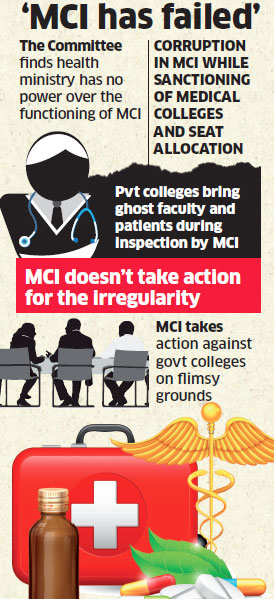
    The MCI has been in the news for the wrong reasons as the Parliamentary Standing Committee on Health in its 92nd report came down heavily on various aspects of the functioning of MCI. British medical Journal also had suggested radical revamp of the MCI. This articles focuses on the medical education governance in India.

    source

    Let’s understand the issues under the following heads:

    • Context
    • Background
    • Weaknesses Highlighted by Parliamentary panel
    • What are the major reforms needed in MCI?
    • Measures needed to overhaul and revamp MCI
    • Mandate of Lodha committee
    • Way forward

    Context:

    • MCI has been criticised for being a ‘biased’ organisation, acting ‘against larger public health goals’ and an ‘exclusive club’ of medical doctors from corporate hospitals and private practice. The British Medical Journal (BMJ) and the Parliamentary Standing Committee in their recent report have called for a ‘radical prescription’ to reform the Medical Council of India (MCI) in order to eliminate corruption and lack of ethics in healthcare.
    • SC appointed a three-member committee headed by former Chief Justice of India R M Lodha to oversee MCI.

    Background

    • The MCI was established under the Indian Medical Council Act 1933 and given responsibility for maintaining standards of medical education, providing ethical oversight, maintaining the medical register, and, through amendments in 1993, sanctioning medical colleges has failed to deliver quality and integrity in the health services across India.
    • The Medical Council of India (MCI) is a statutory body entrusted with the responsibility of establishing and maintaining high standards of medical education in India.

    Weaknesses Highlighted by Parliamentary panel

    In its scathing report, the standing committee felt that the MCI has repeatedly failed on all its mandates over the years. The committee noted the following as some of the prominent failures of MCI.

    • Failure to create a curriculum that produces doctors suited to working in Indian context especially in the rural health services and poor urban areas. The committee felt that this has created disconnect between medical education system and health system.
    • Failure to maintain uniform standards of medical education, both at the undergraduate and post-graduate levels.
    • Devaluation of merit in admission, particularly in private medical institutions due to prevalence of capitation fees, which make medical education available only to the rich and not necessarily to the most deserving.
    • Non-involvement of the MCI in any standardized summative evaluation of the medical graduates and post-graduates.
    • Failure to put in place a robust quality assurance mechanism.
    • Very little oversight of PG medical education leading to huge variation in standards.
    • Failure to create a transparent system of medical college inspections and grant of recognition or de-recognition.
    • Failure to oversee and guide the Continuing Medical Education in the country, leaving this important task in the hands of the commercial private industry.
    • Failure to instill respect for a professional code of ethics in the medical professionals and take disciplinary action against doctors found violating the code of Ethics.

    What are the major reforms needed in MCI?

    1. There is a need to restructure the MCI. It should not be an elected body dominated by vested interest but should represent all stakeholders through nomination. The MCI, as presently elected, neither represents professional excellence nor its ethos. The current composition of the Council reflects that more than half of the members are either from 21 corporate hospitals or in private practice.
    2. The MCI currently sets standards for recognition, inspects and licenses medical colleges; overseas Registration and Ethical Conduct of Doctors. It now proposes to undertake accreditation as well. Such concentration of powers creates a serious conflict of interest and provides a fertile ground for misuse of authority. So there is a need to create a transparent system of licensing of medical colleges.
    3. There should be bifurcation of the functions of MCI and recommends that different structures be created for discharging different functions.
    4. There is a need to revisit ICT tools and revisit minimum standards which are required under the act to establish medical colleges.
    5. A code of ethics which is in line with the international standards needs to be developed for the medical professionals to reduce the corrupt practices.
    6. It needs to see a balance between the number of seats available for medical courses at undergraduate and postgraduate level.

    Measures needed to overhaul and revamp MCI

    1. The Parliamentary committee made a number of recommendations to overhaul the system. Some of the important recommendations of the committee are the following,
    2. Doctor – Population ratio in India is 1:1674 as against the WHO norm of 1:1000, hence the government should immediately spell out policy stance in great detail to augment the capacity of production of doctors including specialists and super-specialists at the scale and speed required to meet India’s health needs.
    3. The regulatory framework of medical education and practice should be comprised of professionals of the highest standards of repute and integrity, appointed through a rigorous and independent selection process.
    4. Urgent measures have to be taken to restructure the composition of MCI to encourage diversity so that it does not become an exclusive club of doctors.
    5. Physical infrastructure requirement should be pruned down in such a way that it should have just about 30 to 40 percent standing value in the total assessment of a medical college.
    6. Support to convert district hospitals into medical colleges. If a district hospital is converted into a medical college, it will not only be equipped with specialists of all disciplines, providing the healthcare services across the whole spectrum but will also produce some doctors in its area of operation and will thus help reduce geographical mal-distribution of doctors.
    7. The PG entrance exam should be held immediately after the final MBBS examination so that the graduate doctor could concentrate on practical skills during his internship.
    8. Ethics should be made one of the cornerstones of the syllabus of medical education.
    9. Introduction of Common Medical Entrance Test (CMET) should be done across the nation barring those States who wish to remain outside the ambit of the CMET. A common exit test should be introduced for MBBS doctors.

    Mandate of the Lodha committee

    1. Lodha Committee would have complete authority to oversee all statutory functions under the MCI Act.
    2. All policy decisions of the MCI will need approvals from the Committee. It will also be free to issue remedial directions.
    3. The Committee will function for 1 year, unless a suitable mechanism is brought in earlier by it.
    4. Initially the panel will function for a year, unless suitable mechanism is brought in place earlier which will substitute the said committee.

    Way forward

    • The abysmal doctor-patient ratios in India’s rural areas and poorer districts, the sanctioning of new medical colleges without ensuring trained medical faculty, the failure to produce adequate specialist doctors, and corruption in the conduct of inspections and in granting sanctions to medical colleges have wrecked the MCI’s credibility.So, there is a need to bring back the integrity which MCI has lost over the years.
    • Whether Lodha Committee manages to inculcate the changes needed in MCI or ends up being one of the numerous other attempts at cleaning up the medical education scene remains to be seen.

    References:

  • Aadhaar Card Issues

    Aadhaar Bill 2016, Hopes and Concerns 

    Basics of Aadhaar

    Aadhaar is an ambitious project that seeks to provide unique identification numbers to each individual in a country, collecting demographic and biometric information in the process. Currently, UIDAI has issued over 98 crore Aadhaar numbers.

    Need for Aadhaar: India must use technology in a transformational way to accelerate social and economic justice. It will help in expansion of opportunities for all at scale and speed.

    What is the Aadhaar Bill?

    Aadhaar (Targeted Delivery of Financial and Other Subsidies, Benefits and Services) Bill, 2016, has been passed by Parliament, to provide for efficient, transparent, and targeted delivery of subsidies, benefits and services.

    It will enable the govt. to reset the subsidy regime and deliver state benefits directly to their intended beneficiaries, plugging leakages.

    How Aadhar is linked with DBT?

    India spends nearly Rs. 4 lakh crore on subsidies, in order to complement the political democracy with socio-economic democracy.

    On January 1, 2013, the UPA govt launched the Direct Benefit Transfer scheme under which monetary benefits would be transferred directly to the beneficiaries through an Aadhaar-enabled platform.

    The effort to channelize subsidies, benefits and services to through a 12-digit number or to say its biometric alternative can help plug the leakages in the subsidy framework and give a boost to the Jan Dhan Yojna, which remains closely aligned to this scheme.

    Follow our story on Direct Benefits Transfer: The Big Reform.

    Do read the Economic Survey chapter on JAM Trinity.

    What are the concerns on Privacy front?

    There are certain provisions in the Bill, that provide avenues for surveillance of citizens. A person’s Aadhaar number can become a standard data point in all business, banking and legal transactions. Our data systems are not secure and watertight. The people who maintain these systems are vulnerable to pressures and inducements.

    • The issue of privacy vs. security is a hot subject around the world, evident in the current controversy in Apple Inc.’s refusal to break the encryption on an iPhone as demanded by FBI
    • Sceptics argue that no other country, and certainly no democratic country, has ever held its own citizens hostage to such a powerful infrastructure of surveillance
    • Govt. accepts right to privacy as a valuable right, but questions it as a fundamental right
    • In 1954, a 8-judge bench of SC had ruled that right to privacy cannot be a fundamental right. But, some judgments post-1990 noted that right to privacy can be construed as fundamental right, subject to certain restrictions and circumstances

    However, there are other concerns of exclusion, by denying the services to people who didn’t enroll for it or chose not to do it.

    Safeguards

    According to Nandan Nilekani, the Bill had incorporated several safeguards with regard to privacy as highlighted by the A.P. Shah Committee report, on privacy law.

    There are other provisions in this Bill that seem to address the concern:

    • The unique numbers will not be considered as proof of citizenship
    • The Aadhar system ensures privacy through design, as it uses a federated architecture. In other words, as banking data is wholly inside the banking system, similarly, the biometric data is never shared by UIDAI
    • The core bio-metric information cannot be shared with any person even with the consent of the Aadhaar card holder. Even, the general information cannot be unlawfully shared
    • Only a Court of the District Judge or above has been given the power to order disclosure of information excluding core biometrics
    • National Security” is the only ground on which a Competent Authority can share this information. Every decision of the Competent Authority has to be reviewed by a Committee comprising of the Cabinet Secretary, the Law Secretary and the Secretary, Information Technology before it is given effect

    What was Supreme Court’s stand on Aadhaar?

    In 2013, the Supreme Court ruled that Aadhaar could not be made mandatory to receive benefits. No one should be excluded from social welfare scheme, just because of a requirement of Aadhar.

    In 2015, It also prohibited the sharing the Aadhaar information with any agency. The case was referred to a larger bench to decide the question whether Aadhaar infringed the right to privacy.

    What is Aadhaar Bill versus Money Bill controversy?

    According to experts, the Bill was not a money Bill under Article 110 of the Constitution because it did not “contain ONLY provisions” dealing with the matters enumerated in that Article. Various Constitutional experts have argued that the Speaker’s decision to certify it as a money Bill was also plainly wrong.

    Do you want to know about Money Bill?

    As per Article 110(1), a bill that contains only provisions dealing with the following qualifies as a money bill:

    1. The imposition, abolition, remission, alteration or regulation of any tax
    2. Regulation of borrowing or the giving of any guarantee by the govt of India, or undertaking financial obligation by the government
    3. The custody of the Consolidated Fund of India or the Contingency Fund of India, the payment of moneys into or withdrawal from them
    4. The appropriation of moneys out of the CFI
    5. Declaring any expenditure as a charged expenditure on the CFI <can you tell us the difference b/w charged expenditure and non charged expenditure? Also can you tell us one prominent constitution body whose expenditure is not charged? Answer in the comments.>
    6. The receipt of money on account of the CFI or the public account of India or the ambit of accounts of the Union or of a state <can you tell us the difference b/w consolidated fund of India and public accounts of India? Answer in the comments>
    7. Any matter incidental to the above issues

    A money bill cannot be rejected by the Rajya Sabha, which can only suggest changes, the Lok Sabha is free to reject.

    Speaker: Article 110(3) confirms finality on the speaker’s decision on the question of whether a bill is a money bill.

    What were the amendments moved by Rajya Sabha?

    • It wanted to restrict the use of Aadhaar numbers only for targeting of govt benefits or service and not for any other purpose
    • It wanted to replace the term ‘national security’ with ‘public emergency and public safety’, arguing that the term ‘national security’ is very vague
    • It wanted an Oversight Committee to review the Competent Authority’s decision, which should also comprise of either the CVC or the CAG
    • It wanted to delete a section which says that if under any other law the use of Aadhaar number for establishing the identity of an individual is permitted, the same law is not being over-ruled

    Conclusion

    There is little doubt that India needs to streamline the way it delivers benefits, and to empower citizens with a basic identification document. But this cannot be done without ensuring the strictest protection of privacy.

    Follow our story on Aadhaar Cards: The Identity Revolution.

    Published with inputs from Pushpendra