The Union Government amended the Foreign Contribution (Regulation) Rules, 2011, introducing stricter norms for NGOs receiving foreign funds under the Foreign Contribution (Regulation) Act (FCRA), 2010.
New Registration Requirements
NGOs must register under one or more of five categories: Social, Economic, Educational, Cultural, and Religious
Must specify: Exact purpose of foreign contribution. State/UT-wise area of operation.
Separate fee payable for each category and each State/UT.
Enhanced Disclosure
NGOs must disclose: Websites, Social media accounts, Publications (books, magazines, newspaper articles), and Annual activities and geographical scope.
Expanded Definition of “Key Functionary”
Now includes: Office-bearers, Directors, Trustees, Partners, Karta/Head of Hindu Undivided Family (HUF), Governing body members, and Any person controlling or managing the organization.
Restrictions
NGOs with foreign nationals (except Persons of Indian Origin) as key functionaries will generally not be eligible unless specifically permitted by the Central Government.
Educational and cultural activities must remain strictly non-political.
Religious activities exclude proselytisation.
Penalties
Minimum fine: ₹1 lakh.
Misuse of foreign funds or use for unapproved purposes/States: 30% of the amount involved or ₹1 lakh, whichever is higher.
Similar penalties for Excess administrative expenditure, Speculative investments, and Unauthorized receipt or utilization of foreign contributions.
Regulates acceptance and utilization of foreign contributions and hospitality by individuals, associations, and NGOs.
Administered by the Ministry of Home Affairs (MHA).
Objectives: Ensure foreign funds do not adversely affect Sovereignty and integrity of India, National security, Public interest, and Democratic institutions
[2021] At the national level, which ministry is the modal agency to ensure effective implementation of the scheduled Tribes and Other Traditional Forest Dwellers (Recognition of Forest Rights) Act, 2006?
[A] Ministry of Environment, Forest and Climate Change
The Department of Administrative Reforms and Public Grievances (DARPG) released the 46th CPGRAMS Monthly Report for States/UTs, highlighting public grievance redressal performance and capacity-building initiatives.
Public Grievance Redressal
Public Grievances (PG) received:85,900
PG cases redressed:84,365
Total pending cases (31 May 2026):2,13,190
22 States/UTs have more than 1,000 pending grievances.
State Performance
Highest disposals:
Uttar Pradesh: 27,030 cases
Maharashtra: 9,476 cases
User Participation
New CPGRAMS users registered:65,174
Registrations from Uttar Pradesh:11,365
Feedback collected by Call Centre:78,830
From States/UTs: 32,283
Common Service Centres (CSCs)
CPGRAMS integrated with 5 lakh+ CSCs and 2.5 lakh Village Level Entrepreneurs (VLEs).
8,562 grievances registered through CSCs during May 2026.
Sevottam Scheme
FY 2022-23 to FY 2026-27 (till May):1,175 training programmes conducted and 38,693 officers trained.
New Initiative: Samadhan Didi, an AI-enabled Voice Chatbot, launched on 30 May 2026 to improve digital public grievance redressal.
CPGRAMS (Centralized Public Grievance Redress and Monitoring System)
An online platform for citizens to lodge grievances against Central Ministries, Departments, and States/UTs.
Developed and managed by DARPG.
Enables tracking, monitoring, and time-bound disposal of grievances.
Sevottam Scheme: A quality management framework aimed at improving Citizen charters, Public grievance redressal, and Service delivery excellence
[2021] With reference to the Union Government, consider the following statements: 1. N. Gopalaswamy Iyengar Committee suggested that a minister and a secretary be designated solely for pursuing the subject of administrative reform and promoting it. 2. In 1970, the Department of Personnel was constituted on the recommendation of the Administrative Reforms Commission, 1966, and this was placed under the Prime Minister’s charge. Which of the statements given above is/are correct?
The issue is in the news following a proposal under the Jan Vishwas framework to centrally publish all government edicts and treat any non publicly accessible edict as null and void. The debate has also gained attention after the Indian Roads Congress (IRC) issued a takedown notice against the public sharing of its road safety standards, raising questions about whether government standards and safety regulations should be freely accessible as part of the law and public knowledge.
What are government edicts?
Government Edicts: Government edicts are legally binding instruments issued by the State, including laws, rules, regulations, notifications, circulars, guidelines, standards, SOPs, and government orders that govern citizens and institutions.
Why should they be public?
Rule of Law: Citizens cannot obey laws they cannot access. Eg: Public access to Indian Roads Congress (IRC) standards.
Legal Transparency: Prevents hidden or “shadow” regulations. Eg: Central publication of government notifications.
Democratic Accountability: Enables public scrutiny of government actions. Eg: Citizens reviewing road safety standards.
Access to Justice: Ensures equal knowledge of legal obligations. Eg:MSMEs accessing compliance standards without barriers.
Citizen Empowerment: Creates an informed citizenry and participatory governance. Eg: Engineers and researchers using public standards.
Why is public access to safety standards important for democracy?
Public Safety: Open standards improve compliance and reduce risks. Eg:Helmet and building safety standards.
Right to Information: Citizens have a right to know rules affecting their lives. Eg: Free access to drinking water quality standards.
Transparency: Prevents arbitrary enforcement of technical regulations. Eg: Publicly available road construction norms.
Ease of Doing Business: Reduces compliance costs for businesses. Eg: MSMEs accessing manufacturing standards.
Inclusive Governance: Eliminates information asymmetry. Eg: Contractors and citizens following the same safety norms.
How can the Jan Vishwas framework improve legal transparency?
Centralized Repository: All government edicts available on one digital platform. Eg: Expansion of India Code.
Removal of Shadow Instruments: Makes regulations, circulars, guidelines, and SOPs publicly accessible. Eg: Publishing notifications and standards.
Null and Void Principle:Unpublished edicts should have no legal force. Eg: Citizens cannot be penalized under inaccessible rules.
Digital Governance: Creates searchable and regularly updated legal databases. Eg: Online repository of standards and regulations.
Regulatory Certainty: Improves predictability and compliance. Eg: Uniform interpretation of safety standards.
Which global practices can India adopt for open government standards?
Open Government Doctrine: Laws belong to the public domain. Eg: U.S. Supreme Court principle, “No one should own the law.”
Public Interest Access: Mandatory safety standards should be freely accessible. Eg:European Union constitutional jurisprudence.
Open Licensing: Government information can be reused without restrictions. Eg:UK Open Government Licence.
Works of Government Policy: Government publications should not be subject to restrictive copyright. Eg:U.S. federal government works are in the public domain.
Digital Legal Repository: Ensures centralized access to legal materials. Eg: Government portals providing free legal documents.
What are the implications of making government standards freely accessible?
Strengthened Rule of Law: Ensures equal access to legal obligations. Eg: Public availability of BIS and IRC standards.
Improved Public Safety: Promotes better implementation of technical standards. Eg: Compliance with building and road safety norms.
Economic Growth: Lowers compliance costs and encourages innovation. Eg: Support for Make in India and MSMEs.
Greater Transparency and Accountability: Reduces regulatory opacity. Eg: Open access to government notifications and guidelines.
Enhanced Democratic Participation: Creates informed stakeholders. Eg: Researchers, civil society, and courts using open government standards.
Knowledge as a Public Good: Publicly funded information should benefit everyone. Eg:BIS making Indian Standards freely available online.
Conclusion
Government edicts and mandatory safety standards are public goods that form the foundation of the rule of law, transparency, and democratic accountability. Ensuring their free and universal accessibility through the Jan Vishwas framework can strengthen legal certainty, public safety, ease of doing business, and citizen empowerment, reaffirming the principle that “no one should own the law.”
India’s water challenge is increasingly shifting to peri-urban areas that are growing rapidly but lack proper governance and services. This has become important because India’s urban expansion is accelerating fast: the number of Census towns rose from 1,362 to 3,784 in two decades. While the Jal Jeevan Mission has brought tap water to nearly 80% of rural households, peri-urban regions still face urban-level pressures without reliable water and sanitation services.
What are Peri-Urban Areas?
Peri-urban areas are transitional zones located on the outskirts of metropolitan regions where urban and rural activities mix.
They are characterized by rapid, often unplanned, land-use changes, overlapping jurisdictions, and a heterogeneous population with diverse socio-economic backgrounds.
India’s peri-urban landscape represents the transition zone where farmlands, fragmented settlements, industrial units, and expanding cities intersect.
These areas are neither fully rural nor formally urban, resulting in governance ambiguity.
Why are peri-urban areas emerging as the “missing middle” in India’s water governance framework?
Institutional Vacuum: Creates governance ambiguity as peri-urban areas remain outside effective rural governance but lack urban administrative integration.
Rapid Urbanisation: Expands peri-urban settlements at a pace faster than institutional adaptation. Census towns increased from 1,362 to 3,784, registering a 178% rise over two decades.
Unplanned Settlement Growth: Converts agricultural land into industrial sheds and densely clustered settlements without parallel expansion of water and sanitation infrastructure.
Administrative Limbo: Produces fragmented accountability as these regions are “no longer villages but not recognised cities.”
Service Deficit: Imposes urban-level costs without corresponding urban-level services, creating dual vulnerabilities.
How does governance fragmentation intensify water insecurity in peri-urban regions?
Intermittent Water Supply: Forces residents into uncertain access arrangements. In Rawta village near Delhi, water is supplied only on alternate days between 7 p.m. and midnight, compelling households to sacrifice sleep for water collection.
Dependence on Informal Markets: Encourages exploitation by private water vendors, particularly where piped access remains unreliable.
Municipal Overstretch: Weakens service delivery when peri-urban regions are absorbed into municipal corporations without administrative preparedness. In Gurugram, abolition of rural governance exposed residents to urban prices without adequate services.
Governance Discontinuity: Generates inefficiencies during transitions from panchayat systems to municipal administration.
How does peri-urban expansion transfer environmental burdens onto vulnerable communities?
Groundwater Contamination: Intensifies due to waste dumping and untreated urban spillovers. In peri-urban Hyderabad, toxic leachate from waste dumps contaminated groundwater systems.
Urban Resource Extraction: Diverts water away from downstream users. The Bisalpur Dam, originally built for Tonk and Sawai Madhopur irrigation, increasingly prioritises Jaipur’s urban demand, shifting costs to rural farmers.
Sacrifice Zones: Converts peri-urban regions into sites bearing ecological costs of urban growth without compensatory governance mechanisms.
Water Inequity: Expands when rural water sources are appropriated for urban consumption without accountable regulatory systems.
Why is sanitation failure becoming a major peri-urban governance crisis?
Septic Tank Dependence: Leaves nearly 40 million urban households dependent on on-site sanitation systems such as septic tanks.
Irregular Desludging: Creates public health risks because septic tanks are often cleaned only after overflow.
Illegal Disposal: Encourages dumping of untreated septage into rivers and open fields, undermining sanitation outcomes.
Infrastructure Reversal: Weakens gains achieved under the Swachh Bharat Mission, as a single 5,000-litre tanker dumping untreated waste can negate sanitation improvements created by thousands of constructed toilets.
Public Health Risk: Increases groundwater contamination, vector-borne diseases, and ecological degradation.
Institutional reforms necessary to address the peri-urban water governance vacuum:
How can governance structures be redesigned for peri-urban settlements?
Nagar Panchayats: Ensure institutional continuity for all Census towns, as envisioned under the 74th Constitutional Amendment.
Functional Reclassification: Strengthens governance capacity after rural-to-urban transitions.
Collaborative Governance: Improves accountability through local coordination. The Sultanpur village platform experiment brought together engineers, panchayat representatives, and residents, demonstrating better coordination outcomes.
Why must water-source sustainability become central to urban water planning?
Catchment Protection: Prevents encroachment and ecological degradation at water origins.
Solid Waste Regulation: Reduces contamination risks near drinking water sources.
Community Monitoring: Strengthens local accountability through sanitation inspections of water bodies.
Source Sustainability: Addresses a key gap in Jal Jeevan Mission, which expanded tap access but requires stronger long-term water source protection.
Why is a ‘Swachh Bharat Mission 3.0’ necessary for peri-urban India?
Faecal Sludge Management: Prioritises safe collection and treatment of septage.
Decentralised Treatment Infrastructure: Facilitates establishment of faecal sludge treatment plants where sewerage systems remain economically unviable beyond 15-20 km.
Technology Integration: Deploys GPS-equipped desludging trucks to prevent illegal dumping.
Narrow-Lane Accessibility: Introduces mini-cesspool vehicles, as demonstrated in Berhampur, Odisha.
Financial Integration: Internalises desludging expenses (₹1,500-₹6,000 per trip) into monthly water charges through sanitation levies.
Rural Employment Linkage: Leverages employment guarantee programmes for sanitation implementation.
Can decentralised wastewater treatment improve peri-urban water resilience?
Modular Systems: Support localised treatment close to wastewater generation points.
High Water Recovery: Technologies developed by Indra Water and Tigreen recover over 95% of used water.
Low Resource Requirement: Minimises land and energy consumption.
Policy Support: Requires single-window clearances, green procurement mandates, and government-backed guarantees to create treated-water markets.
Why should peri-urban water infrastructure be treated as strategic infrastructure?
Future Urbanisation: India will require 230 million housing units and nearly 500 cities by 2047, increasing water demand sharply.
Blended Financing: Strengthens investment capacity through models such as Uttarakhand’s financing framework, combining State risk-bearing with World Bank concessional loans linked to performance indicators.
Infrastructure Prioritisation: Ensures financing for sanitation, decentralised treatment, and water reuse systems.
Conclusion
Peri-urban India represents the decisive frontier of India’s water future. Continued institutional neglect risks creating zones of ecological degradation, sanitation failure, and social inequity. Governance continuity, decentralised treatment, source sustainability, and strategic financing are necessary to transform peri-urban regions into resilient urban transitions rather than sacrifice zones of growth.
Value Addition
Jal Jeevan Mission (JJM), 2019
Objective: Ensures Functional Household Tap Connections (FHTCs) to every rural household under the Ministry of Jal Shakti.
Coverage Expansion: Increased rural tap water access from nearly 17% in 2019 to around 80%+ households, marking one of India’s largest public service delivery programmes.
Community Participation: Strengthens local ownership through Village Water and Sanitation Committees (VWSCs/Pani Samitis).
Source Sustainability: Supports rainwater harvesting, groundwater recharge, watershed management, and local water conservation to ensure long-term water security.
Swachh Bharat Mission (Urban & Grameen)
Objective: Ensures Open Defecation Free (ODF) status, improved sanitation infrastructure, and behavioural transformation.
SBM-Grameen: Strengthens household toilets, solid-liquid waste management, and village sanitation systems.
SBM 2.0 Focus: Expands from toilet construction to ODF+, ODF++ standards, ensuring safe treatment of faecal waste.
Behavioural Change: Promotes sanitation through Jan Andolan (people’s movement) and awareness campaigns.
AMRUT Mission (Atal Mission for Rejuvenation and Urban Transformation), 2015
Objective: Strengthens urban water supply, sewerage networks, septage management, stormwater drainage, and green spaces.
Coverage: Targets 500+ cities, particularly focusing on basic urban infrastructure.
Water Security Focus: Ensures universal water supply, reduction of non-revenue water losses, and sewage treatment expansion.
AMRUT 2.0: Prioritises water circularity, reuse of treated wastewater, rejuvenation of water bodies, and drinking water security.
Atal Bhujal Yojana (Atal Jal), 2019
Objective: Ensures sustainable groundwater management in water-stressed regions through community participation.
Coverage: Implemented across 7 water-stressed States, Gujarat, Haryana, Karnataka, Madhya Pradesh, Maharashtra, Rajasthan, and Uttar Pradesh.
Demand-side Management: Promotes water budgeting, crop diversification, efficient irrigation, and community-led groundwater monitoring.
Institutional Innovation: Uses performance-based incentives for States linked to groundwater outcomes.
World Bank Support: Implemented with financial and technical assistance from the World Bank.
Case Studies / Examples
Rawta Village (Delhi): Example of Intermittent Water Access
Issue: Residents receive piped water only on alternate days between 7 p.m. and midnight.
Governance Challenge: Reflects irregular service delivery despite physical infrastructure presence.
Gurugram: Example of Municipal Absorption Challenges
Issue: Rural governance structures were abolished and peri-urban areas absorbed under the municipal corporation.
Challenge: Municipal institutions struggled with administrative capacity and service provision.
Outcome: Residents experienced urban-level costs without adequate urban services.
Berhampur, Odisha: Example of Sanitation Innovation
Innovation: Introduced mini-cesspool vehicles for desludging in narrow peri-urban lanes inaccessible to large trucks.
Outcome: Improved faecal sludge management and reduced illegal dumping risks.
Bisalpur Dam, Rajasthan: Example of Urban-Rural Water Conflict
Issue: Originally constructed for irrigation in Tonk and Sawai Madhopur, but increasingly redirected to meet Jaipur’s urban water demand.
Challenge: Creates tensions between urban consumption priorities and rural livelihoods.
Hyderabad: Example of Groundwater Contamination
Issue:Toxic landfill leachate from waste dumps contaminated peri-urban groundwater.
Challenge: Demonstrates environmental costs of unregulated urban expansion and weak waste management.
Uttarakhand Financing Model: Example of Blended Infrastructure Financing
Model: Combines State risk-bearing with concessional World Bank loans linked to performance indicators.
Objective: Ensures financing for water, sanitation, and decentralised treatment infrastructure.
Outcome: Encourages result-based financing and accountability.
PYQ Relevance
[UPSC 2024] Analyse the role of local bodies in providing good governance at local level and bring out the pros and cons of merging the rural local bodies with the urban local bodies
Linkage: The PYQ directly tests peri-urban governance transition. The article discusses how peri-urban areas fall into a governance vacuum during transition from Gram Panchayat to municipal governance, creating water and sanitation failures.
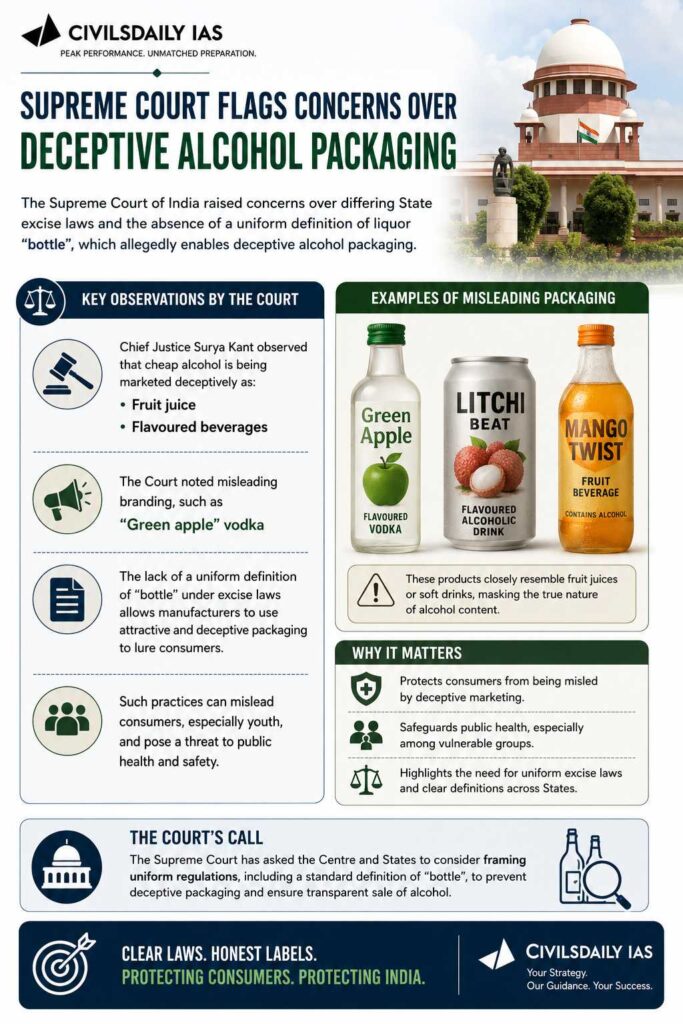
The Supreme Court of India raised concerns over differing State excise laws and the absence of a uniform definition of liquor “bottle”, which allegedly enables deceptive alcohol packaging.
Key Observations by the Court
Chief Justice Surya Kant observed that cheap alcohol is being marketed deceptively as:
Fruit juice
Flavoured beverages
The Court noted misleading branding, such as“Green apple” vodka
Issue Raised in the Petition
The petition was filed by: Community Against Drunken Driving
Main Concerns
No uniform definition of “bottle” across States.
Some State excise laws even include:
Sacks
Wrappers
Cartons
Risks Highlighted
The petition argued that such packaging:
Encourages underage drinking
Promotes public consumption
Increases smuggling risks
Encourages drinking while travelling
Creates environmental hazards
Public Health Concerns
Attractive colourful packaging resembles fruit drinks.
Health warnings are often not prominently displayed.
Alcohol companies allegedly use deceptive marketing to expand consumption.
Court Action
The Supreme Court issued notice to:
Central Government
All State Governmentsare
seeking responses on the issue.
Constitutional and Governance Aspect
Alcohol regulation falls under the State List in the Seventh Schedule of the Constitution.
States have power to frame excise laws and regulate liquor sale and taxation.
[2024] Which one of the following statements is correct as per the Constitution of India?
(a) Inter-State trade and commerce is a State subject under the State List.
(b) Inter-State migration is a State subject under the State List.
(c) Inter-State quarantine is a Union subject under the Union List.
(d) Corporation tax is a State subject under the State List
The Union Ministry of Environment, Forest and Climate Change has notified the Solid Waste Management (SWM) Rules, 2026, superseding the Solid Waste Management Rules, 2016. The rules have been notified under the Environment (Protection) Act, 1986.
What are the major changes introduced under the SWM Rules, 2026?
Mandatory Waste Segregation: Makes 4-way segregation at source compulsory, wet waste, dry waste, sanitary waste, and special-care waste.
‘Polluter Pays’ Principle: Allows environmental compensation/penalties for non-compliance, false reporting, forged documents, or poor waste management practices.
Extended Responsibility for Bulk Generators: Introduces Extended Bulk Waste Generator Responsibility (EBWGR); entities generating 100 kg/day waste, 20,000 sq. m area, or 40,000 litres/day water use must process waste responsibly.
Scientific Waste Processing: Promotes composting, bio-methanation, recycling through Material Recovery Facilities (MRFs), and waste-to-energy systems.
Centralised Online Portal: Enables end-to-end digital tracking of waste generation, collection, transport, processing, landfill audits, and legacy waste remediation.
Restrictions on Landfills: Limits landfilling to non-recyclable, inert, and non-energy recoverable waste, while discouraging unsegregated dumping through higher landfill fees.
Legacy Waste Remediation: Mandates mapping, biomining, and bioremediation of old dumpsites with time-bound implementation.
Mandatory Use of RDF: Requires industries, including cement plants, to gradually increase Refuse Derived Fuel (RDF) use from 5% to 15% over six years.
Special Rules for Hilly Areas & Islands: Enables tourist user fees, decentralised wet waste processing by hotels/restaurants, and waste regulation based on local carrying capacity.
Institutional Oversight: Creates Central and State-level Committees, with Chief Secretaries-led State Committees for implementation monitoring.
Why has India’s waste crisis become a major governance challenge?
Urban Waste Burden: Indian cities face plastic-clogged drains, worsening monsoon flooding and sanitation stress.
Landfill Hazard: Landfills increasingly generate methane, fire incidents, and leachate contamination, creating ecological and health risks.
Air Pollution:Open burning of waste contributes to deteriorating urban air quality.
Rural Waste Expansion: Rural areas increasingly face plastic waste, sanitary waste, pesticide containers, e-waste, and packaged consumption debris.
Ecological Emergency: Waste has evolved from a local nuisance to a national environmental problem, requiring systemic intervention.
How do the Solid Waste Management Rules, 2026 differ from the 2016 framework?
The Solid Waste Management (SWM) Rules, 2026, supersede the 2016 framework, shifting India from a “collect-and-dump” model to a structured circular economy focused on resource recovery. While the 2016 rules laid the foundation, the 2026 update introduces stricter enforcement, digital tracking, and expanded responsibilities.
Dimension
SWM Rules, 2016
SWM Rules, 2026
Waste segregation
Mandated 3-stream segregation: bio-degradable, non-biodegradable, and domestic hazardous waste.
Introduces mandatory 4-stream segregation: wet waste, dry waste, sanitary waste, and special-care waste, enabling more scientific processing and recycling.
Accountability & Enforcement
Limited practical enforcement and weak penalty mechanisms.
Introduces Environmental Compensation under the ‘Polluter Pays’ Principle’, with penalties for improper segregation, false reporting, forged documents, and non-compliance.
Bulk Waste Generators (BWGs)
Broad responsibility framework without clear operational thresholds.
Defines BWGs through quantified thresholds(≥100 kg/day waste generation, ≥20,000 sq. m built-up area, or ≥40,000 litres/day water use) and introduces Extended Bulk Waste Generator Responsibility (EBWGR) for on-site processing or certification.
Monitoring Mechanism
Relied largely on manual and fragmented reporting systems.
Establishes a centralised online portal for end-to-end tracking of waste generation, collection, transport, processing, disposal, audits, and legacy waste remediation.
Industrial Waste Use (RDF)
Limited emphasis on industrial fuel substitution.
Mandates gradual adoption of Refuse Derived Fuel (RDF) in industries such as cement plants, increasing substitution from 5% to 15% over six years.
Legacy Waste Dumpsites
Recognised legacy waste but lacked strict timelines.
Mandates time-bound biomining and bioremediation of legacy dumpsites, with quarterly progress reporting through the digital portal.
Does the 2026 framework undermine federalism and subsidiarity?
Constitutional Basis: The Rules derive authority from the Environment (Protection) Act, 1986, enacted under Article 253, allowing Parliament to implement international obligations such as the 1972 Stockholm Declaration.
Federal Concern: Subjects such as land, sanitation, public health, agriculture, and local governance largely fall within State or local domains.
National Floor Principle: A minimum national standard should not become a uniform operational blueprint for all States.
Subsidiarity Principle: Governance should function at the lowest competent level, moving upward only when capacity is absent.
Administrative Overreach: The Rules assume central competence and local incapacity, reducing States to implementing agencies.
Hayekian Insight: Nobel Laureate F.A. Hayek highlighted that effective decisions depend on local and contextual knowledge, not distant administrative command.
Why may a uniform waste management model fail across India?
Geographical Diversity: Waste systems suitable for resource-rich metros like Mumbai may fail in Himalayan pilgrimage towns, fragile slopes, coastal panchayats, tribal settlements, and low-density villages.
Rural Institutional Deficit: Rural local bodies often lack sanitation engineers, waste collection systems, digital capacity, and fiscal resources.
MRF Expansion Challenge: Extending Material Recovery Facilities (MRFs) to every panchayat risks creating an administratively unsustainable model.
Compliance Burden: Excessive reporting requirements may shift focus from service delivery to paperwork.
Megacity Exception: Cities like Delhi, Mumbai, Bengaluru, Kolkata, Chennai may require metropolitan-level integrated waste authorities.
How does centralised digital governance create implementation concerns?
Portal-Centric Governance: The Rules require Central Pollution Control Board (CPCB)-linked data uploads, audits, and central reporting modules.
Dashboard Governance: Officials risk spending excessive time on compliance reporting rather than actual waste management outcomes.
Blurring Accountability: Excessive centralisation may weaken local ownership and citizen accountability.
Data Federalism: States should possess shared digital platforms with flexibility to customise indicators and dashboards.
Capacity Building: Data systems should strengthen sub-national governance capacity, not merely discipline compliance.
Why is democratic participation central to effective waste management?
Citizen Engagement: Waste segregation depends on household participation, awareness, and behavioural change.
Community Institutions:Ward committees, municipal councils, self-help groups, and resident bodies strengthen compliance.
Local Reporting: Periodic waste reports should be placed before municipal councils and ward committees, not only central portals.
By treating waste as a local resource rather than a national liability, an alternative framework shifts the focus from “disposal” to “decentralised circularity.”
The Proposed “Polycentric Circularity” Model
Component
Strategic Implementation
Differentiated Governance
Megacities use tech-heavy AI-monitored collection, while Rural Panchayats use “Zero-Waste Village” models focusing on 100% on-site composting.
State-Led Innovation
States could compete on “Resource Recovery Indexes.” For example, a coastal state might pilot ocean-plastic specific rules that wouldn’t apply to a landlocked state.
Micro-Entrepreneurship
Integrating Women’s Cooperatives (like the Swachh model in Pune) turns waste into a livelihood. SHGs manage ward-level dry waste collection centers, reducing transport costs.
Cluster-Based Sharing
Towns within a 30-40km radius share a single high-tech Material Recovery Facility (MRF) or Bio-methanation plant, making advanced technology financially viable for small municipalities.
Minimum Standards: The Centre should establish minimum national environmental norms.
State Flexibility: States should receive autonomy to design context-sensitive waste systems.
Differentiated Governance:Metropolitan authorities may govern megacities, while simplified systems may suit rural regions.
Cluster-Based Facilities: Small towns can adopt shared regional waste infrastructure.
Women’s Cooperatives: Waste management can integrate self-help groups and community-based models.
Evidence-Based Review: A national body may periodically evaluate outcomes and revise standards based on evidence.
Laboratory of Democracy:Justice Louis Brandeis’ idea (New State Ice Co. v. Liebmann, 1932) theorises that States function as “laboratories of democracy”, enabling policy experimentation.
Conclusion
India’s waste crisis requires a federal, differentiated, and participatory governance model rather than a uniform compliance architecture. The Solid Waste Management Rules, 2026 can strengthen environmental outcomes. But this can be done only if they balance minimum national standards with State flexibility, local accountability, fiscal support, and citizen participation. Effective waste management depends not merely on regulation, but on institutional design aligned with India’s diversity.
PYQ Relevance
[UPSC 2018] What are the impediments in disposing the huge quantities of discarded solid wastes which are continuously being generated? How do we remove safely the toxic wastes that have been accumulating in our habitable environment?
Linkage: The PYQ directly connects with the article’s focus on scientific waste management, segregation, landfill reduction, and safe disposal of hazardous/special-care waste under the SWM Rules, 2026. It also reflects UPSC’s emphasis on environmental governance, waste-processing mechanisms, and mitigation measures for pollution.
According to the Department of Administrative Reforms and Public Grievances (DARPG), the Department of Financial Services’ Insurance Division topped the Grievance Redressal Assessment and Index (GRAI) rankings in the Group A category for March 2026.
About Grievance Redressal Assessment and Index (GRAI)
The Grievance Redressal Assessment and Index (GRAI) is an evaluation framework developed by Department of Administrative Reformsand Public Grievances to assess the performance of Ministries and Departments in handling public grievances.
The first edition, GRAI 2022, was released on 21 June 2023.
Objective
To measure the effectiveness and efficiency of grievance redressal mechanisms.
To improve accountability and citizen-centric governance.
To evaluate how quickly and effectively ministries resolve grievances through the CPGRAMS platform.
Four Major Dimensions
Efficiency
Feedback
Domain
Organisational Commitment
These dimensions are measured using 11 indicators.
Significance of GRAI
Encourages timely disposal of grievances.
Promotes transparency in administration.
Improves public service delivery.
Creates competition among departments for better governance standards.
Strengthens citizen trust in government institutions.
Centralized Public Grievance Redress and Monitoring System (CPGRAMS)
CPGRAMS is an online grievance redressal platform that allows citizens to lodge complaints regarding public service delivery.
It is Available 24×7
A single integrated portal linked with Central Ministries, Departments, and States
Developed and monitored by: Department of Administrative Reforms and Public Grievances under the Ministry of Personnel, Public Grievances and Pensions.
[2021] With reference to the Union Government, consider the following statements: 1. N. Gopalaswamy Iyengar Committee suggested that a minister and a secretary be designated solely for pursuing the subject of administrative reform and promoting it. 2. In 1970, the Department of Personnel was constituted on the recommendation of the Administrative Reforms Commission, 1966, and this was placed under the Prime Minister’s charge. Which of the statements given above is/are correct? [A] 1 only [B] 2 only [C] Both 1 and 2 [D] Neither 1 nor 2
The Government of India has launched the Swasth Bharat Portal, a unified digital platform aimed at integrating fragmented health programme systems across the country.
About Swasth Bharat Portal
A single integrated digital health platform
Designed to connect multiple health programme systems through:
API based interoperability
What are Application Programming Interfaces (APIs)?
Instead of building unique, complex connections between every single system, APIs act as “universal translators” or bridges, allowing disparate tools to work together seamlessly without requiring deep knowledge of each other’s internal code
Main Objectives
Eliminate duplicate data entry
Streamline reporting systems
Improve evidence based planning
Support faster decision making in health programmes
Key Features
Unified Health Platform: Acts as a one stop aggregator for health programmes
Interoperability
Uses federated architecture and APIs
Enables seamless exchange of health data
Data VisualisationProvides tools for monitoring and local level planning
[2022] With reference to Ayushman Bharat Digital Mission, consider the following statements: 1. Private and public hospitals must adopt it. 2. As it aims to achieve universal health coverage, every citizen of India should be part of it ultimately. 3. It has seamless portability across the country. Which of the statements given above is/are correct? [A] 1 and 2 only [B] 3 only [C] 1 and 3 only [D] 1, 2 and 3
According to the latest report of the National Crime Records Bureau (NCRB), India recorded nearly 1.99 lakh traffic related deaths in 2024, with speeding emerging as the leading cause of fatalities.
Key Findings of the NCRB Report
Traffic Accident Deaths
Average deaths per day: 546
Total traffic related deaths in 2024: 1.99 lakh
Share of Road Accidents: Around 88% of traffic deaths were due to road accidents
States with Highest Fatalities
Uttar Pradesh
Tamil Nadu
Maharashtra
About NCRB
National Crime Records Bureau
Established in: 1986
Nodal Ministry: Ministry of Home Affairs
Compiles and analyses crime and accident statistics in India
Government Initiatives for Road Safety
Motor Vehicles Amendment Act, 2019
National Road Safety Policy
Black Spot Identification Programme
[2022] In India, which one of the following compiles information on industrial disputes, closures, retrenchments and lay-offs in factories employing workers? (a) Central Statistics Office (b) Department for Promotion of Industry and Internal Trade (c) Labour Bureau (d) National Technical Manpower Information System
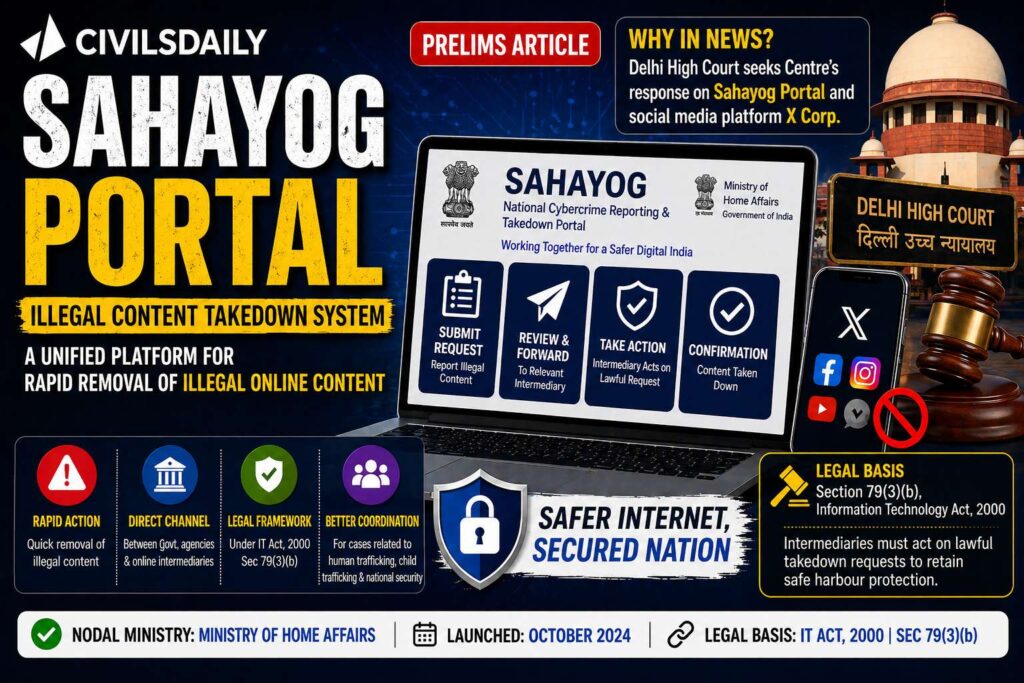
The Delhi High Court has asked the Union government to clarify whether social media platform X Corp. must participate in the Sahayog Portal for cases related to human trafficking, child trafficking, and national security.
About Sahayog Portal
Launched in October 2024
An online platform to enable rapid removal of illegal content from the internet
Facilitates direct communication between government agencies and online intermediaries
Nodal Ministry: Ministry of Home Affairs
Legal Basis
Operates under Section 79(3)(b) of the Information Technology Act, 2000
Ensures intermediaries act on lawful takedown requests
Maintains safe harbour protection if due diligence is followed
[2017] In India, it is legally mandatory for which of the following to report on cyber security incidents? 1 Service providers 2 Data Centres 3 Body corporate Select the correct answer using the code given below: (a) 1 only (b) 2 only (c) 1 and 2 only (d) 1, 2 and 3