💥Mains Ready By December. Smash Mains & Smash PYQ Admissions Open

GS Paper: Government Scheme/Policies

  • The job puzzle

    Context

    The government has assured the creation of one million jobs over the next one-and-a-half years. This may be optimistic, but if it does materialise, the employment landscape will change dramatically.

    Background

    • What is the unemployment rate? Expressed in percentage, the unemployment rate is defined as the share of people who are without any job.
    • Joblessness in the country essentially relates to educated young adults seeking jobs in the formal economy.
    • The government recently announced it would recruit 10 lakh people in “mission mode” over the next one-and-a-half years.
    • The announcement came at a time when the unemployment rate for youth (aged 15-29 years) in urban areas has been hovering at over 20 per cent for the last several quarters.

    What is the employment situation in India today?

    • If jobs are being created on a progressive basis, there will be an increase in income generation, which in turn, should spur consumption.
    • Therefore, if consumption picks up – this can be indicated by the growth in the consumer goods segments — then one can be confident of jobs being created.
    • What is the situation in India? Consumer durable goods have been registering negative or slightly positive growth for the last five years or so — this is a reflection of the purchasing power of the people that ultimately can be linked to job creation.
    • There have been talks of start-up economy in the country and their achievements.
    • Interestingly, it is a well-known fact that, globally, 80-85 per cent of start-ups fold up in the first couple of years mainly due to non-viable models that fail the scaling-up challenge.
    • Therefore, while start-ups sound exciting, job creation at scale cannot be part of these experiments, unless there is an assured flow of funds.

    Challenge in recruiting 10 lakh people

    • It will be a really big task given that presently the central government offices house around 3.45 million personnel as per the budget for 2022-23.
    • Short time frame: The first challenge is in recruiting such a large number in this short period of time considering that there are fairly lengthy processes involved in hiring people to government departments.
    • Finding meaningful role: Hiring such a number is good for the country, but finding meaningful roles for them in various departments needs to be seriously examined.
    • Quite clearly, plans need to be in place to provide work to this set of new employees.
    • Increase in cost for the government: The third issue that would have to be kept in mind is the increase in cost for the government.
    • As per the budget for 2022-23, the average outgo per employee was around Rs 12.20 lakh.
    • Assuming the new set earns half of the existing average, the additional cost would be at least Rs 60,000 crore.
    • The salary outlay for the year was Rs 4.22 lakh crore.
    • These provisions would have to be made in subsequent budgets.

    Conclusion

    The overall unemployment picture looks complex today. While the government’s intent to add over a million jobs in the next 18 months is laudable, the task is audacious and challenging from both an administrative and financial point of view.

    UPSC 2023 countdown has begun! Get your personal guidance plan now! (Click here)
  • Extending the Aspirational District Programme (ADP)

    The PM has hoped to extend the Aspirational District Programme (ADP) to block and city levels.

    Aspirational Districts Programme (ADP)

    • Launched in January 2018, the ‘Transformation of Aspirational Districts’ initiative aims to remove this heterogeneity through a mass movement to quickly and effectively transform these districts.
    • The broad contours of the program are Convergence (of Central & State Schemes), Collaboration (of Central, State level ‘Prabhari’ Officers & District Collectors), and Competition among districts driven by a spirit of mass Movement.
    • With States as the main drivers, this program will focus on the strength of each district, identify low-hanging fruits for immediate improvement, measure progress, and rank districts.

    Behind the name

    • PM then negated the idea of naming any scheme based on their backwardness.
    • Rather the name ‘Aspirational’ presents a more affirmative action-based execution of the scheme.

    Selection of districts

    • A total of 117 Aspirational districts have been identified by NITI Aayog based upon composite indicators.
    • The objective of the program is to monitor the real-time progress of aspirational districts based on 49 indicators (81 data points) from the 5 identified thematic areas.

    Weightage has been accorded to these districts as below:

    • Health & Nutrition (30%)
    • Education (30%)
    • Agriculture & Water Resources (20%)
    • Financial Inclusion & Skill Development (10%)
    • Basic Infrastructure (10%)

    Strategy of the ADP

    The core Strategy of the program may be summarized as follows.

    • Making development a mass movement in these districts
    • Identify low hanging fruits and the strength of each district, to act as a catalyst
    • for development.
    • Measure progress and rank districts to spur a sense of competition.
    • Districts shall aspire to become State’s best to Nation’s best.

    Features of the ADP

    • It has transformed into a Jan Andolan.
    • The ADP is different in trying to monitor the improvement of these districts through real-time data tracking.
    • The programme seeks to develop convergence between selected existing central and state government programmes.
    • District performance in the public domain and experience building of the district bureaucracy is another notable feature.
    • The programme is targeted, not towards any single group of beneficiaries, but rather towards the population of the district as a whole.

    What makes this program special?

    The program reflects what has become of the development project in India under neoliberalism, especially after the end of planning.

    • Long overdue sectors have been given more emphasis.
    • It is not a tailor-made program with one-size-fit strategy. More onus has been laid on the districts. It has a district-intervention strategy.
    • It works on the principle of SWOT (strength, weakness, opportunity and threats) model and comparison with national best parameters for effective resource management.
    • It is the most reviewed programme by the Prime Minister.
    • A general idea behind the idea is that a good work never goes un-noticed. It is duly appreciated on social media as well as by the officials.

    Programmatic Strengths

    • A key strength of the ADP is the collection of baseline data and follow-ups at regular intervals.
    • Sustaining this effort would create a robust compilation of statistics for use by both researchers and policy-makers.
    • In doing this, the government also brings much-needed attention to human development and a willingness to meet the Sustainable Development Goals (SDGs).
    • Incremental progress being made in the chosen districts as reflected in the rankings.
    • The programme also claims to be “non-partisan and unbiased” and geared towards all-India growth.
    • The selection of districts indeed suggests that the programme has not favored any bias either regional, political or any other.
    • The programme seeks convergence of central and state schemes anchored around specific activities.

    Issues with the programme

    • Using the case of Bihar, they argue that the programmes selection of districts itself is problematic.
    • In fact, it actually excludes the most backward districts because per capita income, the most basic measure of development, has not been considered.
    • There seems to be some ambiguity around the issue of whether the programme is concerned only with improved access or also with the quality of service provided.
    • The indicators used are not defined relationally, rather they are static human development indicators that do not see people mired in dynamic social relations.
    • It is also accused that the state is not making any new or focused public investment (except for possible use of Flexi-funds) into these districts, on the other hand, it is moralizing about their inability to improve (through rankings).
    • The programme is carrying the burden of proving the government’s “developmental” work without addressing any of the fundamental issues around achieving equitable development.
    • Yet, the NITI Aayog justifies the overall approach as capitalizing on “low-hanging fruit.”

    Way forward

    • The program has been able to make difference in the lives of citizens of India, in education, health, nutrition, financial inclusion, skill development and this has made a difference to some most backward and most geographically far-flung districts of the nation.
    • ADP is ‘aligned to the principle of “leave no one behind—the vital core of the SDGs. Political commitment at the highest level has resulted in the rapid success of the program the report said.
    • UNDP has recommended revising a few indicators that are slightly close to reaching their saturation or met by most districts like ‘electrification of households’ as an indicator of basic infrastructure.


    UPSC 2023 countdown has begun! Get your personal guidance plan now! (Click here)

  • Nanhi Pari Programme

    The ‘Nanhi Pari’ programme was recently launched by the Northwest Delhi district administration.

    Nanhi Pari Programme

    • Nanhi Pari programme aims to provide a one-stop solution to parents, eliminating their need to visit various offices to obtain documents.
    • Under the programme, essential services such as the provision of a birth certificate, Aadhaar card registration and opening a bank account for girls are completed and delivered in government hospitals in the district before the mother and baby are discharged.
    • The programme will help in getting registration of baby girls and mothers under various schemes such as the Sukanya Samriddhi Account scheme, the Ladli scheme and Pradhan Mantri Matru Vandana Yojana at the hospital itself.

    Significance of the Programme

    • The programme makes the processes for schemes as simple as possible for all children and mothers.
    • Parents would not have to go from here to there, trying to avail themselves of the essential schemes.
    • Apart from ensuring that schemes reach target beneficiaries and protecting the interests of girl children, the programme also aims to promote institutional deliveries.


    UPSC 2023 countdown has begun! Get your personal guidance plan now! (Click here)

  • Questioning the Safety of Aadhaar

    Two days after issuing an advisory asking people to refrain from sharing photocopies of their Aadhaar Card, the Unique Identification Development Authority of India (UIDAI) opted to withdraw the notification.

    UIDAI Advisory

    • The withdrawn notice had suggested holders use a masked Aadhaar card instead of the conventional photocopy.
    • It added that the document must not be downloaded from a cybercafe or public computer and if done for some reason, must be permanently deleted from the system.
    • Private entities like hotels or film halls cannot collect or keep copies of the identification document.

    What is Masked Aadhaar?

    • ‘Masked Aadhaar’ veils the first eight digits of the twelve-digit ID with ‘XXXX’ characters.
    • The notice informed that only entities possessing a ‘User Licence’ are permitted to seek Aadhaar for authentication purposes.

    Why in news now?

    • In July 2018, Telecom Regulatory of India’s Chairman tweeted his Aadhaar number challenging users to “cause him any harm”.
    • In response, users dug up his mobile number, PAN number, photographs, residential address and date of birth.
    • UIDAI dismissed assertions of any data leak, arguing that most of the data was publicly available.
    • It did however caution users from publicly sharing their Aadhaar numbers.

    Security of Aadhaar: What does the law say?

    • The Aadhaar (Targeted Delivery of Financial and Other Subsidies Benefits and Services) Act, 2016 makes it clear.
    • Aadhaar authentication is necessary for availing subsidies, benefits and services that are financed from the Consolidated Fund of India.
    • In the absence of Aadhaar, the individual is to be offered an alternate and viable means of identification to ensure she/he is not deprived of the same.
    • Separately, Aadhaar has been described as a preferred KYC (Know Your Customer) document but not mandatory for opening bank accounts, acquiring a new SIM or school admissions.
    • The requesting entity would have to obtain the consent of the individual before collecting his/her identity.
    • The entity must ensure that the information is only used for authentication purposes on the Central Identities Data Repository (CIDR).

    What is CIDR?

    • This centralised database contains all Aadhaar numbers and holder’s corresponding demographic and biometric information.
    • UIDAI responds to authentication queries with a ‘Yes’ or ‘No’.
    • In some cases, basic KYC details (as name, address, photograph etc.) accompany the verification answer ‘Yes’.
    • The regulator does not receive or collect the holder’s bank, investment or insurance details.

    Protection of confidentiality

    • The Act makes it clear that confidentiality needs to be maintained and the authenticated information cannot be used for anything other than the specified purpose.
    • More importantly, no Aadhaar number (or enclosed personal information) collected from the holder can be published, displayed or posted publicly.
    • Identity information or authentication records would only be liable to be produced pursuant to an order of the High Court or Supreme Court, or by someone of the Secretary rank or above in the interest of national security.

    Is identity theft via Aadhaar possible?

    • As per the National Payment Corporation of India’s (NCPI) data, ₹6.48 crore worth of financial frauds through 8,739 transactions involving 2,391 unique users took place in FY 2021-22.
    • Since the inception of the UID project, institutions and organisations have endowed greater focus on linking their databases with Aadhaar numbers.
    • This include bank accounts especially in light of the compulsory linkage for direct benefit transfer schemes.

    Structural problems with UIDAI

    • The Aadhaar Data Vault is where all numbers collected by authentication agencies are centrally stored.
    • Comptroller and Auditor General of India’s (CAG) latest report stipulated that UIDAI has not specified any encryption algorithm (as of October 2020) to secure the same.
    • There is no mechanism to illustrate that the entities were adhering to appropriate procedures.
    • Further, UIDAI’s unstable record with biometric authentication has not helped it with de-duplication efforts, the process that ensures that each Aadhaar Number generated is unique.
    • The CAG’s reported stated that apart from the issue of multiple Aadhaars to the same resident, there have been instances of the same biometric data being accorded to multiple residents.

    Conclusion

    • The CAG concluded it was “not effective enough” in detecting the leakages and plugging them.
    • Biometric authentications can be a cause of worry, especially for disabled and senior citizens with both the iris and fingerprints dilapidating.
    • Though the UIDAI has assured that no one would be deprived of any benefits due to biometric authentication failures.
    • The absence of an efficient technology could serve as poignant premise for frauds to make use of their ‘databases’.

    Try this PYQ:

    Q.Consider the following statements:

    1. Aadhaar metadata cannot be stored for more than three months.
    2. State cannot enter into any contract with private corporations for sharing of Aadhaar data.
    3. Aadhaar is mandatory for obtaining insurance products.
    4. Aadhaar is mandatory for getting benefits funded out of the Consolidated Fund of India.

    Which of the statements given above is/are correct?

    (a) 1 and 4 only

    (b) 2 and 4 only

    (c) 3 only

    (d) 1, 2 and 3 only


    [wpdiscuz-feedback id=”m9l8xajnd2″ question=”Please leave a feedback on this” opened=”1″]Post your answers here.[/wpdiscuz-feedback]


    UPSC 2023 countdown has begun! Get your personal guidance plan now! (Click here)

  • Delimitation fallouts

    Context

    Four years from now, when the delimitation of the constituencies will take place, India’s electoral democracy will stand on an existential crossroads.

    Historical background of North-South tension

    • There was a time, not all that long ago, when English speakers in the south of India routinely referred to our north as ‘Upper India’.
    • The Imperial Legislative Council, with its Central Legislative Assembly as the Lower House and the Council of State as the Upper House, being located in Delhi pushed that upperness further up.
    •  Later, the Constituent Assembly continued the ‘India’s north as India’s peak’ image.
    • Role of Congress: The Indian National Congress was from the very start, aware of the need for India’s regions to be seen as equal, bereft of any asymmetry.
    • Its very third session after Bombay (1885) and Calcutta (1886) was held in Madras (1887, and many times later).
    • The All India Kisan Sabha, the peasant wing of the Communist Party of India, likewise, which had first met in a ‘founder-conference’ in Lucknow in 1936, met at its fifth session in 1940 in Palasa, Srikakulam.
    • These considered arrangements embody the opening Article 1 of our Constitution: India, that is Bharat.

    What would be the Impact of delimitation

    • A delimitation of the constituencies that will elect Members of the Lok Sabha, following the population figures returned by the next decennial Census, is to take place in 2026.
    • Need to increase number of members: We cannot have, should not have, the same number of Members of Parliament — 543 — representing a vastly increased population in the Lok Sabha.
    • Mathematically speaking, the higher the number of people per constituency, the lower the impact each voter has on parliamentary representation — clearly an undesirable situation.
    • Reduced representation to States that stabilised their population: Re-arranging and standardising the number of people per constituency through the scheduled delimitation exercise will inevitably lead to a reduced representation for States that have managed to stabilise their populations, and to a higher representation for States that have not stabilised their populations.
    • Considering the Census data for 2011, almost half (48.6%) of our population (of approximately 1.38 billion) is contributed by the States of Uttar Pradesh, Maharashtra, Bihar, West Bengal and Madhya Pradesh.
    • Issues with population-based marking: A population-based marking out or re-arrangement of constituencies, as envisaged in Article 82 of the Constitution, will have the effect of giving more MPs to the States and Union Territories that have let their numbers grow, and will give markedly less MPs to those that have held their numbers in some check.
    • Realising the anomaly that a delimitation based on Census data would cause, a delimitation freeze was put in position by Prime Minister Indira Gandhi through the 42nd Amendment of the Constitution in 1976. 
    •  This was extended by Prime Minister Atal Bihari Vajpayee through the 84th Amendment.
    • It is this extension that is to end in 2026, placing us at a crossroads.

    Way forward

    • There are two alternatives before us:
    • 1] Onother freeze: One, we go in for another freeze, this time not for any specific period but for until all States have achieved population stabilisation.
    • 2] Mathematically equitable formula: Two, we request demographic and statistical experts to devise a mathematical model along the lines of the ‘Cambridge Compromise’ based on a mathematically equitable “formula” for the apportionment of the seats of the European Parliament between the member-states.

    Conclusion

    The population-stabilising States of India that is Bharat, which include all the southern States, must continue to enrich our legislative and parliamentary processes as they have been doing since the time of the Imperial Legislative Council, with no penalties having to be paid for their sense of responsibility. We need to limit population, not representation.

    UPSC 2023 countdown has begun! Get your personal guidance plan now! (Click here)

  • Union Finance Ministry revises MPLADS Rules

    At a time when MPs have been asking for an increase in the MP Local Area Development Scheme (MPLADS) fund, the Union Finance Ministry has ordered revised rules, under which the interest that the fund accrues will be deposited in the Consolidated Fund of India.

    What is the MPLAD scheme?

    • The Members of Parliament Local Area Development Scheme (MPLADS) is a program first launched during the Narasimha Rao Government in 1993.
    • It was aimed towards providing funds for developmental works recommended by individual MPs.

    Funds available

    • The MPs then were entitled to recommend works to the tune of Rs 1 crore annually between 1994-95 and 1997-98, after which the annual entitlement was enhanced to Rs 2 crore.
    • The UPA government in 2011-12 raised the annual entitlement to Rs 5 crore per MP.

    Implementation

    • To implement their plans in an area, MPs have to recommend them to the District Authority of the respective Nodal District.
    • The District Authorities then identify Implementing Agencies that execute the projects.
    • The respective District Authority is supposed to oversee the implementation and has to submit monthly reports, audit reports, and work completion reports to the Nodal District Authority.
    • The MPLADS funds can be merged with other schemes such as MGNREGA and Khelo India.

    Guidelines for MPLADS implementation

    • The document ‘Guidelines on MPLADS’ was published by the Ministry of Statistics and Programme Implementation in June 2016 in this regard.
    • It stated the objective of the scheme to enable MPs to recommend works of developmental nature with emphasis on the creation of durable community assets based on the locally felt needs in their Constituencies.
    • Right from the inception of the Scheme, durable assets of national priorities viz. drinking water, primary education, public health, sanitation, and roads, etc. should be created.
    • It recommended MPs to works costing at least 15 percent of their entitlement for the year for areas inhabited by Scheduled Caste population and 7.5 percent for areas inhabited by ST population.
    • It lays down a number of development works including construction of railway halt stations, providing financial assistance to recognized bodies, cooperative societies, installing CCTV cameras etc.

    Answer this PYQ in the comment box:

    With reference to the funds under the Members of Parliament Local Area Development Scheme (MPLADS), which of the following statements are correct? (CSP 2020)

    1. MPLADS funds must be used to create durable assets like physical infrastructure for health, education, etc.
    2. A specified portion of each MP’s fund must benefit SC/ST populations.
    3. MPLADS funds are sanctioned on a yearly basis and the unused funds cannot be carried forward to the next year.
    4. The district authority must inspect at least 10% of all works under implementation every year.

    Select the correct answer using the code given below:

    (a) 1 and 2 only

    (b) 3 and 4 only

    (c) 1, 2 and 3 only

    (d) 1, 2 and 4 only


    [wpdiscuz-feedback id=”8vgi4pxuwk” question=”Please leave a feedback on this” opened=”1″]Post your answers here.[/wpdiscuz-feedback]


    UPSC 2023 countdown has begun! Get your personal guidance plan now! (Click here)

  • Extreme Poverty down in India

    Context

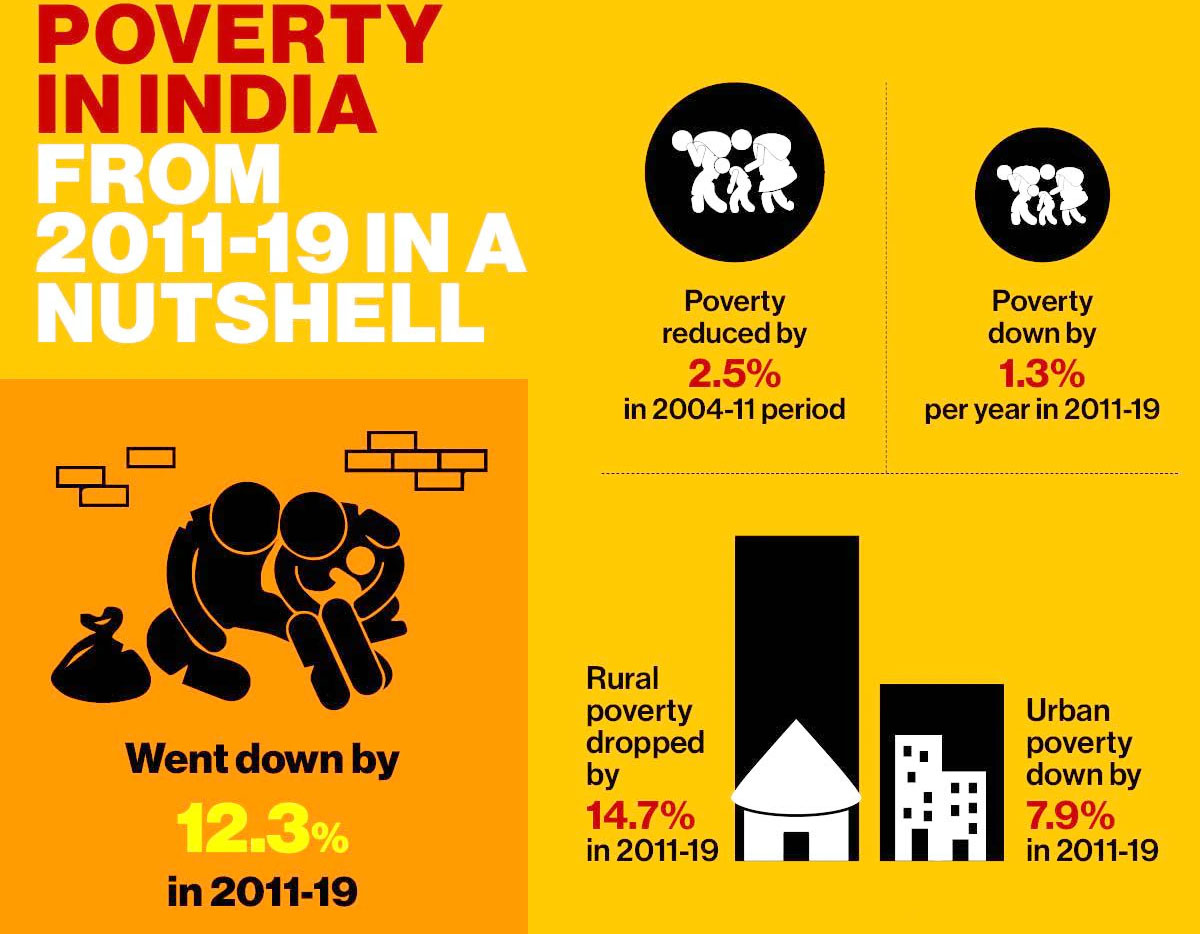
    A recent World Bank Report has shown that extreme poverty in India more than halved between 2011 and 2019 – from 22.5 per cent to 10.2 per cent.  The reduction was higher in rural areas, from 26.3 per cent to 11.6 per cent.

    What explains the reduction in poverty?

    • Poverty has reduced significantly because of the government’s thrust on improving the ease of living of ordinary Indians through schemes.
    • These schemes include the Ujjwala Yojana, PM Awas Yojana, Swachh Bharat Mission, Jan Dhan and Mission Indradhanush in addition to the Deendayal Antyodaya Yojana-National Rural Livelihood Mission and improved coverage under the National Food Security Act.
    • It is important to understand how poverty in rural areas was reduced at a faster pace.
    • Much of the success can be credited to all government departments, especially their janbhagidari-based thrust on pro-poor public welfare.

    Contributing factors

    1] Identification of beneficiaries through SECC 2011

    • The identification of deprived households on the basis of the Socioeconomic and Caste Census (SECC) 2011 across welfare programmes helped in creating a constituency for the well-being of the poor, irrespective of caste, creed or religion.
    • Deprivation criterion: Since deprivation was the key criterion in identifying beneficiaries, SC and ST communities got higher coverage and the erstwhile backward regions in Bihar, Madhya Pradesh, Rajasthan, Uttar Pradesh, Jharkhand, Odisha, Chhattisgarh, Assam, Rajasthan and rural Maharashtra got a larger share of the benefits.
    • Gram Sabha Validation: Social groups that often used to be left out of government programmes were included and gram sabha validation was taken to ensure that the project reached these groups.

    2] Widened coverage of women

    • The coverage of women under the Deendayal Antyodaya Yojana and Self Help Groups (SHG) increased from 2.5 crore in 2014 to over 8 crore in 2018 as a result of more than 75 lakh SHGs working closely with over 31 lakh elected panchayati raj representatives, 40 per cent of whom are women.
    • This provided a robust framework to connect with communities and created a social capital that helped every programme.
    • The PRI-SHG partnership catalysed changes that increased the pace of poverty reduction and the use of Aadhaar cleaned up corruption at several levels and ensured that the funds reached those whom it was meant for.

    3] Creation of basic infrastructure

    • Finance Commission transfers were made directly to gram panchayats leading to the creation of basic infrastructure like pucca village roads and drains at a much faster pace in rural areas.
    • The high speed of road construction under the Pradhan Mantri Gram Sadhak Yojana created greater opportunities for employment in nearby larger villages/census towns/kasbas by improving connectivity and enhancing mobility.

    4] Availability of credit through SHGs

    • The social capital of SHGs ensured the availability of credit through banks, micro-finance institutions and MUDRA loans.
    • Livelihood diversification: The NRLM prioritised livelihood diversification and implemented detailed plans for credit disbursement.

    5]  Implementation of social sector schemes

    • In the two phases of the Gram Swaraj Abhiyan in 2018, benefits such as gas and electricity connections, LED bulbs, accident insurance, life insurance, bank accounts and immunisation were provided to 63974 villages that were selected because of their high SC and ST populations.
    • The performance of line departments went up manifold due to community-led action.
    • The gains are reflected in the findings of the National Family Health Survey V, 2019-2021.

    6] Universal coverage schemes

    • The thrust on universal coverage for individual household latrines, LPG connections and pucca houses for those who lived in kuccha houses ensured that no one was left behind. This created the Labarthi Varg.

    7] Increase in fund transfer to rural area

    • Seventh, this was also a period in which a high amount of public funds were transferred to rural areas, including from the share of states and, in some programmes, through extra-budgetary resources.

    8] Community participation

    • The thrust on a people’s plan campaign, “Sabki Yojana Sabka Vikas” for preparing the Gram Panchayat Development Plans and for ranking villages and panchayats on human development, economic activity and infrastructure, from 2017-18 onwards, laid the foundation for robust community participation involving panchayats and SHGs, especially in ensuring accountability.

    9] Social and concurrent audit

    • Through processes like social and concurrent audits, efforts were made to ensure that resources were fully utilised.
    • Several changes were brought about in programmes like the MGNREGS to create durable and productive assets.

    10] Focus of states on improving livelihood diversification

    • The competition among states to improve performance on rural development helped.
    • Irrespective of the party in power, nearly all states and UTs focussed on improving livelihood diversification in rural areas and on improving infrastructure significantly.

    Conclusion

    All these factors contributed to improved ease of living of deprived households and improving their asset base. A lot has been achieved, much remains to be done.

    UPSC 2023 countdown has begun! Get your personal guidance plan now! (Click here)

  • ‘Mission Antyodaya’ can help transform rural India

    Context

    This article argues that given the right momentum, the ‘Mission Antyodaya’ project bears great promise to eradicate poverty in its multiple dimensions among rural households.

    Background of Mission Antyodaya

    • The ‘Mission Antyodaya’ project was launched by the Government of India in 2017-18.
    • The Ministry of Panchayati Raj and the Ministry of Rural Development act as the nodal agents to take the mission forward.
    • Key goals: The main objective of ‘Mission Antyodaya’ is to ensure optimum use of resources through the convergence of various schemes that address multiple deprivations of poverty, making gram panchayat the hub of a development plan.
    • Annual survey: This planning process is supported by an annual survey that helps to assess the various development gaps at the gram panchayat level, by collecting data regarding the 29 subjects assigned to panchayats by the Eleventh Schedule of the Constitution.
    • Also, data regarding health and nutrition, social security, good governance, water management and so on are also collected.
    • The idea of the Ministry of Panchayati Raj to identify the gaps in basic needs at the local level, and integrating resources of various schemes, self-help groups, voluntary organisations and so on to finance them needs coordination and capacity-building of a high order.
    • If pursued in a genuine manner, this can foster economic development and inter-jurisdictional equity.

    Infrastructural gaps as pointed out by the Mission Antyodaya Survey

    • The ‘Mission Antyodaya’ survey in 2019-20 for the first time collected data that shed light on the infrastructural gaps from 2.67 lakh gram panchayats, comprising 6.48 lakh villages with 1.03 billion population.
    • The maximum score values assigned will add up to 100 and are presented in class intervals of 10.
    • While no State in India falls in the top score bracket of 90 to 100, 1,484 gram panchayats fall in the bottom bracket.
    • Even in the score range of 80 to 90, 10 States and all Union Territories do not appear.
    • The total number of gram panchayats for all the 18 States that have reported adds up only to 260, constituting only 0.10% of the total 2,67,466 gram panchayats in the country.
    •  If we consider a score range of 70-80 as a respectable attainment level, Kerala tops but accounts for only 34.69% of gram panchayats of the State, the corresponding all-India average is as low as 1.09%.
    • The composite index data, a sort of surrogate for human development, are also not encouraging.
    • Although only 15 gram panchayats in the country fall in the bottom range below 10 scores, more than a fifth of gram panchayats in India are below the 40 range.
    • The gap report and the composite index show in unmistakable terms that building ‘economic development and social justice’ remains a distant goal even after 30 years of the decentralisation reforms and nearly 75 years into Independence.

    Way forward

    • Converge resources: Given the ‘saturation approach’ (100% targets on select items) of the Ministry of Panchayati Raj, the possibilities of realising universal primary health care, literacy, drinking water supply and the like are also immense.
    • But there is no serious effort to converge resources (the Mahatma Gandhi National Rural Employment Guarantee Act, the National Rural Livelihood Mission, National Social Assistance Programme, Pradhan Mantri Awas Yojana, etc.) and save administrative expenses.
    • Deploy the data to India’s fiscal federalism: Another lapse is the failure to deploy the data to India’s fiscal federalism, particularly to improve the transfer system and horizontal equity in the delivery of public goods in India at the sub-State level.
    • The constitutional goal of planning and implementing economic development and social justice can be achieved only through strong policy interventions.

    Conclusion

    The policy history of India has been witness to the phenomenon of announcing big projects and failing to take them to their logical consequence. ‘Mission Antyodaya’ is a striking case in recent times.

    UPSC 2023 countdown has begun! Get your personal guidance plan now! (Click here)

  • Anatomy of communal violence in India

    Context

    Communal violence, a complex phenomenon, has been over-simplified to suit a convenient political narrative.

    India’s syncretic traditions and impact of invasions

    • For aeons, India has had syncretic traditions inspired by the Vedic aphorism, “Ekam sad vipra bahudha vadanti” (there is only one truth and learned persons call it by many names).
    •  Because of this underpinning, Indian society has never insisted on uniformity in any facet of life.
    • This equanimity of Indian society was, however, disrupted by invading creeds.
    • The first such incursion came in 712, when Muhammad bin Qasim vanquished Sindh, and as Chach Nama, a contemporary Arab chronicle states, introduced the practice of treating local Hindus as zimmis, forcing them to pay jizya (a poll tax), as a penalty to live by their beliefs.
    • In the 11th century, Mahmud of Ghazni, while receiving the caliphate honours on his accession to the throne, took a vow to wage jihad every year against Indian idolaters.
    • The fact is, ties between the two communities were seldom cordial.
    • There were intermittent skirmishes, wars and occasional short-lived opportunistic alliances.
    • When Pakistan declared itself an Islamic Republic in 1947, it would have been natural for India to identify itself as a Hindu state.
    • It didn’t, and couldn’t have — because of its Hindu ethos of pluralism.
    • India, is, and will always be, catholic, plural, myriad and a vibrant democracy.

    Conclusion

    It’s relevant to recall what Lester Pearson (14th PM of Canada) said: “Misunderstanding arising from ignorance breeds fear, and fear remains the greatest enemy of peace.”

    UPSC 2022 countdown has begun! Get your personal guidance plan now! (Click here)

  • [pib] UDAN Scheme awarded PM Award for Excellence in Public Administration

    The Ministry of Civil Aviation’s flagship Regional Connectivity Scheme UDAN (Ude Desh ka Aam Nagrik) has been awarded Prime Minister’s Award for Excellence in Public Administration this year.

    What is UDAN Scheme?

    • The Ude Desh Ka Aam Nagrik (UDAN) scheme is a low-cost flying scheme launched with the aim of taking flying to the masses.
    • The first flight under UDAN was launched by the PM in April 2017.
    • It is also known as the regional connectivity scheme (RCS) as it seeks to improve air connectivity to tier-2 and tier-3 cities through revival of unused and underused airports.

    Working of the Scheme

    • Airlines are awarded routes under the programme through a bidding process and are required to offer airfares at the rate of ₹2,500 per hour of flight.
    • At least 50% of the total seats on an aircraft have to be offered at cheaper rates.
    • In order to enable airlines to offer affordable fares they are given a subsidy from the govt. for a period of three years.

    Success of the scheme

    • In a short span of 5 years, today 419 UDAN routes connect 67 underserved/unserved airports, including heliports and water aerodromes, and over 92 lakh people have benefited from it.
    • More than 1 lakh 79 thousand flights have flown under this scheme.
    • UDAN scheme has immensely benefitted several sectors pan-India including Hilly States, North-Eastern region, and Islands.
    • The scheme also led to development of new Greenfield Airports such as Pakyong near Gangtok in Sikkim, Tezu in Arunachal Pradesh, and Kurnool in Andhra Pradesh.
    • Krishi UDAN Scheme launched in August 2020, on international and national routes has assisted farmers in transporting agricultural products.

    Issues with the working

    • Discontinuance: In reality, some of the routes launched have been discontinued as most of the routes awarded under UDAN are not active.
    • On-paper Ambitions: UDAN was expanded to provide improved connectivity to hilly regions and islands through helicopters and seaplanes. However, they mostly remain on paper.
    • The reasons include:
    1. Failure to set up airports or heliports due to lack of availability of land
    2. Airlines unable to start flights on routes awarded to them or finding the routes difficult to sustain
    3. Adverse impact of the COVID-19 pandemic

    Various challenges

    • Lack of funds: Many small airlines await infusion of funds, to be able to undertake maintenance of aircraft, pay rentals to lessors, give salaries to its staff, etc.
    • Maintenance issue: Many players don’t have more than one or two planes and they are often poorly maintained. New planes are too expensive for these smaller players.
    • Availability of pilots: Often, they also have problems with the availability of pilots and are forced to hire foreign pilots which costs them a lot of money and makes the business unviable.
    • Competition: Only those routes that have been bagged by bigger domestic players such as IndiGo and SpiceJet have seen a better success rate.

    Way forward

    • The govt offers subsidies for a route for a period of three years and expects the airline to develop the route during this time so that it becomes self-sufficient.
    • Airlines need an extension of the subsidy period for their operational continuity.
    • Due to the rise in COVID cases, travel restrictions and passenger safety too needs to be taken into consideration in the loss-making of such airlines.


    UPSC 2022 countdown has begun! Get your personal guidance plan now! (Click here)