The Bihar Home Department has issued a notification regulating the jurisdiction of the Central Bureau of Investigation (CBI) in the State under Section 6 of the Delhi Special Police Establishment Act, 1946. It widens the agency’s standing general consent over offences involving employees of the Government of India, central Public Sector Undertakings (PSUs) and private persons implicated alongside them. A proviso then removes that automatic authority over public servants appointed in connection with the affairs of the Bihar government and over State-owned, State-controlled and State-aided bodies. The notification supersedes every previous notification on the subject. The result is a two-tier regime. The same agency needs no permission to investigate a central employee in Bihar. It needs case-by-case permission to investigate a State employee.
What is consent under Section 6 of the Delhi Special Police Establishment Act, 1946?
The statute is the CBI’s source of police powers: The CBI cannot ordinarily exercise its powers and jurisdiction inside a State without that State government’s consent.
Two forms of consent: General consent allows the agency to investigate specified offences or categories of cases without seeking permission each time. Specific consent is granted for an individual case.
Consent is tied to a notified offence list: The offences the agency may investigate are notified under Section 3 of the Act, so a State’s general consent operates only over that notified list.
What does the Bihar notification alter on each side of the line?
The offence list under general consent is widened: Consent now covers offences under the Bharatiya Nyaya Sanhita, 2023, the Bharatiya Nagarik Suraksha Sanhita, 2023, the Bharatiya Sakshya Adhiniyam, 2023, the Information Technology Act, 2000, cybercrime, and the Prevention of Corruption Act, 1988 as amended.
Whom the wider consent covers: It applies to employees of the Government of India, employees of PSUs under the Government of India, and private persons implicated alongside them.
The proviso carves out the State’s own establishment: Prior consent of the Bihar government is mandatory for any probe of public servants appointed in connection with the affairs of the State, and of persons in any corporation, company or bank owned by, controlled by, or receiving financial assistance from the State.
The State decides each request individually: On receiving a proposal from the Delhi Special Police Establishment, the State government considers it and takes a decision on granting powers of investigation case by case.
Why is the order read as widening the agency’s reach rather than curbing it?
The two-pronged reading inside the police establishment: The stated reading is that the first part of the order lets the CBI investigate cases that were the State’s prerogative, and the second part balances that by requiring the State’s permission.
It is read as a template for other States: The assessment within the agency is that Bihar may have set a precedent for other States, and that the order gives the CBI more scope rather than less.
The consent bar binds the executive alone: The requirement of State consent applies only to executive action by the CBI. It does not restrict a High Court or the Supreme Court from ordering a CBI investigation within a State without the State government’s consent.
Challenges to the general consent mechanism
Consent is revocable at will and leaves probes suspended: A State can withdraw general consent at any time, and the agency must then seek permission for every fresh case in that State. Eg. West Bengal withdrew its general consent in November 2018 and has required case-by-case permission since. The Fix: Prescribe a statutory period within which a State must decide a case-by-case request, with reasons recorded for a refusal.
The agency has no charter of its own: The CBI rests on a 1946 police establishment law and a 1963 executive resolution, so its very constitution has been litigated. Eg. The Gauhati High Court in Navendra Kumar v. Union of India (2013) held the 1963 resolution constituting the CBI to be invalid, and the Supreme Court stayed that order within days. The Fix: Enact a dedicated CBI statute fixing its composition, its jurisdiction over notified central offences and the limits of State consent.
Corruption probes against State officials face two separate gates: Consent under Section 6 is only the first permission, and a further approval is needed before an inquiry into a public servant’s official decisions can begin. Eg. Section 17A of the Prevention of Corruption Act, 1988, inserted in 2018, requires prior approval of the competent authority before any enquiry into a recommendation made or decision taken by a public servant in discharge of official functions. The Fix: Run both approvals through a single time-bound window, so a refusal at either gate is recorded once and is appealable.
Selective consent invites a political reading of every case: The State controls access to its own officials, so each grant or refusal is readable as a political act rather than a legal one. Eg. The Supreme Court described the agency as a “caged parrot speaking in its master’s voice” in the coal blocks allocation matter in 2013. The Fix: Publish an annual statement of consent requests received, granted, refused and pending, State by State, so the pattern is visible rather than inferred.
Joint cases now straddle two consent regimes: One case involving a central employee and a State public servant is fully open on one accused and permission-dependent on the other, which splits a single investigation. Eg. A corruption case in a centrally funded scheme executed by a State department typically names officials of both. The Fix: Provide that where a case includes even one accused covered by general consent, the State decides on the whole case within a fixed period rather than on each accused separately.
Conclusion
The notification is in force and it supersedes every earlier consent order in the State. It settles nothing about the underlying arrangement, which lets the same agency be widened and fenced by a single executive order that no legislature debated. What is worth watching is whether other States adopt the split model, and whether Bihar attaches any timeline to the permissions it has now reserved to itself. A permission with no deadline is a refusal that never has to be written down.
Back2Basics: Central Bureau of Investigation
Constitution: The CBI was set up by a resolution of the Ministry of Home Affairs in 1963, and it is not a statutory body created by its own Act.
Administrative control: It functions under the Department of Personnel and Training in the Ministry of Personnel, Public Grievances and Pensions.
Superintendence is split: For offences under the Prevention of Corruption Act, 1988, superintendence vests in the Central Vigilance Commission. For all other matters it vests in the Central Government.
Appointment of the Director: The Director is appointed on the recommendation of a committee of the Prime Minister, the Leader of the Opposition in the Lok Sabha and the Chief Justice of India or a Supreme Court judge nominated by the Chief Justice.
Matching Previous Year Question
“The jurisdiction of the Central Bureau of Investigation (CBI) regarding lodging an FIR and conducting probe within a particular State is being questioned by various States. However, the power of the States to withhold consent to the CBI is not absolute. Explain with special reference to the federal character of India.”
The Tamil Nadu Chief Minister has opened the sluice gates of the Mettur Dam, giving some relief to Cauvery Delta farmers after a delayed irrigation season. The Tamil Nadu government has ascribed the delay to a deficit in the southwest monsoon and to Karnataka’s failure to honour its water sharing obligation under the Supreme Court’s 2018 verdict.
What is the Cauvery Management Authority?
What it was set up to do: The Authority was constituted to oversee the implementation of the Supreme Court’s 2018 verdict on the sharing of the Cauvery’s waters.
Its statutory basis: It was created under the Inter-State River Water Disputes Act, 1956, following the Court’s direction that a scheme be framed to give effect to the award.
How it operates: A regulation committee assesses storage, inflows and crop water requirements and advises the Authority, which then directs releases between the basin States.
Where it works: The Authority has functioned during normal monsoon years, when the allocation the verdict fixed can simply be applied.
Why did this year’s Mettur schedule slip?
The normal calendar: In a normal year the dam opens on 12 June and its gates are shut on 28 January, giving the region’s agriculturists a 230 day irrigation window.
The schedule is not self executing: That calendar is contingent on the monsoon and on the release of water in the Cauvery’s upstream by Karnataka.
What went wrong this year: The Tamil Nadu government attributed the delay to the southwest monsoon deficit and to Karnataka not meeting its release obligation.
What the opening actually buys: With the rainfall deficit narrowing in August, the Tamil Nadu government has leeway to release water for 45 days, well short of a full season.
What does the 2018 verdict not settle?
No distress sharing formula: The Court did not codify a formula for water sharing in years when the rains play truant, so a deficit year has no rule to fall back on.
The sustainability direction did not bind: The Court’s emphasis on sustainable water use was lost on the two States, which continued to plan as though the allocation were guaranteed.
The gap shows up on the first bad monsoon: The dispute flared again in 2023, the first below par monsoon after 2018, and the same pattern has repeated this year.
Litigation is the default, not the exception: Tamil Nadu has said it will continue legal efforts to secure its share, which returns the question to a forum that has already declined to write a distress rule.
Why has the Mekedatu proposal deepened the deadlock?
The proposal: Karnataka’s push for the Mekedatu Dam on the river has reignited old fears downstream.
Karnataka’s case: The Karnataka government argues the dam would primarily serve Bengaluru’s water needs while allowing better regulation of releases.
Why it has not landed: That argument has found no takers in Tamil Nadu, where a storage structure upstream reads as an instrument of control rather than of regulation.
The underlying shift: The Cauvery today has to meet the competing demands of agriculture and urbanisation, and the two States sit on opposite sides of that shift.
What would a negotiated settlement have to contain?
A move away from the courtroom: Rather than lean on the judiciary, the Cauvery dependent States would do well to come together and plan for the efficient use of the river’s waters.
Demand side measures: Solutions range from disincentivising water intensive crops to encouraging decentralised water management.
The expertise required: Any such plan will need inputs from hydrologists, economists, agricultural scientists and farmers’ organisations.
The political precondition: Representatives of the two States will need to sit together, understand each other’s fears and shed confrontationist attitudes.
Challenges to the Cauvery Management Authority
No enforcement machinery of its own: The Authority depends on the two State governments to execute its release directions and holds no independent field administration. Eg. Its directions in the deficit year of 2023 were contested by Karnataka and taken back to the Supreme Court. The Fix: Give the Authority operational control over gate operations at specified control points for the duration of a declared distress period.
Storage and inflow data are State reported and contested: Each State submits its own figures on realisable flows, so the Authority arbitrates between rival datasets before it can decide anything. Eg. The two States have filed conflicting inflow estimates for the same periods at Biligundlu, the inter State measuring point. The Fix: Place telemetry at every control point under a jointly audited third party gauge network publishing real time readings.
Groundwater sits outside the allocation: The award divides surface flows alone, so competing extraction continues unregulated on both sides of the border. Eg. The Central Ground Water Board classifies several assessment units in the Cauvery basin as over exploited. The Fix: Notify a joint basin wide extraction cap alongside the surface allocation, so a shortfall in releases is not simply pumped out of the aquifer.
Electoral cycles set State positions: Water release becomes an electoral question in both States, which raises the political cost of any concession to the point where none is offered. Eg. Assembly resolutions and shutdowns in Karnataka have followed release orders in successive dispute years. The Fix: Shift the release decision to a pre agreed rule curve triggered by reservoir storage, so no government has to announce a discretionary concession.
Conclusion
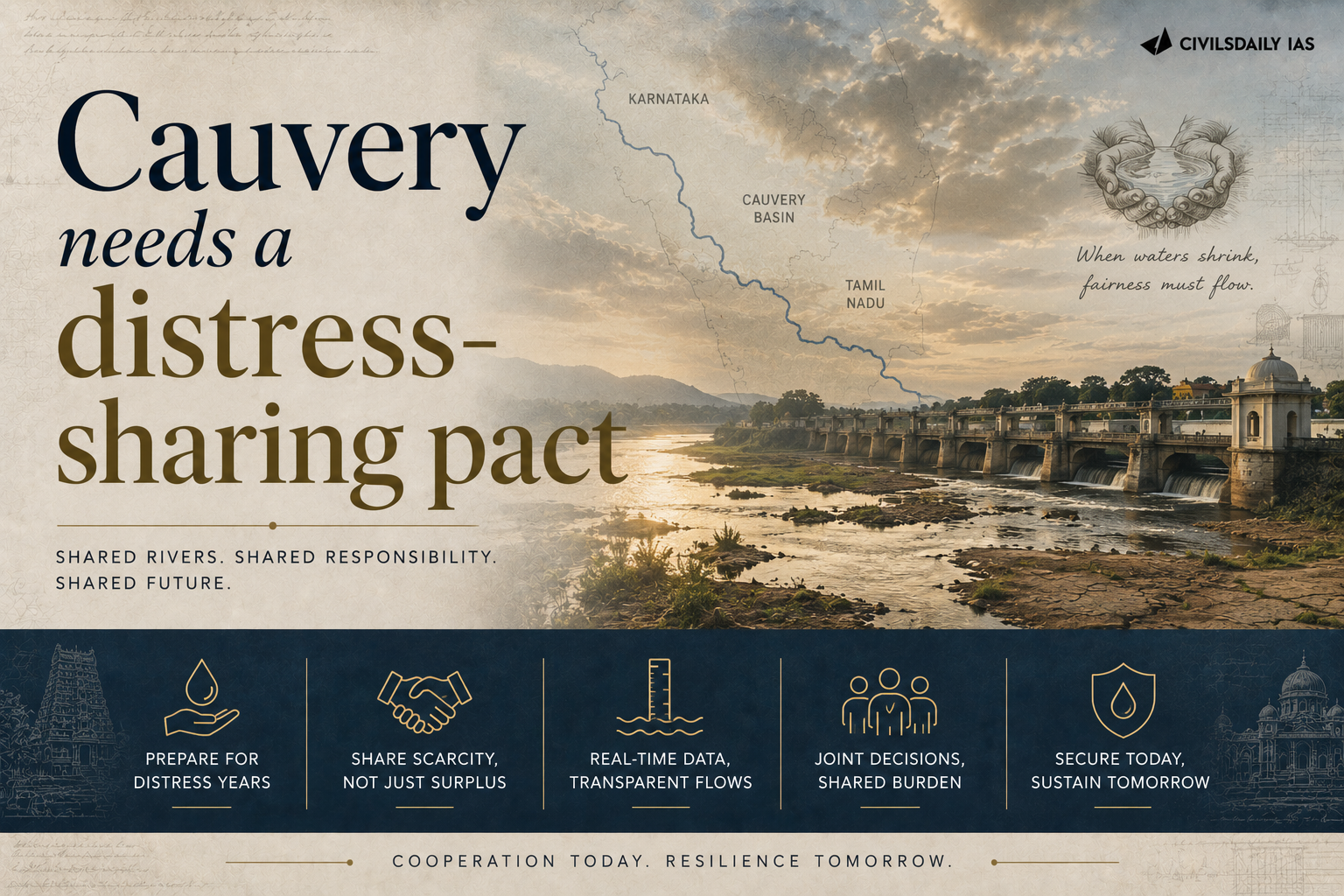
A river shared by two States needs a rule for the bad years, not only for the good ones. The Cauvery has one for the good years, and every deficit season is therefore litigated afresh. The forward step is a negotiated distress sharing pact between the basin States, agreed before the next failed monsoon rather than during it, and covering the cities as well as the fields. Until such a pact exists, each shortfall will keep arriving at a court that has already declined to supply the formula the States will not write for themselves.
Back2Basics: Mettur Dam
Where it is: The dam is built across the Cauvery at Mettur in the Salem district of Tamil Nadu, at the point where the river enters the plains.
When it was built: It was completed in 1934 and is one of the oldest large dams in India.
What it holds: Its reservoir is known as the Stanley Reservoir, and it serves irrigation, drinking water and hydroelectric generation.
What it commands: Releases from Mettur irrigate the Cauvery delta districts, which is why the date on which its gates open sets the cropping calendar for the region.
[2013, GS2, 10 marks] Constitutional mechanisms to resolve the inter-state water disputes have failed to address and solve the problems. Is the failure due to structural or process inadequacy or both? Discuss.”
The five southern States failed to speak with one voice on delimitation at the recently concluded 31st meeting of the Southern Zonal Council. The Karnataka Chief Minister demanded that the 1971 Census remain the basis for delimitation for another 25 years, and no other Chief Minister matched that position. The south’s “political retreat” from its once-influential national role comes amid growing anxieties over representation and federalism. The tension is between a structural shift, a Lok Sabha that a few Hindi heartland States can dominate, and a self-inflicted one, southern Chief Ministers whose dependence on New Delhi for funds has turned them into supplicants.
Why has national politics tilted north since Independence?
The national movement itself was north-led: Gandhi, Nehru, Netaji and Patel were the tallest leaders, and C. Rajagopalachari of Madras, T. Prakasam of Andhra and E.M.S. Namboodiripad of Keralam never had comparable national presence.
Southern resistance is not part of the national memory: The resistance movements and anti-British revolts of the south are not valorised across the country, least of all in northern India.
The early Congress was still inclusive: A galaxy of southern leaders in its leadership ranks let the original Indian National Congress be seen as an all-inclusive umbrella party.
Demographics and language did the rest: Blame demographics or the penchant for a “national” language, parliamentary politics has produced northern domination, and both the Congress and the Jana Sangh and its successor the Bharatiya Janata Party (BJP) have been led from the north.
Only one full-term southern Prime Minister: In nearly eight decades of independence, only one Prime Minister from the south completed a full term, and other southern Prime Ministers were seen as placeholders.
Party structures reinforce it: The domination of the Nehru-Gandhi family in the Congress, and the ideological dominance of Hindi and political dominance of the Hindi heartland in the BJP, have overshadowed southern leadership.
Where have southern leaders of stature come from, and why not from national parties?
The Congress once had strong regional leaders: K. Kamaraj and C. Subramaniam in Tamil Nadu; Neelam Sanjiva Reddy, Kasu Brahmananda Reddy, Marri Chenna Reddy and Y.S. Rajasekhara Reddy in Andhra Pradesh; S. Nijalingappa, Devaraj Urs and S.M. Krishna in Karnataka; and K. Karunakaran in Keralam.
The BJP has none: The party has no south Indian leader of stature in its leadership ranks, and the one who rose from within, B.S. Yediyurappa, quickly faded.
Distinction came from regional parties: M.G. Ramachandran and Jayalalithaa in Tamil Nadu, Namboodiripad in Keralam, N.T. Rama Rao in Andhra Pradesh, K. Chandrashekar Rao in Telangana, and H.D. Deve Gowda, Ramakrishna Hegde and Siddaramaiah in Karnataka all rose through regional parties or national parties with a markedly regional presence.
National parties deny the space: They have rarely let southern leaders acquire a national profile, and P.V. Narasimha Rao, the first south Indian Prime Minister, owed the office largely to his Hindi-speaking skills and was denied his due place in the Congress pantheon.
What did the Southern Zonal Council reveal about the south’s stand on delimitation?
One strong intervention: The Karnataka Chief Minister also called for the Lok Sabha’s strength to be retained at the present 543 seats and for women’s reservation to be implemented.
One tepid mention: The Keralam Chief Minister made only a passing reference to delimitation.
One retreat: The Tamil Nadu Chief Minister revised his earlier strong opposition and sought only an assurance that States would not be denied their present proportional share of representation in the Lok Sabha.
One absence: The Telangana Chief Minister missed the meeting and deputed the Deputy Chief Minister.
The rest was administrative: The other demands concerned financial devolution, river water disputes and administrative issues, and the most politically consequential issue did not compel the five Chief Ministers onto a common platform.
How has dependence on New Delhi muted the southern States?
Supplication for funds: Varying degrees of dependence on the Centre make each southern State supplicate for funds and echo some of the BJP’s ideological obsessions.
Andhra Pradesh as the sharpest case: The Chief Minister and Deputy Chief Minister have become more communal in their political articulation than some of the BJP’s allies in the National Democratic Alliance, and the Chief Minister’s need for central funds has diminished his stature as a representative of the Telugu people, a role his party, the Telugu Desam Party, once embodied.
A Centre-State committee ignored: The committee on Centre-State relations chaired by Justice Kurian Joseph, appointed last year by the then Dravida Munnetra Kazhagam government in Tamil Nadu, received little attention in the media or among the southern leadership, a silence that amounts to Chief Ministers abdicating their responsibility.
Keralam’s leadership has weakened: The former Chief Minister from the Communist Party of India (Marxist) took a submissive approach to the Union government, and over two decades both the CPI(M)-led and Congress-led alliances have been unable to make their presence felt nationally.
A silent forum, and silence about it: The National Development Council (NDC) has not met even once under the present Prime Minister, and hardly anyone across the political spectrum has expressed disquiet.
What did an assertive south once extract from Delhi?
A Commission from a slogan: N.T. Rama Rao’s declaration that “The Centre is a conceptual myth”, alongside other Opposition Chief Ministers, prompted the Prime Minister to appoint the Sarkaria Commission on Centre-State relations in June 1983, and its report was widely reported and discussed.
A funding formula from a coalition of States: In 1968-69, Namboodiripad mobilised the Chief Ministers of Andhra Pradesh and Rajasthan to get the NDC to endorse the Gadgil Formula (the population-weighted formula for distributing Plan assistance among States).
Earlier national leaderships listened: The Congress, the Janata Party and the Janata Parivar coalitions were not dismissive of southern concerns on language, Centre-State relations, allocation of funds or railway lines, and policy direction was less Hindi-heartland-centric.
Those parties had a southern base: They had a consequential presence in the southern States and included influential leaders from the region, so the south did not feel its voice was stifled whatever the outcome.
Is the south’s muted voice a product of arithmetic or of abdication?
The arithmetic is already against the south: Peninsular India’s political presence in the federation is weak even under the present distribution of Lok Sabha seats.
A few States can decide: The entire southern region could be rendered politically inconsequential by the strength of two and a half to three Hindi heartland States in the Lok Sabha.
The delimitation design will sharpen the fear: If such scenarios enter southern political discourse, the delimitation design the Union government is pushing will only heighten political anxieties in the region.
Anxiety will outrun the supplicants: Those anxieties will overwhelm the present crop of supplicant Chief Ministers, the point at which abdication stops being an option.
Challenges to the south’s voice in national politics
The seat freeze has a sunset: The freeze on Lok Sabha seat allocation lasts only until the first Census after 2026, after which a population-based readjustment reallocates seats northward. Eg. Tamil Nadu’s share of the House could fall from 7.1 percent to 6.3 percent under a population-based expansion. The Fix: Fix each State’s share of the Lok Sabha rather than its seat count, so any expansion preserves present proportions.
Fiscal transfers also weight population: Finance Commission formulas that weight 2011 population reduce the share of States that controlled fertility early. Eg. Karnataka’s share of the divisible pool fell from 4.713 percent under the Fourteenth Finance Commission to 3.647 percent under the Fifteenth. The Fix: Raise the weight for demographic performance in the devolution formula so fertility decline is rewarded, not penalised.
The Rajya Sabha does not protect States: Seats in the Council of States are allotted by population under the Fourth Schedule, so the second chamber replicates rather than offsets the north’s numerical weight. Eg. Uttar Pradesh holds 31 Rajya Sabha seats against Keralam’s 9. The Fix: Give State governments a weighted vote on Bills affecting Centre-State relations, on the model of Germany’s Bundesrat.
Language policy is set centrally: Central education policy carries a language design southern States have resisted for six decades, and funds are tied to its adoption. Eg. Tamil Nadu’s two-language policy against the three-language formula of the National Education Policy, 2020, with Samagra Shiksha funds withheld over the dispute. The Fix: Delink scheme funding from acceptance of the language formula and leave the choice to the State, as the Constitution’s State List entry on education once did.
Conclusion
The south’s weakness has two sources and both are real. The seat arithmetic is beyond any Chief Minister’s control, but the failure to build a common platform is not. What to watch is whether the five southern Chief Ministers table a joint position on the basis for delimitation before the Union government’s design is legislated. Until they do, the region’s anxiety over representation has no political vehicle.
What is the current status of Centre-State relations in India?
Two commissions frame the agenda: The Sarkaria Commission, appointed in 1983 and reporting in 1988, and the Punchhi Commission of 2010 remain the reference points for reform of Centre-State relations.
Plan bargaining has ended: The Planning Commission was replaced by NITI Aayog in 2015, and the NDC, the forum where States once negotiated Plan funds, has fallen dormant.
Devolution stands at 41 percent: The Sixteenth Finance Commission retained the States’ share of the divisible pool at 41 percent.
A delimitation design is on the table: The Constitution (One Hundred and Thirty-first Amendment) Bill, 2026 proposed expanding the Lok Sabha from 543 to 850 seats (815 for States, 35 for Union Territories) on 2011 Census data, linked the 33 percent women’s quota to that exercise, and would shift the Lok Sabha to Rajya Sabha ratio from 2.2:1 to 3.3:1.
Constitutional Provisions Related to Centre-State Relations
Article 3: Parliament may form, merge or alter States and their names without the consent of the State concerned.
Article 80 and the Fourth Schedule: Rajya Sabha seats are allotted to States by population, not equally.
Article 81: Fixes the composition of the Lok Sabha and the proportionality of seats to population across States.
Article 82: Requires readjustment of seats after every Census by a law of Parliament.
Article 263: Empowers the President to establish an Inter-State Council to inquire into and advise on inter-State disputes and common interests.
Article 280: Constitutes the Finance Commission to recommend the distribution of tax proceeds between the Union and the States.
Article 356: Allows President’s Rule where a State’s constitutional machinery fails.
Laws and Rules Governing Centre-State Relations
States Reorganisation Act, 1956: Creates the five Zonal Councils (Northern, Central, Eastern, Western and Southern), statutory advisory bodies chaired by the Union Home Minister with State Chief Ministers as rotating Vice-Chairpersons.
Inter-State River Water Disputes Act, 1956: Lets a State request the Centre to refer a water dispute to a tribunal whose award, once gazetted, has the force of a Supreme Court order.
Inter-State Council Order, 1990: Constituted the Inter-State Council under Article 263 on the Sarkaria Commission’s recommendation.
Delimitation Act, 2002: Governed the last readjustment of constituency boundaries, which was done without altering any State’s seat total.
Challenges in Centre-State Relations
Politicisation of the Governor’s office: Governors from the ruling party at the Centre have withheld assent to State Bills for years. Eg. Tamil Nadu and Kerala took their Governors to the Supreme Court over delayed assent. The Fix: Adopt the Punchhi Commission’s fixed five-year tenure for Governors, with appointment after consulting the Chief Minister.
A dormant coordination forum: The Inter-State Council has no binding authority and meets rarely, so Centre-State disputes go to court instead of to dialogue. Eg. The Council has met only 11 times since 1990, most recently in 2016. The Fix: Implement the National Commission to Review the Working of the Constitution’s recommendation of at least three Council meetings a year, with a dedicated secretariat.
Centralisation through the fiscal channel: The Centre raises revenue through cesses and surcharges that are not shared, and delays transfers that are owed. Eg. GST compensation cess payments to States were delayed between 2019 and 2022. The Fix: Cap cesses and surcharges at 10 percent of gross tax revenue so the divisible pool is not artificially shrunk.
Rigid Centrally Sponsored Schemes: Uniform scheme parameters ignore geographic and ecological variation across States. Eg. Recent changes to the Mahatma Gandhi National Rural Employment Guarantee Scheme’s funding shifted burden onto States. The Fix: Allow States to customise 25 to 30 percent of scheme parameters to local needs.
[2026, GS2, 15 marks] How far has the Indian federal framework been successful in accommodating regional and cultural diversities? Highlight the role of asymmetric federalism and suggest measures to make dispute resolution mechanisms more effective.”
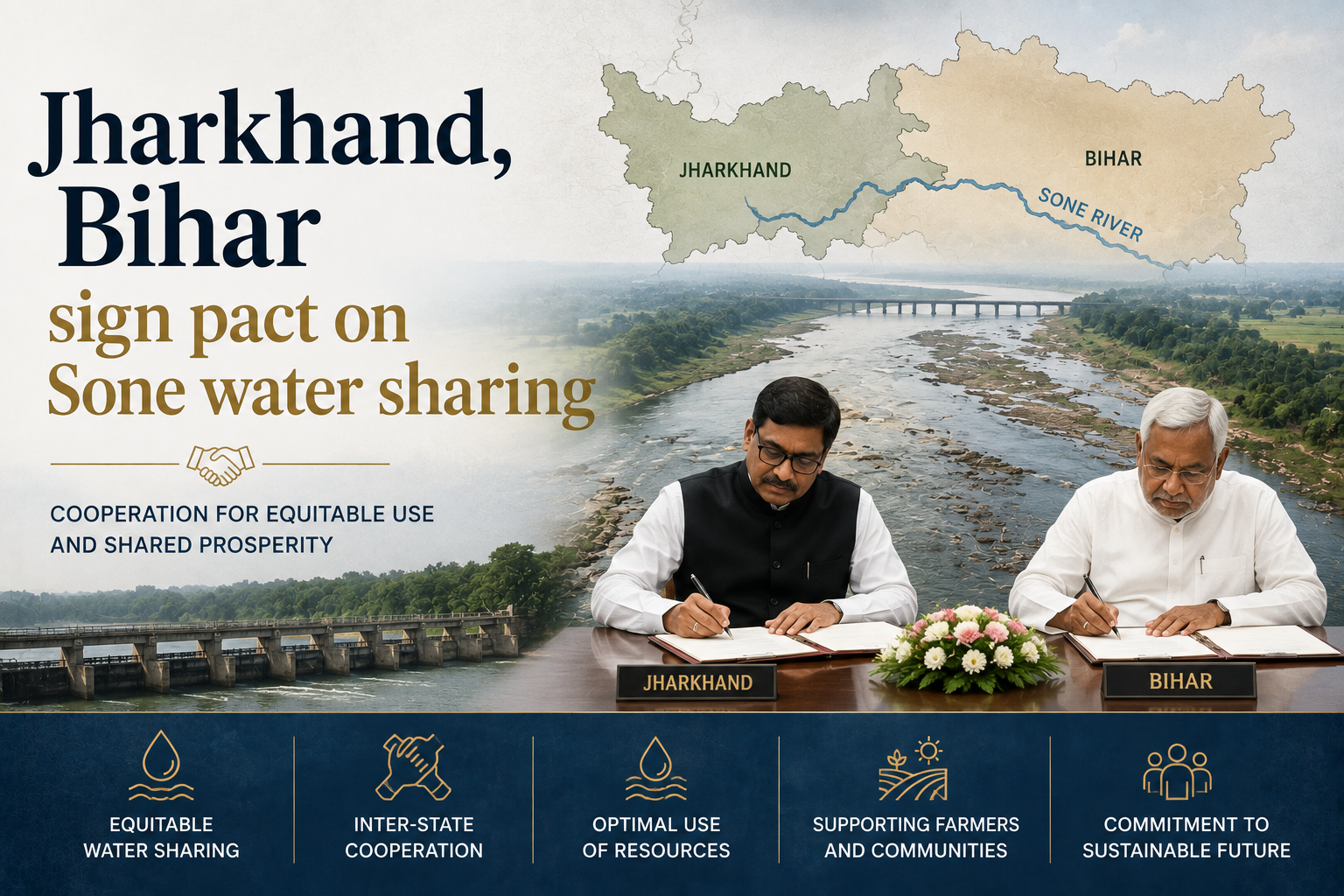
Bihar and Jharkhand have signed a memorandum of understanding on sharing the water of the Sone river, allocating 5.75 million acre feet to Bihar and 2 million acre feet to Jharkhand.
What has been agreed on the Sone, and what was in dispute?
The dispute was over one inherited allocation: The 1973 agreement allotted 7.75 million acre feet (MAF), one acre foot being the volume that covers an acre of land to a depth of a foot, or about 1,233 cubic metres, to then undivided Bihar.
Bihar takes the larger share: The formal consensus allocates 5.75 MAF of the river’s water to Bihar.
Jharkhand takes the remainder: The remaining 2 MAF is allocated to Jharkhand.
The route chosen is agreement rather than adjudication: The States settled by memorandum instead of taking the claim to a tribunal constituted under the Inter-State River Water Disputes Act, 1956.
What does the settlement change on the ground?
A long-pending eastern India dispute closes: The agreement resolves a water dispute that had run unresolved between the two States since the bifurcation.
Irrigation is the stated primary gain: It is expected to provide irrigation water to lakhs of farmers in rural Bihar and rural Jharkhand.
Drinking water supply is the second use: It is also expected to supply drinking water to a large population across both States.
It is the fourth such deal this year: This is the fourth water agreement concluded between States in the year, each intended to raise water availability for irrigation, rural development and drinking purposes.
Challenges to the Sone water sharing agreement
An executive memorandum carries no adjudicatory backing: A memorandum binds two governments politically and gives neither a forum to enforce it when a release is withheld. Eg. The Krishna and Cauvery allocations required tribunal awards under the Inter-State River Water Disputes Act, 1956 and were litigated for decades afterwards. The Fix: Convert the split into a scheduled allocation under a joint Sone board with a statutory review clause and a defined dispute reference.
A fixed annual quantity assumes a fixed annual yield: An allocation stated in acre feet holds only in a normal year, and the Sone’s flow is monsoon dominated and highly variable. Eg. The Indrapuri barrage at Dehri has repeatedly failed to fill its canal command in deficit years. The Fix: Restate the split as a share of realised flow measured at agreed gauging points, with a separate lean season protocol.
No joint measurement machinery is named: Neither State is committed to a common gauging point or a common data record, so each will compute its own entitlement from its own readings. Eg. The Cauvery dispute turned for years on the absence of agreed real-time flow data at the inter-State point. The Fix: Install telemetered gauges at the State boundary and publish daily flow and release data on a single public portal.
Upstream storage decisions sit outside the deal: New reservoirs and diversions on tributaries above the boundary change what reaches the downstream State without breaching any allocation figure. Eg. Storage projects on Sone basin tributaries in Jharkhand alter the flow arriving at Bihar’s canal headworks. The Fix: Make any new storage above the boundary subject to prior consultation with a defined objection window for the downstream State.
Delivery efficiency is untouched by the allocation: A larger paper share does not reach a farmer where the canal system loses much of the release before the tail end. Eg. Unlined and silted distributaries in the Sone canal command leave tail end villages dependent on groundwater in the same season the head reach is irrigated. The Fix: Tie the drawal of the agreed share to verified canal lining and command area development milestones reported annually.
Conclusion
Bihar-Jharkhand Sone water agreement is a positive step toward cooperative river management, improving irrigation and drinking water availability. With transparent monitoring, flexible sharing during droughts and joint planning, it can ensure long-term water security and regional development.
Back2Basics: Sone River
Source and course: It rises on the Amarkantak plateau in Madhya Pradesh, close to the source of the Narmada, and flows in the opposite direction to it.
Status in the Ganga system: It is the largest of the southern tributaries of the Ganga, and it joins the main river upstream of Patna.
States traversed: Its course runs through Madhya Pradesh, Uttar Pradesh, Chhattisgarh, Jharkhand and Bihar.
Principal structure: The Indrapuri barrage at Dehri feeds the Sone canal system, among the oldest large canal networks built in India.
“[2013, GS2, 10 marks] Constitutional mechanisms to resolve the inter-state water disputes have failed to address and solve the problems. Is the failure due to structural or process inadequacy or both? Discuss.”
Chief Justice of India Surya Kant remarked, while hearing the three-decade-old Satluj-Yamuna Link (SYL) canal case, that “once the heart opens, the door also opens,” after Attorney General R. Venkataramani told the Bench that Punjab and Haryana now “speak in a joint voice.” The conciliatory language follows a 1996 suit by Haryana seeking completion of the SYL canal and comes months before Punjab’s Assembly elections, raising the question of whether it signals a genuine shift or another turn of phrase in a dispute where both states have historically hardened their positions, including a standoff last year when Punjab refused to loan Haryana water from the Bhakra dam for thirsty villages in Hisar and Fatehabad.
What is the SYL canal dispute?
A link canal ordered under a 1981 tripartite agreement: The SYL was designed as a 214-km canal, 122 km in Punjab and 92 km in Haryana, to carry surplus Ravi-Beas waters assessed at 17.17 million acre feet (MAF) under a 1981 agreement brokered by then Prime Minister Indira Gandhi between Punjab, Haryana and Rajasthan.
Haryana has completed its share, Punjab has not: Haryana finished its 92-km portion years ago, while construction on Punjab’s stretch has remained stalled since the 1980s.
Legal basis on both sides: Haryana rests its claim on its status as a successor state of undivided Punjab, the 1981 agreement and successive Supreme Court rulings directing Punjab to complete its share. Punjab invokes the riparian principle, under which states through which a river flows hold primary rights to its waters, to challenge the 1981 allocation.
Why has construction on the canal stalled for decades?
Militancy halted work at its peak: The Shiromani Akali Dal’s Nehar Roko Morcha against the canal evolved into the Dharam Yudh Morcha after the Akalis joined radical ideologue Jarnail Singh Bhindranwale. In 1990, Babbar Khalsa International militants shot dead SYL chief engineer M.L. Sikri, superintending engineer Avtar Singh Aulakh, and 32 labourers at the site.
Punjab legislated itself out of the pact: In 2004, the Congress government headed by then Chief Minister Amarinder Singh passed the Punjab Termination of Agreements Act, 2004, ending Punjab’s obligations under the 1981 pact; the Supreme Court struck the Act down in 2016.
Land returned to original owners: In 2016, the Akali government in Punjab returned the land acquired for canal construction to its original owners, a practical and political obstacle to reviving construction on the Punjab side.
Why does Punjab resist sharing the water?
Groundwater is already overexploited: Roughly 73 to 76 percent of Punjab’s blocks are overexploited, forcing farmers to dig progressively deeper wells, while border districts in southern Punjab at the tail end of the canal network struggle to irrigate.
The 1955 allocation is seen as historically unfair to Punjab: The Centre in 1955 allocated non-riparian Rajasthan 8 MAF of water, leaving undivided Punjab with 7.2 MAF of the Ravi-Beas waters, a division Punjab’s political class continues to cite as the root grievance.
Water unites Punjabi public opinion: Opposition to sharing water with Haryana cuts across political lines in Punjab. Eg. Rapper Sidhu Moosewala’s song “SYL,” released after his death, sang “Paani chhado, tibka nahin dinde (forget about water, we won’t give a drop)” and drew a large public response before being taken down.
Why does Haryana insist the canal must be completed?
Its own water stress is worsening: Haryana’s southern and south-western districts face falling water tables, down to 1,700 feet in places, and Chief Minister Nayab Singh Saini has repeatedly appealed to Punjab to share water, this year earmarking Rs 100 crore for the canal.
It considers the legal position settled in its favour: Haryana points to its status as successor state, the 1981 agreement and repeated Supreme Court directions to Punjab as establishing its entitlement to the share of Ravi-Beas waters the canal was meant to carry.
What is the Eradi Tribunal assessing, and what can it not do?
Re-verifying the water assumed available: The Ravi-Beas Waters Tribunal, commonly called the Eradi Tribunal after its first chairman Justice V. Balakrishna Eradi, was set up in 1986 to re-verify water claims. The present tribunal, headed by retired Supreme Court judge Justice Vineet Saran with Justices P. Naveen Rao and Suman Shyam, conducted fresh field inspections in Punjab this summer, examining river inflows, canal outflows and hydraulic structures.
Punjab’s position before the tribunal: Punjab’s Chief Minister and officials told the tribunal the state faces severe groundwater depletion and an acute canal water shortage, has no surplus for Haryana or Rajasthan, and that only Punjab, Himachal Pradesh and Jammu and Kashmir fall within the actual Ravi-Beas basin.
A tribunal finding cannot force construction: Whatever the tribunal concludes on whether the water assumed under the 1981 agreement still exists, it cannot itself build the canal or make Punjab’s people accept a settlement they consider damaging; only a negotiated political solution between the two states can do that.
Conclusion
The cordial language before the Supreme Court reflects political intent at the highest level, but it sits atop a dispute rooted in militancy, a legislated repudiation of the original pact and unresolved questions before the Eradi Tribunal about whether the water assumed under the 1981 agreement still exists. With Punjab’s Assembly elections approaching, whether the two states can convert this rhetorical shift into an actual settlement remains uncertain.
What is Fiscal Federalism?
About: Fiscal federalism is the division of financial powers, resources and responsibilities between the Union and the states, governing how revenue, expenditure and shared resources such as inter-state river waters are allocated and adjudicated.
Rationale: It exists because states have unequal revenue capacity and unequal access to shared natural resources, requiring a constitutional and institutional mechanism to allocate resources and resolve disputes between states and the Centre.
Named typology: Centre-state financial relations operate through tax devolution, grants-in-aid, and inter-state dispute mechanisms such as river water tribunals under Article 262 and the Inter-State River Water Disputes Act, 1956.
Article 262: Empowers Parliament to provide for the adjudication of disputes relating to the use, distribution or control of waters of inter-state rivers, and to bar the jurisdiction of the Supreme Court and other courts over such disputes if Parliament so provides.
Inter-State River Water Disputes Act, 1956: Provides the statutory framework under which river water tribunals, such as the Eradi Tribunal, are constituted to adjudicate disputes between riparian states.
Seventh Schedule, State List Entry 17: Places water, including water supplies and irrigation, within the states’ legislative domain, subject to the Union’s power under Entry 56 of the Union List over inter-state rivers declared expedient in the public interest.
Challenges in Centre-State River Water Sharing
Tribunal awards without enforcement teeth: River water tribunal decisions can remain unimplemented for decades without an enforcement mechanism binding the states. Eg. The SYL canal dispute has remained unresolved for over three decades despite multiple Supreme Court directions to complete construction. Fix. Empower the Inter-State River Water Disputes Act framework with a standing implementation authority with a fixed timeline, rather than leaving execution to the state governments involved in the dispute.
Elections repeatedly delaying settlement: Water disputes become politically charged ahead of state elections, discouraging incumbent governments from conceding ground. Eg. The renewed conciliatory statements before the Supreme Court in the SYL case have come months ahead of the Punjab Assembly elections, raising doubts about whether they reflect a genuine shift.
An opinion piece argues that the Mines and Minerals (Development and Regulation) Amendment Act, 2026 (MMDR Amendment Act) has centralised mineral taxation authority at the expense of States. This disturbs a long standing settlement, dating to the original Mines and Minerals (Development and Regulation) Act, 1957, under which States collected royalty on minerals within their territory without a corresponding compensation mechanism now built in. The piece contends this follows a pattern already seen in the Goods and Services Tax (GST) Council, where States have progressively lost autonomous taxation power to a Union-dominated body. The tension is between the Union’s claim that uniform mineral taxation supports national resource planning, and States’ claim that this erodes a revenue base the Seventh Schedule recognises as theirs.
What changed under the amendment?
Centralised rate-setting power: The amendment shifts the power to determine certain mineral levies and cesses from State legislatures to the Union government, narrowing what States can independently tax.
Erosion of a settled compromise: Mineral royalty had functioned as a relatively stable, State-collected revenue source since the 1957 Act. The amendment disturbs that settlement without a corresponding compensation mechanism.
Why is this compared to the GST Council experience?
Repeated pattern of centralisation: The piece argues that the GST Council, though structured as a joint Centre-State body, has in practice let Union preferences dominate rate decisions, and that the same dynamic is now repeating in mineral taxation.
States left to negotiate after the fact: Under both regimes, States raise objections after a rate or rule is set centrally, rather than co-designing the rule up front.
Current Status of Fiscal Federalism in India
The Union controls the most buoyant tax sources, income tax, corporate tax and the dominant share of the GST base, while States carry larger expenditure responsibilities in health, education and welfare, producing a standing vertical fiscal imbalance.
Devolution to States is currently governed by the 16th Finance Commission’s award, which fixed the States’ share of the divisible pool at 41 percent.
Mineral royalty and cesses have historically sat with States as an independent, non-shared revenue source, which is the specific arrangement this amendment narrows.
Constitutional Provisions Related to Fiscal Federalism
Article 246 and the Seventh Schedule: Distribute taxation and legislative subjects between the Union, State and Concurrent Lists, and mineral development is a subject that straddles Union and State competence under Entry 54 of the Union List and Entry 23 of the State List.
Article 280: Establishes the Finance Commission to recommend the distribution of net tax proceeds between the Union and the States.
Article 246A and Article 279A: Together create the GST regime and the GST Council as the joint body that recommends GST rates and administration.
Article 293: Governs the Union’s control over State borrowing where a State remains indebted to the Union.
Major debates surrounding Fiscal Federalism
Divisible pool erosion through cesses and surcharges: Revenue the Union raises as a cess or surcharge does not enter the divisible pool the Finance Commission distributes, so a nominal 41 percent devolution understates the Union’s discretionary control over shared revenue.
State taxation autonomy under GST: States gave up the power to independently tax goods and services on joining GST, leaving royalty and mineral levies among the few remaining independent State taxation instruments, which is precisely what this amendment now narrows.
Weak third-tier finances: Local bodies devolved under the 73rd and 74th Amendments remain financially dependent on State and Union transfers, compounding the same imbalance one tier further down.
Challenges in Fiscal Federalism
No binding consultation requirement before a rate change: Neither the GST Council’s structure nor the MMDR Act requires the Union to secure State consent before altering a shared levy, only consultation. Eg. The GST Council’s voting structure gives the Union a one-third weightage sufficient to block any change it opposes. Fix. Amend Article 279A to require a demonstrated State revenue-neutral transition before a Council decision that narrows State taxation power takes effect.
No compensation mechanism for a narrowed State tax base: Unlike the GST transition, which carried a five-year compensation guarantee for States, the MMDR Amendment Act, 2026 carries no equivalent revenue protection for States losing mineral levy autonomy. Eg. The GST Compensation Cess mechanism lapsed in 2022, and States have separately argued its withdrawal alone widened the same imbalance this amendment now adds to. Fix. Extend a time-bound compensation formula, indexed to each State’s historical mineral revenue, for a fixed transition period.
Government Initiatives for Fiscal Federalism
Finance Commission: A constitutional body appointed every five years to recommend Union-State and inter-State devolution of tax proceeds and grants-in-aid.
GST Council: The joint Union-State body under Article 279A that recommends GST rates, exemptions and administrative rules.
District Mineral Foundation: A statutory trust under the Mines and Minerals (Development and Regulation) Act, 1957 that channels a share of mineral royalty into welfare of mining-affected areas, funded from the same royalty base this dispute concerns.
Back2Basics: Mines and Minerals (Development and Regulation) Act, 1957
The Act is the principal central law governing mineral concessions and mineral development in India, most recently amended in 2026.
It empowers the Union to prescribe rates of royalty and dead rent on minerals, which States then collect.
A 2015 amendment introduced auction as the mandatory mode of allocating mineral concessions, replacing the earlier discretionary allotment system.
Conclusion
The mineral taxation dispute is presented as further evidence that fiscal federalism in India increasingly follows a pattern of after-the-fact State objection to Union-set rules, rather than genuine ex ante bargaining. What remains unresolved is whether States will pursue a legal challenge or extract a compensation formula through political negotiation.
“[2025, GS2, 15 marks] Examine the evolving pattern of Centre-State financial relations in the context of planned development in India. How far have the recent reforms impacted the fiscal federalism in India?”
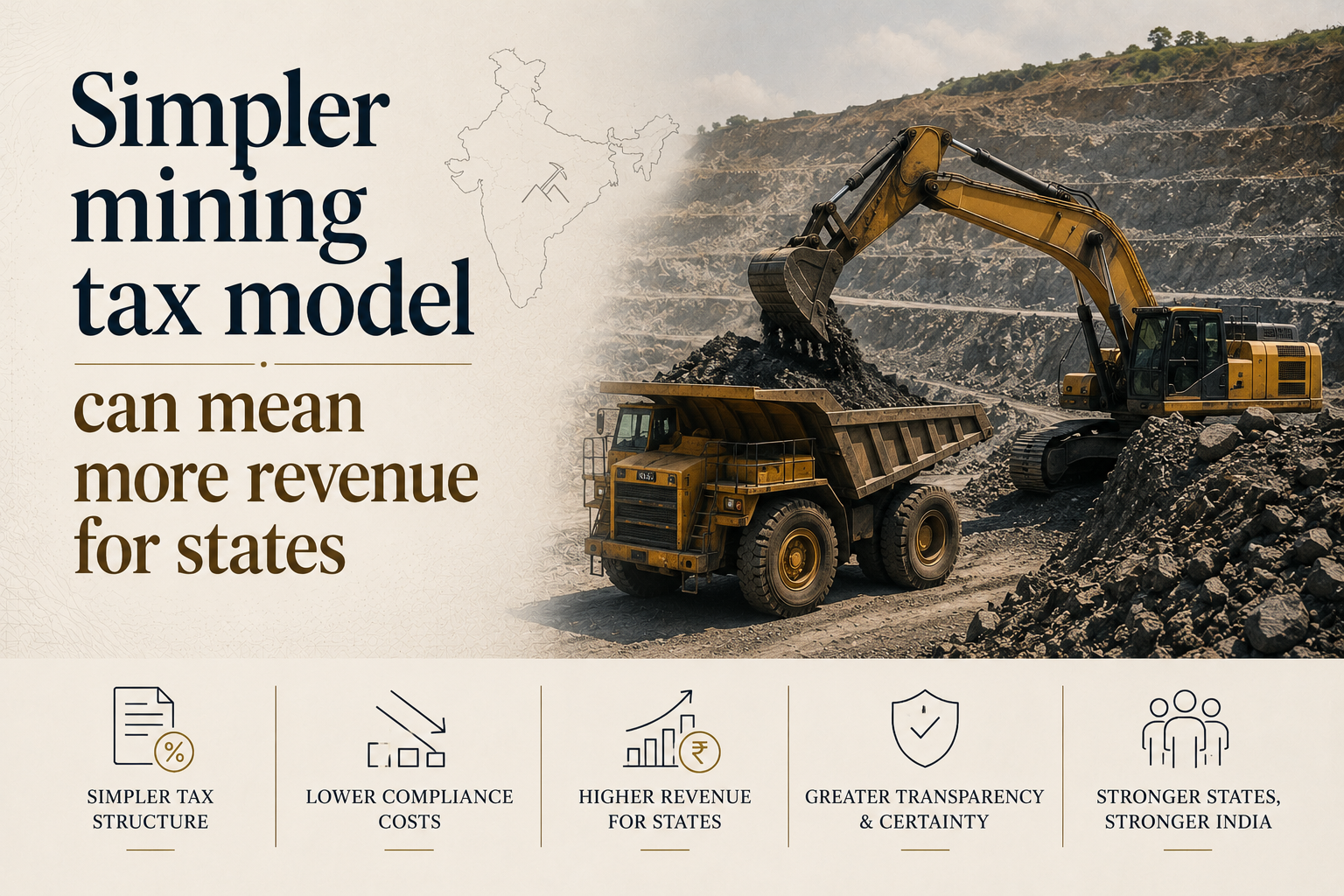
The chairperson of the Economic Advisory Council to the Prime Minister, argues that the recently passed Mines and Minerals (Development and Regulation) Amendment Act, 2026 replaces a fragmented mineral taxation system, up to 14 different taxes, charges, fees and levies across States, with a simpler, uniform and predictable framework, extending the certainty-over-discretion principle already applied to mineral block allocation in 2015 to mineral taxation itself.
What does the amended Act change, and what does it retain?
It targets fiscal fragmentation across States: The amendment addresses a landscape where mineral producers face up to 14 types of taxes, charges, fees and levies that differ by State, and aims to keep India’s mineral market integrated rather than fractured along State fiscal lines.
The revenue-sharing formula with States is retained, not altered: Since the e-auction regime began in 2015, States have received more than Rs 7 lakh crore, about 90% of total revenue from the coal and non-coal sectors combined, through royalty, auction premium, District Mineral Foundation (DMF) contributions and GST; the amendment continues this formula, with 90 paise of every rupee earned from mineral production retained by the State.
The reform is framed as continuing a 12-year trajectory: The op-ed traces the shift from a pre-2014 system of discretionary block allotment, marked by delay and opacity, to transparent competitive e-auctions, arguing that the new tax simplification extends the same certainty principle to fiscal treatment of mining.
Conclusion
The op-ed’s position is that a simpler, uniform mineral tax framework under the amended MMDR Act protects mineral-rich States’ own revenue pool while removing the fiscal fragmentation that has made India’s mineral market uncompetitive against import sources, an argument resting on the Act’s own revenue-sharing data rather than a general case for lower taxation.
Back2Basics
Mines and Minerals (Development and Regulation) Act, 1957: The principal central legislation governing regulation of mines and mineral development in India, under which State governments grant mineral concessions but the Centre sets the overarching regulatory and taxation framework.
District Mineral Foundation (DMF): A non-profit trust set up in mining-affected districts under the Act to work for the interest and benefit of persons and areas affected by mining-related operations, funded through a share of royalty payments.
“[2025, GS2, 15 marks] Examine the evolving pattern of Centre-State financial relations in the context of planned development in India. How far have the recent reforms impacted the fiscal federalism in India?”
The Ministry of External Affairs denied political clearance for a United States visit by the Chief Minister of Telangana, A. Revanth Reddy, a visit that had included planned meetings with the Mayor of New York and the Vice-President of the United States. Indian States require political clearance from the Union government before a Chief Minister undertakes an official foreign visit, a longstanding practice meant to keep foreign policy under central control. Denying clearance for meetings with a State chief executive and senior foreign leaders sets up a tension between the Centre’s constitutional primacy over foreign affairs and the norm of allowing Opposition-ruled States a role in India’s outward-facing federalism.
Why does a Chief Minister need Union clearance to travel abroad?
Foreign affairs sit exclusively with the Union: Entry 10 of the Union List places foreign affairs, including all matters bringing the Union government into relation with any foreign country, exclusively within the Centre’s legislative and executive competence.
Political clearance is an executive practice, not a statutory requirement: The requirement that a Chief Minister obtain the Ministry of External Affairs’ political clearance before an official foreign visit rests on executive instructions rather than a specific Act, developed to keep sub-national actors from appearing to conduct independent foreign policy.
Distinct from clearance for private or non-official travel: Clearance requirements attach to visits with an official or government-to-government character, such as meetings with a foreign government’s officials, rather than to purely personal travel.
Why is denying clearance in this instance being criticised?
Meetings involved routine sub-national and diplomatic engagement: A meeting between an Indian Chief Minister and the Mayor of New York, or a courtesy meeting with the Vice-President of the United States, falls within the kind of city-to-state and state-to-country economic diplomacy the Centre has itself encouraged States to pursue for investment.
Selective application undermines federal trust: Denial of clearance to an Opposition-ruled State’s Chief Minister, where clearance is routinely granted for similar visits by Chief Ministers of Union government-aligned States, reads as a partisan use of a foreign-policy gatekeeping power.
Costs India’s global federal image: India projects itself internationally as a cooperative federal system encouraging States to compete for investment; blocking a State’s own outreach to a potential investment and diaspora hub like New York works against that projection.
Undermines Centre-Opposition dialogue norms: Routine denial of clearance to Opposition Chief Ministers, without a stated security or diplomatic justification, erodes the norm that foreign-policy gatekeeping is applied on non-partisan grounds.
Conclusion
The Ministry of External Affairs’ denial of political clearance for the Chief Minister of Telangana’s US visit is criticised here as an overreach of a gatekeeping power meant to coordinate foreign policy, not to selectively restrict an Opposition-ruled State’s economic and diplomatic outreach. The episode is likely to recur with other Opposition-ruled States unless the Centre states clear, non-partisan criteria for granting or denying political clearance.
Back2Basics: Political clearance for foreign travel by State functionaries
An executive requirement, not a statutory one, under which a Chief Minister or other State functionary must obtain the Ministry of External Affairs’ approval before undertaking an official foreign visit.
Rests on the Union’s exclusive constitutional competence over foreign affairs under Entry 10 of the Union List in the Seventh Schedule.
Applies to visits with an official or government character; distinguished from private travel, which does not require the same clearance.
Has periodically become a point of Centre-State friction when applied to Opposition-ruled States’ Chief Ministers.
Matching Previous Year Question
“[2021] Which one of the following in Indian polity is an essential feature that indicates that it is federal in character? (a) The independence of the judiciary is safeguarded. (b) The Union Legislature has elected representatives from constituent units. (c) The Union Cabinet can have elected representatives from regional parties. (d) The Fundamental Rights are enforceable by Courts of Law. ANSWER: (a)”
The Telangana Chief Minister’s visit to the United States has been cancelled after the Ministry of External Affairs denied “clearance from political angle”. The refusal invokes a standing requirement. Every public servant, including the elected head of a State government, must obtain political clearance from the Union government before travelling abroad. That requirement was last formalised in a Cabinet Secretariat circular of 6 May 2015. That circular made prior political clearance and clearance under the Foreign Contribution (Regulation) Act, 2010 mandatory for such travel. The contest is over an executive discretion that decides whether a State’s chief executive may travel abroad at all.
What is political clearance?
A Union permission for foreign travel by officials: Political clearance is an approval granted by the Ministry of External Affairs before any public servant undertakes a foreign trip.
Its coverage is not limited to senior functionaries: It is required not only for public servants at the top of the administration but for any government servant travelling abroad.
Its stated purpose is foreign policy screening: The system exists to ensure that official foreign visits do not carry diplomatic or foreign policy implications that the government has not assessed.
It is a precondition, not a formality: No other clearance in the chain is processed until political clearance has been obtained.
On what basis is clearance granted or refused?
The nature of the event: What the visit is for, and whether the occasion is one at which an Indian official presence carries diplomatic weight.
The level of participation from other countries: Who else is attending and at what rank, which determines the protocol implications of an Indian participant.
The kind of invitation extended: Who issued the invitation and through which channel, which is where a direct approach by a foreign mission to a State government becomes an issue.
India’s relations with the host country: The current state of the bilateral relationship, which can make an otherwise routine visit sensitive.
The volume is substantial: The Ministry receives hundreds of requests for political clearance every month from ministries, secretaries, bureaucrats and other officials.
The process has been online since 2016: Applications can be made on the Ministry’s portal at epolclearance.gov.in, and clearance is issued after coordination among various divisions of the Ministry.
What clearances must a Chief Minister obtain?
Two authorities must be informed: Chief Ministers, along with State and Union Territory ministers, must inform both the Cabinet Secretariat and the Ministry of External Affairs about any foreign visit.
Private travel is not exempt: The requirement applies whether the visit is official or private.
Two clearances are mandatory: The Cabinet Secretariat circular of 6 May 2015 states that prior political clearance and clearance under the Foreign Contribution (Regulation) Act, 2010 are mandatory.
A third clearance comes from the finance side: Chief Ministers, State ministers and other State officials also need clearance from the Department of Economic Affairs, with a copy of the application sent to the Secretary of that Department.
The sequence is fixed: The Department of Economic Affairs and the administrative ministry concerned will entertain an application only if the Ministry of External Affairs political clearance is attached to it.
How do the rules differ for Union ministers and Members of Parliament?
Union ministers face a second gate: After obtaining political clearance from the Ministry of External Affairs, a Union minister needs additional clearance from the Prime Minister, whether the trip is official or personal.
Members of the Lok Sabha go to the Speaker: Clearance for a Lok Sabha member is granted by the Speaker of the House.
Members of the Rajya Sabha go to the Chairperson: Clearance for a Rajya Sabha member is granted by the Chairperson of that House.
The pattern is significant: Union ministers and Members of Parliament are cleared within their own institution. A State Chief Minister is cleared by an authority outside the State’s own structure.
What does the record of past denials show?
Refusal is not a new development: Political clearance being denied to a Chief Minister has happened repeatedly across governments of different parties.
A Delhi Chief Minister was refused twice: In 2022 the then Delhi Chief Minister had to cancel a Singapore visit after not receiving clearance, and in October 2019 the Centre had not approved his attendance at another conference abroad.
Refusals also occurred under the previous Union government: During the earlier United Progressive Alliance government, the Ministry denied political clearance for trips by the then Chief Minister of Assam, who belonged to the Congress, to the United States and Israel.
Party affiliation did not decide the outcome: The same government also denied clearance to the then Chief Minister of Jharkhand, who belonged to the Bharatiya Janata Party, for a visit to Thailand.
What grounds has the Ministry cited for refusing a Chief Minister’s travel?
Channel of invitation as a ground: For a proposed New York visit on 2 April 2012 for a “high level meeting”, the Ministry recorded that direct correspondence by a diplomatic mission with a State government was inappropriate. The objection was to the route of the invitation, not to the substance of the meeting.
Protocol capacity as a ground: For a proposed visit to Israel for an event on water and environment technology, the Ministry recorded that the agencies concerned would be hard put to provide special consideration for a Chief Minister, both from the substantive and the protocol angles.
Neither ground turns on foreign policy risk: Both refusals rest on how a State government engages a foreign mission and on the resources a mission can spare, rather than on any assessed diplomatic consequence of the visit.
The reasons are not published as a rule: These grounds surfaced through disclosed file notings, not through any obligation to communicate reasons to the applicant.
Is political clearance a foreign policy filter or a check on State autonomy?
Foreign affairs is genuinely a Union subject: Entries 10 to 14 of the Union List place foreign affairs, diplomatic representation and treaty implementation exclusively with the Union, so a clearance requirement has a constitutional foundation.
The State interest is economic, not diplomatic: States compete for investment through overseas roadshows and investor summits, so a travel refusal directly affects a State’s own economic strategy rather than the country’s foreign policy.
The record cuts both ways: The pattern of past refusals weakens the charge that the instrument is purely partisan, and it equally shows that the discretion runs without a settled standard whoever is in office.
Challenges to the political clearance system
Discretion without published criteria invites the charge of bias: A refusal that cannot be tested against a written standard will always be read politically, whatever the actual reason. Eg. Past refusals to Chief Ministers were each read at the time as partisan acts. Fix. Notify a written clearance policy listing the grounds of refusal and require that the applicable ground be communicated in every rejection.
No timeline means a delay works as a refusal: Where no decision deadline exists, a pending file achieves the same result as a denial once the event date passes. Eg. Conference and summit invitations carry fixed dates that a delayed clearance renders moot. Fix. Fix a statutory outer limit of fifteen working days, after which clearance is deemed granted.
Multiple clearances multiply points of failure: A Chief Minister needs the Ministry of External Affairs, the Cabinet Secretariat and the Department of Economic Affairs to act in sequence, and each can stall. Eg. The finance side will not even open a file until the political clearance is attached to it. Fix. Route the entire chain through the single existing online portal with a common tracking number and visible stage wise status.
No forum reviews a refusal: There is no appellate authority, so the only remedy is writ litigation, which is slower than any travel schedule. Eg. Cancelled visits are typically abandoned rather than litigated. Fix. Designate an appellate authority in the Cabinet Secretariat with a seven day disposal requirement.
States have no institutional channel for external economic engagement: Investment promotion by States is treated case by case through the clearance route rather than through a standing mechanism. Eg. States conduct overseas investor roadshows without any permanent Union State coordination forum for external economic engagement. Fix. Constitute a standing States division consultation under the Ministry of External Affairs to pre clear recurring categories of economic travel.
The instrument has no statutory basis: The entire regime rests on executive circulars, so its scope can be widened or narrowed without legislative scrutiny. Eg. The governing instrument for Chief Ministers is a Cabinet Secretariat circular of 2015. Fix. Place the clearance framework in subordinate legislation laid before Parliament, so changes to its scope are on the record.
Conclusion
The refusal is not an unprecedented act, and the constitutional basis for a Union filter on official foreign travel is not seriously in doubt, since foreign affairs sits squarely on the Union List. What the episode exposes is that the filter operates through executive circulars alone, which is what allows every refusal to be read as a political act. Until the grounds of refusal are codified and a review route exists, an instrument designed to protect foreign policy coherence will keep producing federal friction it was never meant to create.
What is the current status of Centre State relations in India?
The division of powers is constitutionally fixed: Legislative competence is distributed through the Seventh Schedule across the Union List, the State List and the Concurrent List, with residuary powers vesting in Parliament.
The scheme is federal with strong unitary features: Parliament may alter State boundaries without State consent, may legislate on a State List subject in the national interest, and central law prevails over State law on the Concurrent List.
The fiscal position of States has weakened: The States’ effective share of the Centre’s gross tax revenue fell from about 35 per cent in the 2015 to 2020 period to roughly 31 per cent in 2020 to 2024, even as the recommended devolution share stands at 41 per cent.
The standing dialogue forum is largely dormant: The Inter State Council under Article 263 meets infrequently, and its recommendations carry no binding force.
Constitutional provisions related to Centre State relations
Articles 245 and 246 with the Seventh Schedule: Distribute legislative power between Parliament and the State Legislatures across three enumerated lists.
Union List entries 10 to 14: Place foreign affairs, diplomatic and consular representation, United Nations organisations, participation in international conferences, and entering into and implementing treaties exclusively with the Union.
Article 248: Vests residuary legislative power, over subjects in none of the three lists, in Parliament.
Article 254: Provides that a central law prevails over an inconsistent State law on a Concurrent List subject.
Article 256: Requires every State to exercise its executive power so as to ensure compliance with laws made by Parliament, and empowers the Union to give directions to that end.
Article 257: Empowers the Union to direct a State so that the State’s executive power does not impede the exercise of Union executive power.
Article 263: Empowers the President to establish an Inter State Council to inquire into and advise on disputes and on subjects of common interest between States and the Union.
Article 282: Allows the Union to make grants for any public purpose, which is the route for discretionary transfers outside the Finance Commission award.
Major debates surrounding Indian federalism
How federal the Constitution actually is: One reading treats India as a unitary state with subsidiary federal features, and the competing reading treats the Centre and the States as co equal within their respective fields, bound by a duty of cooperation.
The office of the Governor: Delays in granting assent to State legislation and the use of discretionary powers have made the Governor the most contested institutional link in the federal chain.
Population based devolution and the North South gap: Southern States argue that devolution formulas anchored in population penalise States that achieved demographic stabilisation, and the delimitation exercise sharpens the same dispute.
Fiscal autonomy after the Goods and Services Tax: States have lost the power to vary rates on most goods, which removes the principal instrument they held for responding to a local revenue shock.
Conditional transfers and scheme design: Centrally Sponsored Schemes require States to find matching funds for programmes designed centrally, which converts State budgets into co financing instruments for Union priorities.
What it regulates: It governs the acceptance and utilisation of foreign contribution and foreign hospitality by individuals, associations and companies in India.
Who administers it: The Foreigners Division of the Ministry of Home Affairs, which grants registration and prior permission and can suspend or cancel a registration.
Why it applies to official travel: Acceptance of foreign hospitality, which includes travel, boarding or lodging costs borne by a foreign source, requires prior permission for public servants and legislators.
Who is barred outright: Election candidates, judges, government servants, members of legislatures, journalists and office bearers of political parties are prohibited from accepting foreign contribution.
Matching Previous Year Question
“[2024, GS2, 15 marks] What changes has the Union Government recently introduced in the domain of Centre-State relations? Suggest measures to be adopted to build the trust between the Centre and the States and for strengthening federalism.”
The 31st meeting of the Southern Zonal Council was held at Mahabalipuram in Tamil Nadu on 20 August 2026, chaired by the Union Home Minister, who described South India as the biggest contributor to the country’s development. Every demand the southern States tabled at the same meeting asked that this contribution not cost them seats, funds or control over shared resources. The praise and the agenda therefore pointed in opposite directions.
What are the Zonal Councils?
What they are: Zonal Councils are advisory bodies that bring the States and Union Territories of a region together with the Centre to discuss matters of common interest. There are five Zonal Councils, covering the Northern, Central, Eastern, Western and Southern zones.
Their legal basis: They were created by Sections 15 to 22 of the States Reorganisation Act, 1956, so they are statutory bodies and not constitutional ones.
Who sits on them: The Union Home Minister is the chairman of each Zonal Council. The Chief Ministers of the member States are members, with the office of vice chairman rotating annually among them, and each State also nominates two other ministers.
What they can do: They discuss and make recommendations on inter State disputes, economic and social planning, border and linguistic minority issues, and matters arising from State reorganisation. Their conclusions are recommendatory and carry no binding force.
What did the Union Home Minister set out as the South’s contribution?
The three pillars named: The development journey of South India was attributed to three pillars, namely a high literacy rate, trained manpower, and technical expertise in the utilisation of deep seas.
The sectors credited: The region was said to have contributed across literature, research and development, space, information technology, artificial intelligence, industrial development and agriculture, with the automobile, pharmaceutical and infrastructure sectors also named.
The instruction drawn from it: The rest of the country was asked to learn from South India on innovation and revenue generation.
The timeframe set: The Independence Day message that what has not been achieved in the last seven decades must be accomplished in the next five to seven years was underlined, with every State asked to contribute.
Water framed as the region’s constraint: Water was described as the soul of the region across four areas, namely agriculture, industry, healthy citizens and the environment.
The proposal on rivers: Linking major rivers from the Brahmaputra to the Kaveri and the Godavari was put forward as a way to ensure the country faces no water shortage for the next 100 years.
The nutrition point: Malnutrition and stunted growth were described as snowballing into a national problem, with the fight against malnutrition credited to Tamil Nadu and Andhra Pradesh before it was accepted across India.
What did each southern State place before the Council?
Kerala: The State sought State specific premiums for the Ayushman Bharat Pradhan Mantri Jan Arogya Yojana in place of a uniform national premium, eligibility aligned with the National Food Security Act, 2013 database, and a revised central share reflecting actual expenditure incurred on centrally sponsored families. It also sought a more equitable and flexible funding approach for centrally sponsored schemes and asked that auctioning of mineral blocks along the Kerala coast be put on hold.
Kerala on Mullaperiyar: The State reaffirmed its willingness to supply water to Tamil Nadu from a new dam it has proposed at Mullaperiyar in Idukki district in place of the existing structure, offering to bear the construction expense while leaving construction and location to Tamil Nadu.
Karnataka: The State argued that success in population control must not be allowed to diminish southern political representation, urged the Centre to reconsider the recently passed Mines and Minerals (Development and Regulation) Amendment Bill, 2026, and pressed for fairness in funds, voice and respect.
Karnataka on delimitation: The State urged the Council to adopt a resolution calling on the Centre to honour the 1971 Census as the basis for delimitation.
Tamil Nadu: The State conveyed its concerns on delimitation and pressed that the existing freeze on the number of Lok Sabha seats should continue. It asserted its position on increasing the storage height of the Mullaperiyar Dam.
Tamil Nadu on the terms of the relationship: The State stated that southern States seek not preferential treatment but fair and equitable treatment that respects fiscal autonomy and rewards performance alongside equity.
Andhra Pradesh: The State projected that the southern economy could reach $10 trillion by 2047, sought greater cooperation among States in the region and urged the Centre to expedite resolution of bifurcation related issues.
Telangana: The State stated that established adjudicatory mechanisms on Krishna waters must be respected and reiterated that it retains lower riparian rights over surplus waters. It stated that it sought no special privilege but only its fair entitlement through the legal mechanisms already established.
Telangana on the method: The State stated that cooperative federalism should provide a framework for resolving inter State issues in a fair, time bound and legally sustainable manner.
The demand two States made jointly: Tamil Nadu and Karnataka both urged that the existing number of Lok Sabha seats be frozen and that women’s reservation be accommodated within the current number of seats.
What the Council recorded as agreed: On the division of assets and liabilities between Andhra Pradesh and Telangana, both States agreed to resolve the matters in consultation with the Ministry of Home Affairs. On pending water issues, the southern States agreed to early resolution through meetings involving the ministries concerned, the Inter-State Council and the respective States.
Why does delimitation dominate the southern agenda?
The freeze is the source of the current seat distribution: The number of Lok Sabha seats allotted to each State has been held at the 1971 Census population, so States that reduced fertility fastest have not lost seats for doing so.
The freeze has an expiry: The freeze runs until the first Census taken after 2026, after which readjustment on current population becomes constitutionally due.
Performance and representation move in opposite directions: States that completed the demographic transition earliest have the slowest population growth, so a population based readjustment reduces their share of the House.
The demand is for the freeze to be extended, not for a new formula: Tamil Nadu and Karnataka both asked that the existing number of seats continue rather than proposing an alternative allocation rule.
Women’s reservation raises the stakes: Accommodating the reserved seats within the current total, as both States asked, keeps the reservation from becoming a reason to expand the House on a population basis.
Why do water disputes keep returning to the Council table?
The rivers are inter State and the users are not: The Krishna, the Kaveri and the Godavari cross State boundaries, so every allocation decision transfers water from one electorate to another.
Adjudication and negotiation run in parallel: Telangana pressed that established adjudicatory mechanisms be respected on Krishna waters, which places a tribunal award and a Council discussion on the same question at the same time.
A structure can outlive its settlement: The Mullaperiyar dispute turns on the storage height of an ageing structure, with Kerala proposing a replacement dam and Tamil Nadu asserting a claim over storage in the existing one.
Ownership and operation are split: Kerala offered to bear the cost of a new dam while leaving construction and location to Tamil Nadu, which separates who pays from who controls.
Interlinking is offered as the way past allocation: The proposal to link the Brahmaputra to the Kaveri and the Godavari reframes a distribution dispute as a supply problem, which shifts it out of the tribunal system and into a capital project.
Can a body without binding power settle demands of this kind?
The Council can only recommend: Nothing decided at a Zonal Council binds the Centre or any State, so agreement at the table is a statement of intent rather than a settlement.
The demands are not within its gift: Delimitation is fixed by the Constitution and by Parliament, mineral taxation by a central Act, and river water allocation by tribunals under a separate statute.
What it did settle was procedural: The two outcomes recorded, on Andhra Pradesh and Telangana assets and on pending water issues, were agreements to hold further consultations rather than agreements on substance.
The forum multiplies rather than converges: Water issues were referred onward to the ministries concerned, the Inter-State Council and the States, which adds forums to a dispute rather than closing it.
The tension the meeting exposed: The southern States were praised for performance and simultaneously asked the Centre to ensure that performance does not reduce their seats, their scheme funding or their control over coastal minerals.
Challenges to the Zonal Council as a forum for resolving these demands
Meetings are irregular and agenda driven: A Council that meets once in a year or longer cannot track an issue between sittings, so items are carried forward rather than closed. Eg. The Southern Zonal Council reached only its 31st meeting in 2026, seven decades after the Councils were created in 1956.
Recommendations carry no enforcement: There is no mechanism to compel a member State or the Centre to act on a resolution the Council adopts. Eg. Karnataka’s request that the Council resolve to honour the 1971 Census for delimitation would bind neither Parliament nor the Centre even if adopted.
The Council has no dispute settlement power over water: Inter State river water disputes are reserved to tribunals by statute, so the Council can discuss but not decide them. Eg. The Krishna waters question was placed before the Council even as Telangana insisted that established adjudicatory mechanisms be respected.
Fiscal questions sit outside its mandate: Scheme design and the central share are decided by the Union ministries and the Finance Commission, not by a regional council. Eg. Kerala’s request for State specific Ayushman Bharat premiums has to be settled by the health ministry, not by the Council.
Asymmetry of the chair: The Union Home Minister chairs the Council, so the Centre presides over a forum where the principal counterparty in most disputes is the Centre itself. Eg. Karnataka used the meeting to ask the Centre to reconsider a central Act on mineral taxation.
Overlapping bodies dilute accountability: The Inter-State Council, the NITI Aayog Governing Council, the Goods and Services Tax Council and the Zonal Councils all handle Centre State coordination without a clear division of subjects. Eg. The pending water issues were referred simultaneously to the concerned ministries, the Inter-State Council and the States.
Conclusion
The Council closed with agreement on two procedural points, namely further consultation on the division of Andhra Pradesh and Telangana assets and further meetings on pending water issues, and the next step lies with the Ministry of Home Affairs. The substantive demands raised, on delimitation, on the freeze on Lok Sabha seats, on centrally sponsored scheme funding and on coastal mineral auctions, remain with Parliament and the Union ministries. The meeting confirmed that the southern States are asking to be held harmless for the very performance they were praised for. That question cannot be answered by a body whose conclusions are recommendatory.
What is Cooperative Federalism?
About: Cooperative federalism is a working arrangement in which the Union and the States act as collaborating levels of the same government rather than as rival sovereigns, coordinating through joint institutions on subjects that neither can handle alone.
Rationale: It exists because the Indian Constitution distributes powers between two levels while leaving many problems, such as river water, internal migration, public health and taxation of a single national market, indivisible across those levels.
The institutional forms it takes:
Constitutional coordination bodies: The Inter-State Council and the Finance Commission are created by the Constitution itself rather than by statute.
Statutory coordination bodies: The Zonal Councils under the States Reorganisation Act, 1956 and the North Eastern Council under its own 1971 statute are created by Parliament.
Executive coordination bodies: The NITI Aayog Governing Council and its Regional Councils operate through executive resolution rather than statute.
Constitutionally mandated joint decision bodies: The Goods and Services Tax Council under Article 279A takes decisions binding in practice on both levels through a weighted vote.
The doctrinal companion: Competitive federalism describes States competing on outcome indicators for investment and rank, and operates alongside cooperative federalism rather than replacing it.
Key Concerns Regarding Cooperative Federalism
The Governor’s office as a point of friction: Reservation of Bills for the President’s consideration and indefinite withholding of assent place an appointee of the Centre inside the State legislative process.
Central agencies operating in State subjects: Police and public order are State List subjects, while central investigative agencies operate within States, and several States have withdrawn general consent for such operations.
Unilateral legislation on Concurrent List subjects: Parliament can legislate on Concurrent List entries without State agreement, and central law prevails over State law under Article 254 in the event of repugnancy.
Central control over the higher civil service: All India Service officers serve in the States but are governed by central cadre rules, so deputation and disciplinary control sit with the Centre.
Coordination bodies meet at the Centre’s discretion: The Inter-State Council and the Zonal Councils have no fixed calendar in the Constitution or the statute, so their frequency depends on the Union executive.
Reorganisation obligations remain open for years: Division of assets and liabilities after State bifurcation is left to be settled by consultation, which leaves successor States negotiating long after reorganisation.
Constitutional Framework Governing Centre State Coordination
Article 246 with the Seventh Schedule: Distributes legislative power across the Union List, the State List and the Concurrent List.
Article 254: Provides that central law prevails over a repugnant State law on a Concurrent List subject, subject to Presidential assent for the State law.
Article 262: Empowers Parliament to provide for adjudication of disputes over the waters of inter State rivers and to bar the jurisdiction of courts, including the Supreme Court, over such disputes.
Article 263: Empowers the President to establish an Inter-State Council to inquire into and advise upon inter State disputes and to investigate and discuss subjects of common interest.
Article 279A: Establishes the Goods and Services Tax Council as a joint forum of the Centre and the States with a weighted voting formula.
Article 280: Establishes the Finance Commission to recommend the distribution of net tax proceeds between the Union and the States and the principles governing grants in aid.
Article 281 and Article 282: Require Finance Commission recommendations to be laid before Parliament, and allow the Union and the States to make grants for any public purpose, which is the constitutional basis for centrally sponsored schemes.
Article 81 and Article 82: Fix the composition of the Lok Sabha and require readjustment of seat allocation among States after each Census, on the terms Parliament determines.
Article 293: Places conditions on State borrowing where a State is indebted to the Union.
Article 131: Confers original jurisdiction on the Supreme Court in disputes between the Government of India and one or more States.
Laws and Rules Governing Inter State Coordination
States Reorganisation Act, 1956: Reorganised the States on a linguistic basis and created the five Zonal Councils.
Sections 15 to 22 establish the Councils, fix their composition and define their advisory functions on inter State and Centre State matters.
North Eastern Council Act, 1971: Created a sixth regional council for the north eastern States, later amended in 2002 to add Sikkim and to make the Council a regional planning body.
Inter-State River Water Disputes Act, 1956: Provides for the constitution of a tribunal where a State complains that its interests in an inter State river are affected.
The 2002 amendment fixed a one year deadline for constituting a tribunal and a three year deadline for its award, with a further two year extension permitted.
Andhra Pradesh Reorganisation Act, 2014: Governs the bifurcation of Andhra Pradesh and Telangana, including the division of assets, liabilities and institutions still under negotiation.
Inter-State Council Order, 1990: The Presidential order that constituted the Inter-State Council on a recommendation of the Sarkaria Commission on Centre State relations, and defined its duties.
It makes the Prime Minister the chairman, with the Chief Ministers of all States, the Chief Ministers of Union Territories with legislatures, administrators of other Union Territories and six Union Cabinet Ministers nominated by the Prime Minister as members.
A Standing Committee chaired by the Union Home Minister handles continuous consultation, and the Council Secretariat functions under the Ministry of Home Affairs.
Its recommendations are not binding on the Centre or on any State.
Challenges in Centre State Fiscal and Resource Relations
The divisible pool is smaller than the tax collected: Cesses and surcharges are not shared with the States, so revenue can rise without the States’ share rising with it. Eg. Kerala pressed at the Council for a revised central share reflecting actual expenditure incurred on centrally sponsored families.
Centrally sponsored schemes carry uniform design across unequal States: A single national parameter ignores differences in cost, disease burden and delivery capacity across States. Eg. Kerala asked for State specific premiums under the Ayushman Bharat Pradhan Mantri Jan Arogya Yojana in place of a uniform national premium.
Resource decisions on State territory are taken centrally: Auction and regulation of major minerals sit with the Centre while the resource and its social costs sit in the State. Eg. Kerala asked that auctioning of mineral blocks along its coast be put on hold, and Karnataka asked the Centre to reconsider the 2026 mineral law amendment.
River water adjudication is slow enough to become a political dispute: Tribunal timelines stretch across electoral cycles, so States negotiate politically while adjudication is pending. Eg. The Krishna waters allocation between Andhra Pradesh and Telangana remained live at the Council table.
Bifurcation settlements remain unfinished for years: Division of assets, liabilities and institutions is left to consultation without a deadline. Eg. Andhra Pradesh and Telangana agreed at this meeting to resolve asset and liability division in consultation with the Ministry of Home Affairs, twelve years after reorganisation.
Fiscal performance is not rewarded in the transfer formula: Devolution weights population and income distance heavily, so States with better demographic and fiscal outcomes receive a smaller share. Eg. Tamil Nadu stated at the meeting that it seeks treatment that rewards performance alongside equity.
Borrowing headroom is set by the Centre: State borrowing limits are fixed centrally under Article 293 and under the fiscal responsibility framework, which caps State led capital spending. Eg. Andhra Pradesh projected a $10 trillion southern economy by 2047, a target that depends on capital expenditure the States do not independently control.
Way Forward
Fix a statutory meeting calendar for the Councils: Require the Zonal Councils and the Inter-State Council to meet at a defined minimum frequency, with published agendas and action taken reports on earlier resolutions.
Create an action taken mechanism: Record each Council recommendation against a named ministry with a response deadline, so a recommendation produces a documented decision rather than a carry forward.
Settle the delimitation question before the freeze lapses: Resolve the basis for readjustment through a parliamentary process now, rather than allowing the constitutional deadline to force it.
Cap cesses and surcharges as a share of gross tax revenue: Limit the proportion of central tax revenue kept outside the divisible pool so that devolution tracks actual collections.
Allow State specific parameters within national schemes: Permit variation in premium, unit cost and beneficiary definition within centrally sponsored schemes where a State demonstrates a different cost structure.
Enforce the statutory timelines for water tribunals: Apply the one year constitution and three year award deadlines strictly, and use a single permanent tribunal with benches to prevent each dispute restarting from the beginning.
Close reorganisation settlements with a deadline: Fix an outer date for completing the division of assets, liabilities and institutions under reorganisation statutes, with an arbitral mechanism where consultation fails.
“[2025] With reference to India, consider the following:
I. The Inter-State Council
II. The National Security Council
III. Zonal Councils
How many of the above were established as per the provisions of the Constitution of India?