Why in the News
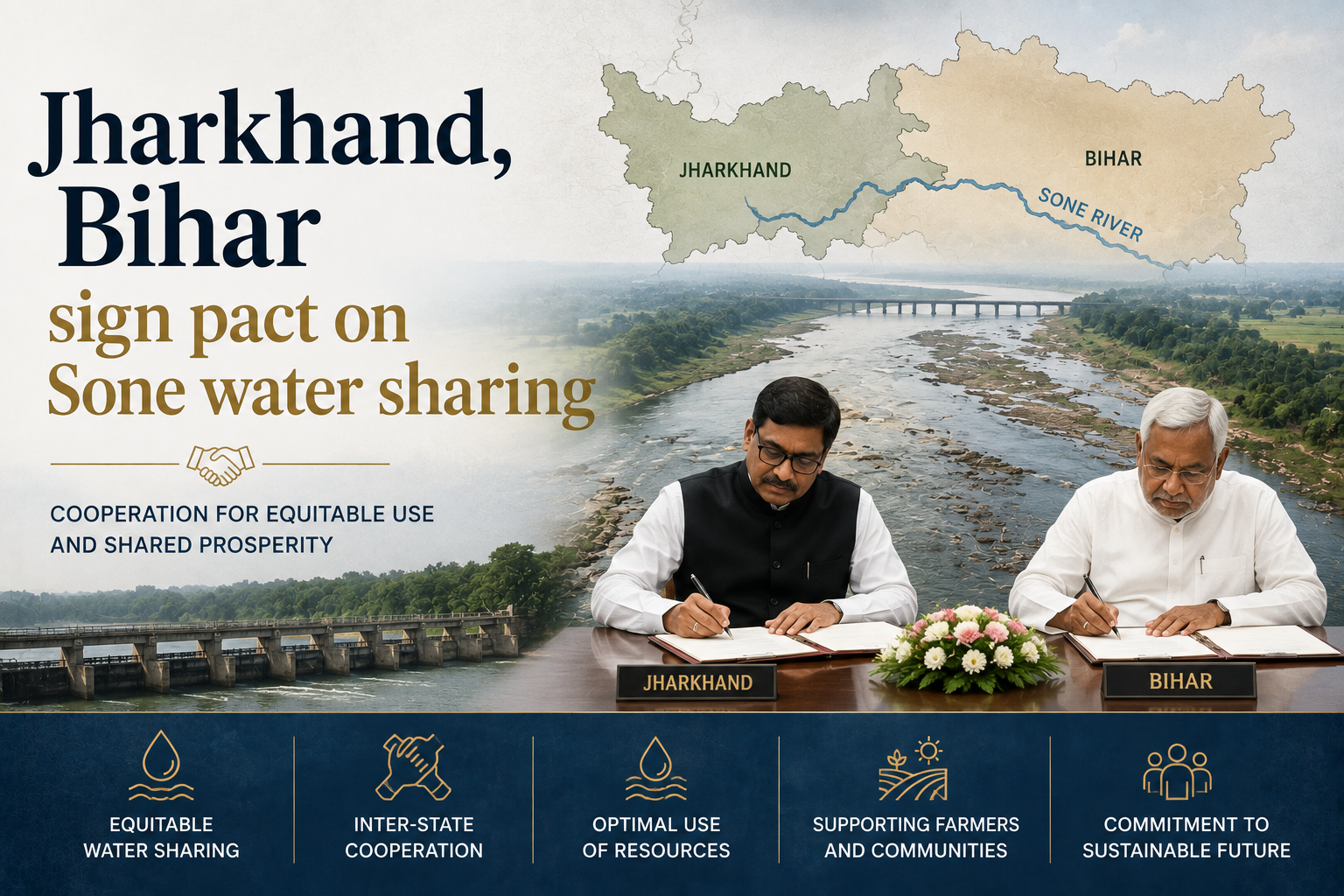
Bihar and Jharkhand have signed a memorandum of understanding on sharing the water of the Sone river, allocating 5.75 million acre feet to Bihar and 2 million acre feet to Jharkhand.
What has been agreed on the Sone, and what was in dispute?
- The dispute was over one inherited allocation: The 1973 agreement allotted 7.75 million acre feet (MAF), one acre foot being the volume that covers an acre of land to a depth of a foot, or about 1,233 cubic metres, to then undivided Bihar.
- Bihar takes the larger share: The formal consensus allocates 5.75 MAF of the river’s water to Bihar.
- Jharkhand takes the remainder: The remaining 2 MAF is allocated to Jharkhand.
- The route chosen is agreement rather than adjudication: The States settled by memorandum instead of taking the claim to a tribunal constituted under the Inter-State River Water Disputes Act, 1956.
What does the settlement change on the ground?
- A long-pending eastern India dispute closes: The agreement resolves a water dispute that had run unresolved between the two States since the bifurcation.
- Irrigation is the stated primary gain: It is expected to provide irrigation water to lakhs of farmers in rural Bihar and rural Jharkhand.
- Drinking water supply is the second use: It is also expected to supply drinking water to a large population across both States.
- It is the fourth such deal this year: This is the fourth water agreement concluded between States in the year, each intended to raise water availability for irrigation, rural development and drinking purposes.
Challenges to the Sone water sharing agreement
- An executive memorandum carries no adjudicatory backing: A memorandum binds two governments politically and gives neither a forum to enforce it when a release is withheld. Eg. The Krishna and Cauvery allocations required tribunal awards under the Inter-State River Water Disputes Act, 1956 and were litigated for decades afterwards.
The Fix: Convert the split into a scheduled allocation under a joint Sone board with a statutory review clause and a defined dispute reference. - A fixed annual quantity assumes a fixed annual yield: An allocation stated in acre feet holds only in a normal year, and the Sone’s flow is monsoon dominated and highly variable. Eg. The Indrapuri barrage at Dehri has repeatedly failed to fill its canal command in deficit years.
The Fix: Restate the split as a share of realised flow measured at agreed gauging points, with a separate lean season protocol. - No joint measurement machinery is named: Neither State is committed to a common gauging point or a common data record, so each will compute its own entitlement from its own readings. Eg. The Cauvery dispute turned for years on the absence of agreed real-time flow data at the inter-State point.
The Fix: Install telemetered gauges at the State boundary and publish daily flow and release data on a single public portal. - Upstream storage decisions sit outside the deal: New reservoirs and diversions on tributaries above the boundary change what reaches the downstream State without breaching any allocation figure. Eg. Storage projects on Sone basin tributaries in Jharkhand alter the flow arriving at Bihar’s canal headworks.
The Fix: Make any new storage above the boundary subject to prior consultation with a defined objection window for the downstream State. - Delivery efficiency is untouched by the allocation: A larger paper share does not reach a farmer where the canal system loses much of the release before the tail end. Eg. Unlined and silted distributaries in the Sone canal command leave tail end villages dependent on groundwater in the same season the head reach is irrigated.
The Fix: Tie the drawal of the agreed share to verified canal lining and command area development milestones reported annually.
Conclusion
Bihar-Jharkhand Sone water agreement is a positive step toward cooperative river management, improving irrigation and drinking water availability. With transparent monitoring, flexible sharing during droughts and joint planning, it can ensure long-term water security and regional development.
Back2Basics: Sone River
- Source and course: It rises on the Amarkantak plateau in Madhya Pradesh, close to the source of the Narmada, and flows in the opposite direction to it.
- Status in the Ganga system: It is the largest of the southern tributaries of the Ganga, and it joins the main river upstream of Patna.
- States traversed: Its course runs through Madhya Pradesh, Uttar Pradesh, Chhattisgarh, Jharkhand and Bihar.
- Principal structure: The Indrapuri barrage at Dehri feeds the Sone canal system, among the oldest large canal networks built in India.
“[2013, GS2, 10 marks] Constitutional mechanisms to resolve the inter-state water disputes have failed to address and solve the problems. Is the failure due to structural or process inadequacy or both? Discuss.”
