Mains Ready By December. Smash Mains & Smash PYQ Admissions Open

GS Paper: GS2-02.Functions & responsibilities of the Union and the States; issues and challenges of federal structure;

  • Account for the legal and political factors responsible for the reduced frequency of using Article 356 by the Union Governments since mid 1990s.

    Article 356 empowers the Union to impose President’s Rule in a State when the constitutional machinery fails. Between 1950-1990, it was invoked over 90 times. However, since the mid-1990s, its frequency has declined.

    Grounds of Imposition of President’s Rule

    Article 355 – Union’s duty to protect States and ensure constitutional governance.

    Article 356 – President’s Rule if State govt. cannot be carried on as per Constitution (based on Governor’s report or otherwise).

    Article 365 – If the State fails to comply with Union directions, the President may hold constitutional machinery has failed.

    Legal Factors

    The 38th Amendment (1975) made President’s Rule immune from judicial review, but the 44th Amendment (1978) reversed this, restoring judicial scrutiny.

    S.R. Bommai v. Union of India (1994) Guidelines

    Judicial Review – Proclamation under Article 356 subject to court scrutiny.

    Floor Test Rule – Majority to be tested on the floor of the House, not decided by Governor/President.

    Limits on Dissolution – Assembly cannot be dissolved before Parliament approves President’s Rule.

    Non-Arbitrariness – Political differences or administrative failures do not justify dismissal.

    Basic Structure Check – Federalism held as part of the Basic Structure; arbitrary use of Article 356 violates it.

    Subsequent Judicial Oversight – SC interventions in Uttarakhand (2016) and Arunachal Pradesh (2016) reinstated governments, reinforcing judicial limits on Centre’s power.

    Evolving Constitutional Conventions – Growing acceptance that President’s Rule is an exceptional remedy of last resort.

    Political Factors

    Rise of Coalition Politics (Post-1990s) – NDA, UPA and regional coalitions ensured that Centre relied on States for stability, reducing incentive for dismissals.

    Rise of Regional Parties – Strong regional satraps made dismissal politically costly, pushing Union towards consensus-based federalism.

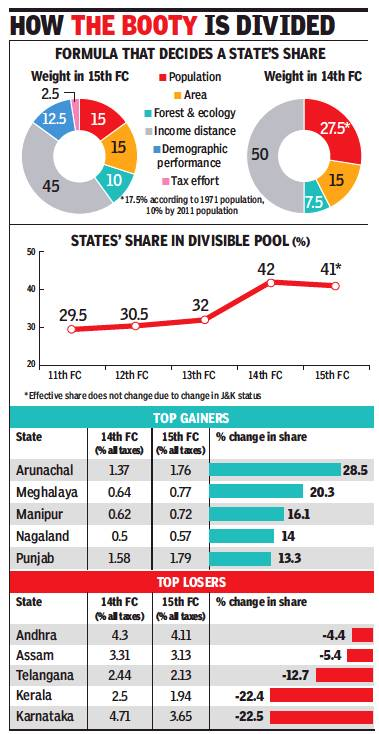
    LPG Reforms (1991 onwards) shifted focus from political control to economic autonomy of states. Eg – 14th Finance Commission (2015) increased States’ share of divisible tax pool from 32% to 42%, strengthening fiscal federalism.

    Maturation of Federal Culture – Growth of cooperative federal institutions (Inter-State Council, GST Council, NITI Aayog) created forums for resolving Centre-State disputes outside coercive measures.

    Stable Majority Governments in States – As governance matured, strong state leadership and regional mandates reduced chances of political instability being exploited by the Union.

    Active Role of President – In 1997, President K.R. Narayanan returned the Cabinet’s recommendation for President’s Rule in Uttar Pradesh.

    Integrity of Governors – In 1990-91, Governor Surjit Singh Barnala refused Centre’s directive to recommend President’s Rule in Tamil Nadu.

    Though the frequency of Article 356 has reduced, instances like Maharashtra (2019) show it is still misused. Thus, the way forward is

    Punchhi Commission

    Localized use of Article 356 – applicable to a district or part of a district, not the whole State.

    Emergency duration should be limited to 3 months only.

    Sarkaria Commission

    Last resort – Invoke Article 356 only when all alternatives fail.

    Prior warning to the State and exploration of alternate solutions required.

    Proclamation must state material facts, ensuring Parliamentary control.

    Governor’s report should be a speaking document with wide publicity.

    Obtain State’s explanation before action.
    Federalism

  • What changes has the Union Government recently introduced in the domain of Centre-State relations? Suggest measures to be adopted to build the trust between the Centre and the States and for strengthening federalism.

    As per Granville Austin, India is a “cooperative federalism” model, where Centre and States are bound in a “seamless web” to achieve socio-economic revolution. The recent changes highlight the spirit of ‘competitive-cooperative federalism’.

    Recent Changes in Centre-State Relations

    Legislative

    Farm Acts, 2020 – Parliament legislated in agriculture (State subject) under Concurrent List.

    GNCTD (Amendment) Act, 2021 – Enhanced LG’s powers in Delhi.

    All India Services rules amendment – Greater Centre control over deputation/discipline.

    Executive / Institutional

    Governor-State tensions – Delayed assent to bills (TN, Kerala, WB).

    Pandemic handling – Centralised lockdown and restrictions.

    Revival of Inter-State Council

    NITI Aayog – Replaced Planning Commission

    Financial

    15th Finance Commission – New devolution formula using 2011 census and performance criteria.

    GST Council – Extended GST compensation cess.

    Rise in cess & surcharges – increased from 10.4% in 2011-12 to 20% in 2021-22.

    Conditional borrowing – Linked to reforms under FRBM/Art. 293.

    Issues in Centre-State Relations

    Financial Issues

    Cesses & surcharges not shared with States.

    Special category status demand – Bihar, Andhra Pradesh.

    Finance Commission TOR – (e.g., use of 2011 Census penalising southern States).

    GST regime – Delayed compensation, reduced fiscal autonomy.

    Administrative Issues

    Governor’s appointment & dismissal (Art. 156) – Often politically motivated

    Control over All India Services

    Central agencies’ overreach – CBI, ED, NIA operating in States without consent.

    Legislative Issues

    Encroachment on State List – use of Epidemic Diseases Act, 1897 and Disaster Management Act, 2005 in public health (a State subject).

    Measures to Build Trust & Strengthen Federalism

    Sarkaria Commission (1983-88)

    Inter-State Council (Art. 263) to be activated as a permanent forum for consultation.

    Governor’s role – should be impartial; appointment in consultation with CM.

    Centre’s use of Art. 356 – to be a measure of last resort.

    All India Services – joint consultation in rules of recruitment, posting, and deputation.

    Punchhi Commission (2007-10)

    Clear guidelines for Governor’s office – fixed tenure, limited discretion, no arbitrary withholding of assent to bills.

    Concurrent List – reduce overlap by greater consultation before Union laws are enacted.

    National Commission to Review the Working of the Constitution (NCRWC, 2000)

    Decentralisation – strengthen local bodies and fiscal devolution.

    Inter-Governmental Forums – regular meetings between PM and CMs to resolve disputes.

    Second Administrative Reforms Commission (2nd ARC, 2005-09)

    Neutral federal institutions – e.g., CBI under Lokpal for credibility, not political misuse.

    Fiscal federalism – ensure predictability in devolution; reduce tied grants in Centrally Sponsored Schemes.

    Finance Commission Recommendations

    Suggested GST Council as a true federal forum for resolving fiscal disputes.

    “Federalism is not a monolith; it is a dialogue between self-rule and shared rule.” Thus, such Acts must be exercised with consultation and cooperation.

  • Examine the evolving pattern of Centre-State financial relations in the context of planned development in India. How far have the recent reforms impacted the fiscal federalism in India?

    Fiscal federalism refers to the financial relations between centre and states, covering the division of taxation powers, expenditure responsibilities, and transfer mechanisms. Article 268 – 293 deal with Fiscal Federalism in India.

    Evolving Pattern of Centre-State Financial Relations in Planned Development

    1950-1990- Centralised Planning Era

    The Planning Commission controlled transfers through discretionary plan grants.

    The Finance Commission played a limited role in fiscal transfers.

    The Centre shaped State priorities through proliferation of CSS.

    1991-2014- Reform & Decentralisation Phase

    Economic liberalisation gave States more fiscal autonomy in revenue and expenditure.

    Introduction of VAT (2005) boosted State revenues through a buoyant tax base.

    CSS were rationalised but tied funds still constrained State flexibility.

    2015 onwards- New Federalism Phase

    The 14th Finance Commission raised devolution to 42%, enhancing fiscal space for States.

    NITI Aayog replaced the Planning Commission and adopted a consultative approach.

    GST (2017) introduced pooled sovereignty and created a shared tax regime.

    The 15th Finance Commission continued 41% devolution but increased performance-linked grants.

    Impact of Recent Reforms on Fiscal Federalism

    Positive Impacts

    Institutionalised Cooperative Federalism – GST Council as joint decision-making forum.

    Economic Efficiency – GST reduced cascading taxes, transport time cut by 33%, tax base expanded from 66 lakh (2017) to 1.5 crore+ (2024), collections near .

    Strengthened Development Role – States’ developmental expenditure rose from 8.8% of GDP (2004-05) to 12.5% (2021-22).

    Negative Impacts

    The Centre retains major taxation powers (income tax, CGST, natural resources), while States restricted to SGST.

    Cesses & surcharges grew, shrinking States’ effective share from 35% (2015-20) to ~31% (2020-24).

    Delayed GST compensation, especially during COVID, undermined States’ trust.

    Borrowing capped at 3% of GSDP, with enhanced limits tied to reform conditions (e.g., power sector).

    The 15th FC’s 45% income distance weight penalised better-performing States (TN, Kerala, Karnataka).

    Grants-in-aid declined from to , reducing States’ fiscal flexibility.

    CSS burden increased as States finance a larger share but have little role in design.

    Way Forward

    Equity in devolution – Use HDI as a parameter in horizontal tax distribution.

    Off-budget borrowings – Scrutinise and report to ensure transparency and accountability.

    Horizontal imbalance – Guarantee minimum share for rich States and set a ceiling for poorer States.

    Increase Devolution to 50% under 16th FC.

    Include Cess/Surcharge in divisible pool

    Restructure CSS – Consolidate into fewer umbrella schemes

    For India’s fiscal federalism to be effective, it must rest on the principles of autonomy, adequacy, and elasticity.

  • Discuss the nature of Jammu and Kashmir Legislative Assembly after the Jammu and Kashmir Reorganization Act, 2019. Briefly describe the powers and functions of the Assembly of the Union Territory of Jammu and Kashmir.

    The Jammu and Kashmir Reorganization Act, 2019, following the abrogation of Article 370 and 35A, reorganized the former State of J&K into two Union Territories – Jammu & Kashmir (with legislature) and Ladakh (without legislature).

    Nature of J&K Legislative Assembly after the J&K Reorganization Act, 2019

    The UT of J&K Assembly resembles that of Delhi and Puducherry, functioning under Article 239A with limited law-making powers.

    The Lieutenant Governor (LG) is the head of the UT, appointed by the President, and wields greater authority than Governors of states.

    The Assembly has a five-year term (not six as earlier).

    Abolition of J&K Legislative Council – Bicameralism ended, Assembly became unicameral.

    Out of 107 seats in J&K Assembly-

    83 elected,

    24 reserved for Pakistan-occupied Kashmir (PoK),

    5 to be nominated by the LG, including 2 women (as per the Act, 2019 amendment 2023).

    Powers and Functions of J&K Legislative Assembly

    Legislative Powers

    Can legislate on subjects of the State List, except public order, police and concurrent list subject.

    Section 36 – Financial Bills in J&K UT can be introduced or moved in the Legislative Assembly only on the recommendation of the Lieutenant Governor.

    Laws require assent of the LG, who may refer bills to the President.

    Executive Oversight

    The Council of Ministers, headed by the Chief Minister, is collectively responsible to the Assembly.

    The Assembly exercises oversight through questions, motions, debates, and budget control.

    However, Section 53 – LG acts in discretion on matters related to All India Services & Anti-Corruption Bureau.

    Financial Powers

    Can pass the annual budget and authorize expenditure from the Consolidated Fund of J&K.

    Money Bills require the prior recommendation of the LG.

    The J&K Legislative Assembly post-2019 is a restricted legislature, balancing democratic representation with the Union’s direct control over sensitive subjects.