Mains Ready By December. Smash Mains & Smash PYQ Admissions Open

GS Paper: GS2-02.Functions & responsibilities of the Union and the States; issues and challenges of federal structure;

  • Under what circumstances can the Financial Emergency be proclaimed by the President of India? What consequences follow when such a declaration remains in force?

    The framers of the Indian Constitution, drawing from the experience of political and economic instability during colonial times, provided for Financial Emergency under Article 360.

    Circumstances for Proclamation

    The President may proclaim a Financial Emergency if he is satisfied that the financial stability or credit of India, or any part thereof, is threatened.

    Such a proclamation must be approved by both Houses of Parliament within 2 months (30 days if Lok Sabha is dissolved).

    Once approved, it remains in force until revoked by the President; no maximum time limit is prescribed.

    Consequences of Financial Emergency

    Union Control over State Finances – The Union can direct States to follow financial discipline and reduce expenditure.

    Reservation of Money Bills – All State Money Bills must be reserved for the President’s approval.

    Reduction of Salaries – The President may direct reduction in salaries and allowances of persons serving the Union or State, including judges of the Supreme Court and High Courts.

    Executive Directions – Union may issue binding directions to States regarding financial propriety.

    Centralisation of Fiscal Powers – Parliament acquires a dominant role in fiscal management, subordinating State autonomy.

    Though never invoked in India, the provision of Financial Emergency underscores the precautionary design of the Constitution.
  • From the resolution of contentious issues regarding distribution of legislative powers by the courts, ‘Principle of Federal Supremacy’ and ‘Harmonious Construction’ have emerged. Explain.

    As per Ivor Jennings, India is “a federation with a strong centralising tendency.” The 7th Schedule is a reflection of this tendency.

    Contentious Issues regarding Distribution of Legislative Powers

    Concurrent List repugnancy – Eg- Education (Concurrent List, Entry 25) – Centre’s NEET law vs Tamil Nadu’s opposition to it.

    Residuary powers with the Union

    Under Article 249, Rajya Sabha can empower Parliament to legislate on State List subjects. Eg- Essential Commodities Act (food items, agricultural produce).

    During National Emergency (Art. 250) or President’s Rule (Art. 356), Parliament can legislate on State subjects.

    Principle of Federal Supremacy

    In cases of irreconcilable conflict, Union law prevails over State law.

    Judicial Validation–

    Union of India v. H.S. Dhillon (1972) – Parliament has residuary powers.

    State of Karnataka v. Union of India (1977) – Union’s primacy in matters of national importance.

    State of West Bengal v. Union of India (1963) – SC upheld Parliament’s power to acquire State property.

    Zameer Ahmed Latifur Rehman Sheikh v. State of Maharashtra (2010) – SC ruled that a central money laundering law overrides conflicting State law under Article 254(1).

    Protects national unity and uniformity in crucial subjects.

    Principle of Harmonious Construction

    Courts attempt to reconcile conflicts so that both Union and State laws can function simultaneously.

    Judicial Validation–

    In C.B. Boarding and Lodging v. State of Mysore (1970), the SC upheld the State’s power to levy tax on lodging houses, even though taxation on income was a Union subject.

    State of Rajasthan v. G. Chawla (1959) – Both Centre and State laws upheld through harmonious interpretation.

    Hoechst Pharmaceuticals v. State of Bihar (1983) – Repugnancy avoided through reconciliation.

    Preserves federal balance and safeguards state autonomy.

    “Federalism is not a monolith; it is a dialogue between self-rule and shared rule.” Both Union & States are creatures of the Constitution

  • Indian Constitution exhibits centralising tendencies to maintain unity and integrity of the nation. Elucidate in the perspective of the Epidemic Diseases Act, 1897; The Disaster Management Act, 2005 and recently passed Farm Acts.

    According to Paul Brass “Indian federalism is highly centralized, designed more to maintain unity than to promote autonomy.”

    Centralising Tendencies in the Indian Constitution

    Legal (Constitutional & Legislative)

    Residuary Powers (Art. 248, Entry 97 Union List) – Vested in Parliament, not States.

    Dominance of Union List (Art. 246) – 100 subjects; State List is narrower.

    Concurrent List (Art. 254) – Union law prevails in case of conflict.

    Emergency Provisions (Arts. 352, 356, 360) – Centre can override State powers.

    Parliament can legislate on State subjects under Art. 249.

    Governor’s Role (Art. 200, 201)

    Administrative

    All-India Services (Art. 312)

    Office of Governor – Agent of Centre in States

    Union’s directions to States (Arts. 256-257) – States bound to ensure compliance with Union laws.

    Deployment of Armed Forces

    Financial

    Centralised Finance – Major revenue sources (income tax, customs, excise, GST) with Union.

    Borrowing restrictions (Art. 293) – States require Centre’s consent to borrow.

    Cess and surcharges (Art. 270) not shared with States (Eg- Education Cess, Health Cess)

    GST regime – Erodes States’ fiscal autonomy.

    Centralising Tendencies in Indian Constitution

    Epidemic Diseases Act, 1897

    Public Health is a State List subject (Entry 6, List II), but the Centre can issue uniform guidelines.

    Empowers Centre to declare any disease as epidemic.

    Union can issue regulations for prevention and containment.

    Authority to restrict movement and detain individuals during epidemics.

    Centre can override conflicting State laws.

    Disaster Management Act, 2005

    Law and order and public health are primarily State subjects, but Act was used to declare nationwide lockdowns, interstate movement controls, and essential supply chains during COVID-19.

    State Disaster Management Authorities (SDMA) include central representatives.

    Union controls allocation and distribution of resources across States.

    Centre can override States’ decisions in disaster response.

    National Response Force primarily drawn from central armed forces.

    Farm Acts, 2020 (repealed in 2021)

    Though Agriculture is a State List subject, Parliament legislated under Concurrent List (Entry 33).

    Weakened State APMC mandis by allowing farmers to sell outside their jurisdiction.

    Dispute resolution mechanisms

    Gave Centre greater control over regulation of essential commodities.

    Enhanced central role in agri-marketing and e-marketing of produce.

    Analysis of Centralising Tendencies

    “Federalism is not a monolith; it is a dialogue between self-rule and shared rule.” Thus, such Acts must be exercised with consultation and cooperation.

  • How far do you think cooperation, competition and confrontation have shaped the nature of federation in India? Cite some recent examples to validate your answer.

    As per Rajeev Bhargava, Indian federalism is “multi-layered federalism”, involving cooperation, competition and confrontation.

    Cooperation – Building Cooperative Federalism

    GST Council (2017-present)– Example of Centre-State cooperation in indirect tax reform.

    NITI Aayog– Platform for policy collaboration on health, education, climate, and SDGs.

    COVID-19 Pandemic (2020-21)– Joint management of lockdowns, vaccination drives, and health protocols.

    National Education Policy 2020– Designed through Centre-State consultations.

    Competition – Driving Competitive Federalism

    Ease of Doing Business rankings by DPIIT– States competing to attract investment.

    Investment Summits – Gujarat (Vibrant Gujarat), UP (GIS 2023)

    NITI Aayog Indices – Eg- SDG Index, Health Index etc

    Tourism branding – Kerala (eco-tourism), MP (wildlife), Odisha (sports tourism)

    Confrontation – Political and Constitutional Tensions

    Delhi vs Union (2018 & 2023 SC rulings, GNCTD Amendment Act 2023)– Tussle over control of services and administration.

    Farm Laws (2020-21 protests)– States like Punjab opposed Union laws encroaching on agriculture.

    NEET & Education policy– Tamil Nadu contesting Centre’s dominance in education, a Concurrent List subject.

    Governor-State conflicts– Frequent in Kerala, West Bengal, and Tamil Nadu over assent to bills.

    Fiscal confrontations– Disputes over GST compensation cess (2020-22).

    Centrally sponsored schemes– States complain of shrinking fiscal autonomy due to high tied grants.

    “Federalism is not a monolith; it is a dialogue between self-rule and shared rule.” Both Union & States are creatures of the Constitution

  • Explain the significance of the 101st Constitutional Amendment Act. To what extent does it reflect the accommodative spirit of federalism?

    The 101st Constitutional Amendment Act, 2016 introduced the Goods and Services Tax (GST) with effect from July 1, 2017. It was a landmark tax reform aimed at creating a “One Nation, One Tax, One Market” framework.

    Significance of the 101st Amendment Act

    Unified Taxation System – Subsumed 17 central & state taxes and 23 cesses, removing cascading effects.

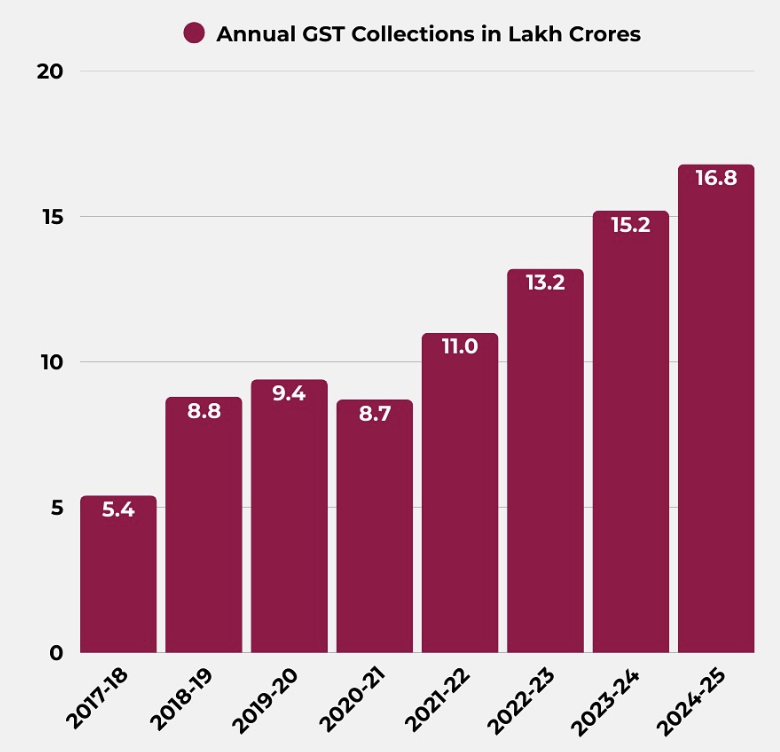
    Expansion of Tax Base – Taxpayers increased from 66 lakh (2017) to over 1.5 crore (2024).

    Revenue Growth – Tax base rose from over a decade (CAGR 14.4%); average monthly collections near .

    Economic Efficiency – Eliminated cascading effects of taxation and reduced compliance costs.

    Household Savings – Reduced overall tax burden, saving families ~4% on monthly expenses.

    Ease of Doing Business – Unified national market and reduced transport time by 33%, improving efficiency.

    Digital Governance – GSTN ensured transparency, compliance, and reduced evasion.

    GST Reflecting the Accommodative Spirit of Federalism

    Institutionalised Cooperative Federalism – The GST Council (Art. 279A) is a federal forum of Union and State Finance Ministers deciding by consensus (3/4th majority).

    Pooled Sovereignty – Both Union and States share taxing powers under Article 246A, representing co-ownership of fiscal authority.

    Balanced Federal Approach – Dual GST (CGST + SGST) integrates economies while maintaining State autonomy.

    Fiscal Balance – Provided States 5-year compensation for revenue loss, cushioning transition.

    Special Provisions – Petroleum, alcohol, electricity kept outside GST, respecting States’ revenue needs.

    Challenges

    Complex multi-tier rate structure increases compliance burden.

    Frequent rate revisions affect business stability.

    GST Council decided to do away with the compensation cess

    Revenue shortfalls weaken State finances.

    Centre’s Dominance – Weighted voting gives Centre 33%.

    Way Forward

    Revive National Anti-Profiteering Authority to ensure rate cuts are passed on to customers

    Periodic technological upgrades in GSTN.

    Strengthen dispute resolution mechanism within GST Council.

    As the Supreme Court (Mohit Minerals, 2022) clarified, GST Council recommendations are not binding, reaffirming that India’s federalism is based on cooperation, not coercion.