💥Join UPSC 2027,2028 Mentorship (July Batch) + XFactor Notes & Microthemes PDF

GS Paper: Intellectual Property Rights

  • Kashmir saffron gets GI certificate

    The J&K administration has issued the certificate of geographical indication (GI) registration for saffron grown in the Kashmir Valley.

    Must read:

    GI Tags in news for 2020 Prelims

    All time GI tags in news

    Kashmir saffron

    • It is cultivated and harvested in the Karewa (highlands) in some regions of Kashmir, including Pulwama, Budgam, Kishtwar and Srinagar.
    • It is a very precious and costly product. Iran is the largest producer of saffron and India is a close competitor.
    • It rejuvenates health and is used in cosmetics and for medicinal purposes.
    • It has been associated with traditional Kashmiri cuisine and represents the rich cultural heritage of the region.
    • Saffron cultivation is believed to have been introduced in Kashmir by Central Asian immigrants around 1st Century BCE. In ancient Sanskrit literature, saffron is referred to as ‘bahukam’.

    3 Types

    The saffron available in Kashmir is of three types —

    • ‘Lachha Saffron’, with stigmas just separated from the flowers and dried without further processing;
    • ‘Mongra Saffron’, in which stigmas are detached from the flower, dried in the sun and processed traditionally; and
    • ‘Guchhi Saffron’, which is the same as Lachha, except that the latter’s dried stigmas are packed loosely in air-tight containers while the former has stigmas joined together in a bundle tied with a cloth thread

    Whats’ so special about Kashmir Saffron?

    • The unique characteristics of Kashmir saffron are its longer and thicker stigmas, natural deep-red colour, high aroma, bitter flavour, chemical-free processing, and high quantity of crocin (colouring strength), safranal (flavour) and picrocrocin (bitterness).
    • It is the only saffron in the world grown at an altitude of 1,600 m to 1,800 m AMSL (above mean sea level), which adds to its uniqueness and differentiates it from other saffron varieties available the world over.
  • GI tag for Sohrai Khovar painting, Telia Rumal

    Jharkhand’s Sohrai Khovar painting and Telangana’s Telia Rumal were given the Geographical Indication (GI) tag by the Geographical Indications Registry.

    This year, many GI tags have been allocated. A few of them to count are- Kashmir saffron, Manipur black rice, Gorakhpur terracotta, Kovilpatti kadalai mittai etc.  Check here for more.

    Sohrai Khovar painting

    • The Sohrai Khovar painting is a traditional and ritualistic mural art being practised by local tribal women in the area of Hazaribagh district of Jharkhand.
    • The painting is primarily being practised only in the district of Hazaribagh. However, in recent years, for promotional purposes, it has been seen in other parts of Jharkhand.
    • It is prepared during local harvest and marriage seasons using local, naturally available soils of different colours in the area.
    • Traditionally painted on the walls of mud houses, they are now seen on other surfaces, too.
    • The style features a profusion of lines, dots, animal figures and plants, often representing religious iconography.
    • In recent years, the walls of important public places in Jharkhand, such as the Birsa Munda Airport in Ranchi, and the Hazaribagh and Tatanagar Railway Stations, among others, have been decorated with these paintings.

    Telia Rumal

    • Telia Rumal cloth involves intricate handmade work with cotton loom displaying a variety of designs and motifs in three particular colours — red, black and white.
    • The Rumal can only be created using the traditional handloom process and not by any other mechanical means as otherwise, the very quality of the Rumal would be lost.
    • During the Nizam’s dynasty, Puttapaka, a small, backward village of the Telangana region of Andhra Pradesh had about 20 families engaged in handloom weaving, who were patronized by rich families and the Nizam rulers.
    • The officers working in the court of the Nizam would wear the Chituki Telia Rumal as a symbolic representation of status.
    • Telia Rumals were worn as a veil by princesses at the erstwhile court of the Nizam of Hyderabad, and as a turban cloth by Arabs in the Middle East.

    Back2Basics: Geographical Indications in India

    • A Geographical Indication is used on products that have a specific geographical origin and possess qualities or a reputation that are due to that origin.
    • Such a name conveys an assurance of quality and distinctiveness which is essentially attributable to its origin in that defined geographical locality.
    • This tag is valid for a period of 10 years following which it can be renewed.
    • Recently the Union Minister of Commerce and Industry has launched the logo and tagline for the Geographical Indications (GI) of India.
    • The first product to get a GI tag in India was the Darjeeling tea in 2004.
    • The Geographical Indications of Goods (Registration and Protection) Act, 1999 (GI Act) is a sui generis Act for protection of GI in India.
    • India, as a member of the WTO enacted the Act to comply with the Agreement on Trade-Related Aspects of Intellectual Property Rights
    • Geographical Indications protection is granted through the TRIPS Agreement.
  • Kashmir saffron gets GI tag

    Kashmir saffron has been given the Geographical Indication (GI) tag by the Geographical Indications Registry.

    Must read:

    GI Tags in news for 2020 Prelims

    All time GI tags in news

    Kashmir saffron

    • It is cultivated and harvested in the Karewa (highlands) in some regions of Kashmir, including Pulwama, Budgam, Kishtwar and Srinagar.
    • It is a very precious and costly product. Iran is the largest producer of saffron and India is a close competitor.
    • It rejuvenates health and is used in cosmetics and for medicinal purposes.
    • It has been associated with traditional Kashmiri cuisine and represents the rich cultural heritage of the region.
    • Saffron cultivation is believed to have been introduced in Kashmir by Central Asian immigrants around 1st Century BCE. In ancient Sanskrit literature, saffron is referred to as ‘bahukam’.

    3 Types

    The saffron available in Kashmir is of three types —

    • ‘Lachha Saffron’, with stigmas just separated from the flowers and dried without further processing;
    • ‘Mongra Saffron’, in which stigmas are detached from the flower, dried in the sun and processed traditionally; and
    • ‘Guchhi Saffron’, which is the same as Lachha, except that the latter’s dried stigmas are packed loosely in air-tight containers while the former has stigmas joined together in a bundle tied with a cloth thread

    Whats’ so special about Kashmir Saffron?

    • The unique characteristics of Kashmir saffron are its longer and thicker stigmas, natural deep-red colour, high aroma, bitter flavour, chemical-free processing, and high quantity of crocin (colouring strength), safranal (flavour) and picrocrocin (bitterness).
    • It is the only saffron in the world grown at an altitude of 1,600 m to 1,800 m AMSL (above mean sea level), which adds to its uniqueness and differentiates it from other saffron varieties available the world over.
  • Rethinking the role of Intellectual Property in Corona crisis

    The article discusses the idea of creating a patent pool of the patents dealing with Covid-19. Such a patent pool will be effective in avoiding the possibility of the hostile response of societies towards patent rights. And also avoid the conflict between nations. corporations and international organisations.

    Purpose of patent rights

    • The purpose of creating and recognising patent rights is for the common public good, i.e., innovation should be made public in exchange for a limited monopoly.
    • Thus, patents need to be disclosed to the public in order to enable further research.
    • Should pandemics such as COVID-19be an exception to this?
    • With the outbreak of COVID-19, there are several innovations.
    • All these innovations may be the subject matter of patent applications around the world.
    • It will be a few years before patents are even granted.
    • However, friction already exists among various stakeholders.
    • For instance, one country made attempts to obtain exclusive rights to a vaccine being developed.
    • On the other hand, there are also collaborations taking place.
    • However, the spirit of collaborative solutions is only on the anvil.
    • The question that arises is whether the exclusivity that is recognised by patent rights will be detrimental to society.
    • Will patents create roadblocks or is there a solution?

    Possibility of conflicts over patent rights

    • Governments and international organisations need to arrive at a consensus in advance to ensure that the system is ready.
    • Procrastination would be disastrous.
    • Creating hindrances through exclusivity claims, in the wake of a pandemic, will result in dividing countries, corporations and international organisations.
    • This will not benefit patients and the world as a whole.
    • If patent owners create impediments on the strength of patent rights, the world will start despising patents and that is not a situation IP owners ought to be in.
    • Under the TRIPS (Trade-Related Aspects of Intellectual Property Rights) regime, there are several tools such as compulsory licensing that are available to ensure access to medicines.
    • However, beyond the laws, society needs to respect innovation.
    • To protect the sanctity and integrity of patent systems, and in order to ensure that an anti-IP sentiment is not generated globally, answers need to be found within the existing regime.
    • In exceptional circumstances such as these, there is a likelihood that societies may resort to extreme steps to protect themselves.
    • Before such ideas are floated, solutions should be created.

    The idea of creating a patent pool

    • One method by which aggregation and dissemination of innovative products can be ensured is by creating a patent pool.
    • Patent pools are usually effective in aggregating, administering and licensing patents related to specific areas of technology.
    • Such pools are usually managed by a central agency and the patents which become part of the pool are readily made available for licensing.
    • Some pools even publish the royalty rates payable for such licences.
    • Anyone who wishes to obtain a licence will be able to approach the pool, agree to the terms, and begin to manufacture and sell the products.
    • Such pools are prevalent in, for instance, standard essential patents related to telecom and digital innovations.
    • At the moment, individual efforts are being made by research organisations to create their own pools.
    • A more fruitful endeavour would be to create a global pool of COVID-19-related innovations, or innovations related to rare pandemics, in respect of vaccines and medicines.
    • This could be managed by a trustworthy international organisation.
    • All countries ought to have the right to implement these innovations without further permission from the patent-holders.
    • This would not require countries resorting to provisions such as compulsory licensing, state acquisition, etc.
    • Even if royalties are at a minimal level, the revenues would still be in billions of dollars owing to the large swathes of the population affected by the pandemic, who will need to be administered these products.

    Way forward

    • Creation of a pool and immediate licensing will ensure that there are hundreds of manufacturers across the world.
    • As a result, vaccines and medicines will be quickly available.
    • Such a pool needs the cooperation of not just countries and international organisations but also the hundreds of researchers, innovators, companies and universities involved.
    • Doha Declaration: Pooling of patent resources is also in line with the Doha Declaration on Public Health which is a part of the TRIPS agreement.
    • This declaration recognises the need for taking measures to ‘protect public health’ and ‘promote access to medicines’.

    A direct question on the issue can be asked by the UPSC, for ex-“Though IPRs have been provided to respect and protect the innovations and ideas, but in the wake of corona crisis, some strict provisions need to be changed. In light of the above statement, discuss the limitations of the exclusivity clause under the patents rights. And how can it be overcome in emergency situations?”

    Conclusion

    Public-private partnerships (PPP) need to be scaled up. Creation of the ‘PPP-pandemic patent pool’ at a global level, to pool all innovations, is the way forward. Let us not wait any longer.

  • GI tag to Manipur black rice, Gorakhpur terracotta and Kovilpatti kadalai mittai

    Chak-Hao, the black rice of Manipur and the Gorakhpur terracotta and the Kovilpatti kadalai mittai of Tamil Nadu have bagged the Geogrphical Indication (GI) tag.

    Must read: GI Tags in news for 2020 Prelims

    Chak-Hao

    • Chak-Hao, the scented glutinous rice which has been in cultivation in Manipur over centuries.
    • It is characterized by its special aroma. It is normally eaten during community feasts and is served as Chak-Hao kheer.
    • The application for Chak-Hao was filed by the Consortium of Producers of Chak-Hao (Black Rice), Manipur and was facilitated by the Department of Agriculture.
    • Chak-Hao has also been used by traditional medical practitioners as part of traditional medicine.
    • According to the GI application filed, this rice takes the longest cooking time of 40-45 minutes due to the presence of a fibrous bran layer and higher crude fibre content.
    • At present, the traditional system of Chak-Hao cultivation is practised in some pockets of Manipur.
    • Direct sowing of pre-soaked seeds and also transplantation of rice seedlings raised in nurseries in puddled fields are widely practised in the State’s wetlands.

    Gorakhpur terracotta

    • The terracotta work of Gorakhpur is a centuries-old traditional art form, where the potters make various animal figures like, horses, elephants, camel, goat, ox, etc. with hand-applied ornamentation.
    • The application was filed by Laxmi Terracotta Murtikala Kendra in Uttar Pradesh.
    • Some of the major products of craftsmanship include the Hauda elephants, Mahawatdar horse, deer, camel, five-faced Ganesha, singled-faced Ganesha, elephant table, chandeliers, hanging bells etc.
    • The entire work is done with bare hands and artisans use natural colour, which stays fast for a long time.
    • There are more than 1,000 varieties of terracotta work designed by the local craftsmen.
    • The craftsmen are mainly spread over the villages of Aurangabad, Bharwalia, Langadi Gularia, Budhadih, Amawa, Ekla etc. in Bhathat and Padri Bazar, Belwa Raipur, Jungle Ekla No-1, Jungle Ekla No-2 in Chargawan block of Gorakhpur.

    Kovilpatti kadalai mittai

    • It is a candy made of peanuts held together with glistening syrup, and topped with wisps of grated coconut dyed pink, green and yellow.
    • It is made using all natural ingredients such as the traditional and special ‘vellam’ (jaggery) and groundnuts and water from the river Thamirabarani is used in the production, which enhances the taste naturally.
    • It is manufactured in Kovilpatti and adjacent towns and villages in Thoothukudi district.
    • It is produced by using both groundnuts and jaggery (organic jaggery), in carefully selected quantities from selected specific locations in Tamil Nadu.

    Back2Basics: Geographical Indications in India

    • A Geographical Indication is used on products that have a specific geographical origin and possess qualities or a reputation that are due to that origin.
    • Such a name conveys an assurance of quality and distinctiveness which is essentially attributable to its origin in that defined geographical locality.
    • This tag is valid for a period of 10 years following which it can be renewed.
    • Recently the Union Minister of Commerce and Industry has launched the logo and tagline for the Geographical Indications (GI) of India.
    • The first product to get a GI tag in India was the Darjeeling tea in 2004.
    • The Geographical Indications of Goods (Registration and Protection) Act, 1999 (GI Act) is a sui generis Act for protection of GI in India.
    • India, as a member of the WTO enacted the Act to comply with the Agreement on Trade-Related Aspects of Intellectual Property Rights
    • Geographical Indications protection is granted through the TRIPS Agreement
  • Global Intellectual Property Index 2020

    India has been ranked 40th out of 53 countries on a global intellectual property index, even as the country has shown improvement in terms of scores when it comes to the protection of IP and copyright issues.

    GIP Index

    • The Global IP Index was released by Global Innovation Policy Center or GIPC of the US Chambers of Commerce.
    • The GIPC Index consists of five key sets of indicators to map the national intellectual property environment for the surveyed countries.
    • The major indicator categories are:
    1. patents, related rights, and limitations;
    2. copyrights, related rights, and limitations;
    3. trademarks, related rights, and limitations;
    4. enforcement;
    5. membership and ratification of international treaties.

    India’s performance

    • India was placed at 36th position among 50 countries in 2019.
    • India’s score, however, increased from 36.04 per cent (16.22 out of 45) in 2019 to 38.46 per cent (19.23 out of 50) in 2020, a 2.42 per cent jump in absolute score.
    • However, India’s relative score increased by 6.71 per cent.
    • India also continues to score well in the Systemic Efficiency indicator, scoring ahead of 28 other economies in these indicators.

    Challenges for India

    • GIPC has identified several challenges for India. Prominent among them are:

    Patentability requirements, patent enforcement, compulsory licensing, patent opposition, regulatory data protection, transparency in reporting seizures by customs, and Singapore Treaty of Law of TMs and Patent Law Treaty

    Measures to protect IPs in India

    • Since the release of the 2016 National IPR Policy, the government of India has made a focused effort to support investments in innovation and creativity through increasingly robust IP protection and enforcement.
    • Since 2016, India has improved the speed of processing for patent and trademark applications, increased awareness of IP rights among Indian innovators and creators, and facilitated the registration and enforcement of those rights.
    • To continue this upward trajectory, much work remains to be done to introduce transformative changes to India’s overall IP framework and take serious steps to consistently implement strong IP standards.
  • Intellectual Property Rights in India

    What are IPRs?

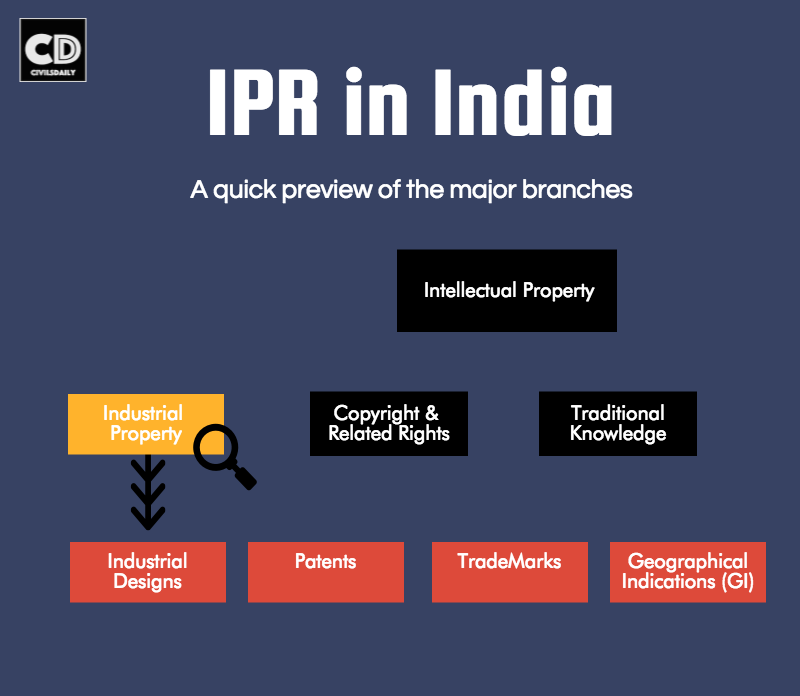
    Intellectual Property Rights (IPRs) are legal rights, which result from intellectual invention, innovation and discovery in the industrial, scientific, literary and artistic fields. These rights entitle an individual or group to the moral and economic rights of creators in their creation.


    Types:

    Patent- It is a set of exclusive rights granted by a sovereign state to an inventor for a limited period of time in exchange for detailed public disclosure of an invention.

    Copyright- It is a legal right created by the law of a country that grants the creator of an original work exclusive rights for its use and distribution. It includes literary & artistic works such as novels, poems, plays, films, musical works, drawing, painting, photography, sculpture, architectural designs

    Trademark- It is a recognizable sign, design, or expression which identifies products or services of a particular source from those of others. Trademarks used to identify services are usually called service marks.

    Industrial design right- It is an intellectual property right that protects the visual design of objects that are not purely utilitarian. An industrial design consists of the creation of a shape, configuration or composition of pattern or color, or combination of pattern and color in three-dimensional form containing aesthetic value. An industrial design can be a two- or three-dimensional pattern used to produce a product, industrial commodity or handicraft.

    Trade secret- It is a formula, practice, process, design, instrument, pattern, commercial method, or compilation of information which is not generally known or reasonably ascertainable by others, and by which a business can obtain an economic advantage over competitors or customers

    Geographical Indication (GI)- It is a name or sign used on certain products which corresponds to a specific geographical location or origin (e.g. a town, region, or country). The use of a geographical indication may act as a certification that the product possesses certain qualities, is made according to traditional methods, or enjoys a certain reputation, due to its geographical origin. A recent example is of Indian variety of Basmati rice getting GI tag.

    From above points, it is clear that IPR is a very sensitive issue in terms of businesses different kinds and international relations as well.

    IPRs in pharmaceutical sector:

    Some sectors are very sensitive in terms of IPRs like pharmaceuticals. Let’s explore briefly into IPR issues in pharmaceutical sector.

    We hear of two kinds of drugs- generic and brand name drugs:

    Generic drugs are those whose patent has expired or does not exist and which can be produced by any registered manufacturer without need of taking permission from any authority and also without any payment of royalty.

    Brand name drugs are those which are patented and cannot be produced without the consent of the patent holder. A royalty is to be paid for production of these drugs.

    But what happens if a company holds patent of an essential drug and there is an emergency in which the drug needs to be provided at low cost for vast populace? In this case, Compulsory Licensing comes to the rescue.

    What is Compulsory Licensing?

    • A compulsory license provides that the owner of a patent or copyright licenses the use of their rights against a payment. This payment is either set by law or determined through some form of arbitration
    • In essence, under a compulsory license, an individual or company seeking to use another’s intellectual property can do so without seeking the rights holder’s consent, and pays the rights holder a set fee for the license
    • This is an exception to the general rule under intellectual property laws that the intellectual property owner enjoys exclusive rights that it may license – or decline to license – to others

    Does there have to be an emergency?

    Not necessarily. This is a common misunderstanding. The TRIPS Agreement does not specifically list the reasons that might be used to justify compulsory licensing. However, the Doha Declaration on TRIPS and Public Health confirms that countries are free to determine the grounds for granting compulsory licences.

    In March 2012, India granted its first compulsory license ever. The license was granted to Indian generic drug manufacturer Natco Pharma Ltd for Sorafenib tosylate, a cancer drug patented by Bayer.

    Here, first thing first, What is TRIPS?

    • TRIPS is an international agreement administered by the World Trade Organization (WTO), which sets down minimum standards for many forms of intellectual property (IP) regulations as applied to the nationals of other WTO Members
    • It was negotiated at the end of the Uruguay Round of the General Agreement on Tariffs and Trade (GATT) in 1994
    • TRIPS requires WTO members to provide copyright rights, covering content producers including performers, producers of sound recordings and broadcasting organizations, geographical indications, including appellations of origin, industrial designs, integrated circuit layout-designs, patents, new plant varieties, trademarks, trade dress, and undisclosed or confidential information
    • The agreement also specifies enforcement procedures, remedies, and dispute resolution procedures

    Now, back to the topic…

    India is a huge market for generic drugs and hence it is very obvious that there must emerge issues out of patents for pharmaceuticals.

    One such case came up in 1998- Novartis v. Union of India & Others

    It was a landmark decision by a two-judge bench of the Supreme Court, on the issue of whether Novartis could patent Glivec in India. It was the culmination of a seven-year-long litigation fought by Novartis. The Supreme Court upheld the Indian patent office’s rejection of the patent application.

    Ground of rejection?

    Novartis claimed patent for he changed form of Glivec on the basis of the increased bio-availability in the body of the patient by making changes in chemical composition of its original anti-cancer drug Imatinib Mesylate. This changed form of the drug could not withstand the ‘enhanced therapeutic efficacy’ test enshrined under Section 3(d) of Indian Patents Act and therefore it was rejected.

    Recently, Gilead got patent for its Hepatitis C drug Solvadi. An application for the same patent was first rejected in January 2015 as lacking inventiveness and novelty. The decision, however, is seen as a major blow to the access to drug movement

    Now let’s turn towards the latest developments in the IPRs in India.

    New IPR Policy

    Govt of India recently released a new National Intellectual Property Rights (IPR) Policy which is in compliance with WTO’s agreement on TRIPS

    Why a new policy?

    • Global drug brands led by US companies have been pushing for changes to India’s intellectual property rules for quite some time now. They have often complained about India’s price controls and marketing restrictions
    • Also, an IPR policy is important for the government to formulate incentives in the form of tax concessions to encourage research and development (R&D)
    • It is also critical to strengthen the Make In India, Startup and Digital India schemes
    • The IPR policy comes at a time when India and other emerging countries faces fresh challenges from the developed world and mega regional trade agreements such as the Trans-Pacific Partnership (TPP)

    Seven objectives:

    1. IPR Awareness: To create public awareness about the economic, social and cultural benefits of IPRs among all sections of society
    2. Generation of IPRs: To stimulate the generation of IPRs
    3. Legal and Legislative Framework: To have strong and effective IPR laws, which balance the interests of rights owners with larger public interest
    4. Administration and Management: To modernize and strengthen service-oriented IPR administration
    5. Commercialization of IPRs: Get value for IPRs through commercialization
    6. Enforcement and Adjudication: To strengthen the enforcement and adjudicatory mechanisms for combating IPR infringements
    7. Human Capital Development: To strengthen and expand human resources, institutions and capacities for teaching, training, research and skill building in IPRs

    Highlights:

    • The new policy calls for providing financial support to the less empowered groups of IP owners or creators such as farmers, weavers and artisans through financial institutions like rural banks or co-operative banks offering IP-friendly loans
    • The work done by various ministries and departments will be monitored by the Department of Industrial Policy & Promotion (DIPP), which will be the nodal department to coordinate, guide and oversee implementation and future development of IPRs in India
    • The policy, with a tagline of Creative India: Innovative India, also calls for updating various intellectual property laws, including the Indian Cinematography Act, to remove anomalies and inconsistencies in consultation with stakeholders
    • For supporting financial aspects of IPR commercialisation, it asks for financial support to develop IP assets through links with financial institutions, including banks, VC funds, angel funds and crowd-funding mechanisms
    • To achieve the objective of strengthening enforcement and adjudicatory mechanisms to combat IPR infringements, it called for taking actions against attempts to treat generic drugs as spurious or counterfeit and undertake stringent measures to curb manufacture and sale of misbranded, adulterated and spurious drugs
    • The policy will be reviewed after every five years to keep pace with further developments in the sector

    International angle:

    Last month, the US Trade Representative kept India, China and Russia on its “Priority Watch List” for inadequate improvement in IPR protection. However, brushing aside concerns of the US on India’s IPR regime, the government said its intellectual property rights laws are legal-equitable and WTO-compliant. Thus, the government has not yielded to pressure from the United States to amend India’s patent laws.

    Benefits:

    • The new policy will try to safeguard the interests of rights owners with the wider public interest, while combating infringements of intellectual property rights
    • By 2017, the window for trademark registration will be brought down to one month. This will help in clearing over 237,000 pending applications in India’s four patent offices
    • It also seeks to promote R&D through tax benefits available under various laws and simplification of procedures for availing of direct and indirect tax benefits
    • Unlike earlier where copyright was accorded to only books and publications, the recast regime will cover films, music and industrial drawings
    • A host of laws will also be streamlined — on semi-conductors, designs, geographical indications, trademarks and patents
    • The policy also puts a premium on enhancing access to healthcare, food security and environmental protection
    • Policy will provide both domestic and foreign investors a stable IPR framework in the country
    • This will promote a holistic and conducive ecosystem to catalyse the full potential of intellectual property for India’s growth and socio-cultural development while protecting public interest
    • It is expected to lay the future roadmap for intellectual property in India, besides putting in place an institutional mechanism for implementation, monitoring and review
    • The idea is to incorporate global best practices in the Indian context and adapt to the same

    Challenges:

    • According to the policy, India will retain the right to issue so-called compulsory licenses to its drug firms, under “emergency” conditions
    • Also, the government has indicated that there is no urgent need to change patent laws that are already fully World Trade Organization-compliant. So India has resisted pressure from the US and other Western countries to amend its patent laws
    • The policy also specifically does not open up Section 3(d) of the Patents Act, which sets the standard for what is considered an invention in India, for reinterpretation


    Published with inputs from Swapnil


  • GI(Geographical Indicator) Tags

    GI status is an indication that identifies goods as produced from a particular area, which has special quality or reputation attributable to its geographical origin.

    India, as a member of the World Trade Organization (WTO), enacted the Geographical Indications of Goods (Registration and Protection) Act, 1999 has come into force with effect from 15 September 2003

    The GI tag ensures that none other than those registered as authorised users (or at least those residing inside the geographic territory) are allowed to use the popular product name.

    In India, a GI’s registry operates in Chennai in accordance with the provisions of the Geographical Indications of Goods (Registration and Protection) Act 1999, which came into effect in September 2003.

    India has 236 GI products registered so far and over 270 more products have applied for the label. Let’s take a look at 10 such geographical indicators in India.

    To follow up with latest developments on GI tags –