💥Join UPSC 2027,2028 Mentorship (August Batch) + XFactor Notes & Microthemes PDF

GS Paper: Representation Of People’s Act

  • In news: Electoral Bond Scheme

    Central Idea

    • The government has announced a fresh tranche of electoral bond sales for a 10-day period starting through the authorised branches of State Bank of India across the country.

    About the Electoral Bond Scheme

    Definition Banking instruments for political party donations with donor anonymity.
    Launch 2017-18 Union Budget
    Purchase Method Available to Indian citizens and Indian-incorporated companies from select State Bank of India branches. Can be bought digitally or via cheque.
    Donation Process Purchasers can donate these bonds to eligible political parties of their choice.
    Denominations Available in multiples of ₹1,000, ₹10,000, ₹10 lakh, and ₹1 crore.
    KYC Requirements Purchasers must fulfill existing KYC norms and pay from a bank account.
    Lifespan of Bonds Bonds have a 15-day life to prevent them from becoming a parallel currency.
    Identity Disclosure Donors contributing less than ₹20,000 need not provide identity details like PAN.
    Redemption Electoral Bonds can be encashed only by eligible political parties through an Authorized Bank.
    Eligibility of Parties Only parties meeting specific criteria, including securing at least 1% of votes in the last General Election, can receive Electoral Bonds.
    Restrictions Lifted Foreign and Indian companies can now donate without disclosing contributions as per the Companies Act.
    Objective To enhance transparency in political funding and ensure funds collected by political parties are accounted or clean money.


    Also read:

    Challenging the Electoral Bond Scheme

  • Challenging the Electoral Bond Scheme

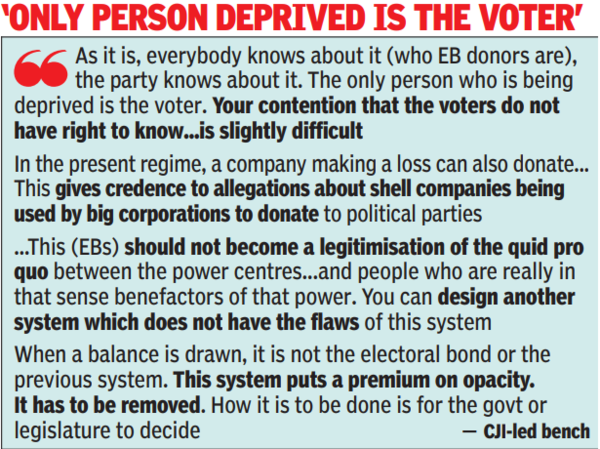
    Electoral Bonds: Supreme Court to govt: Will you remove opacity of electoral  bonds? | India News - Times of India

    Key Highlights:

    • Tradition of Secrecy: Indian political parties, historically resistant to public scrutiny, operate in a culture of secrecy regarding their funding sources and applications.
    • Corporate Dependency: The exorbitant funds required for political processes and operations often come from Big Business entities, creating a financial reliance on these corporations.
    • Quid Pro Quo: Political parties, in return for financial support from corporations, are often expected to reciprocate with political favors, creating a symbiotic relationship between the two.
    • Voter Empowerment: Civil society campaigns, notably through Public Interest Litigation (PIL), seek to empower voters by improving access to background information on electoral candidates.
    • Challenging Legislative Opacity: PIL serves as a tool to challenge legislative attempts to obscure the identities of corporate donors, promoting transparency in political funding.
    • Democratic Right to Information: The campaign is grounded in the citizen’s democratic right to information, an integral aspect of the fundamental right to speech and expression under the Constitution.
    • Countering Legislative Maneuvers: PIL acts as a countermeasure against legislative maneuvers designed to undermine transparency in political funding.

    Challenges:

    • Hiding Corporate Donors: Political establishments employ legislative tactics to conceal the identities of corporate donors, preventing public awareness of the financial backers of political parties.
    • Electoral Trusts and Bond Schemes: The introduction of schemes like the Electoral Trusts Scheme (2013) and the Electoral Bond Scheme (EBS) creates barriers that obscure the direct link between political parties and their corporate donors.
    • Transparency Concerns: Legislative changes raise concerns about jeopardizing transparency, incentivizing corrupt practices, and limiting the accountability of political parties.
    • Nexus Between Politics and Business: The legislative landscape contributes to a growing perception of a nexus between political entities and big business, raising questions about ethical governance.

    Key Phrases for value addition:

    • Amendments Under Scrutiny: Recent amendments in the legal framework of corporate donations face scrutiny and constitutional challenges.
    • Right to Know’ Infringement: Allegations arise that these amendments infringe upon the citizen’s fundamental ‘Right to know’ under Article 19(1)(a) of the Constitution.
    • Transparency Need: The importance of transparency in political funding is emphasized as a cornerstone of a healthy and accountable democratic process.
    • Autonomy Compromise: Concerns are raised about the compromise of the country’s autonomy, with potential negative impacts on governance and democratic values.

    Analysis

    • Undermining Transparency: Legislative changes are criticized for undermining transparency, creating a more opaque environment in political funding.
    • Electoral Bond Scheme Critique: The Electoral Bond Scheme (EBS) faces critique for introducing opacity in political funding, limiting citizens’ access to vital information concerning electoral financing.
    • Opacity in Politics and Business: The intertwining opacity in political and business spheres is identified as a growing trend with potential repercussions for democratic processes.
    • Influence of Special Interest Groups: Critics argue that legislative changes enable special interest groups, corporate lobbyists, and foreign entities to exert undue influence on the electoral process.

    Key Data for mains value addition:

    • Favored Donation Mode: Electoral bonds have become the favored mode of political donation due to their anonymity features.
    • ₹13,791 Crore Sales: Until July 2023, electoral bonds amounting to ₹13,791 crore have been sold in 27 tranches.
    • 55.9% Donation Share: Electoral bonds contribute significantly, accounting for 55.9% of political donations received by 31 parties.
    • BJP’s Leading Redemption: The BJP leads in the redemption of electoral bonds, with 74.5% of the total until 2020-2021.

    Key Facts:

    • Opacity and Corruption Concerns: Critics express concerns about the opacity introduced by legislative changes, potentially incentivizing corrupt practices in political funding.
    • Majority Cash Dealings: Despite the availability of formal options like electoral bonds, the majority of political dealings continue to be in cash.
    • Electoral Bond Impact: Receipts from electoral bonds enable political parties to engage in formal economy transactions, covering infrastructure, equipment, and media publicity costs.
    • Ongoing Legislative Scrutiny: Legislative changes continue to undergo scrutiny, impacting transparency and accountability in political funding.

    Key Terms:

    • Electoral Trusts Scheme
    • Electoral Bond Scheme
    • Right to Know
    • Corporate Donations
    • Transparency
    • Corruption
    • Political Funding
    • Constitutional Challenges

    Way Forward:

    • Hopes for a Level Playing Field: Expectations are pinned on judicial intervention to ensure a more level playing field in future elections.
    • Upholding Freedom of Speech: The judiciary is anticipated to play a crucial role in upholding the right to freedom of speech and expression, empowering voters with information.
    • Addressing Transparency Concerns: Recognizing the critical need for transparency, steps are expected to be taken to address concerns related to opacity and anonymity in corporate donations.
    • Judicial Scrutiny Importance: The importance of judicial scrutiny in ensuring the preservation of democratic values and principles is emphasized.
  • Regulating Political Funding: Rules around the world, India’s challenges

    Central Idea

    • Campaign financing plays a pivotal role in democratic societies, yet the approach to regulating it must be tailored to the nuances of each country’s political system.
    • As exemplified by the United States and India, where political dynamics vary significantly, it is imperative to adopt a framework that aligns with the prevailing political landscape.

    Tap to read more about Ceiling on Election Expenditures in India

    https://www.civilsdaily.com/news/election-campaign-funding-by-political-parties/

    Understanding Political Systems:

    • US Individual-Centric Elections: In the United States, elections revolve around individual candidates and their campaign machinery, even at the national presidential level.
    • India’s Party-Centric Politics: Conversely, India, akin to most parliamentary systems, places political parties at the core of electoral politics. Therefore, India’s campaign finance framework should primarily focus on parties rather than individual candidates.

    Key Aspects of an Effective Framework:

    A comprehensive campaign finance framework necessitates attention to four critical facets: regulating donations, imposing expenditure limits, public financing, and disclosure requirements.

    (A) Donations:

    • Regulation and Limitation: To prevent undue influence, some individuals or organizations, such as foreign entities, may be prohibited from making contributions.
    • Donation Limits: Donation limits are crucial to thwart the dominance of a few major donors, be they individuals, corporations, or civil society organizations. For instance, the US employs varying contribution limits based on donor types, while the UK relies on expenditure limits.

    (B) Expenditure Limits:

    • Balancing Political Competitiveness: Expenditure limits serve as a bulwark against a financial arms race among political parties, allowing them to focus on winning votes rather than fundraising.
    • Examples: In the UK, political parties are restricted from spending more than £30,000 per contested seat. However, the US’s expansive interpretation of the First Amendment has hindered efforts to impose expenditure limits.

    (C) Public Financing:

    • Two Approaches: Public funding can be allocated based on predetermined criteria, like Germany’s system that considers past votes, membership fees, and private donations. Alternatively, democracy vouchers, as seen in Seattle, USA, allow voters to allocate public funds to candidates of their choice.
    • Challenge: Public funding may complement private donations but does not fully address the task of regulating private money.

    (D) Disclosure Requirements:

    • Balancing Transparency and Anonymity: Disclosure nudges voters away from electing politicians involved in quid pro quo arrangements. However, mandatory disclosure isn’t always desirable, as it may deter donations by exposing donors to retaliation.
    • Anonymity’s Role: Anonymity can protect donors from retribution or extortion. Striking a balance between transparency and anonymity is a challenge faced by many jurisdictions.

    Chilean Experiment: Complete Anonymity?

    • Chile’s “Reserved Contributions”: Chile’s system aimed at “complete anonymity” allowed donors to contribute to political parties via the Electoral Service, which forwarded the sum without revealing the donor’s identity.
    • Coordination Challenges: Despite the intent for complete anonymity, coordination between donors and parties compromised the system’s efficacy.

    Balancing Transparency and Anonymity in Political Finance

    • An Effective Approach: Many jurisdictions strike a balance by allowing anonymity for small donors while mandating disclosure for large donations.
    • Examples: In the UK, political parties must report donations exceeding £7,500 in a year, while the US and Germany set limits at $200 and €10,000, respectively.
    • Rationale: Small donors typically have less influence and are more vulnerable to partisan victimization, while large donors may engage in quid pro quo arrangements.

    Challenges in India’s Framework

    • Lack of Donation Limits: India has no limits on individual or corporate contributions, and the 2017 Finance Act removed official contribution limits.
    • Expenditure Limits: Parties can spend freely, albeit not on individual candidates.
    • Disclosure Requirements: Parties are only obligated to disclose donations exceeding ₹20,000, creating a loophole as they split large donations into smaller amounts.
    • Electoral Bonds: Since 2017, electoral bonds have allowed large donors to hide their contributions.

    Changing Dynamics in Indian Politics

    • Involvement of Third Parties: India has witnessed a surge in the engagement of political consultancies, campaign groups, and civil society organizations in political campaigns, mirroring trends seen in the US.
    • Need for Rethinking: The evolving political landscape necessitates a reevaluation of India’s 20th-century political funding framework.

    Conclusion

    • Crafting a campaign finance framework requires an astute understanding of a nation’s political system and its nuances.
    • By adapting strategies that regulate donations, impose expenditure limits, facilitate public financing, and balance transparency with anonymity, countries like India can ensure that their campaign finance frameworks evolve to meet the challenges of the modern political landscape.
  • How are Symbols allotted to Political Parties in India?

    symbols

    Central Idea

    • A recent Supreme Court decision declining a plea by a political party in Telangana, questioning the allocation of election symbols, has thrown the spotlight on the intriguing world of political symbols in India.
    • This article delves into the process of symbol allocation and its role in shaping the country’s political landscape.

    Symbols Allocation Authority: ECI

    • The ECI is responsible for allocating symbols to political parties, following guidelines laid out in The Election Symbols (Reservation and Allotment) Order, 1968.
    • This order aims to regulate symbol specification, reservation, choice, and allotment during elections.

    Types of Election Symbols

    • Reserved and Free Symbols: Symbols can be either reserved, exclusively assigned to recognized political parties, or ‘free’ symbols that can be chosen by unrecognised registered parties’ candidates. Unrecognized parties are those that haven’t met the criteria for state party recognition.
    • Exclusive Symbols: Recognized national and state parties are granted exclusive symbols, signifying their established status.

    Symbol Selection by Parties

    • Preference Lists: Unrecognized parties provide a list of ten preferred symbols from the free symbol pool.
    • Proposal of New Symbols: Parties can propose up to three new symbols for consideration, provided they do not resemble reserved or free symbols, carry religious or communal connotations, or depict birds or animals.
    • Common Symbol Assignment: The ECI may allot a proposed symbol as a common symbol for the party if it deems it suitable.

    Historical Origins of Symbols

    • Sketching Process: Symbols were initially sketched by MS Sethi, who retired from the ECI in 1992. These symbols were conceived through brainstorming sessions where the goal was to identify objects that the common man could relate to.
    • Birth of Familiar Symbols: Many iconic symbols such as the bicycle, elephant, and broom originated from these sessions.
    • Unconventional Entries: Some lesser-known symbols like a pair of glasses, a nail cutter, and a neck-tie were also suggested, reflecting the diversity of ideas.
    • Modern Additions: Over time, new symbols like a bowl of noodles and a mobile charger have been included in the symbol list, reflecting contemporary times.

    Political Parties’ Say

    • Preference Submission: Unregistered parties submit their symbol preferences from the list of free symbols.
    • Proposal of New Symbols: Parties can suggest up to three new symbols with clear designs and drawings.
    • Criteria for Approval: Proposed symbols must not resemble existing reserved or free symbols, possess religious or communal connotations, or depict birds or animals.

    Symbol Allocation in Split Parties

    • Decision by ECI: When recognized political parties split, the ECI determines the symbol assignment. For example, the Congress party’s symbol evolved from a pair of bulls to the current hand symbol due to splits.
    • Recent Example: The ECI assigned different symbols to factions of the Shiv Sena, allowing one faction to retain the bow and arrow symbol while allotting a flaming torch to the other.

    Conclusion

    • The allocation of election symbols in India is a meticulous process governed by the ECI’s guidelines.
    • These symbols hold profound significance in political campaigns, representing parties’ identities and ideologies.
    • Understanding the history and intricacies of symbol allocation provides valuable insights into India’s dynamic political landscape.
  • Electoral Bond Sale: Impact on Political Funding

    electoral bond

    Central Idea

    • The government announced the 28th tranche of Electoral Bond sales, scheduled to take place over a ten-day span at authorized branches of the State Bank of India.

    Why discuss Electoral Bonds?

    • Impact on Political Funding: The announcement of the upcoming electoral bond sale has implications for political funding in India. As part of the government’s efforts to reform the political financing system, electoral bonds aim to bring transparency and accountability to campaign financing.
    • Upcoming Elections: The timing of the sale window aligns with the upcoming assembly elections in some States, highlighting the significance of electoral bonds in shaping the financial landscape of political campaigns.
    • Continued Scrutiny: The use and impact of electoral bonds continue to be a subject of debate and scrutiny, with stakeholders assessing their role in enhancing or altering the political funding ecosystem in the country.

    About Electoral Bond Scheme

    Definition Banking instruments for political party donations with donor anonymity.
    Purchase Method Available to Indian citizens and Indian-incorporated companies from select State Bank of India branches. Can be bought digitally or via cheque.
    Donation Process Purchasers can donate these bonds to eligible political parties of their choice.
    Denominations Available in multiples of ₹1,000, ₹10,000, ₹10 lakh, and ₹1 crore.
    KYC Requirements Purchasers must fulfill existing KYC norms and pay from a bank account.
    Lifespan of Bonds Bonds have a 15-day life to prevent them from becoming a parallel currency.
    Identity Disclosure Donors contributing less than ₹20,000 need not provide identity details like PAN.
    Redemption Electoral Bonds can be encashed only by eligible political parties through an Authorized Bank.
    Eligibility of Parties Only parties meeting specific criteria, including securing at least 1% of votes in the last General Election, can receive Electoral Bonds.
    Restrictions Lifted Foreign and Indian companies can now donate without disclosing contributions as per the Companies Act.
    Objective To enhance transparency in political funding and ensure funds collected by political parties are accounted or clean money.
  • Reforms and Concerns: The CEC and Other EC Bill, 2023

    cec bill

    Central Idea

    • After being passed in the Rajya Sabha on August 10, the Chief Election Commissioner and Other Election Commissioners (Appointment, Conditions of Service and Term of Office) Bill, 2023, has now moved to the Lok Sabha for approval.

    CEC and Other EC Bill, 2023

    • Objective: To amend constitutional provisions that currently equate Election Commissioners with Supreme Court judges, as well as addressing recent judicial rulings.

    Key Provisions of the Bill

    • Salary and Service Conditions: The Bill proposes to align the salary, allowances, and service conditions of the Chief Election Commissioner (CEC) and the two Election Commissioners with those of a Cabinet Secretary.
    • Repealing the 1991 Act: The Bill’s passage would lead to the repeal of the Election Commission Act of 1991, where Election Commissioners enjoyed parity with Supreme Court judges in terms of remuneration.
    • Potential Impact: While the stipulated salaries for Supreme Court judges and Cabinet Secretaries are similar, Supreme Court judges receive additional post-retirement benefits, raising concerns about the increased bureaucracy’s potential impact on the authority and independence of Election Commissioners.

    Challenges to Independence

    • Shifting Authority: The Election Commission’s primary role involves overseeing, directing, and controlling elections, as defined in Article 324 of the Constitution. Concerns arise that this control may shift if Election Commissioners, now equivalent in rank to Cabinet Secretaries, attempt to discipline Union Ministers for electoral violations.
    • Current Status: Presently, when commissioners summon government officials, their orders are perceived as carrying the authority of a Supreme Court Judge, a status that may change if they are seen as equals to Cabinet Secretaries.

    Preserving Independence and Equivalence to SC Judges

    • Constitutional Safeguards: Article 324 (5) of the Constitution specifies that a CEC can only be removed in a manner similar to that of a Supreme Court judge, safeguarding the independence and equivalence of Election Commissioners to Supreme Court judges.
    • Previous SC Ruling: The Bill also seeks to constitute a committee comprising the Prime Minister, Leader of the Opposition in the Lok Sabha, and a Cabinet Minister nominated by the PM to select Election Commission members. Notably, this committee excludes the CJI, in contrast to a top court ruling from March 2023.

    Background: The SC Ruling

    • Committee Formation: In March 2023, a five-judge Supreme Court bench unanimously ruled that a committee consisting of the Prime Minister, Leader of the Opposition in Lok Sabha, and the Chief Justice of India (CJI) should select the Chief Election Commissioner (CEC) and Election Commissioners (ECs).
    • Founding Principles: The ruling emphasized that India’s founding fathers did not intend for the executive to exclusively dictate appointments to the Election Commission, striving for a more balanced selection process.
    • PIL Origins: The case originated from a PIL filed in 2015, challenging the constitutionality of the President appointing ECI members based on the PM’s advice.

    Impact on the 1991 Act

    • Bill’s Amendment: The Bill aims to repeal the 1991 Act, which previously ensured that the CEC and ECs received salaries equivalent to Supreme Court judges.
    • Revised Equality: Section 10 of the Bill specifies that the salary, allowances, and service conditions of the CEC and ECs will match those of the Cabinet Secretary, marking a departure from the 1991 Act’s provisions.

    Various Concerns Raised

    • Autonomy of the Election Commission: Concerns exist due to the selection panel’s composition, which includes a Cabinet Minister nominated by the Prime Minister instead of the CJI.
    • Unanimous Decisions: Suggestions for unanimous committee decisions aim to address one-sided decision-making concerns.
    • Constitutional Validity: Critics argue the Bill violates democratic principles.
    • Conflicting SC Judgment: The Bill diverges from the Supreme Court’s ruling on the importance of an independent committee in selecting Election Commissioners.
    • Past Electoral Integrity: Some believe Indian elections have been generally fair despite government involvement in Election Commissioner appointments.
    • Consistency in Decision-Making: Concerns have been raised about the Commission’s decision consistency regarding Model Code of Conduct violations.
    • Timing of Election Announcements: Questions surround election announcement timing in relation to government programs, raising concerns about political influence.

    Conclusion

    • Balancing Reforms: The Bill reflects efforts to reform election administration but raises concerns about preserving the Election Commission’s independence and its equivalence to Supreme Court judges.
    • Evolution of Selection Process: The ongoing debate highlights the evolving process of selecting Election Commissioners, aiming to ensure fair and transparent appointments while safeguarding the institution’s autonomy.
  • Govt forms committee to work on ‘One Nation One Election’ legislation

    one nation one election

    Central Idea

    • The Centre has taken a significant step towards implementing the “One Nation, One Election” concept by forming a committee led by former President Ram Nath Kovind.
    • This concept aims to synchronize elections across different levels of governance, with the intent of boosting efficiency and governance.
    • The committee’s primary role is to draft the necessary legislative framework for the successful implementation of the concept.

    One Nation, One Election: Background and Rationale

    • The frequent occurrence of elections disrupts the continuity of developmental activities due to adherence to election-related codes and rules.
    • The Prime Minister has been a vocal advocate of simultaneous elections as a solution to this issue.
    • The core idea is to streamline elections across various tiers of government, thereby reducing administrative complexities.

    Nature of Simultaneous Elections

    • Presently, India conducts separate elections for the Lok Sabha and State Assemblies, leading to staggered electoral cycles.
    • The “One Nation, One Election” approach envisions holding elections for all state assemblies and the Lok Sabha simultaneously.

    Historical Context and Shifting Trends

    • In the initial decades after independence, India witnessed concurrent elections.
    • This trend shifted with the untimely dissolution of the fourth Lok Sabha in 1971, which marked the decline of simultaneous elections.
    • The dissolution of the Lok Sabha during the National Emergency declared in 1975 and the dissolution of state assemblies after the 1977 Lok Sabha election further disrupted this cycle.

    Challenges and Necessary Constitutional Amendments

    • A significant challenge lies in aligning the terms of the Lok Sabha and Legislative Assemblies.
    • Amendments to relevant articles of the Constitution, such as Article 83 for the Lok Sabha and Article 172(1) for Legislative Assemblies, may be required to enable synchronized elections.

    Efficiency and Governance Benefits

    Simultaneous elections offer several benefits:

    • Reduction in effort, time, and expenditure due to consolidated election cycles.
    • Mitigation of governance disruptions caused by the Model Code of Conduct during elections.
    • Streamlined campaign expenses, potentially leading to cost savings.
    • Improved voter turnout and enhanced credibility of the electoral process.

    Challenges and Counterarguments

    • Challenges include synchronizing terms, preventing mid-term dissolutions, and addressing the costs associated with electronic voting machines (EVMs).
    • Counterarguments raise concerns about influencing voter choices, potential erosion of government accountability, and implications for democratic principles and federalism.

    Ensuring Effective Implementation

    • Robust legal safeguards are essential to address the challenge of mid-term dissolutions and maintain the integrity of synchronized elections.
    • Some countries employ mechanisms like “no-confidence motions” to ensure governance continuity during the synchronized cycle.

    Conclusion

    • The “One Nation, One Election” initiative holds the potential to streamline India’s electoral process and enhance governance efficiency.
    • Overcoming challenges requires a comprehensive approach along with suitable legal provisions, making the concept a practical reality while preserving democratic principles and federalism.
  • EC to issue Online Airtime Vouchers for Campaigning

    air

    Central Idea

    • The Election Commission of India has implemented a fully online process for allotting airtime to political parties for campaigning on Akashvani and Doordarshan.
    • The new system replaces the traditional method of collecting physical vouchers and instead issues digital time vouchers through an online platform.

    Airtime Vouchers for Campaigning

    • Objective: To provide equitable access to government-owned electronic media during elections for campaigning purposes.
    • Legal basis: The allotment of time on public broadcasters during campaigning is governed by a scheme notified in January 1998, based on Section 39A of the Representation of People Act, 1951.
    • Allotment Criteria: Each National party and recognized State party receive an equitable base time on Doordarshan (DD) and Akashvani.
    • Scope for additional time: Factors such as past electoral performance, representation in the legislature, and the number of candidates fielded by the party are considered to ensure equitable distribution of airtime.
    • Predefined Schedule: The date and time for telecasts and broadcasts by authorized party representatives are predetermined by Prasar Bharati, in consultation with EC and in the presence of party representatives.

    Regulation of these Vouchers

    • Scrutiny of Party Transcripts: Party transcripts undergo scrutiny to ensure compliance with relevant codes. These codes prohibit content that criticizes other countries, attacks religions or communities, incites violence, or engages in personal attacks.
    • Role of Apex Committee: Disagreements over vetted content are referred to an Apex Committee comprising members from Akashvani and DD. The committee’s decision is final.

    Significance of Digital Vouchers

    • Process Improvement: The decision reflects its commitment to leveraging technology for an improved electoral process and enhanced convenience for all stakeholders.
    • Eliminating Physical Collection: Political parties will no longer need to send representatives to the commission’s offices to collect time vouchers during elections.

    Operational Challenges

    • Limited Access: The scheme is exclusively available to national and recognized State parties, leading to concerns about its true equity.
    • Conflict of Interest in the Apex Committee: The Apex Committee consists of officials from Akashvani and DD, raising concerns about potential conflicts of interest.
    • Row over transcript content: These officials are expected to review their own decisions when conflicts arise with political parties over the transcript content.

    Also read:

    How is a ‘National Party’ in India defined?

  • Electoral Bonds chief source of donations for parties: Report

    bond

    Central Idea

    • Electoral bonds have emerged as the primary source of donations for political parties in India, with the BJP securing the majority share.
    • A report by the Association of Democratic Reforms reveals that between 2016-17 and 2021-22, national and regional parties received a total donation of ₹9,188.35 crore through electoral bonds.
    • The BJP received ₹5,271.97 crore, while other national parties collectively received ₹1,783.93 crore.

    Political Donations under Electoral bonds scheme

    • Breakdown of donations: Over the six-year period, the 31 analyzed political parties received a total of ₹16,437.63 crore in donations. Of this, 55.9% came from electoral bonds, 28.07% from the corporate sector, and 16.03% from other sources.
    • BJP leads the pack: The BJP declared donations worth ₹5,271.97 crore through electoral bonds, surpassing the total donations of all other national parties combined.
    • Congress and regional parties: The Congress received the second-highest amount through electoral bonds, with ₹952.29 crore (61.54% of total donations). The Trinamool Congress received ₹767.88 crore (93.27% of total donations).
    • Regional parties’ reliance on bonds: Regional parties such as the BJD, DMK, and TRS received a significant portion of their total donations from electoral bonds.
    • Surge in bond donations: National parties witnessed a 743% increase in donations through electoral bonds between 2017-18 and 2021-22, while corporate donations only rose by 48%.

    Key features of Electoral Bonds Scheme

    • Introduction of Electoral Bond Scheme: The Electoral Bond Scheme 2018 was introduced for electoral funding during the crucial time period analyzed in the report.
    • Removal of donation limit: The Finance Act, 2017 eliminated the previous cap of 7.5% of a company’s average three-year net profit for political donations.
    • Purchase and Donation: Any Indian citizen or company incorporated in India can purchase Electoral Bonds from select branches of the State Bank of India. The bonds can be bought in denominations of ₹1,000, ₹10,000, ₹10 lakh, and ₹1 crore. The purchaser can then donate the bonds to an eligible political party of their choice.
    • Eligibility and KYC: To purchase Electoral Bonds, the buyer must fulfill the Know Your Customer (KYC) norms and make the payment from a bank account. Only individuals and companies with Indian citizenship or incorporation can participate in the scheme.
    • Bond Validity: Electoral Bonds have a life of 15 days, ensuring that they do not function as a parallel currency.
    • Anonymity and Disclosure: Donors who contribute less than ₹20,000 to political parties through Electoral Bonds are not required to provide their identity details, such as the Permanent Account Number (PAN). However, the identity of the donor is known to the bank.
    • Redemption and Eligible Parties: Only political parties registered under Section 29A of the Representation of the People Act, 1951, and securing at least one percent of the votes in the last general election are eligible to receive Electoral Bonds. The bonds can be encashed only through a bank account with the authorized bank.

    Issues with the Scheme

    • Lack of Transparency: The scheme has faced criticism for enabling opaque political funding. While the identity of the donor is captured, it is not revealed to the party or the public, limiting transparency.
    • Limited Tax Benefits: Donations made through Electoral Bonds may not qualify for income tax breaks, potentially discouraging donors from participating in the scheme.
    • Privacy Concerns: The privacy of donors may be compromised as the bank will have knowledge of their identity.
    • Differential Benefits: The scheme can potentially favor parties in power, as the government can access information about the donors and the funds received.
    • Unlimited Donations: Amendments in the Finance Act of 2017 allow for unlimited donations from individuals and foreign companies to political parties without disclosing the sources of funding, raising concerns about the influence of money in politics.
  • Criminalization of Politics: Why ADR has approached the ECI?

    Central Idea

    • The Association for Democratic Reforms (ADR), an electoral watchdog, has written to the Election Commission seeking action against political parties that fail to disclose details of candidates’ criminal cases as mandated by the Supreme Court.
    • The ADR highlights the non-compliance of parties in publishing such information and urges strict action to be taken against defaulting parties.

    About ADR

    Concerns raised by ADR

    • Alarming Statistics: It revealed 43% of newly-elected MPs in 2019 had pending criminal cases.
    • Non-Compliance: ADR reveals political parties flouting Supreme Court’s orders and ECI’s directions.
    • Shortcomings in Forms: ADR identifies shortcomings in the prescribed forms (C2 and C7) used by parties.
    • Inaccessible Information: Many parties lack functional websites or fail to provide accessible links.
    • Improper Justifications: Parties cite “winnability” and popularity as reasons for selecting candidates with criminal records, contrary to the Supreme Court’s ruling.

    Supreme Court’s Mandate (2018)

    • Disclosure Directive: Supreme Court has mandated parties to disclose candidates’ criminal cases on their websites.
    • Prescribed Format: Election Commission of India (ECI) specifies the format for publishing this information.
    • Bold Publication: Supreme Court ordered parties to publish criminal case details prominently.
    • Candidate Obligation: Candidates with pending cases must inform the party about their criminal antecedents.
    • Multiple Publications: Parties and candidates must publish the information multiple times after filing nominations.

    ADR’s Action and Demands

    • Adherence Supreme Court’s Directive: ADR directed to pursue remedies with the ECI.
    • Demanding Strict Action: ADR urges the ECI to take strict action against defaulting parties, including possible de-registration.
    • Transparency and Accountability: ADR calls for the publication of a list of defaulting parties and the imposition of fines.

    Conclusion

    • Urgent Action Needed: ADR’s letter emphasizes the need for action against parties failing to disclose candidates’ criminal cases as mandated by the Supreme Court.
    • Upholding Transparency: Strict enforcement of these orders is essential to maintain transparency and prevent the criminalization of politics.