💥Join UPSC 2027,2028 Mentorship (August Batch) + XFactor Notes & Microthemes PDF

GS Paper: Schemes For Vulnerable Sections

  • [13th June 2026] The Hindu OpED: Equality of treatment for Persons with Disabilities 

    PYQ Relevance[UPSC 2022] The Rights of Persons with Disabilities Act, 2016 remains only a legal document without intense sensitisation of government functionaries and citizens regarding disability. Comment.Linkage: The PYQ examines the gap between statutory rights and actual social, administrative and economic inclusion of Persons with Disabilities. The proposed Minimum Universal Disability Pension Floor Rate (MUDPFR) represents the next step in translating legal rights into meaningful social protection and economic security for PwDs.

    Mentor’s Comment

    India’s welfare architecture has achieved remarkable success in digital inclusion and benefit delivery, yet disability pensions remain fragmented and dependent on State-level discretion. A Minimum Universal Disability Pension Floor Rate (MUDPFR) would establish a nationally guaranteed minimum social security entitlement for Persons with Disabilities, ensuring equality, dignity and portability of benefits while strengthening India’s transition towards a rights-based welfare state.

    Why does India’s disability pension system remain inadequate despite a rights-based legal framework?

    1. Large Beneficiary Base: Census 2011 recorded 2.68 crore PwDs; current estimates place the number at around 4.5-6 crore due to population growth and changing disease profiles.
    2. Constitutional Recognition: Supreme Court has recognized the right to live with dignity as a fundamental right.
    3. Legal Protection: Rights of Persons with Disabilities Act, 2016 provides statutory protection and mandates social security support.
    4. Fragmented Pension System: Disability benefits vary significantly across States.
    5. Low Pension Amounts: Most States provide pensions ranging between ₹300 and ₹500 per month.
    6. Limited Coverage: Indira Gandhi National Disability Pension Scheme covers only a small fraction of eligible beneficiaries.
    7. Domicile-Based Inequality: Pension support often depends on place of residence rather than disability status.

    How does India’s spending on disability welfare compare internationally?

    1. Low Public Spending: India spends only about 0.02% of GDP on disability welfare, including pensions.
    2. South Africa Comparison: Allocates approximately 0.12-0.15% of GDP.
    3. Brazil Comparison: Allocates around 0.45-0.50% of GDP.
    4. OECD Countries: Average spending around 2.2% of GDP.
    5. Australia Comparison: Allocates approximately 0.35-0.40% of GDP.
    6. Resource Gap: India’s spending remains multiple times lower than comparable welfare systems.

    What are the economic and social costs of inadequate disability support?

    1. GDP Loss: World Bank and UNDP estimates indicate low- and middle-income countries lose 3-7% of GDP from exclusion of PwDs.
    2. Educational Exclusion: Limited support reduces access to education.
    3. Employment Barriers: Inadequate social security weakens labour force participation.
    4. Household Vulnerability: Disability income support improves household stability.
    5. Consumption Multiplier: Studies indicate multipliers ranging between 1.4 and 1.6.
      1. Disability pensions have a consumption multiplier of 1.4-1.6, meaning every ₹100 transferred to beneficiaries can generate approximately ₹140-₹160 in economic activity through increased spending on food, healthcare, transport and local services.
    6. Economic Returns: Pro Bono Economics (2025) found socio-economic returns from disability pensions exceed costs by nearly 48%.
    7. Investment Perspective: Disability pensions function as economic investments rather than welfare expenditures alone.

    Why is a Minimum Universal Disability Pension Floor Rate (MUDPFR) being proposed?

    1. Constitutional Obligation: Supports Article 41 directing public assistance in cases of disability.
    2. Implementation of RPwD Act: Operationalises Section 24 guaranteeing social security measures.
    3. Universal Minimum Guarantee: Ensures a baseline pension irrespective of State of residence.
    4. Rights-Based Welfare: Shifts support from charity-based approaches to citizenship-based entitlements.
    5. Portability: Ensures continuity of benefits across States.
    6. Equity: Reduces interstate disparities in pension access and quantum.

    Proposed Design

    1. National Floor Rate: Central government guarantees a minimum pension.
    2. State Top-Ups: States remain free to provide higher benefits.
    3. Uniform Eligibility: Common eligibility standards across India.
    4. Portability: Benefits remain accessible across State boundaries.

    Is a universal disability pension financially feasible?

    1. ₹8,000 Monthly Pension Scenario: Cost estimated at approximately ₹38,400 crore annually.
    2. GDP Share: Around 0.08% of GDP.
    3. 10 Lakh Beneficiaries Scenario: Cost around ₹65 lakh crore? (Article indicates cost projections for larger coverage; emphasis remains below 0.2% GDP even under expanded coverage assumptions.)
    4. ₹15,000 Monthly Pension Scenario: Public expenditure would still remain below 0.2% of GDP.
    5. Comparative Fiscal Context:
      1. Food Subsidy: ₹2.05 lakh crore.
      2. Rural Development: ₹1.80 lakh crore.
      3. Tax Concessions and Revenue Foregone: ₹1.72 lakh crore.
      4. Infrastructure: ₹11.11 lakh crore.

    How can India move from fragmented welfare to integrated disability support?

    1. Institutional Fragmentation: Pension administration is divided between the Ministry of Rural Development and the Department of Empowerment of Persons with Disabilities.
    2. Administrative Delays: Multiple authorities create duplication and accountability gaps.
    3. International Practice: Several countries operate through unified disability-support institutions.

    Proposed Institutional Reforms

    1. National Disability Pension Authority: Oversees eligibility, portability and grievance redress.
    2. National Registry: Creates integrated beneficiary database.
    3. Digital Integration: Links welfare databases through interoperable platforms.
    4. Performance Monitoring: Enables State-wise accountability and benchmarking.
    5. Single Governance Framework: One standard, one system, one nation.

    What lessons can India learn from international experience?

    South Africa

    1. National Disability Grant: Uniform eligibility and nationwide coverage.
    2. Centralized Standards: Ensures portability and consistency.

    Brazil

    1. BPC Programme: Guarantees a national minimum income for persons with disabilities.

    Australia

    1. Nationwide Disability Pension: Central administration with State coordination.
    2. Employment Incentives: Combines social security with labour participation.

    New Zealand

    1. Universal Framework: Nationwide disability support system.

    Other Developing Countries

    1. Kenya, Rwanda, Thailand and Indonesia: National disability income support mechanisms demonstrate feasibility even in developing economies.

    Why should disability pensions be linked with employment and economic participation?

    1. Inclusive Growth: Moves beneficiaries from survival support to productive participation.
    2. MUDPFR Advantage: Creates financial security necessary for skill development and employment.
    3. Employer Incentives: Encourages hiring of persons with disabilities.
      1. Singapore: Integrates disability support with skills training and workforce participation programmes.
      2. South Korea: Combines income support with vocational rehabilitation and employment assistance.
      3. South Africa: Provides a nationwide Disability Grant ensuring minimum income security for PwDs.
      4. Brazil: Guarantees income support through the Benefício de Prestação Continuada (BPC) programme.
      5. Nigeria: Offers tax incentives to employers hiring persons with disabilities, encouraging workplace inclusion.
      6. United Kingdom (Access to Work): Provides financial assistance for workplace accommodations and support services.
      7. Australia (Wage Subsidies): Offers wage subsidies to employers to improve employment opportunities for persons with disabilities.
    4. Existing Indian Base: PM-DAKSH, NAPS and State-level incentives provide foundations for expansion.

    How does a universal disability pension strengthen constitutional morality?

    1. Equality: Reduces domicile-based discrimination.
    2. Dignity: Recognises persons with disabilities as rights-bearing citizens.
    3. Citizenship: Moves welfare from discretionary charity to guaranteed entitlement.
    4. Article 14: Advances equality before law.
    5. Article 21: Supports dignified living.
    6. Social Justice: Aligns welfare architecture with constitutional commitments.
    7. Federal Balance: Preserves State flexibility while guaranteeing minimum national standards.

    Conclusion

    A Minimum Universal Disability Pension Floor Rate (MUDPFR) would mark a shift from fragmented welfare to rights-based social protection by ensuring that disability support is determined by citizenship and need rather than geography. As India aspires to become a developed nation, guaranteeing a minimum income floor for Persons with Disabilities is not merely a welfare measure but a constitutional imperative that advances equality, dignity, inclusion and human capital development.
  • Antyodaya in Action

    Why in the news?

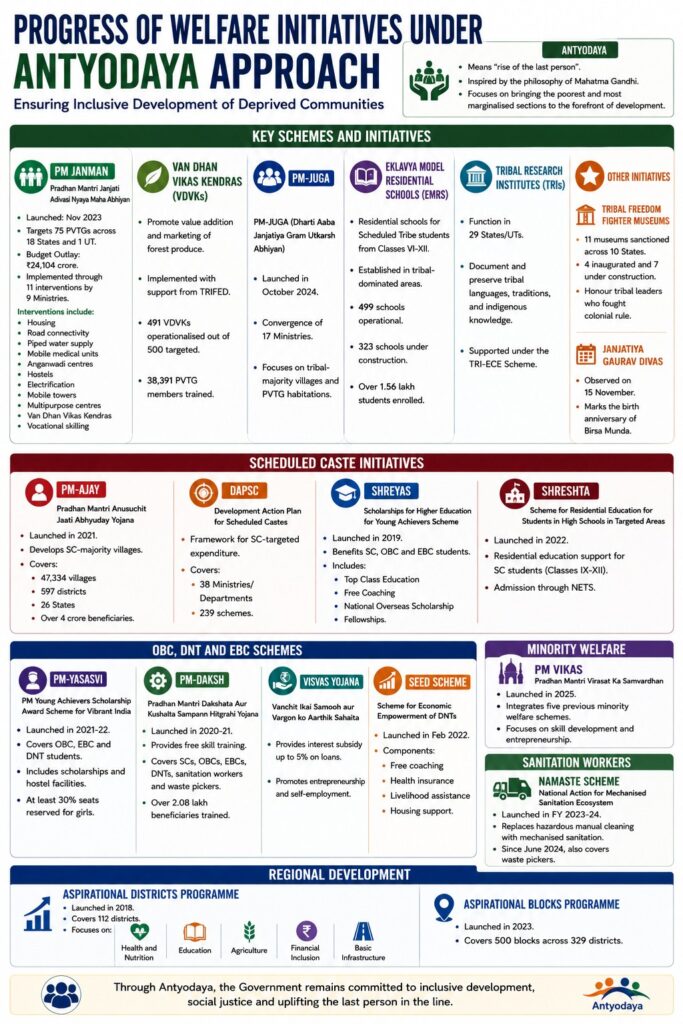
    The Government highlighted the progress of welfare initiatives implemented under the Antyodaya approach aimed at ensuring inclusive development of deprived communities.

    Antyodaya

    • Means “rise of the last person”.
    • Inspired by the philosophy of Mahatma Gandhi.
    • Focuses on bringing the poorest and most marginalised sections to the forefront of development.

    Key Schemes and Initiatives

    PM JANMAN (Pradhan Mantri Janjati Adivasi Nyaya Maha Abhiyan)

    • Launched: November 2023
    • Targets 75 Particularly Vulnerable Tribal Groups (PVTGs) across 18 States and 1 UT.
    • Budget Outlay: ₹24,104 crore.
    • Implemented through 11 interventions by 9 Ministries.
    • Interventions include: Housing, Road connectivity, Piped water supply, Mobile medical units, Anganwadi centres, Hostels, Electrification, Mobile towers, Multipurpose centres, Van Dhan Vikas Kendras, and Vocational skilling

    Van Dhan Vikas Kendras (VDVKs)

    • Promote value addition and marketing of forest produce.
    • Implemented with support from TRIFED.
    • 491 VDVKs operationalised out of 500 targeted.
    • 38,391 PVTG members trained.

    PM-JUGA (Dharti Aaba Janjatiya Gram Utkarsh Abhiyan)

    • Launched in October 2024.
    • Convergence of 17 Ministries.
    • Focuses on tribal-majority villages and PVTG habitations.

    Eklavya Model Residential Schools (EMRS)

    • Residential schools for Scheduled Tribe students from Classes VI-XII.
    • Established in tribal-dominated areas.
    • 499 schools operational.
    • 323 schools under construction.
    • Over 1.56 lakh students enrolled.

    Tribal Research Institutes (TRIs)

    • Function in 29 States/UTs.
    • Document and preserve tribal languages, traditions, and indigenous knowledge.
    • Supported under the TRI-ECE Scheme.

    Tribal Freedom Fighter Museums

    • 11 museums sanctioned across 10 States.
    • 4 inaugurated and 7 under construction.
    • Honour tribal leaders who fought colonial rule.

    Janjatiya Gaurav Divas

    • Observed on 15 November. Marks the birth anniversary of Birsa Munda.

    Scheduled Caste Initiatives

    PM-AJAY (Pradhan Mantri Anusuchit Jaati Abhyuday Yojana)

    • Launched in 2021.
    • Develops SC-majority villages.
    • Covers: 47,334 villages, 597 districts, and 26 States Over 4 crore beneficiaries.

    DAPSC (Development Action Plan for Scheduled Castes)

    • Framework for SC-targeted expenditure.
    • Covers: 38 Ministries/Departments and 239 schemes.

    SHREYAS (Scholarships for Higher Education for Young Achievers Scheme)

    • Launched in 2019.
    • Benefits SC, OBC and EBC students.
    • Includes: Top Class Education, Free Coaching, National Overseas Scholarship, and Fellowships.

    SHRESHTA (Scheme for Residential Education for Students in High Schools in Targeted Areas)

    • Launched in 2022.
    • Residential education support for SC students (Classes IX-XII).
    • Admission through NETS.

    OBC, DNT (De-notified, Nomadic, and Semi-Nomadic Tribes) and EBC (Economically Backward Classes) Schemes

    PM-YASASVI (PM Young Achievers Scholarship Award Scheme for Vibrant India)

    • Launched in 2021-22.
    • Covers OBC, EBC and DNT students.
    • Includes scholarships and hostel facilities.
    • At least 30% seats reserved for girls.

    PM-DAKSH (Pradhan Mantri Dakshata Aur Kushalta Sampann Hitgrahi Yojana)

    • Launched in 2020-21.
    • Provides free skill training.
    • Covers SCs, OBCs, EBCs, DNTs, sanitation workers and waste pickers.
    • Over 2.08 lakh beneficiaries trained.

    VISVAS(Vanchit Ikai Samooh aur Vargon ko Aarthik Sahaita)Yojana

    • Provides interest subsidy up to 5% on loans.
    • Promotes entrepreneurship and self-employment.

    SEED (Scheme for Economic Empowerment of DNTs)

    • Launched in February 2022.
    • Components: Free coaching, Health insurance, Livelihood assistance, and Housing support.

    Minority Welfare

    PM VIKAS (Pradhan Mantri Virasat Ka Samvardhan)

    • Launched in 2025.
    • Integrates five previous minority welfare schemes.
    • Focuses on skill development and entrepreneurship.

    Sanitation Workers

    NAMASTE (National Action for Mechanised Sanitation Ecosystem) Scheme

    • Launched in FY 2023-24.
    • Replaces hazardous manual cleaning with mechanised sanitation.
    • Since June 2024, also covers waste pickers.

    Regional Development

    Aspirational Districts Programme

    • Launched in 2018.
    • Covers 112 districts.
    • Focuses on: Health and Nutrition, Education, Agriculture, Financial Inclusion, and Basic Infrastructure

    Aspirational Blocks Programme

    • Launched in 2023.
    • Covers 500 blocks across 329 districts.

    [2019] Consider the following statements about Particularly Vulnerable Tribal Groups (PVTGs) in India:
    1. PVTGs reside in 18 States and one Union Territory.
    2. A stagnant or declining population is one of the criteria for determining PVTG status.
    3. There are 95 PVTGs officially notified in the country so far.
    4. Irular and Konda Reddi tribes are included in the list of PVTGs.
    Which of the statements given above are correct?

    [A] 1, 2 and 3

    [B] 2, 3 and 4

    [C] 1, 2 and 4

    [D] 1, 3 and 4

  • Supreme Court Recognises Homemakers as “Nation Builders”

    Why in News?

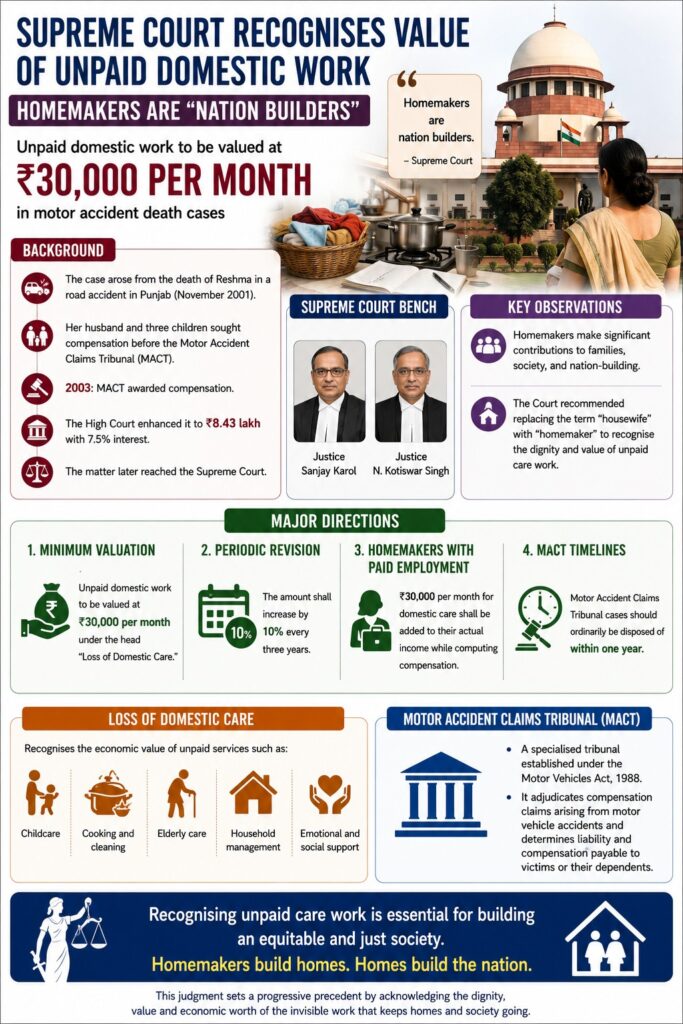
    The Supreme Court held that unpaid domestic work performed by homemakers must be assigned a minimum notional value of ₹30,000 per month while calculating compensation in motor accident death cases. The Court described homemakers as “nation builders.”

    Background

    • The case arose from the death of Reshma in a road accident in Punjab (November 2001).
    • Her husband and three children sought compensation before the Motor Accident Claims Tribunal (MACT).
    • 2003: MACT awarded compensation.
    • The High Court enhanced it to ₹8.43 lakh with 7.5% interest.
    • The matter later reached the Supreme Court.

    Key Observations

    • Homemakers make significant contributions to families, society, and nation-building.
    • The Court recommended replacing the term “housewife” with “homemaker” to recognise the dignity and value of unpaid care work.

    Major Directions

    • Minimum valuation: Unpaid domestic work to be valued at ₹30,000 per month under the head “Loss of Domestic Care.”
    • Periodic revision: The amount shall increase by 10% every three years.
    • Homemakers with paid employment: ₹30,000 per month for domestic care shall be added to their actual income while computing compensation.
    • MACT timelines: Motor Accident Claims Tribunal cases should ordinarily be disposed of within one year.

    Loss of Domestic Care

    • Recognises the economic value of unpaid services such as: Childcare, Cooking and cleaning. Elderly care, Household management, Emotional and social support

    Motor Accident Claims Tribunal (MACT)

    • A specialised tribunal established under the Motor Vehicles Act, 1988.
    • It adjudicates compensation claims arising from motor vehicle accidents and determines liability and compensation payable to victims or their dependents.

    [2021] ‘Right to Privacy’ is protected under which Article of the Constitution of India?

    [A] Article 15

    [B] Article 19

    [C] Article 21

    [D] Article 29

  • Marketing of Divyangjan Vishwakarma Products through One Station One Product (OSOP)

    Why in the news?

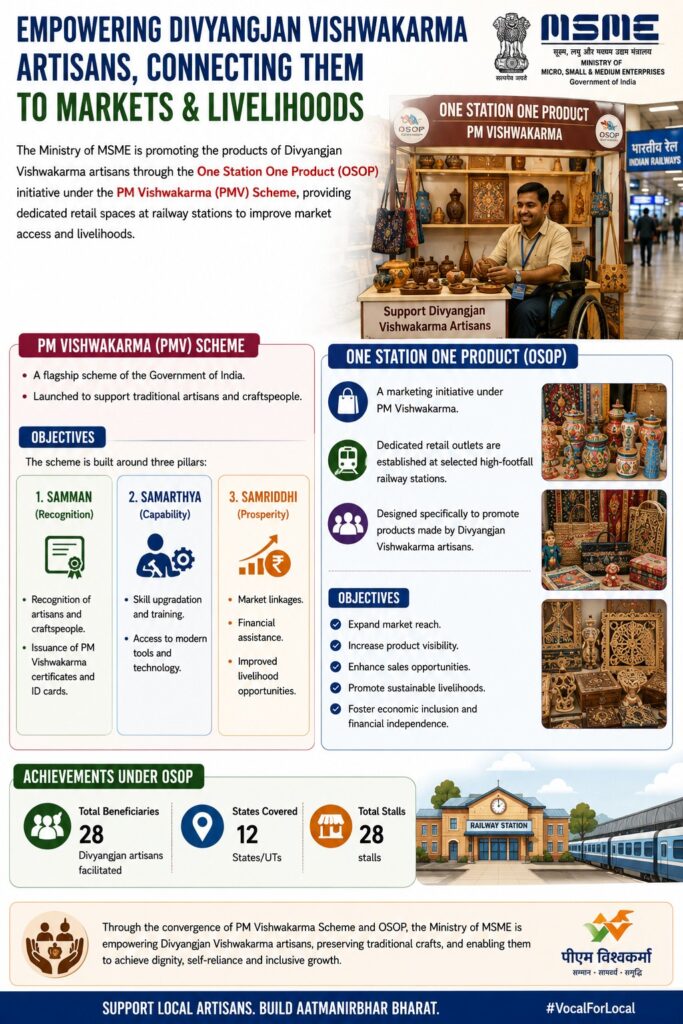
    The Ministry of MSME is promoting the products of Divyangjan Vishwakarma artisans through the One Station One Product (OSOP) initiative under the PM Vishwakarma (PMV) Scheme, providing dedicated retail spaces at railway stations to improve market access and livelihoods.

    PM Vishwakarma (PMV) Scheme

    • A flagship scheme of the Government of India.
    • Launched to support traditional artisans and craftspeople.

    Objectives

    • Recognition of artisans and craftspeople.
    • Issuance of PM Vishwakarma certificates and ID cards.
    • Skill upgradation and training.
    • Access to modern tools and technology.
    • Market linkages. Financial assistance. Improved livelihood opportunities.

    One Station One Product (OSOP)

    • A marketing initiative under PM Vishwakarma.
    • Dedicated retail outlets are established at selected high-footfall railway stations.
    • Designed specifically to promote products made by Divyangjan Vishwakarma artisans.

    Objectives

    • Expand market reach.
    • Increase product visibility.
    • Enhance sales opportunities.
    • Promote sustainable livelihoods.
    • Foster economic inclusion and financial independence.

    Achievements under OSOP

    • Total Beneficiaries: 28 Divyangjan artisans facilitated.
    • States Covered: 12 States/UTs
    • Total Stalls: 28 stalls

    [2023] Consider the following statements with reference to India:
    1. According to the Micro, Small and Medium Enterprises Development (MSMED) Act, 2006, the ‘medium enterprises are those with and machinery between is crore and 25 crore.
    2. All bank loans to the Micro, Small and Medium Enterprises qualify under the priority sector.
    Which of the statements given above is/are correct?

    [A] 1 only

    [B] 2 only

    [C] Both 1 and 2

    [D] Neither 1 nor 2

  • India’s Health Transformation

    Why in the news?

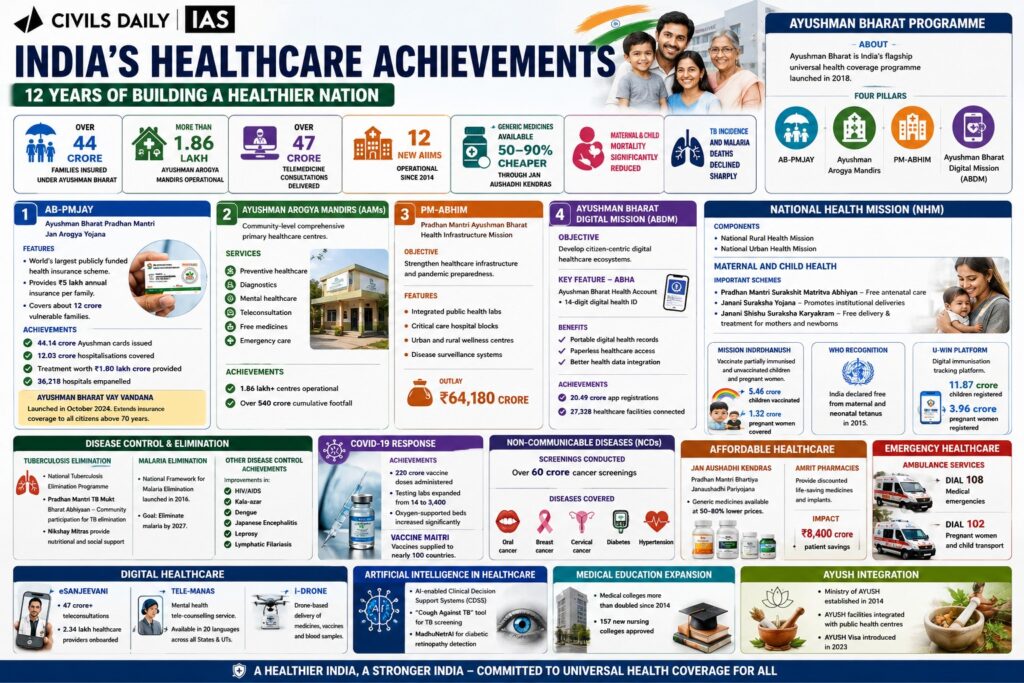
    India highlighted major achievements in healthcare over the past 12 years, focusing on universal health coverage, affordable healthcare, digital health, disease control, and healthcare infrastructure expansion.

    Key Highlights

    • Over 44 crore families are insured under Ayushman Bharat.
    • More than 1.86 lakh Ayushman Arogya Mandirs are operational.
    • Over: 47 crore telemedicine consultations delivered.
    • 12 new AIIMS have been operational since 2014.
    • Generic medicines available: 50–90% cheaper through Jan Aushadhi Kendras.
    • Maternal and child mortality have significantly reduced.
    • TB incidence and malaria deaths declined sharply.

    Ayushman Bharat Programme

    Ayushman Bharat is India’s flagship universal health coverage programme launched in 2018.

    Four Pillars

    1. AB-PMJAY
    2. Ayushman Arogya Mandirs
    3. PM-ABHIM
    4. Ayushman Bharat Digital Mission (ABDM)

    AB-PMJAY

    • Ayushman Bharat Pradhan Mantri Jan Arogya Yojana
    • World’s largest publicly funded health insurance scheme.
    • Provides: ₹5 lakh annual insurance per family.
    • Covers: About 12 crore vulnerable families.
    • 44.14 crore Ayushman cards issued.
    • 12.03 crore hospitalisations covered.
    • Treatment worth: ₹1.80 lakh crore provided.
    • 36,218 hospitals empanelled.
    • Extends insurance coverage to: All citizens above 70 years.

    Ayushman Arogya Mandirs (AAMs)

    • Purpose: Community-level comprehensive primary healthcare centres.
    • Preventive healthcare, Diagnostics, Mental healthcare, Teleconsultation, Free medicines, and Emergency care.
    • 1.86 lakh+ centres operational.
    • Over 540 crore cumulative footfall.

    PM-ABHIM

    • Pradhan Mantri Ayushman Bharat Health Infrastructure Mission
    • Objective: Strengthen healthcare infrastructure and pandemic preparedness.
    • Integrated public health labs.
    • Critical care hospital blocks.
    • Urban and rural wellness centres.
    • Disease surveillance systems.
    • Outlay: ₹64,180 crore.

    Ayushman Bharat Digital Mission (ABDM)

    • Objective: Develop citizen-centric digital healthcare ecosystem.
    • ABHA: Ayushman Bharat Health Account.
    • 14-digit digital health ID.
    • Portable digital health records.
    • Paperless healthcare access.
    • Better health data integration.
    • 20.49 crore app registrations.
    • 27,328 healthcare facilities connected.

    National Health Mission (NHM)

    • National Rural Health Mission
    • National Urban Health Mission.
    • Pradhan Mantri Surakshit Matritva Abhiyan: Free antenatal care for pregnant women.
    • Janani Suraksha Yojana: Promotes institutional deliveries.
    • Janani Shishu Suraksha Karyakram: Free delivery and treatment for mothers and newborns.
    • Mission Indradhanush: Vaccinate partially immunised and unvaccinated children and pregnant women.
      • 5.46 crore children vaccinated.
      • 1.32 crore pregnant women covered.
      • WHO Recognition: India declared free from maternal and neonatal tetanus in 2015.

    U-WIN Platform

    • Purpose: Digital immunisation tracking platform.
    • 11.87 crore children registered.
    • 3.96 crore pregnant women registered.

    Tuberculosis Elimination

    • Programme: National Tuberculosis Elimination Programme
    • Pradhan Mantri TB Mukt Bharat Abhiyaan: Community participation for TB elimination.
    • Support System: Nikshay Mitras provide nutritional and social support.

    Malaria Elimination

    • National Framework for Malaria Elimination launched in 2016.
    • Goal: Eliminate malaria by 2027.
    • Other Disease Control Achievements Improvements in: HIV/AIDS, Kala-azar, Dengue, Japanese Encephalitis, Leprosy, and Lymphatic Filariasis.

    COVID-19 Response

    • 220 crore vaccine doses administered.
    • Testing labs expanded: From 14 to 3,400.
    • Oxygen-supported beds increased significantly.
    • Vaccine Maitri: Vaccines supplied to nearly 100 countries.

    Non-Communicable Diseases (NCDs)

    • Screenings Conducted Over: 60 crore cancer screenings.
    • Diseases Covered: Oral cancer, Breast cancer, Cervical cancer, Diabetes, Hypertension.

    Affordable Healthcare

    • Jan Aushadhi Kendras: Pradhan Mantri Bhartiya Janaushadhi Pariyojana
    • Benefits: Generic medicines available at 50–80% lower prices.

    AMRIT Pharmacies

    • Objective: Provide discounted life-saving medicines and implants.
    • Impact: ₹8,400 crore patient savings.

    Emergency Healthcare

    Ambulance Services

    • Dial 108: Medical emergencies.
    • Dial 102: Pregnant women and child transport.

    Digital Healthcare

    • eSanjeevani
    • 47 crore+ teleconsultations.
    • 2.34 lakh healthcare providers onboarded.

    Tele-MANAS

    • Purpose: Mental health tele-counselling service.
    • Coverage: Available in 20 languages across all States and UTs.
    • i-DRONE: Drone-based delivery of: Medicines, Vaccines, and Blood samples.
    • AI-enabled Clinical Decision Support Systems (CDSS).
    • “Cough Against TB” tool for TB screening.
    • MadhuNetrAI for diabetic retinopathy detection.

    Medical Education Expansion

    • Medical colleges more than doubled since 2014.
    • 157 new nursing colleges approved.
    • AYUSH Integration: Ministry of AYUSH established in 2014.
      • AYUSH facilities integrated with public health centres.
      • AYUSH Visa introduced in 2023.

    [2022] With reference to Ayushman Bharat Digital Mission, consider the following statements:
    1. Private and public hospitals must adopt it.
    2. As it aims to achieve universal health coverage, every citizen of India should be part of it ultimately.
    3. It has seamless portability across the country.
    .Which of the statements given above is/are correct?

    [A] 1 and 2 only

    [B] 3 only

    [C] 1 and 3 only

    [D] 1, 2 and 3

  • VB-G RAM G rules: What changes as scheme set to replace NREGS

    Why in the News?

    The Union government has released draft rules for VB-GRAM G, which is scheduled to replace the Mahatma Gandhi National Rural Employment Guarantee Act (MGNREGA) from July 1, 2025.

    What is the Viksit Bharat-Guarantee for Rozgar and Ajeevika Mission (Gramin) (VB-G RAM G) Act, 2025?

    1. It is a 2025 legislative overhaul of the Mahatma Gandhi National Rural Employment Guarantee Act (MGNREGA). 
    2. It guarantees 125 days of employment (up from 100) per rural household to align with the Viksit Bharat 2047 vision.

    Key Aspects of VB-GRAM G:

    1. Employment Guarantee: Increases guaranteed wage employment to 125 days in a financial year.
    2. Replacement of MGNREGA: The act shifts from a demand-driven model to a supply-driven, budget-capped framework aimed at producing quality assets rather than only providing relief.
    3. Focus Areas: Prioritizes water security, core rural infrastructure, livelihood assets (e.g., storage, livestock shelters), and climate resilience.
    4. Implementation: Implemented as a centrally sponsored scheme with 60:40 fund sharing between Centre and States.
    5. Planning & Tech: Works are planned through Viksit Gram Panchayat Plans and integrated with digital tools like AI-based fraud detection, geo-tagging, and biometric attendance.
    6. Agricultural Support: Empowers states to restrict work during peak agricultural seasons to ensure labor availability for farmers

    How does VB-GRAM G differ structurally from MGNREGS?

    1. Employment Days: Increases annual guaranteed workdays from 100 to 125 days, with a provision for 60-day employment during sowing and harvesting seasons to ensure farm labour availability.
    2. Nature of Guarantee: Alters the rights-based legal guarantee under MGNREGS into a revised framework where employment and wage mechanisms operate through a modified mission structure.
    3. Financial Responsibility: Transfers part of the funding burden to State governments, unlike MGNREGS where the Centre bore 100% wage expenditure.
    4. Institutional Shift: Introduces a new administrative and allocation mechanism under VB-GRAM G rules, replacing existing MGNREGS operational provisions.
    5. Transitional Framework: Ensures continuity for existing job card holders. Workers registered under MGNREGS can continue employment after e-KYC verification under the new system.

    Why is the change in Centre-State fiscal relations significant?

    1. Normative Allocation Formula: Introduces state-wise fund allocation based on parameters determined by the Centre instead of direct expenditure-driven funding.
    2. Sixteenth Finance Commission Linkage: Uses recommendations of the Sixteenth Finance Commission for determining normative allocations.
    3. Fiscal Decentralisation: Requires States to bear a proportion of expenditure, increasing fiscal responsibility at the State level.
    4. Uneven State Impact: States such as Madhya Pradesh, Rajasthan, Haryana, Punjab, Bihar, Uttar Pradesh, Assam, Gujarat, and Tamil Nadu may receive higher allocations, while Andhra Pradesh, Karnataka, Maharashtra, and Chhattisgarh could receive lower allocations compared to MGNREGS.
    5. Compliance-Based Incentives: Allocations may depend on timely social audits, grievance redressal compliance, and panchayat performance indicators.

    Will the new framework strengthen or weaken rural employment security?

    1. Higher Workdays: Expands annual employment entitlement to 125 days, potentially improving wage opportunities.
    2. Agricultural Synchronisation: Ensures labour availability during critical sowing and harvesting seasons, reducing labour shortages in agriculture.
    3. Reduced Legal Certainty: Weakens the statutory employment guarantee character associated with MGNREGS.
    4. State Capacity Dependence: Makes employment outcomes increasingly dependent on State fiscal capacity and administrative efficiency.
    5. Payment Continuity: Maintains Direct Benefit Transfer (DBT) into bank or post office accounts for wage payments.

    How do administrative reforms seek to improve implementation?

    1. National-Level Steering Committee: Strengthens policy oversight and implementation monitoring.
    2. Grievance Redress Rules: Ensures institutional mechanisms for dispute resolution and accountability.
    3. e-KYC Verification: Facilitates beneficiary verification and reduction of ghost beneficiaries.
    4. Administrative Expenditure Rules: Defines expenditure ceilings and implementation procedures.
    5. Central Gramin Rozgar Council: Establishes an institutional mechanism for programme coordination and policy supervision.

    What are the major concerns associated with VB-GRAM G?

    1. Dilution of Rights-Based Welfare: Weakens the legal employment guarantee embedded under MGNREGA, 2005.
    2. Fiscal Stress on States: Increases expenditure burden on fiscally weaker States.
    3. Regional Disparities: Creates differential outcomes due to normative allocation formulas.
    4. Conditional Funding: Links allocations with compliance indicators, potentially disadvantageing weaker administrative units.
    5. Implementation Uncertainty: Transitional changes may create confusion in worker registration and wage continuity.

    Could VB-GRAM G reshape India’s welfare federalism?

    1. Cooperative Federalism: Expands State responsibility in rural employment implementation.
    2. Performance-Based Governance: Links funding with measurable governance outcomes.
    3. Targeted Resource Allocation: Moves from universal expenditure reimbursement toward formula-based transfers.
    4. Rural Labour Market Integration: Aligns employment guarantees with agricultural labour demand cycles.
    5. Welfare Rationalisation: Reflects broader efforts to reduce Union fiscal expenditure on large entitlement programmes.

    Conclusion

    The proposed VB-GRAM G framework reflects a major transition in India’s rural welfare architecture from a rights-based employment guarantee model to a fiscally decentralised and performance-linked framework. While higher workdays, agricultural season alignment, and compliance-based governance may improve efficiency, concerns remain regarding weakened legal guarantees, uneven State capacities, and reduced welfare certainty. Its long-term success will depend on balancing fiscal sustainability with rural livelihood security, while preserving the welfare objectives that made MGNREGS a critical social safety net.

    PYQ Relevance

    [UPSC 2024] Development and welfare schemes for the vulnerable, by its nature, are discriminatory in approach.” Do you agree? Give reasons for your answer 

    Linkage: VB-GRAM G directly changes Centre-State fiscal relations by shifting part of the funding burden to States and introducing a normative allocation model. The article is fundamentally about fiscal federalism and welfare governance, making this PYQ the closest thematic match.

  • JANANI Platform 

    Why in the News?

    The Ministry of Health and Family Welfare launched the JANANI Platform to strengthen digital maternal and child healthcare monitoring in India.

    About JANANI (Journey of Antenatal, Natal and Neonatal Integrated Care) Platform

    • A service-oriented digital platform for monitoring maternal and child healthcare services. 
    • Upgraded version of the existing: Reproductive and Child Health (RCH) Portal

    Objective

    • Comprehensive digital tracking of women during reproductive age by QR Enabled Mother and Child Health Cards
    • Covers:
      • Antenatal care
      • Delivery preparedness
      • Postnatal care
      • Newborn care
      • Family planning services
    • Smart Tracking and Alerts of 
      • High risk pregnancies
      • Due health services
      • Immunisation schedules
    • Real time dashboards for monitoring
    [2023] Consider the following statements in relation to Janani Suraksha Yojana : 
    1. It is a safe motherhood intervention of the State Health Departments. 
    2. Its objective is to reduce maternal and neonatal mortality among poor pregnant women. 
    3. It aims to promote institutional delivery among poor pregnant women. 
    4. Its objective includes providing public health facilities to sick infants up to one year of age. 
    How many of the statements given above are correct? 
    [A] Only one [B] Only two [C] Only three [D] All four
  • National Guidelines on Childhood Diabetes Care

    Why in the News

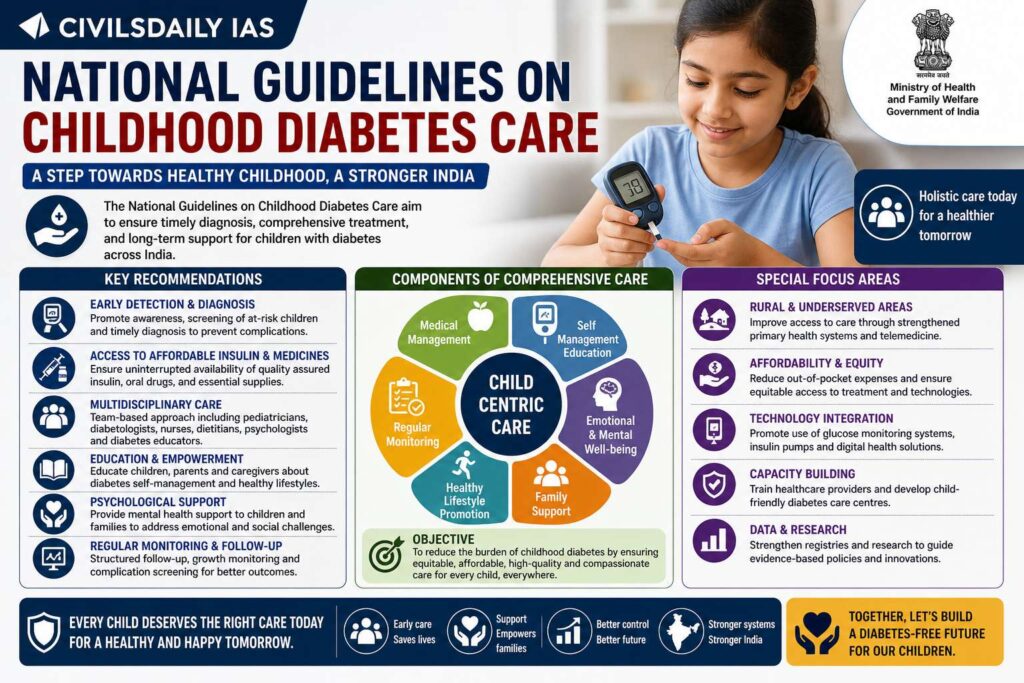
    The Ministry of Health and Family Welfare has released a national framework for childhood diabetes care, providing for universal screening, free lifelong treatment, and integrated care under the public health system.

    Key Features of the Guidelines

    • Universal Screening
      • Covers all children from birth to 18 years
      • Early identification through community level screening
    • Diagnosis and Referral
      • Immediate blood glucose testing for suspected cases
      • Referral to district level health facilities for confirmation

    Free Comprehensive Care

    • Available at public health facilities
    • Includes:
      • Insulin therapy (lifelong)
      • Glucometers and test strips
      • Regular follow up and monitoring
      • Emergency care

    Key Concept

    Diabetes Mellitus

    • A chronic disease where the body:
      • Does not produce enough insulin, or
      • Cannot effectively use insulin
    • Leads to high blood sugar (hyperglycaemia)

    “4Ts” Awareness Framework

    • Helps identify early signs of Type 1 Diabetes
      • Toilet (frequent urination)
      • Thirsty
      • Tired
      • Thin
    [2023] Consider the following statements in the context of interventions being undertaken under Anaemia Mukt Bharat Strategy: 
    1. It provides prophylactic calcium supplementation for pre-school children, adolescents and pregnant women. 
    2. It runs a campaign for delayed cord clamping at the time of child- birth. 
    3. It provides for periodic deworming to children and adolescents. 
    4. It addresses non-nutritional causes of anaemia in endemic pockets with special focus on malaria, hemoglobinopathies and fluorosis. 
    How many of the statements given above are correct? 
    [A] Only one [B] Only two [C] Only three [D] All four
  • Learning outcomes and child health are linked

    Why in the News?

    Recently, there has been POSHAN Pakhwada’s renewed focus on early childhood development (ECD) and India’s push towards human capital formation under Viksit Bharat 2047. It highlights a critical shift, from fragmented welfare delivery to integrated child development, linking nutrition, health, childcare, and learning outcomes

    Why is early childhood development (ECD) a critical policy priority in India?

    1. Critical window: Early childhood is a once-in-a-lifetime phase where brain architecture is formed through nutrition, stimulation, and caregiving.
    2. Economic returns: Investments in ECD yield higher future earnings, better learning outcomes, and lower social costs, often exceeding returns from later interventions.
    3. Policy recognition: National Education Policy (NEP) 2020 identifies Early Childhood Care and Education (ECCE) as a foundational stage, targeting universal pre-primary education by 2030.
    4. Persistent deficits: National surveys report high stunting, wasting, anaemia, and learning gaps, indicating systemic failure despite interventions.
      1. Stunting (Chronic Malnutrition): 35.5% of children under five are stunted (too short for age), indicating long-term undernutrition. Poshan Tracker data from October 2024 indicates 38.9% of measured children in Anganwadis are stunted.
      2. Wasting (Acute Malnutrition): 19.3% of children are wasted (low weight-for-height), a slight decrease from previous records but still high.
      3. Severe Wasting: A concerning increase in severe acute malnutrition (SAM) has been observed, with some reports noting it has increased in 13 of 36 regions/states.
      4. Underweight: 32.1%of children under five are underweight.
      5. Triple Burden: India faces a triple burden of malnutrition: undernutrition, micronutrient deficiency, and rising childhood obesity 3% of children

    Why have existing policies failed to deliver integrated child development outcomes?

    1. Sectoral fragmentation: Health, nutrition, and childcare operate in silos, leading to incomplete service delivery.
    2. Skewed priorities:
      1. Anganwadis: Focus on food supplementation.
      2. Health systems: Prioritise survival and disease control.
      3. Childcare and early learning: Receive limited attention, especially for children under 3
    3. Implementation gaps: Lack of convergence reduces effectiveness of ICDS, POSHAN Abhiyaan, and school meal programmes.
    4. Outcome neglect: Monitoring focuses on inputs (ration distribution) rather than child development outcomes.

    How does childcare access influence both child development and women’s workforce participation?

    1. Care dependency: Child outcomes depend on quality caregiving, which is constrained when childcare is unavailable.
    2. Work-care trade-off: Lack of childcare forces women into difficult choices, affecting both child development and female labour force participation.
    3. High-risk groups: Gaps are acute in informal sectors, agriculture, construction, domestic work.
    4. Case evidence:
      1. Karnataka’s Koshika Mane: Demonstrates community-based childcare benefiting children and working mothers.
      2. Mobile Creches: Shows feasibility of worksite childcare in urban informal settings.
      3. Palna Scheme: Integrates childcare into anganwadi-cum-creches.

    What administrative reforms are needed to strengthen early childhood outcomes?

    1. Platform integration:
      1. Anganwadi + health services: Enables counselling on responsive caregiving and maternal well-being.
      2. Service layering: Combines nutrition with early stimulation and caregiving support.
    2. Programme convergence:
      1. Livelihood linkage: Aligns childcare with social protection and employment programmes.
      2. Private sector role: Facilitates community-based childcare financing and delivery.
    3. Spatial targeting: Locates childcare centres near worksites, markets, and high female labour zones.
    4. Operational adjustments: Aligns anganwadi timings with working caregivers’ needs.

    Why is monitoring child development outcomes more important than input-based evaluation?

    1. Current limitation: Reviews focus on inputs (rations, beneficiaries) rather than child outcomes.
    2. Outcome-based approach:
      1. Tracks developmental indicators (cognitive, physical, social).
      2. Ensures service quality and equity benchmarks.
    3. Data utilisation: Uses existing data systems for local planning and accountability without increasing reporting burden.
    4. Systemic shift: Moves from distribution-centric governance to outcome-centric governance.

    How does integrated early childhood development contribute to India’s long-term growth vision?

    1. Human capital formation: Strengthens future workforce productivity and innovation capacity.
    2. Inclusive growth: Ensures children not only survive but thrive, reducing inequality.
    3. Demographic dividend: Converts India’s population advantage into economic gains.
    4. Strategic alignment: Supports goals of Viksit Bharat 2047 through early investment in human capabilities.

    Conclusion

    India possesses a strong policy base but lacks effective convergence and outcome-oriented implementation. Strengthening childcare systems, integrating services, and focusing on developmental outcomes is essential for transforming nutrition gains into learning and productivity gains, thereby sustaining long-term growth.

    PYQ Relevance

    [UPSC 2024] Poverty and malnutrition create a vicious cycle, adversely affecting human capital formation. What steps can be taken to break the cycle?

    Linkage: This PYQ directly aligns with the article’s theme of nutrition-learning-human capital nexus. It highlights the need for integrated early childhood development and childcare reforms to break intergenerational deprivation.

  • Sub-classification for SC Quota in Karnataka  

    Why in the News?

    The Karnataka Cabinet has officially approved a new internal reservation matrix for Scheduled Castes (SCs), following the landmark 2024 Supreme Court ruling that permits states to sub-classify reserved categories.

    What is the Decision?

    A strategic redistribution of the 15% SC reservation into three distinct categories to ensure equitable opportunities among 101 different sub-castes.

    The Internal Reservation Matrix

    CategoryTargeted CommunitiesAllocation (%)
    Category 1Madigas and allied castes (Dalit Left)5.25%
    Category 2Holeyas and allied castes (Dalit Right)5.25%
    Category 3Bhovi, Lambani, Korama, Koracha & 59 nomadic groups4.5%

    Note: Dalit Left and Right refer to the internal sub-classification of Scheduled Castes (SCs) in India, particularly in Karnataka and Andhra Pradesh, categorized for internal reservation purposes.

    Timeline & Legal Context

    • 1992: Indira Sawhney Case – SC caps total reservation at 50%.
    • 2004: E.V. Chinnaiah Case – SC initially rules that states cannot sub-classify SCs.
    • 2024: State of Punjab v. Davinder Singh – SC 7-judge bench overrules Chinnaiah, allowing sub-classification based on empirical data.
    • 2024 (Oct): Karnataka Cabinet approves the new 5.25 : 5.25 : 4.5 formula.

    Objectives & Challenges

    • Social Justice
      • Addresses the long-standing grievance that “advanced” sub-castes within the SC list were cornering most benefits.
      • Focuses on the “creamy layer” principle within SCs to reach the most marginalized.
    • Legal Hurdles
      • Quantifiable Data: The state must prove under-representation with empirical evidence to survive judicial review.
      • 50% Ceiling: The state’s total reservation (including ST and OBC) currently pushes to 56%, which is under challenge in the High Court.
    [2023] Consider the following statements: 
    Statement – I:The Supreme court of India has held in some judgements that the reservation policies made under Article 16 (4) of the constitution of India would be limited Article 335 for maintenance of efficiency of administration. 
    Statement – II:Article 335 of the Constitution of India defines the term ‘efficiency of administration’. 
    Which of the following is correct in respect of the above statements? 
    [A] Both statement – I and Statement – II are correct explanation for statement – I
    [B] Both statement – I and statement – II are correct and statement II is not the correct explanation for statement I
    [C] Statement – I is correct but statement – II is incorrect.
    [D] Statement – I is incorrect but statement – II is correct.