💥Join UPSC 2027,2028 Mentorship (August Batch) + XFactor Notes & Microthemes PDF

GS Paper: Schemes For Vulnerable Sections

  • In news: Mahatma Gandhi National Rural Employment Guarantee Scheme

    • One-third of the way through the financial year, government data shows that the MGNREGA scheme has used up almost half its allocated funds.
    • Its spending has been more than ₹48,500 crores out of the expanded ₹1 lakh crore allocations announced following the COVID-19 outbreak.

    Try this question for mains:

    Q.Discuss how the MGNREG Scheme has been providing a minimum basic income since the Covid pandemic. Also discuss how it can prove to be a game-changer if coupled with Direct Benefit Transfer (DBT).

    About MGNREGA

    • The MGNREGA stands for Mahatma Gandhi National Rural Employment Guarantee Act of 2005.
    • This is labour law and social security measure that aims to guarantee the ‘Right to Work’.
    • The act was first proposed in 1991 by P.V. Narasimha Rao.

    Its objectives

    • To enhance the livelihood security of the rural poor by generating wage employment opportunities.
    • To create a rural asset base which would enhance productive ways of employment, augment and sustain a rural household income.

    Features of the Scheme

    • MGNREGA is unique in not only ensuring at least 100 days of employment to the willing unskilled workers, but also in ensuring an enforceable commitment on the implementing machinery i.e., the State Governments, and providing a bargaining power to the labourers.
    • The failure of provision for employment within 15 days of the receipt of job application from a prospective household will result in the payment of unemployment allowance to the job seekers.
    • Employment is to be provided within 5 km of an applicant’s residence, and minimum wages are to be paid.
    • Thus, employment under MGNREGA is a legal entitlement.

    Also read:

    [Burning Issue] Reorienting MGNREGA in times of COVID

  • [pib] Kumhar Sashaktikaran Yojana (KSY)

    The Centre has distributed 100 electric potter wheels to 100 trained artisans under the KSY.

    Try this question from CSP 2018:

    Q. Consider the following provisions under the Directive Principles of State Policy as enshrined in the Constitution of India:

    1. Securing for citizens of India a uniform civil code.
    2. Organising village panchayats.
    3. Promoting cottage industries in rural areas.
    4. Securing for all the workers reasonable leisure and Cultural opportunities.

    Which of the above are the Gandhian Principles that are reflected in the DPSP?

    (a) 1, 2 and 4

    (b) 2 and 3

    (c) 1, 3 and 4

    (d) 1, 2, 3 and 4

    Kumhar Sashaktikaran Yojana

    • KSY is an initiative of the Khadi and Village Industries Commission (KVIC) for the empowerment of potters’ community in the remotest of locations in the country.
    • It reaches out to the potters in U.P., M.P., Maharashtra, J&K, Haryana, Rajasthan, West Bengal, Assam, Gujarat, Tamil Nadu, Odisha, Telangana and Bihar.

    Benefits provided

    This program provides the following support to potters.

    • Training for advanced pottery products
    • Latest, new technology pottery equipment like the electric Chaak
    • Market linkages and visibility through KVIC exhibitions

    Back2Basics: KVIC

    • The KVIC is a statutory body formed in April 1957 under the ‘Khadi and Village Industries Commission Act of 1956’.
    • It is an apex organisation under the Ministry of Micro, Small and Medium Enterprises, with regard to khadi and village industries within India.
    • It seeks to plan, promote, facilitate, organise and assist in the establishment and development of khadi and village industries in the rural areas.
    • Its head office is in Mumbai, whereas its six zonal offices in Delhi, Bhopal, Bangalore, Kolkata, Mumbai and Guwahati.
  • [pib] Affordable Rental Housing Complexes (AHRCs) for Urban Migrants / Poor

    The Union Cabinet has given its approval for developing of Affordable Rental Housing Complexes (AHRCs). for urban migrants  / poor.

    Try this question from CSP 2015:

    “Pradhan Mantri Jan-Dhan Yojna’ has been launched for

    (a) Providing housing loan to poor people at cheaper interest rates

    (b) Promoting women’s Self-Help Groups in backward areas

    (c) Promoting financial inclusion in the country

    (d) Providing financial help to the marginalized communities

    AHRC

    • It is a sub-scheme under PM Awas Yojana – Urban.
    • Under the scheme, existing vacant government-funded housing complexes will be converted in ARHCs through Concession Agreements for 25 years.
    • The concessionaire will make the complexes livable by repair/retrofit and maintenance of rooms and filling up infrastructure gaps like water, sewer/ septage, sanitation, road etc.
    • States/UTs will select concessionaire through transparent bidding.
    • Complexes will revert to ULB after 25 years to restart next cycle like earlier or run on their own.

    Beneficiaries of the scheme

    • A large part of the workforce in manufacturing industries, service providers in hospitality, health, domestic/commercial establishments, and construction or other sectors, labourers, students etc. who come from rural areas or small towns seeking better opportunities will be the target beneficiary under ARHCs.

    Benefits of AHRCs

    • Usually, these migrants live in slums, informal/ unauthorized colonies or peri-urban areas to save rental charges.
    • They spend a lot of time on roads by walking/ cycling to workplaces, risking their lives to cut on the expenses.
    • ARHCs will create a new ecosystem in urban areas making housing available at affordable rent close to the place of work.
    • Investment under ARHCs is expected to create new job opportunities.
    • ARHCs will cut down unnecessary travel, congestion and pollution.

    Back2Basics: Pradhan Mantri Awas Yojana (PMAY)

    PMAY-Urban

    The PMAY- Urban Programme launched by the Ministry of Housing and Urban Poverty Alleviation (MoHUPA), in Mission mode envisions provision of Housing for All by 2022. The Mission seeks to address the housing requirement of urban poor including slum dwellers through following programme verticals:

    • Slum rehabilitation of Slum Dwellers with participation of private developers using land as a resource
    • Promotion of Affordable Housing for weaker section through credit linked subsidy
    • Affordable Housing in Partnership with Public & Private sectors
    • Subsidy for beneficiary-led individual house construction /enhancement.

    PMAY-Rural

    • In pursuance to the goal – Housing for all by 2022, the rural housing scheme Indira Awas Yojana has been revamped to Pradhan Mantri Awaas Yojana – Gramin and approved during March 2016.
    • Under the scheme, financial assistance is provided for construction of a pucca house to all houseless and households living in dilapidated houses.
    • It is proposed that one crore households would be provided assistance for construction of pucca house under the project during the period from 2016-17 to 2018-19.
    • The scheme would be implemented in rural areas throughout India except for Delhi and Chandigarh. The cost of houses would be shared between the Centre and States.
  • [pib] Shahapur’s Katkari Tribe

    The newscard is based on the PIB news which discusses the success story of Katkari Tribe, a PVTG in Maharashtra regarding the implementation of Van Dhan Yojana.

    Try this:

    Consider the following statements about Particularly Vulnerable Tribal Groups (PVTGs) in India:

    1) PVTGs reside in 18 States and one Union Territory.

    2) A stagnant or declining population is one of the criteria for determining PVTG status.

    3) There are 95 PVTGs officially notified in the country so far.

    4) Irular and Konda Reddi tribes are included in the list of PVTGs.

    Which of the statements given above are correct? (CSP 2019)

    (a) 1, 2 and 3

    (b) 2, 3 and 4

    (c) 1, 2 and 4

    (d) 1, 3 and 4

    Katkari Tribe

    • The Katkari is an Scheduled Tribe mostly belonging to the state of Maharashtra.
    • They are bilingual, speaking the Katkari language, a dialect of the Marathi-Konkani languages, with each other; they speak Marathi with the Marathi speakers, who are a majority in the populace where they live.
    • In Maharashtra, the Katkari has been designated a Particularly Vulnerable Tribal Group (PVTG), along with two other groups included in this sub-category: the Madia Gond and the Kolam.
    • In the case of the Katkari this vulnerability derives from their history as a nomadic, forest-dwelling people listed by the British Raj under the Criminal Tribes Act of 1871, a stigma that continues to this day.

    What are PVTGs?

    • There are certain tribal communities who have declining or stagnant population, low level of literacy, pre-agricultural level of technology and are economically backward.
    • They generally inhabit remote localities having poor infrastructure and administrative support.
    • These groups are among the most vulnerable section of our society as they are few in numbers, have not attained any significant level of social and economic development.
    • 75 such groups have been identified and categorized as Particularly Vulnerable Tribal Groups (PVTGs).

    Back2Basics: Pradhan Mantri Van Dhan Yojana (PMVDY)

    • It is a retail marketing-led value addition plan for Minor Forest Produce (MFP), meant for forest-based tribes to optimize the tribal income, locally.
    • Under the program, MFP-based tribal groups/enterprises of around 300 members are formed for collection, value addition, packaging & marketing of Minor Forest Produces (MFPs).
    • These tribal enterprises will be in the form of Van Dhan SHGs which will be a group of 15-20 members and such 15 SHG groups will further be federated into a larger group of Van Dhan Vikas Kendras (VDVKS) of around 300 members.
    • TRIFED will support the VDVKs through providing them with model business plans, processing plans & tentative list of equipment for carrying out the value-added work of MFPs.

    Also read:

    https://www.civilsdaily.com/news/pib-development-of-pvtgs-scheme/

  • Pension Reforms

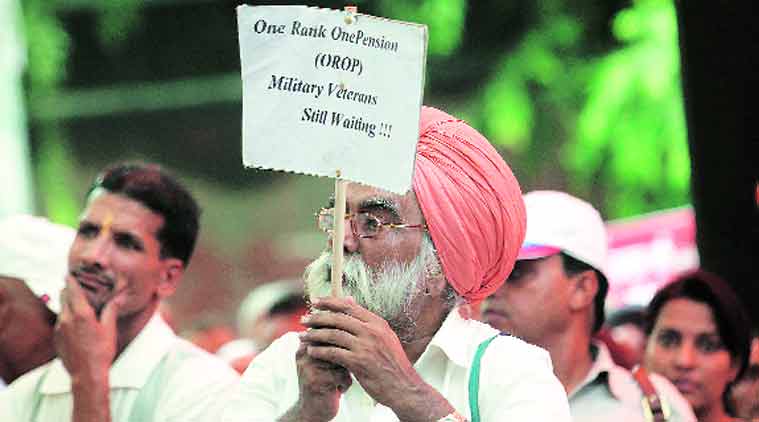
    Everything That You Need to Know on OROP


    • It is a pension scheme for the armed forces personnel which was in existence till 1973.
    • This scheme provided same pension for same rank and for the same length of service irrespective of the date of retirement which was the basis for determining the pension and benefits of the Indian Armed Forces till 1973.
    • OROP was terminated by the government in 1973.

    Which government was in power at that time and who was the PM of India?

    Then came the Koshiyari committee – 

    Bhagat Singh Koshiyari headed a committee which comprised 10 members (an all party parliamentary panel). It was formed in 2011.

    What were the recommendations of the committee?

    1. OROP should be implemented in the defence forces at the earliest and a separate commission should be formed to take decisions on pay allowances, pension, family pension etc. in respect of the defence personnel should be taken into the account by that committee.
    2. The committee recommended to absorb the Armed Forces personnel after their military engagement into other services of government which is a custom in countries like U.S. and China.

    What would be the financial Implications?

    1. Early estimates were around 3000crores for OROP.( by Ministry of Defence)
    2. Revised estimates vary between 8000 to 9000 crores.
    3. According to the Koshiyari committee the estimates for implementation of OROP were around 12000 crores.

    Is OROP expensive for the government?

    1. OROP is affordable by the government as it is a small fraction of the military pension budget.
    2. It includes about 4,00,000 defence civilians.
    3. Defence civilians, which includes the entire civilian bureaucracy in the ministry of defence ,retire at  the age of 60 are mostly based permanently in Delhi and they are not covered by OROP.
    4. It is alleged that they oppose the OROP due to their exclusion from the scheme.

    Government of India on OROP

    1. The government does not subscribe to the definition of Koshiyari committee, but states that there is a need for a new definition of OROP which should be acceptable to all the other ‘stakeholders’.
    2. The stakeholders were neither defined nor identified by the government.
    3. The government stand on the OROP prompted widespread dismay, disappointment and outrage amongst Armed Forces pensioners.
    4. The ministry of defence recommended the proposal for implementation after the approval of the Defence minister.
    5. Now it is with the of the Finance ministry which should make a call on the scheme.