Mains Ready By December. Smash Mains & Smash PYQ Admissions Open

GS Paper: GS3-15.Science and Technology- Developments and their Applications and Effects in Everyday Life.

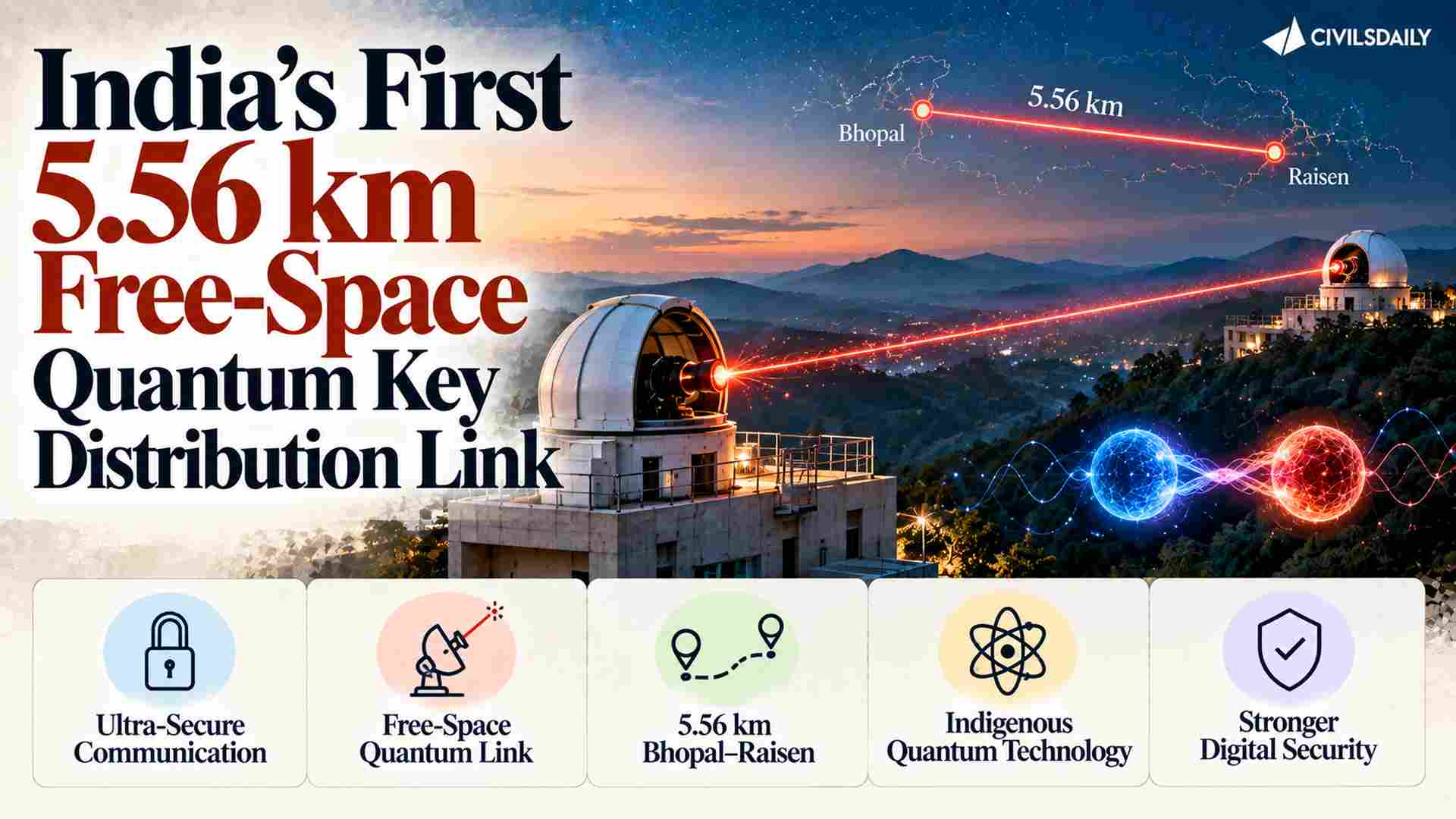
  • India’s First 5.56 km Free-Space Quantum Key Distribution Link

    India’s First 5.56 km Free-Space Quantum Key Distribution Link

    Why in the News?

    • QNu Labs, in collaboration with BISAG-N and IIT Gandhinagar, demonstrated India’s first free-space Quantum Key Distribution (QKD) link over 5.56 km.
    • The field trial was conducted on 27-28 September 2026 between BISAG-N and IIT Gandhinagar.

    Key Highlights

    • Distance: 5.56 km.
    • Technology: Free-space Quantum Key Distribution (QKD).
    • Quantum Bit Error Rate (QBER): below 5%.
    • Secure key generation rate: 230-260 bps.
    • Used Pointing, Acquisition and Tracking (PAT) system.
    • Secure keys were integrated with Vedic Kavach, BISAG-N’s post-quantum cryptography platform.
    • Demonstrated successful end-to-end encryption and decryption of test messages.

    Quantum Key Distribution

    • QKD enables secure communication by using quantum principles to establish cryptographic keys.
    • The demonstration used QNu Labs’ Armos hardware-based QKD device over free-space optical channels.
    • The system was combined with post-quantum cryptography (PQC) and quantum random number generation through Vedic Kavach.
    • The integrated architecture provides resilience even when the physical quantum channel is temporarily unavailable.

    Institutions and Roles

    • QNu Labs: Provided the QKD technology and Armos device.
    • BISAG-N: Provided the field environment and integrated Vedic Kavach.
    • IIT Gandhinagar: Provided the academic and experimental environment for the demonstration.
    • The demonstration highlights collaboration between industry, academia and indigenous technology.

    Significance

    • Provides a foundation for longer-distance quantum-secure networks.
    • Can support future satellite-based quantum communication.
    • Strengthens India’s secure communication infrastructure against quantum-era security threats.
    • Demonstrates integration of hardware-based QKD + software-based post-quantum cryptography.

    Prelims Quick Revision

    • India’s first free-space QKD demonstration: 5.56 km.
    • Trial locations: BISAG-N and IIT Gandhinagar.
    • Trial dates: 27-28 September 2026.
    • QBER: below 5%.
    • Key generation: 230-260 bps.
    • QNu Labs’ QKD device: Armos.
    • BISAG-N platform: Vedic Kavach.
    • BISAG-N is an autonomous scientific society under MeitY.
    • Architecture combines QKD + post-quantum cryptography + quantum random number generation.

    UPSC Prelims Trap

    • QKD and post-quantum cryptography are not the same: QKD uses quantum communication principles for key distribution, while PQC is a cryptographic approach designed to resist attacks from quantum computers.
    • The demonstration used free-space optical channels, not a conventional fibre-optic QKD link.
    • 5.56 km refers to the demonstrated communication-link distance, while 230-260 bps refers to the secure key generation rate.
    • Armos is QNu Labs’ hardware-based QKD device, while Vedic Kavach is BISAG-N’s software-based post-quantum cryptography platform.
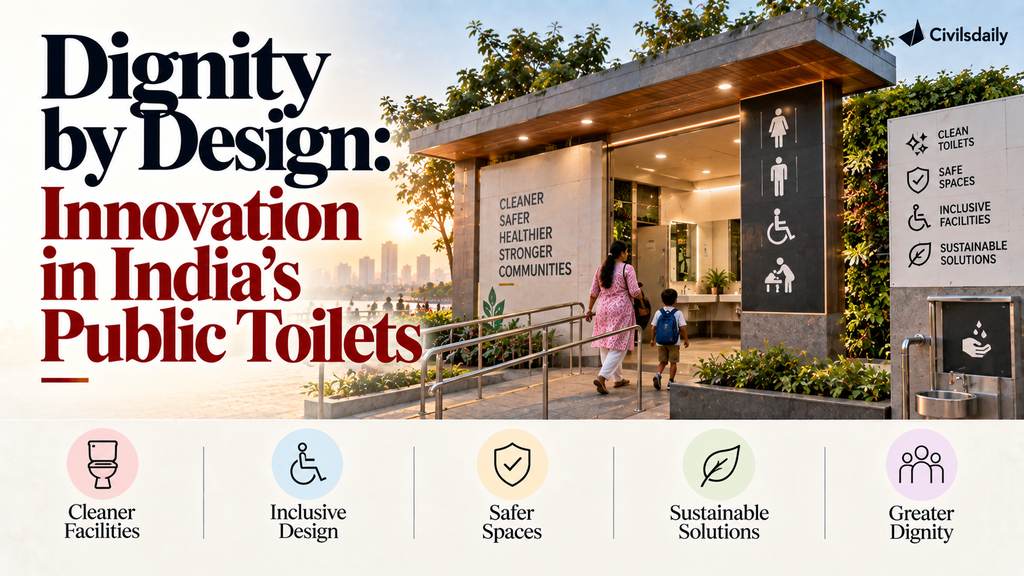
  • Dignity by Design: Innovation in India’s Public Toilets

    Dignity by Design: Innovation in India’s Public Toilets

    Why in the News?

    • Cities are adopting innovative designs and technologies to make Community and Public Toilets (CT/PTs) more accessible, safe, clean and inclusive.
    • The Toilets 2.0 initiative under Swachh Bharat Mission-Urban (SBM-U) was launched in 2022 to improve the quality and user experience of public toilets.

    Key Highlights

    • Swachh Bharat Mission: Launched on 2 October 2014.
    • Cities progressed from ODF towards ODF+ and ODF++.
    • SBM Toilet Locator: Available through the Swachhata App to help citizens locate nearby toilets.
    • Innovations highlighted include:
      • Scrap bus converted into women’s toilet
      • Recycled plastic used in toilet construction
      • Smart and sensor-based public toilets
      • Scientific sanitary-waste disposal
      • Inclusive toilets for women, transgender persons, children and persons with disabilities

    Sthree Toilet, Bengaluru

    • Located at Majestic bus terminal, Bengaluru, Karnataka.
    • Established using a scrap bus and exclusively serves women.
    • Facilities:
      • 3 Indian-style + 2 Western-style commodes
      • Sanitary napkin vending machine
      • Incinerator
      • Breastfeeding and diaper-changing space
      • Solar-powered sensor lights
    • Waste is connected to the nearest sewage chamber.

    Aspirational Toilets, Navi Mumbai

    • Developed by Navi Mumbai Municipal Corporation (NMMC) at Sector 14, Koparkhairane.
    • Used by approximately 8,000-9,000 visitors daily.
    • Construction incorporates:
      • 426 sq m recycled plastic sheeting
      • 5.3 tonnes single-use plastic
      • 11,700 plastic bottles
      • 35,200 bottle caps
      • 85 reused computer keyboards
      • 284 kg scrap metal
    • Follows the principle of 3Rs: Reduce, Reuse and Recycle.
    • Includes facilities for:
      • Women and men
      • Children
      • Persons with disabilities
      • Baby care
      • Sanitary-pad vending
    • Fountain uses treated sewage water.

    Freshrooms, Bhopal

    • Located at 10 Number Market, Bhopal.
    • Developed by Bhopal Municipal Corporation.
    • Operates under Design-Build-Operate-Transfer (DBOT) model through Public-Private Partnership (PPP).
    • Smart Lounge covers 800-1,000 sq ft.
    • Serves around 500-1,000 visitors daily.
    • Features:
      • Sensor-based toilets
      • Touch-free urinals
      • Hot and cold showers
      • Lockers
      • Wi-Fi
      • Café and vending machines
      • Baby-changing rooms
      • Digital information wall
    • Separate accessible facilities for men, women and persons with disabilities.

    Sanitary Waste Management, Karad

    • Karad, Satara district, Maharashtra, has achieved 100% segregation, collection and processing of sanitary and biomedical waste.
    • Collects around 300-350 kg sanitary waste daily.
    • Red bins are provided in public toilets for sanitary waste.
    • Schools use sanitary-pad vending machines and disposal systems.
    • Separate bins in garbage collection vehicles ensure sanitary waste is handled separately.
    • Karad Municipal Council (KMC) partnered with Karad Hospital Association.
    • Common Biomedical Waste Treatment Facility (CBWTF):
      • Capacity: 600 kg/day
      • Incinerator temperature: up to 1,200°C
      • Emissions monitored in real time
      • Linked with the State Pollution Control Board (SPCB) system.
    • PPP model reduces the financial burden on the municipal council.

    Inclusive Toilets, Tirupati

    • Tirupati Municipal Corporation has developed modern toilet complexes for pilgrims, tourists and residents.
    • Pink Toilet Complex:
      • Located near the bus station.
      • Serves 12,000-15,000 users daily.
      • Includes Indian and Western toilets, mother-care facilities, changing rooms, incinerators and sanitary-pad vending machines.
    • Common Public Toilet Complex near railway station:
      • Serves 20,000-25,000 devotees daily.
      • Facilities for men, women, transgender persons, Divyaang persons and children.
      • Includes ramps, handrails, child-friendly fixtures and bathing rooms.

    Prelims Quick Revision

    • SBM launched: 2 October 2014.
    • Toilets 2.0: Launched under SBM-U in 2022.
    • Sthree Toilet: Scrap bus converted into women’s toilet at Majestic, Bengaluru.
    • Navi Mumbai: Toilet constructed using recycled materials including 5.3 tonnes of single-use plastic.
    • Bhopal Freshrooms: Uses DBOT + PPP model.
    • Karad: 600 kg/day CBWTF, incinerator temperature up to 1,200°C.
    • Tirupati Pink Toilet: Serves 12,000-15,000 users daily.
    • Tirupati’s Common Public Toilet provides dedicated facilities for transgender persons and Divyaang persons.

    UPSC Prelims Trap

    • Toilets 2.0 is an initiative under SBM-U, not SBM-Grameen.
    • ODF, ODF+ and ODF++ represent different levels of sanitation outcomes and should not be treated as interchangeable.
    • DBOT is the operational model highlighted for Bhopal’s Freshrooms, while PPP describes the broader partnership framework.
    • Karad’s CBWTF is for treatment of sanitary and biomedical waste; it is not simply a conventional municipal solid-waste processing facility.
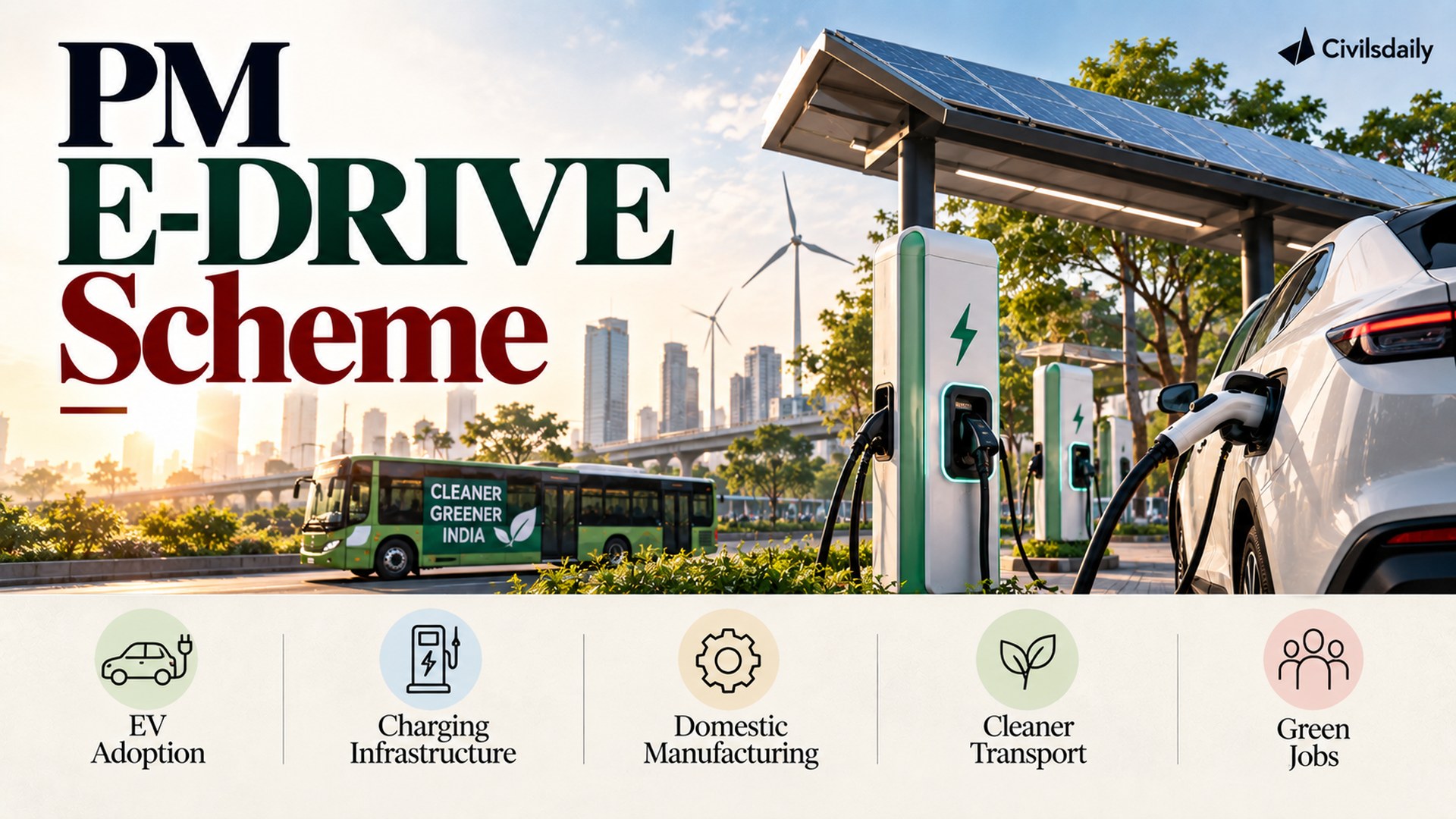
  • PM E-DRIVE Scheme

    PM E-DRIVE Scheme

    Why in the News?

    • The PM Electric Drive Revolution in Innovative Vehicle Enhancement (PM E-DRIVE) Scheme was launched in September 2024 and implemented from October 2024.
    • Its implementation has been extended up to 31 March 2028, with a total outlay of ₹11,900 crore.

    Key Highlights

    • Implemented on a pan-India basis.
    • Supports:
      • EV demand incentives
      • Charging infrastructure
      • E-buses
      • Vehicle testing agencies
      • Domestic EV manufacturing and localisation
    • Targets approximately 28.30 lakh EVs.
    • 26.59 lakh EVs sold as of June 2026.
    • Promotes cleaner mobility and reduction of transport-related environmental impacts.

    EV Categories Covered

    • e-2Ws
    • e-3Ws, including registered e-rickshaws, e-carts and L5
    • e-Ambulances
    • e-Trucks
    • e-Buses
    • EV charging infrastructure
    • Upgradation of vehicle testing agencies

    e-2W Incentive

    • Incentive: ₹2,500/kWh
    • Maximum incentive: ₹5,000 per vehicle
    • Applicable to vehicles priced up to ₹1.5 lakh ex-factory.
    • Allocation: ₹2,767 crore.
    • Target: 45.79+ lakh registered e-2Ws.

    e-3Ws

    • Target sales for registered e-3W L5 achieved.
    • L5 sub-component closed on 26 December 2025.
    • Support for e-rickshaws and e-carts continues until March 2028.

    E-Buses and Charging Infrastructure

    • ₹4,391 crore allocated for 14,028 e-buses.
    • 14,000 e-buses allocated as of August 2026.
    • 13,800 e-buses allocated to seven cities: Delhi, Bengaluru, Hyderabad, Mumbai, Ahmedabad, Pune, and Surat
    • ₹2,000 crore earmarked for nationwide EV Public Charging Stations (EV PCS).
    • ₹851 crore approved for 8,147 chargers to 3 oil marketing companies and 10 States as of 28 September 2026.
    • ₹780 crore allocated for modernisation and upgradation of vehicle testing agencies.

    Demand Incentive Mechanism

    • Eligible buyers receive an upfront reduction in purchase price through e-vouchers.
    • The incentive amount is subsequently reimbursed to the Original Equipment Manufacturer (OEM) by the Ministry of Heavy Industries (MHI).

    Domestic EV Manufacturing

    • Supports India’s domestic EV manufacturing ecosystem.
    • Promotes localisation of EV models.
    • Registered OEMs have obtained certificates of compliance with the Phased Manufacturing Programme (PMP) from MHI testing agencies.
    • Upgraded testing agencies will be equipped to handle new and emerging technologies.

    Prelims Quick Revision

    • Launch: September 2024
    • Implementation: October 2024
    • Extended until: 31 March 2028
    • Total outlay: ₹11,900 crore
    • EVs supported: approximately 28.30 lakh
    • EVs sold: 26.59 lakh as of June 2026
    • e-2W incentive: ₹2,500/kWh, capped at ₹5,000/vehicle
    • e-2W price ceiling: ₹1.5 lakh ex-factory
    • ₹2,000 crore for nationwide EV public charging stations
    • ₹780 crore for vehicle testing agency modernisation

    UPSC Prelims Trap

    • PM E-DRIVE is not limited to EV purchase incentives; it also covers charging infrastructure, e-buses and testing agencies.
    • The ₹2,500/kWh e-2W incentive is subject to a ₹5,000 per vehicle cap.
    • ₹4,391 crore relates to e-buses, while ₹2,000 crore is earmarked for EV public charging stations.
    • L5 e-3W support and e-rickshaw/e-cart support should not be treated as identical sub-components: the L5 target was achieved and that segment closed on 26 December 2025, while support for e-rickshaws and e-carts continues until March 2028.
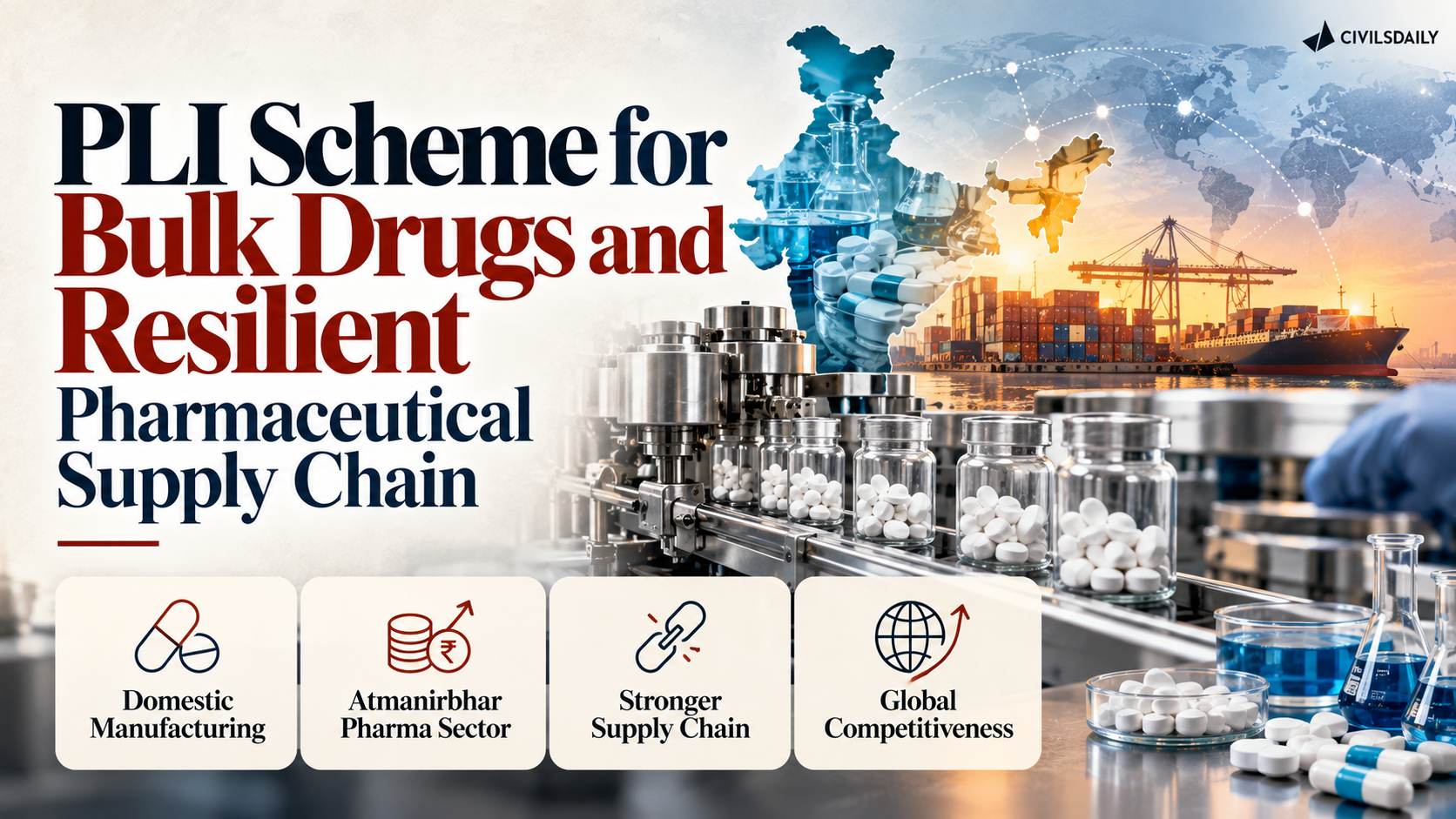
  • PLI Scheme for Bulk Drugs and Resilient Pharmaceutical Supply Chain

    PLI Scheme for Bulk Drugs and Resilient Pharmaceutical Supply Chain

    Why in the News?

    • The Production Linked Incentive (PLI) Scheme for Bulk Drugs is supporting domestic manufacturing of Key Starting Materials (KSMs), Drug Intermediates (DIs) and Active Pharmaceutical Ingredients (APIs).
    • Five greenfield projects have commissioned facilities for critical pharmaceutical inputs, reducing import dependence and strengthening supply-chain resilience.

    Key Highlights

    • Five greenfield projects commissioned under the Bulk Drugs PLI Scheme.
    • Focus areas include:
      • Antibiotic ingredients
      • Cardiovascular medicine APIs
      • Paracetamol starting materials
    • Supports import substitution, domestic value addition, employment generation and backward integration.

    Penicillin G – Andhra Pradesh

    • Company: Lyfius Pharma Pvt. Ltd., subsidiary of Aurobindo Pharma Ltd.
    • Location: Kakinada SEZ, Andhra Pradesh.
    • Investment: ₹2,270.05 crore
    • Capacity: 15,000 MT/year
    • Direct jobs: 2,353
    • Domestic value addition: More than 90%
    • Penicillin G is a fermentation-based KSM.
    • Used to produce 6-APA, which is used in antibiotics such as amoxicillin and ampicillin.
    • Domestic Penicillin G manufacturing restored after about three decades.

    Clavulanic Acid – Himachal Pradesh

    • Company: Kinvan Private Limited, DPB Group.
    • Location: Nalagarh, Himachal Pradesh.
    • Investment: ₹504.68 crore
    • Capacity: 400 MT/year
    • Direct jobs: 465
    • India’s first fermentation-based manufacturing facility for Potassium Clavulanate.
    • Clavulanic Acid is a β-lactamase inhibitor.
    • Combined with penicillin-group antibiotics such as amoxicillin to improve effectiveness against resistant bacteria.

    Sulfadiazine, Telmisartan and Olmesartan – Andhra Pradesh

    • Company: Andhra Organics Limited (AOL), subsidiary of Virchow Laboratories Ltd.
    • Location: Pydibhimavaram, Srikakulam district, Andhra Pradesh.
    • Investment: ₹151.47 crore
    • Direct employment: 221
    • Manufacturing technology developed in-house.
    • Sulfadiazine imports declined by about 73% compared with the FY 2019-20 baseline since domestic supplies began in 2022.
    • Telmisartan and Olmesartan are APIs used in medicines for hypertension.

    Para Amino Phenol – Gujarat

    • Company: Meghmani LLP.
    • Location: Dahej, Gujarat.
    • Investment: ₹60.46 crore
    • Capacity: 13,500 MT/year
    • PAP is a critical starting material for Paracetamol.
    • Facility provides domestic capacity for a material that was earlier largely imported.
    • Supports backward integration in Paracetamol manufacturing.
    • Cumulative production: ₹687 crore.

    Atorvastatin API – Punjab

    • Company: Centrient Pharmaceuticals India Pvt. Ltd.
    • Location: Nawanshahr, Punjab.
    • Investment: ₹161.13 crore
    • Capacity: 206 MT/year
    • Domestic value addition: More than 80%
    • Atorvastatin is a widely prescribed cardiovascular medicine used to lower cholesterol and reduce cardiovascular risk.
    • Cumulative production: ₹432 crore.

    Prelims Quick Revision

    • PLI Bulk Drugs Scheme supports domestic production of KSMs, DIs and APIs.
    • Penicillin G: Kakinada, Andhra Pradesh; 15,000 MT/year.
    • Potassium Clavulanate: Nalagarh, Himachal Pradesh; 400 MT/year.
    • PAP: Dahej, Gujarat; 13,500 MT/year; starting material for Paracetamol.
    • Atorvastatin API: Nawanshahr, Punjab; 206 MT/year.
    • Sulfadiazine imports: declined by about 73% against the FY 2019-20 baseline.
    • Penicillin G is a fermentation-based KSM and is used to produce 6-APA.
    • Clavulanic Acid is a β-lactamase inhibitor used with penicillin-group antibiotics.

    UPSC Prelims Trap

    • API vs KSM: API is the active pharmaceutical ingredient in a medicine, whereas KSM is a starting input used in pharmaceutical manufacturing.
    • PAP vs Paracetamol: PAP is a starting material for Paracetamol, not Paracetamol itself.
    • Clavulanic Acid: It is a β-lactamase inhibitor, not a penicillin-group antibiotic.
    • Penicillin G: It is a fermentation-based KSM and is used in producing intermediates such as 6-APA.
  • IMEI Tampering: Threat to Digital Sovereignty

    IMEI Tampering: Threat to Digital Sovereignty

    Why in the News?

    • India’s active wireless mobile subscriber base reached 1,204.01 million in July 2026, increasing the importance of securing mobile devices and telecom networks.
    • The government has highlighted IMEI tampering as a threat to device identification, network security, consumer protection and law enforcement.

    Key Highlights

    • IMEI is a unique 15-digit number identifying a mobile device on a telecom network.
    • First 8 digits of IMEI form the Type Allocation Code (TAC).
    • GSMA oversees global allocation of TACs.
    • Dual-SIM phones generally have 2 IMEI numbers.
    • IMEI can be displayed by dialing *#06#.
    • IMEI can be verified through Sanchar Saathi or by sending KYM <15-digit IMEI> via SMS to 14422.
    • Manufacturers and importers register applicable IMEIs through Device Setu – Indian Counterfeited Device Restriction (ICDR) portal.

    Unlawful IMEI Tampering

    • It is unlawful to intentionally:
      • Remove, obliterate, change or alter a device’s unique identification number.
      • Use, produce, traffic in, possess or control hardware/software knowing that it has been configured for such alteration.
    • Tampered IMEIs can make device identification and tracking more difficult.

    Device Lifecycle Responsibilities

    • Manufacturers
      • Register applicable IMEIs with the Government before first sale, testing, research or other use.
      • Ensure IMEIs are valid, unique and untampered.
    • Importers
      • Register applicable IMEIs before importing telecom equipment into India.
      • Ensure imported devices carry valid and authorised IMEIs.
    • Resellers/Retailers
      • Ensure devices have valid and untampered IMEIs.
      • Used devices should be checked against the Government database of tampered and blacklisted devices.
    • Brand Owners
      • Ensure compliance with IMEI registration and cybersecurity requirements.
      • Register brands through Device Setu-ICDR, linked to the relevant GSMA TAC.

    Sanchar Saathi

    • Enables citizens to verify IMEI details of mobile handsets.
    • Verification can provide:
      • Brand
      • Model
      • Manufacturer
    • Also provides a mechanism for blocking and unblocking lost or stolen mobile devices through CEIR.

    Legal Safeguards

    • Telecommunications Act, 2023 provides legal safeguards against tampering with telecommunication identifiers.
    • Section 42(3)(c): prohibits tampering with telecommunication identifiers.
    • Section 42(3)(e): prohibits obtaining SIMs or telecommunication identifiers through fraud, cheating or impersonation.
    • Punishment can include:
      • Imprisonment up to 3 years
      • Fine up to ₹50 lakh
      • Or both
    • Such offences are cognizable and non-bailable under Section 42(7).
    • Section 42(6) extends liability to persons who abet or promote such offences.

    Important Full Forms

    • IMEI: International Mobile Equipment Identity
    • TAC: Type Allocation Code
    • GSMA: Global System for Mobile Communications Association
    • DoT: Department of Telecommunications
    • ICDR: Indian Counterfeited Device Restriction
    • CEIR: Central Equipment Identity Register
    • SIM: Subscriber Identity Module
    • CLI: Calling Line Identity
    • KYM: Know Your Mobile

    Prelims Quick Revision

    • IMEI is a 15-digit device identifier.
    • First 8 digits = TAC.
    • GSMA oversees global TAC allocation.
    • Dual-SIM phones generally have 2 IMEIs.
    • *#06# can display the IMEI.
    • IMEI verification: Sanchar Saathi or KYM <IMEI> to 14422.
    • Telecommunications Act, 2023 provides legal safeguards against IMEI tampering.
    • Section 42(3)(c) deals with tampering with telecommunication identifiers.
    • Maximum punishment mentioned: 3 years imprisonment and/or ₹50 lakh fine.
    • Section 42(7): offences are cognizable and non-bailable.

    UPSC Prelims Trap

    • IMEI vs TAC: IMEI identifies the individual mobile device, while TAC is the first 8 digits and identifies the device type/model.
    • IMEI vs SIM: IMEI identifies the device, whereas SIM relates to the subscriber/mobile connection.
    • GSMA vs DoT: GSMA oversees global TAC allocation, while Indian IMEI registration and telecom regulation involve the Government/DoT.
    • Sanchar Saathi vs CEIR: Sanchar Saathi is the citizen-facing platform for telecom-related services, while CEIR is used for blocking/unblocking lost or stolen mobile devices.
  • CCTV at medical stores: Why govt wants them, but chemists don’t

    Why in the News

    The Union Health Ministry has proposed mandatory closed circuit television (CCTV) surveillance at medical stores, with recordings retained for three months. The stated purpose is stricter control over prescription medicines, and the draft notification frames it as addressing “unauthorised access to and sale of Schedule H, H1 and X drugs” under the Drugs and Cosmetics Rules, 1945. The measure was first proposed in 2021 to prevent the abuse of drugs by children, and the Drugs Consultative Committee of the Central Drugs Standard Control Organisation (CDSCO) cleared it this year alongside an application based system. The All India Organisation of Chemists and Druggists has objected on cost, on rural power and connectivity, and on patient privacy. What is contested is whether a camera at the counter reaches the behaviour the rule is aimed at, or only records the transaction while leaving the prescription itself unverified.

    What do Schedules H, H1 and X cover?

    1. Schedule H: These medicines cannot be sold without a prescription from a registered medical practitioner, and they include many antibiotics and steroids.
    2. Schedule H1: These are subject to additional record keeping requirements and include certain antibiotics and anti tuberculosis medicines.
    3. Schedule X: This is the more tightly controlled category carrying additional requirements, and it includes some psychotropic medicines.

    Why has the government proposed camera surveillance?

    1. The original trigger: The measure was first proposed in 2021 to prevent the abuse of drugs by children.
    2. Deterrence is the stated mechanism: Round the clock surveillance is intended to create apprehension among medical store owners and pharmacists, so they are not inclined to sell these medicines to children without a prescription.
    3. What the footage is meant to establish: It is meant mainly to verify whether a sale was made to a minor without a prescription, and not all sales can be verified this way.
    4. Retrieval rather than inspection: Routine inspection every three months is difficult, so the data is to be retrieved when a complaint is received.
    5. Paired with a digital system: The Drugs Consultative Committee decided earlier this year to implement the application based system alongside the CCTV plan.

    How common is prescription drug addiction among children?

    1. Opioid use ranks second: Opioid use, covering heroin, opium and pharmaceutical opioids found in strong painkillers, is the second most common form of addiction among children and affects nearly 1.8 per cent of them.
    2. Cannabis leads: Cannabis use affects 19 per cent of children, according to one of the most comprehensive studies of drug use in India, conducted by the All India Institute of Medical Sciences (AIIMS) and published in 2019.
    3. Alcohol and inhalants: Alcohol use affects 1.3 per cent and inhalant use 1.17 per cent of children, and inhalant use is the only form of addiction more common in children than in adults.
    4. Where pharmaceutical opioids sit: Of an estimated 2.3 crore opioid users of all ages, 25 lakh are dependent on pharmaceutical opioids while the largest group of 63 lakh is dependent on heroin.

    What do chemists object to?

    1. Capital cost against turnover: A store may have to spend nearly Rs 1 lakh to put the system in place, which is not viable for a store with daily sales of Rs 5,000 to Rs 10,000.
    2. Rural power and connectivity: Power failures and connectivity problems in rural areas make continuous recording and retention impractical.
    3. Patient privacy: Recording every purchase captures identifiable patients buying identifiable medicines, which the organisation treats as its most important objection.

    Challenges to CCTV surveillance at medical stores

    1. The prescription itself stays unverified: A camera records who bought a medicine and not whether the prescription produced at the counter was genuine or valid. Eg. Most retail prescriptions in India remain handwritten and are not checked against any prescriber registry at the point of sale.
      The Fix: Mandate electronic prescriptions linked to a verified practitioner registry, so validity is checked at dispensing rather than reconstructed from footage afterwards.
    2. Enforcement capacity is the binding constraint: A rule generating three months of footage at every store needs inspectors and laboratories that the drug regulatory system does not have. Eg. The Mashelkar Committee report of 2003 flagged severe shortages of drug inspectors and testing laboratory capacity.
      The Fix: Fill sanctioned drug inspector posts and tie retail licence renewal to a documented compliance record rather than to a periodic fee.
    3. Surveillance without a data protection scaffold: Footage of a patient buying a specific medicine is sensitive personal data, and the draft names a retention period without naming who may access it or for what. Eg. The Digital Personal Data Protection Act, 2023 requires purpose limitation and security safeguards for personal data held by any entity.
      The Fix: Specify in the notification the authority empowered to demand footage, the permitted purpose, and a mandatory access audit log.
    4. Sales migrate to unmonitored channels: A rule that binds the physical counter pushes unprescribed demand toward online and unlicensed sellers that no store camera reaches. Eg. Draft rules to regulate e pharmacies have been under consideration since 2018 without final notification.
      The Fix: Apply the same prescription verification and record keeping obligations to online dispensing before the retail rule takes effect.

    Conclusion

    The proposal is at the draft notification stage and has cleared the Drugs Consultative Committee, so the next step is the final notification and the compliance window given to retailers. The dispute it exposes is narrower than it appears. The state is regulating the place of sale because the prescription behind the sale is not yet auditable, and until it is, a camera records evidence of a transaction rather than evidence of a violation.

    Back2Basics: Central Drugs Standard Control Organisation (CDSCO)

    1. Status: It is India’s national drug regulatory authority, functioning under the Ministry of Health and Family Welfare and headed by the Drugs Controller General of India.
    2. Statutory basis: It operates under the Drugs and Cosmetics Act, 1940 and the Drugs and Cosmetics Rules, 1945.
    3. Functions: It approves new drugs and clinical trials, lays down standards for drugs, and licenses notified categories such as vaccines and blood products.
    4. Drugs Consultative Committee: This is a statutory advisory body under the Act that advises the Centre and the States on securing uniformity in the administration of the Act.

    Matching Previous Year Question

    “[2014, GS3, 12.5 marks] Can overuse and the availability of antibiotics without doctor’s prescription, the contributors to the emergence of drug-resistant diseases in India? What are the available mechanisms for monitoring and control? Critically discuss the various issues involved.”

  • HAL Hands Over Tejas Trainers, HTT-40 and Dhruv NG

    HAL Hands Over Tejas Trainers, HTT-40 and Dhruv NG

    Why in the News?

    Hindustan Aeronautics Limited (HAL) handed over 2 LCA Tejas FOC Twin Seater Trainers and 3 HTT-40 Basic Trainers to the Indian Air Force (IAF), along with 4 Dhruv Next Generation (NG) helicopters to Pawan Hans Limited (PHL) on 18 September 2026 in Bengaluru. The event highlights India’s growing indigenous defence and civil aerospace capabilities.

    Key Highlights

    LCA Tejas FOC Twin Seater Trainer

    • 2 aircraft handed over to IAF.
    • These are the final two aircraft under the FOC contract.
    • Designed to support pilot training before frontline fighter operations.
    • Retains the core systems and combat capability of the frontline Tejas platform.
    • Provides an indigenous training continuum for fighter pilots.
    • FOC: Final Operational Clearance

    HTT-40 Basic Trainer

    • 3 aircraft handed over to IAF.
    • HTT-40: Hindustan Turbo Trainer-40.
    • Indigenously designed and developed basic trainer aircraft.
    • Intended for primary training of Defence Forces pilots.
    • Uses a turboprop engine.
    • Features modern cockpit and avionics.

    Training Roles

    • HTT-40 can undertake: Aerobatics, General handling, Instrument flying, Navigation, Night flying, and Close formation flying

    Dhruv NG

    • 4 helicopters handed over to Pawan Hans Limited (PHL).
    • Represents HAL’s entry into the civil and commercial rotary-wing segment.
    • Features:
      • Enhanced systems
      • Modern avionics
      • More powerful engine
    • Intended applications:
      • Passenger transport
      • Emergency Medical Services (EMS)
      • Offshore logistics support

    Strategic Significance

    • The initiative demonstrates the development of an integrated Indian aerospace ecosystem covering:
    • Aircraft design, Avionics, Propulsion, Composite materials, Flight-control systems, Manufacturing, Certification, and Maintenance and lifecycle support
    • The government also emphasised greater public-private synergy and indigenous development of emerging technologies such as:
      • Artificial Intelligence (AI)
      • Autonomous systems
      • Unmanned Aerial Systems (UAS)
      • Electronic warfare
      • Cyber technologies
      • Next-generation propulsion

    Defence and Civil Aerospace Linkage

    • An important aspect of the event is the convergence of military and civil aerospace capabilities.
      • Tejas FOC Trainer: indigenous military aerospace capability.
      • HTT-40: indigenous basic military trainer.
      • Dhruv NG: indigenous civil/commercial helicopter capability.
    • This illustrates how common capabilities such as avionics, propulsion, materials, manufacturing and certification can support both civil and defence aerospace sectors.
  • Deep-sea discovery, environmental responsibility

    Deep-sea discovery, environmental responsibility

    Why in the News

    India holds three International Seabed Authority (ISA) exploration contracts covering approximately 95,000 square kilometres across the Central Indian Ocean Basin, the Central Indian Ridge and the Carlsberg Ridge in the international seabed area. Its exploration has identified an estimated 366 million tonnes of polymetallic nodules containing nickel, copper, cobalt and manganese. Under the Deep Ocean Mission, deep sea mining technology, underwater robotics and the MATSYA 6000 human submersible are being developed. The case now put is that this capability raises a prior question rather than settling one: whether everything that can be technologically exploited should necessarily be exploited. The counter position is that these minerals carry legitimate strategic importance for India’s renewable energy, electric mobility and advanced manufacturing ambitions. The tension is between a demonstrated technical capability and an ecosystem whose functioning is not understood well enough to predict what large scale disturbance would do to it.

    What is deep sea mining of polymetallic nodules?

    1. Polymetallic nodules: Mineral concretions the size of a potato that lie loose on the abyssal seabed at depths of roughly 4,000 to 6,000 metres, formed over millions of years as metals precipitate around a nucleus.
    2. Why they are wanted: They carry nickel, copper, cobalt and manganese, the metals used in battery cathodes and in alloys, which ties the deposits to the energy transition.
    3. How collection works: A seabed crawler lifts the nodules off the sediment surface. The nodules are then raised through a riser pipe to a surface vessel, and the sediment and water drawn up with them are discharged back into the water column.
    4. Where the activity is regulated: Mineral activity on the seabed beyond national jurisdiction is administered by the International Seabed Authority, which issues exploration contracts and has not yet finalised the rules for commercial exploitation.

    What does India’s deep ocean research actually show?

    1. Biodiversity surveys: Surveys across 19 seamounts have studied around 1,300 deep sea organisms.
    2. Species new to science: Nearly 23 of those organisms have been reported as new to science.
    3. Mining technology tested: The National Institute of Ocean Technology has tested a mining machine at a depth of about 5,270 metres.
    4. Environmental baselines built alongside: The exploration work has been accompanied by extensive environmental and biodiversity studies rather than resource assessment alone.
    5. The standing gap: The research continues to reveal previously unknown organisms, so the consequences of large scale seabed disturbance cannot be confidently predicted while the inventory remains incomplete.

    Why does strategic importance not settle the question of extraction?

    1. Capability is not permission: Technological progress creates the assumption that what can be exploited should be exploited, and the deep ocean is the case where that assumption does not hold.
    2. The necessity test: Before extraction is considered, the questions are whether the minerals are genuinely necessary at the proposed scale, whether alternatives exist, and whether demand can be reduced.
    3. The demand side routes: Recycling, efficiency, substitution and a circular economy each reduce the quantity of primary metal required, so the case for extraction has to be made against them rather than in their absence.
    4. Where the burden sits: Necessity must be demonstrated rather than presumed, which places the onus on the party proposing extraction rather than on the party opposing it.
    5. Exploration is separable from exploitation: Investment in deep ocean science advances knowledge, biodiversity assessment, environmental baselines and technology without committing the country to commercial mining.

    Why can adaptive management not substitute for the decision itself?

    1. The nature of the disturbance: Mining physically disturbs the seabed, so the damage follows from the activity itself rather than from how carefully it is run.
    2. Limits of adaptive management: Adjusting practice in response to observed harm requires a baseline against which harm can be detected, and the baseline for these ecosystems is incomplete.
    3. Irreversibility: Nodules form over geological time, so the hard substrate they provide is not recreated within any management horizon a contract could set.
    4. The question restated: The operative question is not how to mine with minimum damage but whether there is a need to mine at all.
    5. Why the timing matters: India’s ISA activities remain at the exploration stage, so a high ecological threshold can be fixed before any commercial decision rather than negotiated after one.

    What would leadership on deep sea ecological governance involve?

    1. Recognising ecological value: Treating the deep ocean as a precious ecological asset whose value may exceed that of its mineral wealth, rather than as a mineral reserve alone.
    2. Using the Mission’s own findings: The knowledge generated under the Deep Ocean Mission can support a conclusion that some poorly understood and potentially irreversible ecosystems are better left undisturbed.
    3. Mission LiFE as the domestic anchor: Lower demand, resource efficiency, recycling, substitution and circular consumption already sit in Mission LiFE, so the position has a stated domestic policy basis.
    4. Alignment with existing frameworks: Nature based Solutions, the Sustainable Development Goals (SDGs) and the circular economy share the principle that nature is the capital on which development depends.
    5. The role of science: Science establishes not only how far a country can go but also where it must stop, so identifying the frontiers best left untouched is part of its function.

    Challenges to deep sea mining governance

    1. The exploitation rules are unfinished: The International Seabed Authority has not adopted the regulations for commercial recovery, so there is no agreed standard for environmental thresholds, monitoring or liability. Eg. The two year rule triggered by Nauru in 2021 forced the Authority to face applications even without a completed code.
      The Fix: Hold commercial applications until the exploitation regulations and a liability regime are adopted, and argue that position at the Authority’s Council.
    2. The sponsoring State carries the liability: A contractor operates under the sponsorship of a State, which bears responsibility for ensuring compliance, so a private failure becomes a sovereign exposure. Eg. The International Tribunal for the Law of the Sea advisory opinion of 2011 set out the due diligence obligations of States sponsoring activity in the Area.
      The Fix: Require every sponsored contractor to post an environmental bond and accept independent monitoring before a sponsorship certificate issues.
    3. Sediment plumes travel beyond the mine site: Collection stirs fine sediment that drifts across the seabed, and the discharge from the surface vessel spreads through the water column, so effects extend past the licensed block. Eg. Tracks left by an experimental seabed disturbance in the Peru Basin in 1989 were still visible decades later with little faunal recovery.
      The Fix: Mandate plume modelling and independent monitoring across an agreed buffer around every test and production site.
    4. Recovery time exceeds any contract term: Nodule fields and the organisms attached to them re form over millions of years, so a disturbed area is lost for the purposes of any human management cycle. Eg. Sponges, corals and other attached species in the Clarion Clipperton Zone depend on the hard nodule surface as their only available substrate.
      The Fix: Designate no mining reference zones of ecological significance inside each contract area before exploitation is licensed, not after.
    5. India has no domestic law for activity in the Area: The Offshore Areas Mineral (Development and Regulation) Act, 2002 governs India’s own offshore areas, while activity in the international seabed area is covered only by contract conditions. Eg. India’s exploration contracts sit beyond national jurisdiction, where domestic environmental clearance procedures do not apply at all.
      The Fix: Enact a domestic statute fixing environmental assessment, monitoring and liability standards for Indian entities operating in the Area.
    6. Demand forecasts may not survive a change in battery chemistry: The commercial case for nodules rests on nickel and cobalt demand, which falls as cell chemistries shift away from those metals. Eg. Lithium iron phosphate (LFP) cells use neither nickel nor cobalt and have taken a growing share of electric vehicle batteries.
      The Fix: Tie any extraction decision to a periodically revised national critical mineral demand assessment that accounts for substitution and recycling.

    Conclusion

    India’s position on the seabed is unusual in that it holds the contracts and the technology to use them, and has not yet taken a decision to exploit. That interval is where an ecological threshold can be written in as a condition rather than conceded later as a compromise. The two commitments pull against each other, since the same mineral demand the energy transition generates is what makes the seabed attractive, and reducing that demand is what would make the seabed unnecessary. The point to watch is what India argues when the rules for commercial recovery come to a decision at the Authority, because that is where a principle has to become a stated national position.

    Government Initiatives for deep ocean science and the blue economy

    1. Deep Ocean Mission: Launched in 2021 under the Ministry of Earth Sciences with an outlay of about Rs 4,077 crore, it runs on six pillars covering deep sea mining technology and a manned submersible, ocean climate change advisory services, technologies for deep sea biodiversity, ocean survey and exploration, energy and freshwater from the ocean, and an advanced marine station for ocean biology.
    2. Samudrayaan: The manned ocean mission under the Deep Ocean Mission, designed to take a crew to a depth of 6,000 metres in the MATSYA 6000 submersible.
    3. O SMART: The Ocean Services, Modelling, Application, Resources and Technology scheme, which funds ocean observation, forecasting and marine resource services.
    4. National Centre for Polar and Ocean Research: Headquartered in Goa, it runs India’s polar and Southern Ocean research programmes and supports ocean science campaigns.
    5. Deccan High Level Principles on Blue Economy: Adopted at Chennai under India’s G20 Presidency in 2023, they set out an agreed framework for sustainable ocean management.

    Back2Basics: International Seabed Authority (ISA)

    1. What it is: An autonomous international organisation established under the United Nations Convention on the Law of the Sea (UNCLOS), 1982 and its 1994 Implementation Agreement.
    2. Mandate: It organises and controls all mineral related activity in the Area, meaning the seabed and subsoil beyond the limits of national jurisdiction, which UNCLOS designates the common heritage of mankind.
    3. Membership and seat: It is headquartered in Kingston, Jamaica, and its membership comprises every State party to UNCLOS, India included.
    4. What it issues: It grants exploration contracts to State sponsored contractors and is still drafting the exploitation regulations, known as the Mining Code, that would govern commercial recovery.

    Matching Previous Year Question

    “[2026] Which of the following statements with regard to India’s Deep Ocean Mission is/are correct?

    1. It was launched by the Ministry of Ports, Shipping and Waterways, Government of India.

    2. Matsya-6000 has been designed to carry 3 people for deep sea exploration.

    3. Samudrayaan is a project under this mission.

    (a) 1 only

    (b) 2 and 3 only

    (c) 1 and 2 only

    (d) 1, 2 and 3 Answer: B”
  • Stem cell therapy for autism only in approved clinical trials: Centre

    Why in the News

    The Union Health Ministry has directed States and Union Territories to ensure that stem cell therapy is offered as standard clinical care only for disease conditions and indications the Ministry has approved, with its use for Autism Spectrum Disorder (ASD) restricted to duly approved clinical trials. The advisory, issued on September 16, follows the Supreme Court’s judgment of January 30, 2026 in Yash Charitable Trust & Ors. v. Union of India & Ors., and reiterates the existing regulatory framework rather than creating a new one. The problem it addresses is a gap between practice and evidence. Stem cell interventions have continued to be offered for autism as commercial clinical services even though an Indian Council of Medical Research (ICMR) review found the available evidence does not support them.

    What does the advisory direct?

    1. Approved indications only: Stem cell therapy may be offered as standard clinical care only for disease conditions and indications approved by the Ministry.
    2. Autism confined to trials: For ASD, therapeutic use of any type of stem cell must remain confined to duly approved clinical trials.
    3. The governing guidelines: Such trials must accord with the National Guidelines for Stem Cell Research, 2017, issued by the ICMR and the Department of Biotechnology.
    4. The commercial bar: Interventions not approved for routine clinical use, including those offered for autism, must not be provided as routine, standard or commercial clinical services.

    What prompted the advisory?

    1. The judgment behind it: The advisory follows the Supreme Court’s January 30, 2026 judgment in Yash Charitable Trust & Ors. v. Union of India & Ors.
    2. Who it was issued to: It was issued to States and Union Territories that have adopted the Clinical Establishments (Registration and Regulation) Act, 2010, which is the statute through which clinical establishments are registered and regulated.
    3. The dissemination duty: States and Union Territories have been asked to pass the Court’s directions down to State and district regulatory authorities, and to government and private clinical establishments involved in stem cell research, treatment, promotion or administration.

    Why does the evidence not support stem cell therapy for autism?

    1. The ICMR finding: An ICMR review concluded that the available evidence does not support stem cell therapy over behavioural and supportive therapies for ASD.
    2. The review’s own recommendation: It recommended that such therapy be restricted to approved clinical trials rather than offered as care.
    3. The practice that continues: Stem cell interventions for autism have continued despite the absence of established evidence supporting them as a standard treatment, which is the conduct the advisory is directed at.

    Challenges to regulating unproven stem cell therapy

    1. Adoption of the governing Act is voluntary: The Clinical Establishments Act applies only in States that have adopted it, so an advisory routed through it does not reach every clinical establishment in the country. Eg. Several large States have their own clinical establishment legislation and have not adopted the central Act.
      The Fix: Route the same directions through each State’s own clinical establishment law, so coverage does not depend on adoption of the central statute.
    2. Guidelines carry no penalty of their own: The National Guidelines for Stem Cell Research, 2017 are guidance rather than statute, so breach is punished only through registration action against the establishment. Eg. Clinics offering unapproved stem cell interventions have continued operating while guidance was in force.
      The Fix: Attach defined penalties for offering unapproved cell based interventions to the rules under the clinical establishment framework.
    3. Advertising reaches patients before regulators do: Families encounter claims for stem cell treatment through direct marketing rather than through referral, so demand is created outside the clinical system. Eg. The Drugs and Magic Remedies (Objectionable Advertisements) Act, 1954 lists conditions for which advertising cures is barred, and enforcement against online claims is thin.
      The Fix: Bring digital advertising of cell based therapies under a prior approval requirement tied to the approved indications list.
    4. Desperation drives cross border and unregulated demand: Where no curative treatment exists, families pursue interventions regardless of the evidence, including outside the country. Eg. Stem cell tourism to jurisdictions with weaker oversight is a documented pattern for neurological conditions.
      The Fix: Publish and maintain a public registry of approved indications and approved trial sites, so families can check a claim before paying for it.

    Conclusion

    The advisory settles the legal position rather than changing it: stem cell therapy for autism is a research question, not a clinical service, and the distinction is now to be enforced through the registration authorities in each State. The instrument’s reach depends on how many States have adopted the Clinical Establishments Act and on whether district regulators act on the directions passed to them. The next measurable step is registration action against establishments that continue to offer the intervention commercially.

    Back2Basics: Clinical Establishments (Registration and Regulation) Act, 2010

    1. Purpose: It provides for the registration and regulation of clinical establishments, with a view to prescribing minimum standards of facilities and services.
    2. Coverage: It applies to all recognised systems of medicine and to both government and private establishments, excluding those run by the armed forces.
    3. How it extends to States: It applies directly in Union Territories and in States that adopt it by resolution, since public health is a State subject.
    4. Institutional structure: It establishes a National Council for Clinical Establishments and requires State Councils and District Registering Authorities to maintain a national register.

    Matching Previous Year Question

    “[2017, GS3, 10] Stem cell therapy is gaining popularity in India to treat a wide variety of medical conditions including Leukaemia, Thalassemia, damaged cornea and several burns. Describe briefly what stem cell therapy is and what advantages it has over other treatments?”

  • Delhi ranks first, only 2 large states among top performers in EV list

    Why in the News

    NITI Aayog has released the India Electric Mobility Index (IEMI) 2025, which ranks States and Union Territories on the development of the electric mobility ecosystem and on the adoption of electric vehicles (EVs). Delhi topped the index, followed by Maharashtra and Karnataka. Those two are the only large States among the top performers, out of seventeen. The index therefore records a concentration rather than a diffusion: the territories doing best are small, dense and administratively compact, while most of the country’s population lives in States that the index places in its middle tiers.

    What is the India Electric Mobility Index?

    1. What it measures: It is a composite index assessing the policy framework and the implementation outcomes for electric mobility at the State level.
    2. Who built it: NITI Aayog developed the index in collaboration with World Resources Institute (WRI) India.
    3. Its three themes: Transport electrification progress carries 50% weight, charging infrastructure readiness 30%, and EV research and innovation status 20%.
    4. Coverage: It scores all 36 States and Union Territories on a common 100 point scale.

    What does the overall ranking show?

    1. The spread: Composite scores range from 10 to 84, with a median of 40, so half the country sits at or below two fifths of the achievable score.
    2. The leaders: Delhi scored 84, followed by Maharashtra at 78, Karnataka at 73, Chandigarh at 71 and Goa at 65.
    3. Movement against the 2024 index: Delhi and Maharashtra held the top two positions, Karnataka moved to third by overtaking Chandigarh, and Goa climbed ten places to fifth.
    4. The largest single gain: Madhya Pradesh moved from twenty third rank to seventh.

    How have the large States performed?

    1. Only two in the top tier: Maharashtra and Karnataka are the only large States among the top performers, out of seventeen large States assessed.
    2. The frontrunner band: Eight large States scored between 50 and 64, namely Tamil Nadu, Madhya Pradesh, Odisha, Andhra Pradesh, Telangana, Haryana, Rajasthan and Uttar Pradesh.
    3. The emerging band: Seven large States scored between 35 and 49, namely Chhattisgarh, West Bengal, Bihar, Kerala, Jharkhand, Punjab and Gujarat.
    4. What the distribution implies: The States carrying the largest vehicle populations sit in the middle bands, so national electrification outcomes are decided where the index scores are weakest.

    Where do the three themes diverge?

    1. Transport electrification, the heaviest theme: Delhi, Chandigarh and Maharashtra were the only territories qualifying as top performers on it. It evaluates market absorption, consumer acceptance and demand side momentum, meaning how effectively electric vehicles are actually being adopted.
    2. Charging readiness has a different leader: Karnataka recorded the highest score nationwide at 97, followed by Goa at 92 and Maharashtra at 91.
    3. What charging readiness captures: The charger to vehicle ratio, subsidies for charging infrastructure, building bye laws for charging, and power availability.
    4. Research and innovation: Delhi achieved the top score of 94 on this theme.
    5. The divergence matters: A State can lead on chargers and trail on adoption, since infrastructure readiness is scored independently of vehicles actually registered.

    Challenges to State led electric mobility

    1. Distribution company capacity: Charging load falls on distribution utilities already carrying losses, so sanctioned load and feeder capacity cap how fast chargers can be added. Eg. Several State distribution companies carry aggregate technical and commercial losses above 20%.
      The Fix: Ring fence a concessional EV charging tariff and fund feeder upgrades from the State electric mobility policy corpus.
    2. Subsidy dependence: Registrations track State and central purchase incentives and fall when a scheme window narrows. Eg. Electric two wheeler sales dipped after the FAME II demand incentive was reduced in mid 2023.
      The Fix: Shift from an upfront purchase subsidy to a road tax and registration fee waiver that runs for the life of the vehicle.
    3. Geographic concentration of chargers: Chargers cluster in a few metropolitan pockets, leaving intercity corridors and smaller towns unserved. Eg. The index’s leading territories are small and dense, where covering the whole jurisdiction is far easier than across a large State.
      The Fix: Make charging points at fixed intervals a condition of national and State highway concession agreements.
    4. Battery supply and end of life handling: Cells and the lithium, cobalt and nickel behind them are largely imported, and recycling capacity remains thin. Eg. India imports the overwhelming share of the lithium ion cells it consumes.
      The Fix: Enforce the recycling and extended producer responsibility targets under the Battery Waste Management Rules, 2022 alongside domestic cell manufacturing incentives.
    5. Generation mix limits the climate gain: An electric vehicle’s emissions follow the electricity that charges it, so the benefit shrinks where coal dominates supply. Eg. Coal still supplies close to three quarters of India’s electricity generation.
      The Fix: Align charging tariffs to time of day slots that coincide with solar generation hours.

    Conclusion

    The index measures readiness, and readiness is not the same as transition. Its top ranks are held by territories small enough for a single administration to cover with chargers and incentives, which is not the problem a large State faces. The unresolved tension is that the States with the most vehicles to convert have the least fiscal room to subsidise the conversion and the weakest distribution utilities to power it. Watch whether the next edition shows movement in the frontrunner band of large States, because that band is where the national outcome is actually decided.

    Back2Basics

    1. World Resources Institute India: An independent research organisation working on climate, energy, cities, water and sustainable mobility, operating as the India arm of a global research body.
    2. Role here: It provided the research collaboration for the composite index, including the indicator design behind the three themes.
    3. Urban mobility work: It supports Indian cities on bus transport planning, road safety and electric mobility transition programmes.

    Matching Previous Year Question

    “The adoption of electric vehicles is rapidly growing worldwide. How do electric vehicles contribute to reducing carbon emissions and what are the key benefits they offer compared to traditional combustion engine vehicles?”