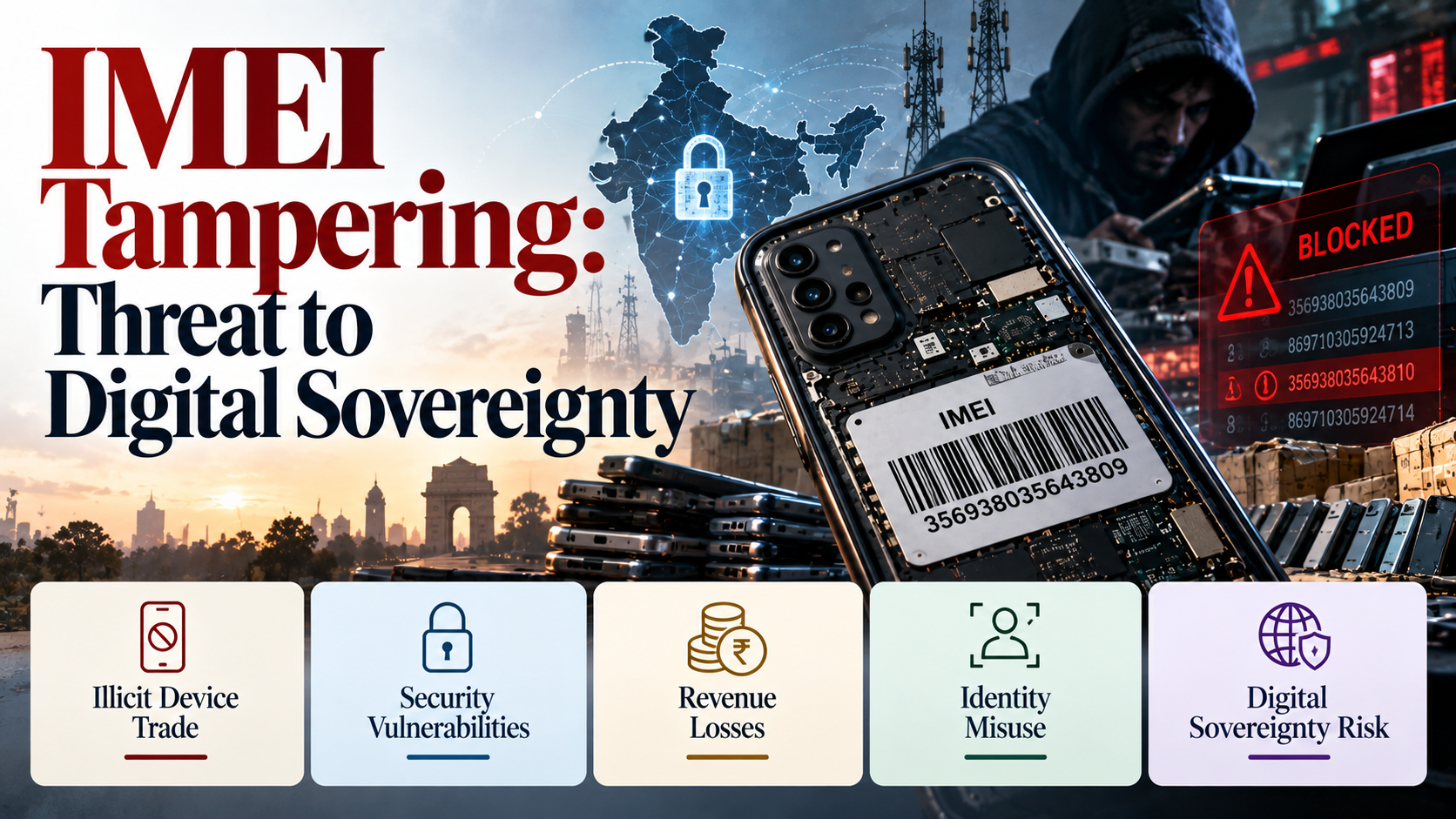
Why in the News?
- India’s active wireless mobile subscriber base reached 1,204.01 million in July 2026, increasing the importance of securing mobile devices and telecom networks.
- The government has highlighted IMEI tampering as a threat to device identification, network security, consumer protection and law enforcement.
Key Highlights
- IMEI is a unique 15-digit number identifying a mobile device on a telecom network.
- First 8 digits of IMEI form the Type Allocation Code (TAC).
- GSMA oversees global allocation of TACs.
- Dual-SIM phones generally have 2 IMEI numbers.
- IMEI can be displayed by dialing *#06#.
- IMEI can be verified through Sanchar Saathi or by sending
KYM <15-digit IMEI>via SMS to 14422. - Manufacturers and importers register applicable IMEIs through Device Setu – Indian Counterfeited Device Restriction (ICDR) portal.
Unlawful IMEI Tampering
- It is unlawful to intentionally:
- Remove, obliterate, change or alter a device’s unique identification number.
- Use, produce, traffic in, possess or control hardware/software knowing that it has been configured for such alteration.
- Tampered IMEIs can make device identification and tracking more difficult.
Device Lifecycle Responsibilities
- Manufacturers
- Register applicable IMEIs with the Government before first sale, testing, research or other use.
- Ensure IMEIs are valid, unique and untampered.
- Importers
- Register applicable IMEIs before importing telecom equipment into India.
- Ensure imported devices carry valid and authorised IMEIs.
- Resellers/Retailers
- Ensure devices have valid and untampered IMEIs.
- Used devices should be checked against the Government database of tampered and blacklisted devices.
- Brand Owners
- Ensure compliance with IMEI registration and cybersecurity requirements.
- Register brands through Device Setu-ICDR, linked to the relevant GSMA TAC.
Sanchar Saathi
- Enables citizens to verify IMEI details of mobile handsets.
- Verification can provide:
- Brand
- Model
- Manufacturer
- Also provides a mechanism for blocking and unblocking lost or stolen mobile devices through CEIR.
Legal Safeguards
- Telecommunications Act, 2023 provides legal safeguards against tampering with telecommunication identifiers.
- Section 42(3)(c): prohibits tampering with telecommunication identifiers.
- Section 42(3)(e): prohibits obtaining SIMs or telecommunication identifiers through fraud, cheating or impersonation.
- Punishment can include:
- Imprisonment up to 3 years
- Fine up to ₹50 lakh
- Or both
- Such offences are cognizable and non-bailable under Section 42(7).
- Section 42(6) extends liability to persons who abet or promote such offences.
Important Full Forms
- IMEI: International Mobile Equipment Identity
- TAC: Type Allocation Code
- GSMA: Global System for Mobile Communications Association
- DoT: Department of Telecommunications
- ICDR: Indian Counterfeited Device Restriction
- CEIR: Central Equipment Identity Register
- SIM: Subscriber Identity Module
- CLI: Calling Line Identity
- KYM: Know Your Mobile
Prelims Quick Revision
- IMEI is a 15-digit device identifier.
- First 8 digits = TAC.
- GSMA oversees global TAC allocation.
- Dual-SIM phones generally have 2 IMEIs.
*#06#can display the IMEI.- IMEI verification: Sanchar Saathi or
KYM <IMEI>to 14422. - Telecommunications Act, 2023 provides legal safeguards against IMEI tampering.
- Section 42(3)(c) deals with tampering with telecommunication identifiers.
- Maximum punishment mentioned: 3 years imprisonment and/or ₹50 lakh fine.
- Section 42(7): offences are cognizable and non-bailable.
UPSC Prelims Trap
- IMEI vs TAC: IMEI identifies the individual mobile device, while TAC is the first 8 digits and identifies the device type/model.
- IMEI vs SIM: IMEI identifies the device, whereas SIM relates to the subscriber/mobile connection.
- GSMA vs DoT: GSMA oversees global TAC allocation, while Indian IMEI registration and telecom regulation involve the Government/DoT.
- Sanchar Saathi vs CEIR: Sanchar Saathi is the citizen-facing platform for telecom-related services, while CEIR is used for blocking/unblocking lost or stolen mobile devices.
