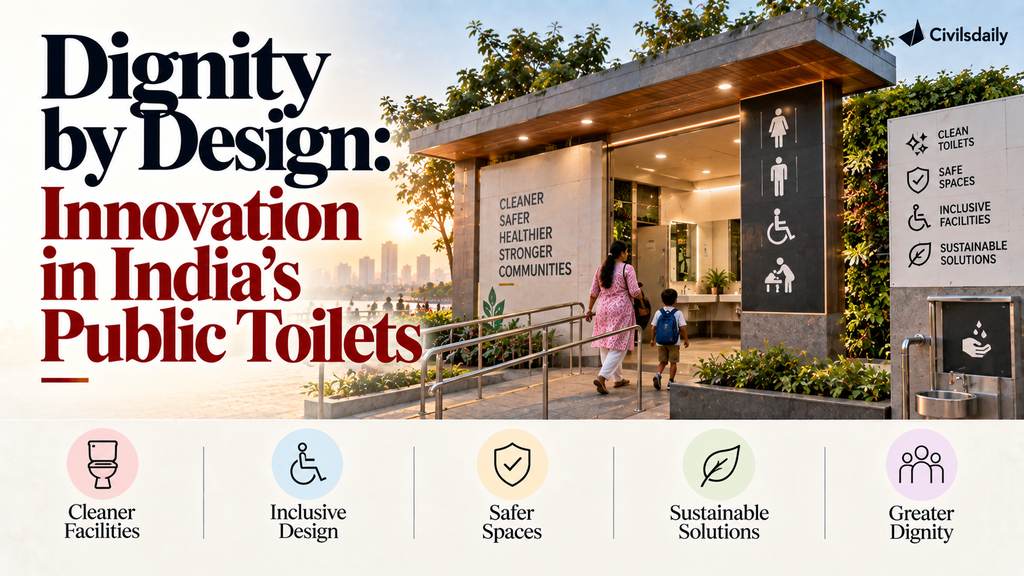
Why in the News?
- Cities are adopting innovative designs and technologies to make Community and Public Toilets (CT/PTs) more accessible, safe, clean and inclusive.
- The Toilets 2.0 initiative under Swachh Bharat Mission-Urban (SBM-U) was launched in 2022 to improve the quality and user experience of public toilets.
Key Highlights
- Swachh Bharat Mission: Launched on 2 October 2014.
- Cities progressed from ODF towards ODF+ and ODF++.
- SBM Toilet Locator: Available through the Swachhata App to help citizens locate nearby toilets.
- Innovations highlighted include:
- Scrap bus converted into women’s toilet
- Recycled plastic used in toilet construction
- Smart and sensor-based public toilets
- Scientific sanitary-waste disposal
- Inclusive toilets for women, transgender persons, children and persons with disabilities
Sthree Toilet, Bengaluru
- Located at Majestic bus terminal, Bengaluru, Karnataka.
- Established using a scrap bus and exclusively serves women.
- Facilities:
- 3 Indian-style + 2 Western-style commodes
- Sanitary napkin vending machine
- Incinerator
- Breastfeeding and diaper-changing space
- Solar-powered sensor lights
- Waste is connected to the nearest sewage chamber.
Aspirational Toilets, Navi Mumbai
- Developed by Navi Mumbai Municipal Corporation (NMMC) at Sector 14, Koparkhairane.
- Used by approximately 8,000-9,000 visitors daily.
- Construction incorporates:
- 426 sq m recycled plastic sheeting
- 5.3 tonnes single-use plastic
- 11,700 plastic bottles
- 35,200 bottle caps
- 85 reused computer keyboards
- 284 kg scrap metal
- Follows the principle of 3Rs: Reduce, Reuse and Recycle.
- Includes facilities for:
- Women and men
- Children
- Persons with disabilities
- Baby care
- Sanitary-pad vending
- Fountain uses treated sewage water.
Freshrooms, Bhopal
- Located at 10 Number Market, Bhopal.
- Developed by Bhopal Municipal Corporation.
- Operates under Design-Build-Operate-Transfer (DBOT) model through Public-Private Partnership (PPP).
- Smart Lounge covers 800-1,000 sq ft.
- Serves around 500-1,000 visitors daily.
- Features:
- Sensor-based toilets
- Touch-free urinals
- Hot and cold showers
- Lockers
- Wi-Fi
- Café and vending machines
- Baby-changing rooms
- Digital information wall
- Separate accessible facilities for men, women and persons with disabilities.
Sanitary Waste Management, Karad
- Karad, Satara district, Maharashtra, has achieved 100% segregation, collection and processing of sanitary and biomedical waste.
- Collects around 300-350 kg sanitary waste daily.
- Red bins are provided in public toilets for sanitary waste.
- Schools use sanitary-pad vending machines and disposal systems.
- Separate bins in garbage collection vehicles ensure sanitary waste is handled separately.
- Karad Municipal Council (KMC) partnered with Karad Hospital Association.
- Common Biomedical Waste Treatment Facility (CBWTF):
- Capacity: 600 kg/day
- Incinerator temperature: up to 1,200°C
- Emissions monitored in real time
- Linked with the State Pollution Control Board (SPCB) system.
- PPP model reduces the financial burden on the municipal council.
Inclusive Toilets, Tirupati
- Tirupati Municipal Corporation has developed modern toilet complexes for pilgrims, tourists and residents.
- Pink Toilet Complex:
- Located near the bus station.
- Serves 12,000-15,000 users daily.
- Includes Indian and Western toilets, mother-care facilities, changing rooms, incinerators and sanitary-pad vending machines.
- Common Public Toilet Complex near railway station:
- Serves 20,000-25,000 devotees daily.
- Facilities for men, women, transgender persons, Divyaang persons and children.
- Includes ramps, handrails, child-friendly fixtures and bathing rooms.
Prelims Quick Revision
- SBM launched: 2 October 2014.
- Toilets 2.0: Launched under SBM-U in 2022.
- Sthree Toilet: Scrap bus converted into women’s toilet at Majestic, Bengaluru.
- Navi Mumbai: Toilet constructed using recycled materials including 5.3 tonnes of single-use plastic.
- Bhopal Freshrooms: Uses DBOT + PPP model.
- Karad: 600 kg/day CBWTF, incinerator temperature up to 1,200°C.
- Tirupati Pink Toilet: Serves 12,000-15,000 users daily.
- Tirupati’s Common Public Toilet provides dedicated facilities for transgender persons and Divyaang persons.
UPSC Prelims Trap
- Toilets 2.0 is an initiative under SBM-U, not SBM-Grameen.
- ODF, ODF+ and ODF++ represent different levels of sanitation outcomes and should not be treated as interchangeable.
- DBOT is the operational model highlighted for Bhopal’s Freshrooms, while PPP describes the broader partnership framework.
- Karad’s CBWTF is for treatment of sanitary and biomedical waste; it is not simply a conventional municipal solid-waste processing facility.
