Why in the News
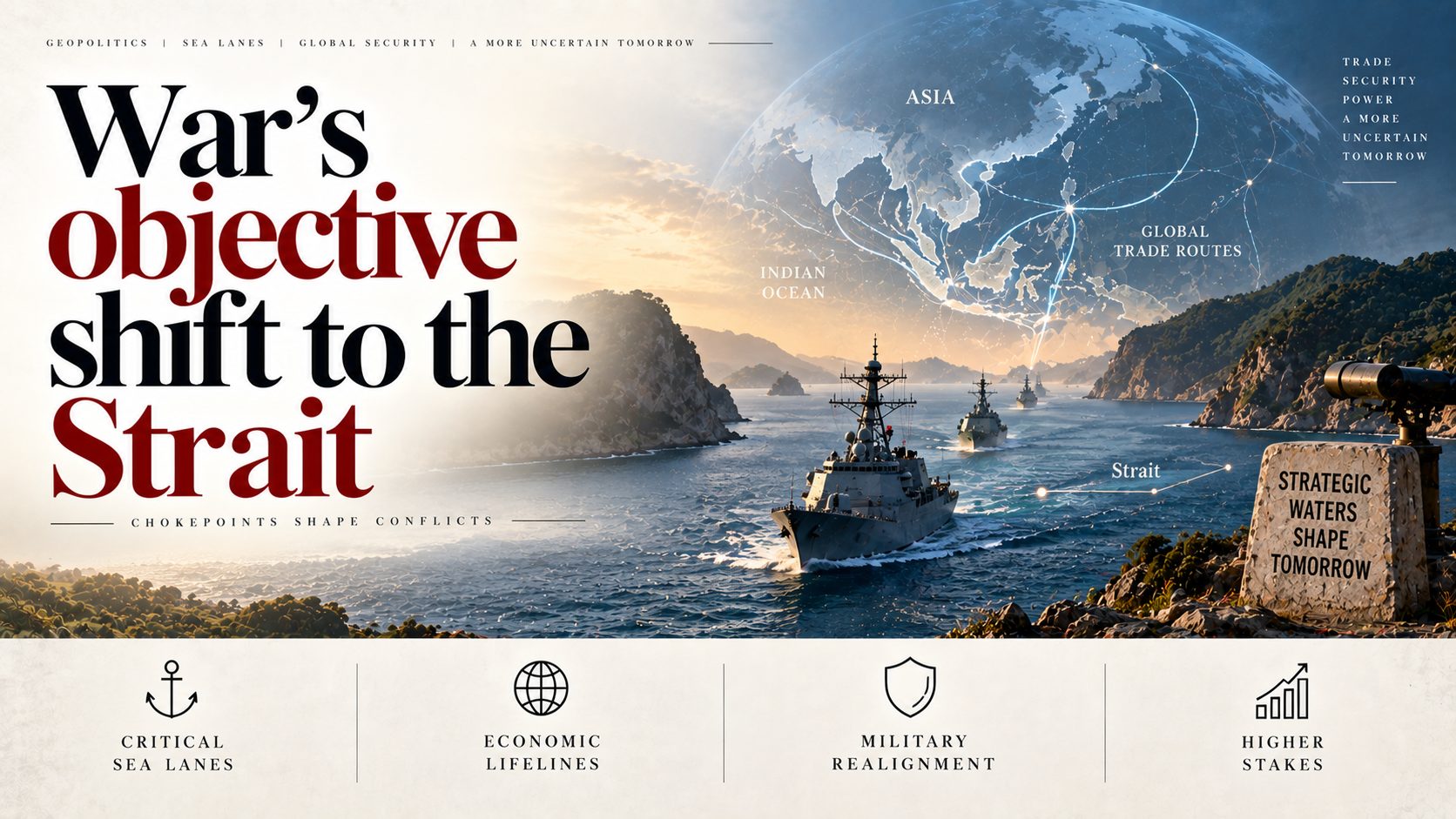
The tension is that the war’s declared objective and its actual battlefield no longer match, since the fighting now turns entirely on the Strait rather than on the nuclear programme.
How did the war’s objective shift to the Strait?
- The stated aims have been displaced: The central focus of the war today is the Strait of Hormuz, not the nuclear facilities or the political order the campaign was launched to change.
- Iran chose the ground and Washington accepted it: Tehran forced the United States to fight over a problem it created rather than pursue Washington’s original objective, which is in itself a strategic victory for Iran.
- The chokehold has not been broken: Iran still maintains its control over the waterway, so the single condition the campaign now exists to remove remains in place.
What has the escalation actually consisted of?
- Iran has crossed into attacks on military vessels: This is the first time in months that Iran has targeted United States warships, apparently seeking to break the naval blockade.
- The United States has crossed a red line in return: By striking Iranian oil tankers in retaliation, Washington extended the war to commercial shipping under Iranian flag.
- Six vessels struck in one round: The Islamic Revolutionary Guard Corps (IRGC), Iran’s parallel armed force reporting to the Supreme Leader, announced that it had struck six vessels in the Gulf, three tankers and three United States-linked ships, in retaliation for the American attacks on oil tankers, and vowed to expand strikes against United States ships.
- The exchange has spread to land targets: The return to American strikes triggered Iranian attacks on United States bases in Kuwait, Bahrain and Jordan.
Why has economic warfare not changed Iran’s position?
- The policy shifted from strikes to pressure and then back: The United States President moved the focus of Iran policy to economic warfare last month, announcing new sanctions and tightening the United States Navy’s blockade of Iran’s ports. Unable to find a way out, Washington returned to strikes.
- The workaround was matched: The United States managed to get some oil tankers through the Strait via a southern route along the Omani coast, and Iran continued to target vessels taking that route.
- Economic pain has raised Iran’s risk appetite rather than lowered it: Iran has emerged more assertive despite its economic difficulties, and the more Washington seeks to trap it in an economic gridlock, the less risk-averse Tehran becomes.
What does the absence of a theory of victory mean?
- Neither instrument has produced a change of position: Neither the military effort nor the economic warfare has forced Iran to alter its stance, and the Strait remains unsafe while the toll on the global economy mounts.
- Attrition has replaced strategy: The administration is ‘mowing the lawn’, a doctrine taken from the Israeli playbook that seeks to periodically degrade an adversary’s attack capability without attempting to defeat it.
- Iran is running its own attrition strategy: Tehran pursues ‘debasification’, pushing United States military presence away from its immediate periphery each time it retaliates.
- Both sides are chasing an outcome neither can reach: Each seeks escalation dominance, the ability to raise the level of force to a point the other cannot match, and the war therefore risks spiralling out of control.
Challenges to reviving a negotiated framework
- The declared aim of regime change is incompatible with a negotiated outcome: No government negotiates the terms of its own removal, so the objective and the talks track cancel each other out. Eg. The talks channel collapsed within months of being opened while the military campaign continued.
The Fix: Separate the nuclear file from the political objective and negotiate only the first, as the 2015 nuclear agreement did. - Verification capacity has been destroyed along with the facilities: Strikes on nuclear sites remove the baseline against which any future inspection regime would measure compliance. Eg. Access for International Atomic Energy Agency inspectors has been the recurring breaking point since the Joint Comprehensive Plan of Action was agreed in 2015.
The Fix: Restore inspector access as the first deliverable of any revived framework, before sanctions relief is discussed. - American commitments carry a credibility discount: A negotiated framework abandoned once is harder to sell domestically in Tehran the second time. Eg. The United States withdrew from the Joint Comprehensive Plan of Action in 2018 despite Iranian compliance being certified.
The Fix: Anchor any revived understanding in a United Nations Security Council resolution rather than in an executive arrangement that a change of administration can reverse. - A pause that leaves the blockade in place gives Iran no reason to stop: Iran’s attacks on shipping are its only instrument against the economic siege, so a ceasefire on attacks alone asks it to surrender the leverage. Eg. Iranian targeting of the southern route began after the blockade of its ports was tightened.
The Fix: Pair a halt to attacks on shipping with a defined easing of the port blockade, so each side gives up an instrument simultaneously. - The costs land on third-party importers with no say in the war: Energy importers absorb the freight, insurance and price consequences of an unsafe Strait without being party to the dispute. Eg. India draws a large share of its crude oil imports from West Asian suppliers whose cargoes transit the Strait.
The Fix: Convene the major Asian importers as a bloc to press both sides on the narrow question of shipping safety, separately from the nuclear dispute.
Conclusion
Six months of strikes and sanctions have moved neither Iran’s position nor the safety of the waterway. The war has produced an unresolved tension rather than a stalemate that can simply be held: the party with overwhelming military superiority cannot convert it into an outcome, and the party under economic siege grows less cautious the tighter the siege becomes. The talks track collapsed once and remains the only route either side has actually attempted, which is why its revival, rather than the next round of retaliation, is the development to watch.
Back2Basics
- Strait of Hormuz: The sea passage connecting the Persian Gulf to the Gulf of Oman and the Arabian Sea, and the only maritime outlet for oil exported from the Gulf producers.
- Geography: It is about 33 km wide at its narrowest point, with inbound and outbound shipping lanes only a few kilometres wide, bounded by Iran on the northern shore and by Oman and the United Arab Emirates on the southern shore.
- Why it is a chokepoint: Roughly a fifth of the world’s seaborne oil moves through it, and there is no alternative sea route out of the Gulf, so a threat to the lane transmits directly into global crude prices.
- Bypass capacity: Pipelines run by Saudi Arabia to the Red Sea and by the United Arab Emirates to Fujairah can carry only a fraction of the volume that normally transits the Strait.
[2018, GS2, 15 marks] In what ways would the ongoing US-Iran Nuclear Pact Controversy affect the national interest of India? How should India respond to this situation?
