Why in News?
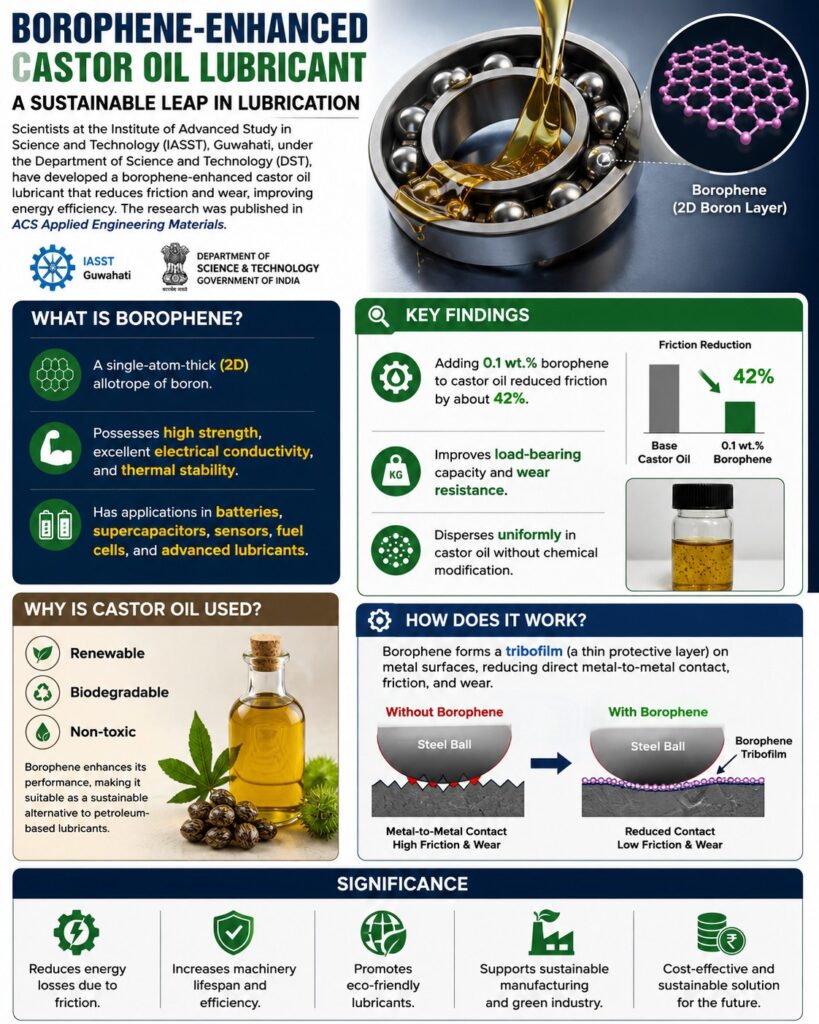
Scientists at the Institute of Advanced Study in Science and Technology (IASST), Guwahati, under the Department of Science and Technology (DST), have developed a borophene-enhanced castor oil lubricant that reduces friction and wear, improving energy efficiency. The research was published in ACS Applied Engineering Materials.
What is Borophene?
- A single-atom-thick (2D) allotrope of boron.
- Possesses high strength, excellent electrical conductivity, and thermal stability.
- Has applications in batteries, supercapacitors, sensors, fuel cells, and advanced lubricants.
Key Findings
- Adding 0.1 wt.% borophene to castor oil reduced friction by about 42%.
- Improves load-bearing capacity and wear resistance.
- Disperses uniformly in castor oil without chemical modification.
How Does It Work?
Borophene forms a tribofilm (a thin protective layer) on metal surfaces, reducing direct metal-to-metal contact, friction, and wear.
Why is Castor Oil Used?
- Renewable, biodegradable, and non-toxic.
- Borophene enhances its performance, making it suitable as a sustainable alternative to petroleum-based lubricants.
Significance
- Reduces energy losses due to friction.
- Increases machinery lifespan and efficiency.
- Promotes eco-friendly lubricants for sustainable manufacturing.
Prelims Facts
- Borophene: Two-dimensional allotrope of boron.
- Lubricant Base: Castor oil.
- Friction Reduction: About 42%.
- Protective Layer: Tribofilm.
- Research Institute: IASST, Guwahati.
- Ministry: Department of Science and Technology (DST).
