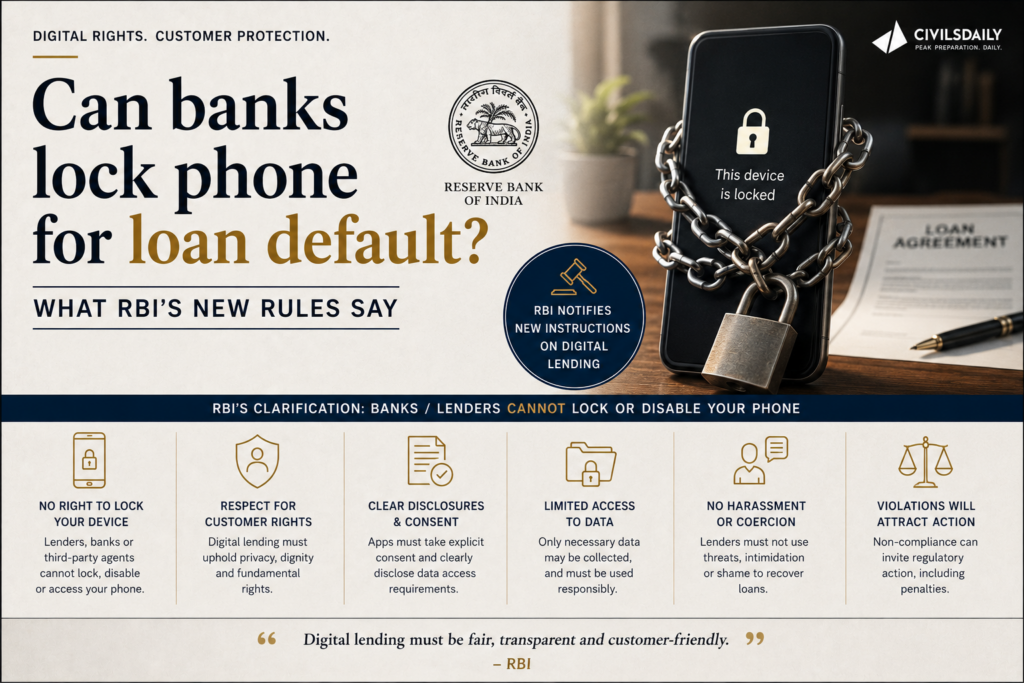
Why in the News
The Reserve Bank of India (RBI) has issued a comprehensive set of rules governing how commercial banks recover unpaid loans, coming into force on January 1, 2027. The framework introduces India’s first detailed regulation of technology-based restrictions on mobile phones financed through bank loans, balancing lenders’ recovery rights against borrower protection.
What is the RBI’s new loan-recovery framework?
- Comprehensive recovery rules: The framework governs the conduct of banks and outsourced recovery agents in recovering unpaid loans, and applies to all commercial banks.
- Board-governed process: It makes recovery a board-governed process rather than a purely operational function, requiring a documented recovery policy.
- Effective date: It comes into force on January 1, 2027.
Can banks now lock a financed phone?
- Only for device loans: Technology-based restrictions can be used only where the loan specifically financed that smartphone, tablet or laptop.
- Disclosure required: The loan agreement must clearly disclose these restrictions in advance.
- 30-day threshold: No restriction can be activated until the account is 30 days past due, despite notices to the borrower.
- Gradual escalation: Restrictions must be introduced gradually.
- 60-day limit for full lock: Complete restrictions can be imposed only after 60 days of non-payment, and outgoing calls cannot be blocked before that.
What safeguards protect borrowers?
- Essential functions protected: Banks cannot disable incoming calls, SMS services or emergency functions.
- Work not disrupted: Restrictions must not interfere with activities necessary for the borrower’s work or employment.
- Visibility: Borrowers must be able to view the status of restrictions on their device at any time.
- Fast restoration: Once overdue amounts are paid, functionality must be restored within one hour.
- Compensation: Where restoration is delayed by the bank, compensation of Rs 250 per hour is payable until access is restored, subject to a ceiling equal to the loan amount.
- Data protection: Banks and third-party technology providers are barred from accessing personal data stored on borrowers’ devices.
How are recovery agents regulated?
- Fixed contact hours: Agents can contact borrowers only between 8 am and 7 pm, unless the borrower requests otherwise.
- Identification: They must identify themselves through identity cards and authorisation letters and carry copies of notices issued by the bank.
- Certification: Only certified individuals can undertake recovery work.
- Background checks: Banks must conduct background verification before appointing agents and periodically thereafter.
How are banks held accountable?
- Call recording: Banks must record recovery-related calls, keep records for at least six months and inform borrowers that conversations are recorded.
- No aggressive incentives: Recovery targets and incentive structures should not encourage aggressive behaviour.
- Grievance redressal: Every bank must set up a dedicated grievance redressal mechanism for recovery complaints, detailed in loan documents and communications.
- Direct responsibility: Banks are made directly responsible for the conduct of outsourced recovery personnel.
Why were fresh directions issued?
- Retail lending boom: India’s retail lending market has expanded rapidly, driven by digital loans, unsecured personal credit and Buy Now Pay Later products.
- Device financing: Growth in financing for smartphones and consumer electronics raised the practice of remotely disabling devices.
- Rising complaints: Complaints about harassment by recovery agents and aggressive collection practices have grown.
Conclusion
The RBI has converted loan recovery from an operational function into a board-governed, rights-based process, and for the first time regulated the remote disabling of financed devices. The framework takes effect on January 1, 2027, and its impact will depend on how banks build recovery policies, certify agents and enforce the device-restriction safeguards. The next milestone is compliance readiness across all commercial banks before the effective date.
Back2Basics: Reserve Bank of India (RBI)
- Type: Central bank and monetary authority of India.
- Established: 1935, nationalised in 1949.
- Governing Acts: RBI Act, 1934 and Banking Regulation Act, 1949.
- Headquarters: Mumbai.
- Core functions: Monetary policy, currency issue, banker to the government, banking regulation and supervision, and management of foreign exchange.
What are the RBI’s Functions?
- About: The RBI is India’s central bank, established in 1935, responsible for monetary policy, currency issuance and financial system regulation.
- Rationale: It exists to maintain price stability, ensure adequate credit flow and safeguard the stability of the banking and payments system.
- Regulatory scope: It regulates commercial banks on liquidity of assets, branch expansion, mergers, winding-up and, increasingly, conduct towards customers.
Statutory Framework Governing Bank Regulation
- Reserve Bank of India Act, 1934: Establishes the RBI and its monetary and regulatory powers.
- Banking Regulation Act, 1949: Empowers the RBI to license, supervise and regulate banks, including branch expansion, mergers and winding-up.
- Payment and Settlement Systems Act, 2007: Provides for RBI regulation of payment systems, including digital lending rails.
- Consumer Protection Act, 2019: Reinforces borrower rights against unfair practices.
Government and RBI Initiatives for Borrower Protection
- Fair Practices Code for Lenders: Sets standards for transparency and conduct in lending.
- RBI Integrated Ombudsman Scheme: Provides a single redressal window for customer complaints against banks and lenders.
- Digital Lending Guidelines, 2022: Regulate loan disbursal, data use and recovery by digital lenders.
- RBI Retail Direct and Financial Literacy programmes: Improve borrower awareness and protection.
Key Facts about RBI Regulation of Banks
- Effective date of new recovery rules: January 1, 2027.
- Compensation cap: Rs 250 per hour for delayed restoration, ceiling equal to the loan amount.
- Recovery contact window: 8 am to 7 pm.
- Record retention: At least six months for recovery calls.
Challenges in Loan Recovery and Retail Lending
- Agent harassment: Aggressive and coercive collection practices remain widespread.
- Digital coercion: Remote disabling of financed devices can cut borrowers off from work and emergencies.
- Data misuse: Access to personal data on devices raises privacy risks.
- Over-leverage: Rapid unsecured and Buy Now Pay Later lending raises default risk.
- Enforcement gaps: Outsourced agents are hard to monitor and hold accountable.
- Grievance delays: Weak redressal leaves borrowers without timely remedy.
Way Forward
- Enforce certification: Ensure only verified, certified agents undertake recovery.
- Audit device restrictions: Independently audit compliance with the 30-day and 60-day safeguards.
- Strengthen redressal: Make grievance mechanisms accessible and time-bound.
- Protect data: Enforce the bar on accessing personal data with strict penalties.
- Promote responsible lending: Tighten underwriting for unsecured and device-linked credit.
PYQ Relevance
[2013] The Reserve Bank of India regulates the commercial banks in matters of
(1) liquidity of assets
(2) branch expansion
(3) merger of banks
(4) winding-up of banks.
Select the correct answer using the codes given below:
(a) 1 and 4 only
(b) 2, 3 and 4 only
(c) 1, 2 and 3 only
(d) 1, 2, 3 and 4
