Why in the News
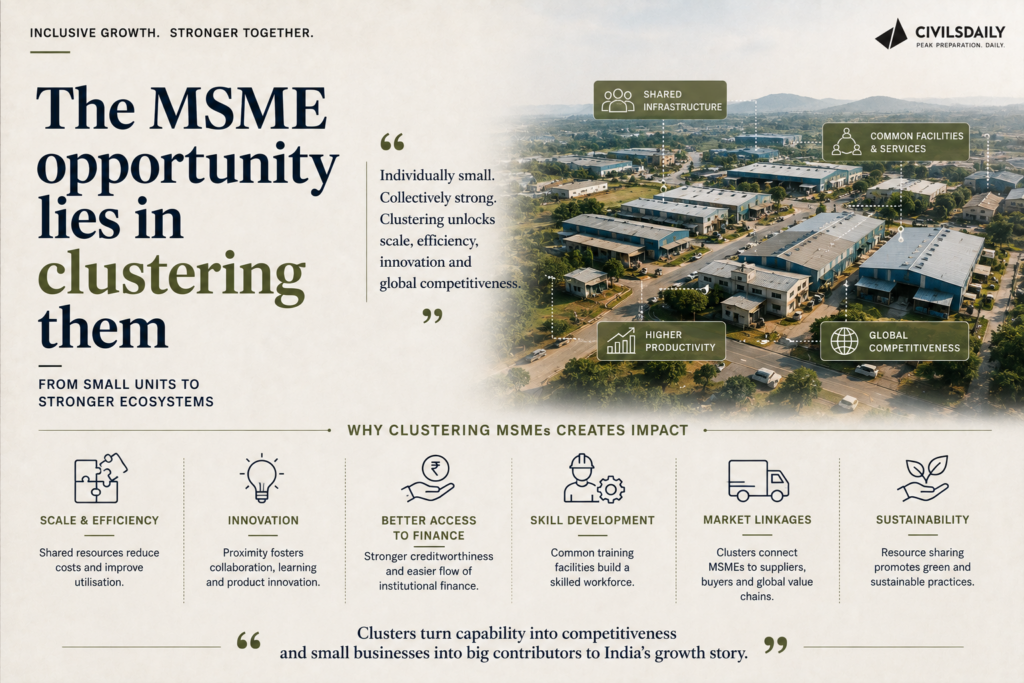
Youth unemployment protests and the passage of the Micro, Small and Medium Enterprises Development (Amendment) Bill, 2026, have refocused attention on the Micro, Small and Medium Enterprises (MSME) sector as a job engine. The central argument is that industrial strength comes not from supporting isolated firms but from building clusters, dense ecosystems where suppliers, labour, research institutions and capital reinforce one another.
What is a cluster-based development model?
- Definition: A cluster is a geographic concentration of firms in a related activity, together with their suppliers, workers, research institutions and finance, located close enough to reinforce one another.
- Core idea: Proximity generates shared benefits that an isolated firm cannot capture on its own.
What is the “Little Giant” programme?
- Chinese niche-firm scheme: The Little Giant programme is a Chinese policy that supports technically strong small firms operating in narrow specialised niches.
- Support offered: It provides these firms with financing, tax support and research and development assistance.
How significant is the MSME sector in India?
- Number of firms: India has 63 million MSMEs.
- Employment: They employ more than 320 million people.
- Output share: They contribute about 31% of Gross Domestic Product (GDP) and 35% of manufacturing output.
- Exports: They account for 49% of exports.
- Structural weakness: The sector remains largely informal, fragmented and concentrated in low-value activities.
What does the MSME Development (Amendment) Bill, 2026, address?
- Delayed payments: It seeks to tackle the problem of delayed payments to smaller firms.
- Dispute resolution: It aims to ease dispute resolution for MSMEs.
- Compliance burden: It reduces some compliance burdens on the sector.
- Limits: It does not by itself resolve the deeper problems of credit access and the burden of Goods and Services Tax (GST), labour, environmental and tax compliance.
Why do clusters work?
- Knowledge spillovers: Technical know-how spreads quickly through worker mobility, informal interaction and shared service providers.
- Talent pooling: A cluster creates a real labour market that attracts and retains specialised workers, which an isolated firm struggles to hire.
- Lower fixed costs: Firms share infrastructure such as testing labs, effluent-treatment plants, cold storage and logistics hubs.
What do global cluster models demonstrate?
- United States, Research Triangle: In North Carolina, universities such as Duke, the University of North Carolina at Chapel Hill and North Carolina State anchored biotechnology and pharmaceutical ecosystems by connecting research with industry.
- China, Guangdong: Industrial zones with land, tax incentives and infrastructure created thick supplier networks, letting firms design, fabricate and prototype quickly.
- China, Little Giant programme: Dedicated support to technically strong small firms in narrow niches through financing, tax support and research assistance.
Why have India’s existing cluster schemes underperformed?
- Infrastructure grants, not ecosystems: India already runs the MSME Cluster Development Programme and PM MITRA textile parks, but many function more like infrastructure grants than true ecosystem builders.
- Firm-level lending: Banks still assess firms individually despite a large MSME credit gap, ignoring cluster-level ties.
- Disconnected universities: Top Indian universities often remain disconnected from nearby industry, unlike US and Chinese models.
What policies can make clusters engines of jobs?
- Specialised hubs: Move from generic industrial estates to sector-specific clusters, such as auto components in Pune and electronics in Sriperumbudur.
- An Indian Little Giant scheme: Identify hidden champions in fields like precision castings and defence components, and give them dedicated credit lines, faster patent processing, research support and priority procurement.
- Cluster-level financing: Assess shared collateral, buyer-supplier ties and collective performance, expanding the Tiruppur textile model through the Small Industries Development Bank of India (SIDBI) and cluster-focused non-banking financial companies.
- University-industry links: Place universities at the centre of the ecosystem as suppliers of talent, lab infrastructure and innovation.
Conclusion:
MSMEs can become engines of jobs, productivity and exports only if policy shifts from isolated firm support to ecosystem building. The Amendment Bill helps with payments, disputes and compliance, but the binding constraints of fragmented finance and weak knowledge networks are addressed only at the cluster level. Strong specialised clusters, cluster-based finance and closer university-industry ties are the missing preconditions.
Back2Basics:
About MSMEs in India
- Definition: MSMEs are enterprises classified by investment in plant and machinery or equipment and by annual turnover.
- Classification: Micro (investment up to Rs 1 crore, turnover up to Rs 5 crore), Small (up to Rs 10 crore and Rs 50 crore), Medium (up to Rs 50 crore and Rs 250 crore).
- Economic role: MSMEs are the second-largest employer after agriculture and a backbone of manufacturing and exports.
- Registration: Firms register on the Udyam portal for formal recognition and scheme access.
Statutory Framework Governing MSMEs
- Micro, Small and Medium Enterprises Development Act, 2006: Provides the legal definition and framework for MSMEs and for tackling delayed payments.
- MSME Development (Amendment) Bill, 2026: Strengthens provisions on delayed payments, dispute resolution and compliance.
- Factoring Regulation Act, 2011: Enables receivables financing that helps MSMEs address delayed payments.
MSME Classification and Support
- Governing Act: Micro, Small and Medium Enterprises Development Act, 2006.
- Ministry: Ministry of Micro, Small and Medium Enterprises.
- Development bank: SIDBI is the principal financial institution for the sector.
- Registration portal: Udyam Registration.
- Composite criteria: Classification uses both investment and turnover.
Government Initiatives for MSMEs
- MSME Cluster Development Programme: Supports common facilities and infrastructure for firm clusters.
- PM MITRA Parks: Integrated textile parks to build scale and supplier networks.
- Credit Guarantee Fund Trust for Micro and Small Enterprises (CGTMSE): Provides collateral-free credit guarantees.
- PM Vishwakarma: Supports traditional artisans and craftspeople.
- Prime Minister’s Employment Generation Programme (PMEGP): Credit-linked subsidy for micro-enterprise creation.
Key Facts about the MSME Sector
- Firm count: 63 million MSMEs.
- Employment: More than 320 million people.
- GDP share: About 31%.
- Export share: 49%.
- Manufacturing output share: 35%.
Challenges in the MSME Sector
- Credit gap: Limited access to affordable formal credit, worsened by firm-level rather than cluster-level assessment.
- Compliance burden: GST, labour, environmental and tax compliance weigh heavily on small firms.
- Informality: Most MSMEs remain outside the formal system, limiting scale and finance.
- Low value addition: Concentration in low-value activities caps productivity and wages.
- Delayed payments: Late payments from buyers strain working capital.
- Weak technology and skills: Limited access to research, testing and specialised labour.
Way Forward
- Build specialised clusters: Concentrate resources in sector-specific hubs rather than generic estates.
- Cluster-based lending: Reform credit appraisal to use collective performance and supplier ties.
- Identify hidden champions: Support niche high-performers with dedicated finance and procurement.
- Integrate universities: Anchor clusters with research institutions for talent and innovation.
- Ease compliance: Simplify and consolidate regulatory requirements for small firms.
PYQ Relevance
[UPSC 2023] Faster economic growth requires increased share of the manufacturing sector in GDP, particularly of MSMEs. Comment on the present policies of the Government in this regard.
Linkage: Examines how MSMEs can drive manufacturing-led economic growth. The article highlights the shift from firm-level support to cluster-based MSME development. It shows how finance, infrastructure, skills and industry-university linkages can raise MSME productivity and jobs
