Why in the news?
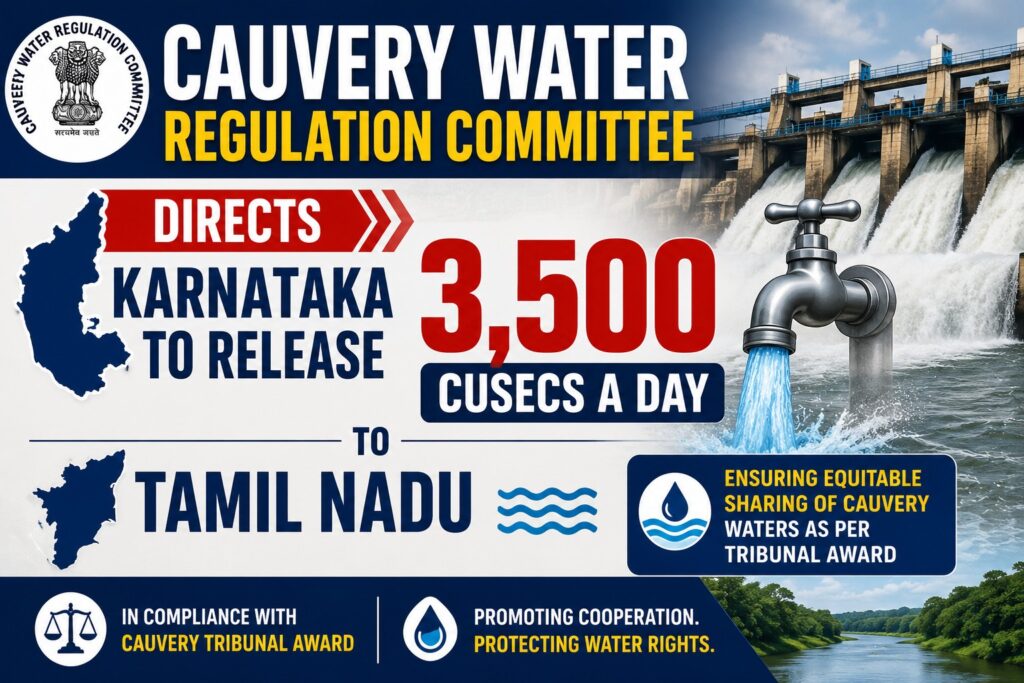
The Cauvery Water Regulation Committee (CWRC) has directed Karnataka to release 3,500 cusecs of water per day for 15 days to Tamil Nadu amid drought conditions. Meanwhile, the Tamil Nadu Chief Minister has urged the Prime Minister to review the Centre’s stand on the proposed Mekedatu Dam project, further intensifying the inter-state water dispute.
Key Highlights
- CWRC directive: Karnataka has been directed to release 3,500 cusecs per day for 15 days to Tamil Nadu.
- Reason: The order was issued due to drought conditions and the need to ensure downstream water availability.
- Parallel dispute: Tamil Nadu has sought a review of the Centre’s position on the Mekedatu Dam project proposed by Karnataka.
- Possible appeal: Karnataka may challenge the CWRC’s direction before the Cauvery Water Management Authority (CWMA).
About the Cauvery River
- Originates at Talakaveri in the Brahmagiri Hills, Karnataka.
- Flows through Karnataka, Tamil Nadu and Puducherry, with a small catchment in Kerala.
- Empties into the Bay of Bengal.
- Total length is about 805 km.
- Left-bank: Harangi, Hemavathi, Shimsha, Arkavathi.
- Right-bank: Kabini, Bhavani, Noyyal and Amaravathi.
Cauvery Water Management Mechanism
Cauvery Water Management Authority (CWMA)
- Constituted in 2018 under the Ministry of Jal Shakti.
- Implements the Supreme Court’s 2018 judgment on Cauvery water sharing.
- Supervises reservoir operations and ensures implementation of water-sharing arrangements.
Cauvery Water Regulation Committee (CWRC)
- Functions under the CWMA.
- Monitors reservoir levels, rainfall and inflows.
- Recommends monthly water releases among basin States.
What is the Mekedatu Project?
- Proposed by Karnataka on the Cauvery River near Mekedatu.
- Intended to provide drinking water to Bengaluru and generate hydroelectric power.
- Tamil Nadu opposes the project, arguing that it could affect downstream water availability and violate the Supreme Court’s allocation.
Constitutional and Legal Provisions
- Article 262: Empowers Parliament to legislate on inter-State river water disputes.
- Inter-State River Water Disputes Act, 1956: Provides for adjudication of river water disputes through tribunals.
- Supreme Court Judgment (2018): Modified the Cauvery Water Disputes Tribunal award and directed the establishment of the CWMA.
“[2013, GS2, 10 marks] Constitutional mechanisms to resolve the inter-state water disputes have failed to address and solve the problems. Is the failure due to structural or process inadequacy or both? Discuss.”
[2020] Which of the following Protected Areas are located in Cauvery basin?
1.Nagarhole National Park
2.Papikonda National Park
3.Sathyamangalam Tiger Reserve
4.Wayanad Wildlife Sanctuary
Select the correct answer using the code given below:
a) 1 and 2 only
b) 3 and 4 only
c) 1, 3 and 4 only
d) 1, 2, 3 and 4
