Why in the News
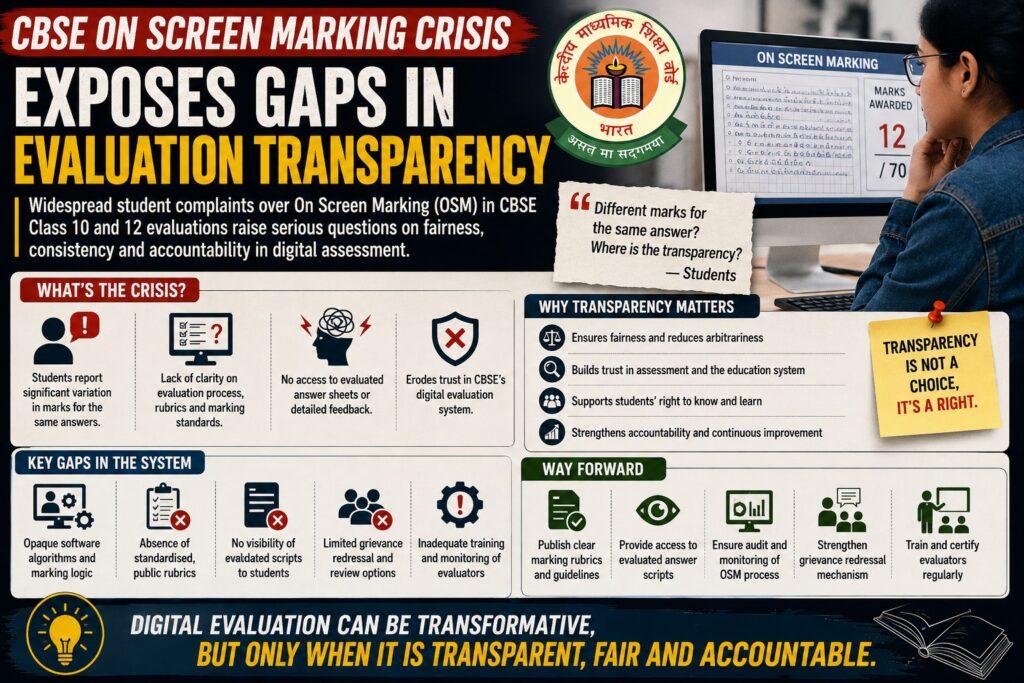
The Central Board of Secondary Education’s On Screen Marking system left roughly 18 lakh Class XII students unable to access their evaluated answer scripts, with only about 4 lakh managing to view them. The Supreme Court has flagged this as a source of frustration of young minds, exposing a gap between the Board’s digital evaluation push and its duty to let students verify their own results.
What is On Screen Marking (OSM)?
- Definition: On Screen Marking is a digital evaluation method where scanned answer scripts are marked by examiners on a screen instead of on paper.
- Objective: The Central Board of Secondary Education (CBSE) adopted it to standardise evaluation and speed up result processing.
- Access problem: Students are meant to view their own scanned, marked scripts after results, but the current system does not guarantee this access at scale.
- CIC role: The Central Information Commission (CIC) had already advised CBSE to frame a standard operating procedure (SOP) for script access before this crisis became public.
Why has script access broken down for most students?
- Capacity gap: The Board built a system that could evaluate scripts digitally but did not build matching capacity to let all students retrieve their own scripts afterward.
- Verification denied: Without script access, students cannot check whether their marks were recorded and totalled correctly.
- Court intervention: The Supreme Court’s intervention signals that the current process fails a basic due process test for an examination body.
- Trust deficit: The gap between the promise of a transparent digital system and the reality of restricted access has deepened student distrust in board evaluation.
What are the challenges to CBSE’s On Screen Marking system?
- Server capacity: Providing 18 lakh students simultaneous access to scanned scripts requires infrastructure the Board has not demonstrated it has built.
- Re-evaluation load: A universal access policy will likely increase re-evaluation requests, straining CBSE’s examination machinery further.
- Accountability gap: No fixed timeline currently binds CBSE to release scripts or resolve discrepancies once a student flags one.
- Precedent for other boards: State boards using similar digital evaluation systems face the same access question, but have no shared standard to follow.
- Data security: Wider script access at scale raises the risk of manipulation or leakage of evaluation data if access controls are weak.
What are the Core Safeguards Used Globally?
- Item-Level Marking: Slicing whole papers into isolated questions, sending each question to a different subject specialist to minimize bias or fatigue.
- Seed Scripts: Silently injecting pre-marked test scripts into an evaluator’s queue; failing to match the benchmark locks the user out for recalibration.
- Centralized Tracking: Real-time dashboards tracking marker progress, turnaround times, and statistical consistency across distributed pools.
Conclusion
The central issue is not the shift to digital evaluation itself but the absence of a guaranteed, time bound right for students to view their own scripts. A proposed seven day transparency framework standard operating procedure would fix the access gap, but only if CBSE is bound to a deadline rather than treating disclosure as discretionary.
PYQ Relevance
[UPSC 2020] National Education Policy 2020 is in conformity with the Sustainable Development Goal-4 (2030). It intends to restructure and reorient education system in India. Critically examine the statement.
Linkage: The PYQ evaluates reforms aimed at improving quality, equity and governance in education. The OSM controversy underscores that digital reforms in education must be accompanied by transparency, accountability and robust grievance redressal to achieve quality education.
