Why in the News?
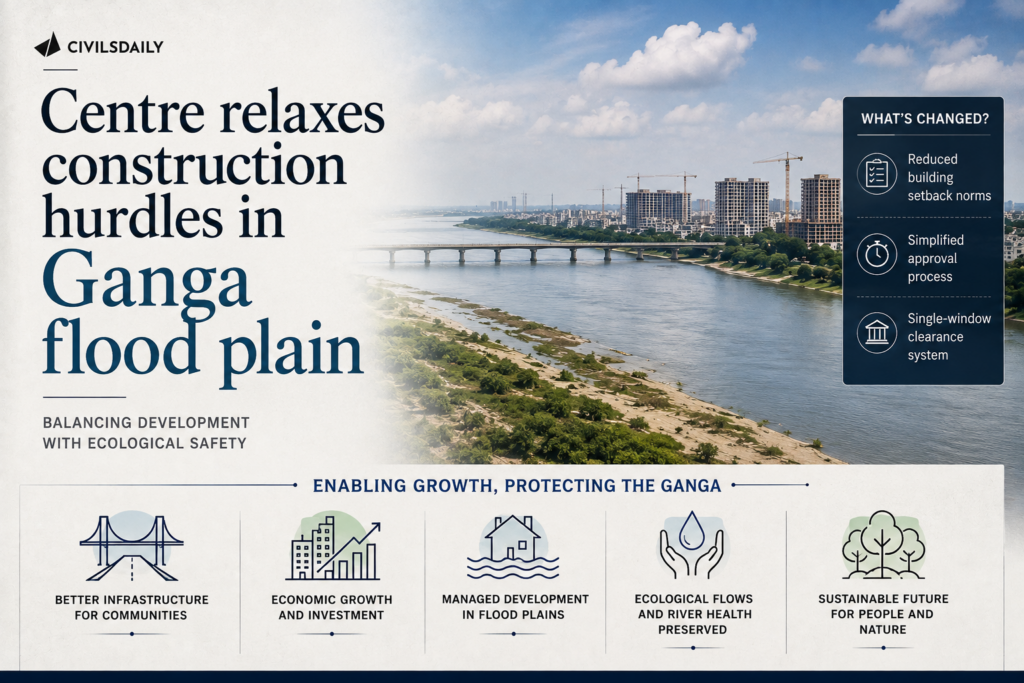
A gazette order of 10 August from the National Mission for Clean Ganga (NMCG) has removed the blanket declaration in the 2016 law that the Ganga flood plain is a construction free zone, replacing the total ban with a stratified, approval based regime. The change exposes the tension between protecting the river’s ecology and permitting development in areas subject only to moderate or rare flooding.
What is the River Ganga Authorities Order that was amended?
- Instrument: The River Ganga (Rejuvenation, Protection and Management) Authorities Order, 2016, notified under the Environment (Protection) Act, 1986, governs protection and management of the river.
- Original ban: The 2016 order declared the bank of the river and its flood plain a construction free zone to reduce pollution and preserve natural groundwater recharge.
- What the amendment does: The 10 August order deletes the no construction clause and replaces the total ban with a regulated system in which some construction is permissible after official clearances.
How does the new stratified definition of a flood plain work?
- Active flood plain: The zone immediately along the channel that submerges at least once every five years, where strict building prohibitions continue, with minor exceptions for temporary set ups such as religious events.
- Regulatory zone: The middle band subject to moderate flooding once every five to 25 years, where construction is now permissible subject to clearances.
- Warning zone: The outer periphery that floods only during severe events of 25 to 100 year frequency, where construction is also now permissible subject to clearances.
- Earlier gap: The 2016 order banned construction in the active flood plain but never defined what active meant, an inconsistency the amendment claims to correct.
Why did the government amend the order?
- Stated rationale: A senior official said the amendment does not dilute standards but corrects an inconsistency in the law between the flood plain definition and the construction ban.
- Litigation pressure: Litigants had routinely cited the blanket construction free zone mandate against riverfront roads, embankments and sewage treatment plants before the National Green Tribunal.
- Scope limit: The new order does not grant blanket permission for development and keeps a regulated approval process in place.
Does the change protect the river or dilute safeguards?
- The protection case: Confining strict prohibition to the active flood plain leaves the ecologically most sensitive channel margin protected while allowing regulated use elsewhere.
- The dilution concern: Opening the regulatory and warning zones to construction reduces the natural groundwater recharge and pollution buffer the 2016 order sought to preserve.
- Enforcement risk: An approval based system shifts protection from a clear legal bar to case by case clearances that depend on administrative capacity and vigilance.
What are the challenges to regulating the Ganga flood plain?
- Encroachment pressure: Dense settlement and commercial demand along the river make flood plains attractive for construction.
- Weak demarcation: Flood plain zoning requires accurate hydrological mapping that is incomplete across the basin.
- Fragmented jurisdiction: Multiple states, municipal bodies and agencies share authority over the river, complicating uniform enforcement.
- Climate variability: Changing flood frequencies undermine fixed five, 25 and 100 year return period assumptions.
- Pollution load: Untreated sewage and industrial effluent continue to enter the river despite protection orders.
Conclusion
The amendment ends the 2016 blanket ban on flood plain construction and installs a three zone regime that permits regulated building beyond the five year flood line after clearances. The government frames this as correcting a legal inconsistency, while the ecological question is whether an approval based system can protect the river’s recharge and pollution buffer as effectively as an outright prohibition did. The next test lies in how clearances are granted and whether active flood plain protection holds against development pressure.
Back2Basics:
Foundational Context: Ganga Rejuvenation in India
- About: Ganga rejuvenation is a national programme to abate pollution and conserve and rejuvenate the river through sewage treatment, riverfront management and flow protection.
- Scale: The Ganga basin covers roughly one fourth of India’s land area and supports a large share of the population.
- Institutional design: The effort is coordinated by the National Mission for Clean Ganga under the National Ganga Council, with the Jal Shakti Ministry as the nodal ministry.
- Approach: It combines infrastructure such as sewage treatment plants with regulatory tools such as flood plain zoning and construction control.
Statutory Framework Governing the Ganga
- Environment (Protection) Act, 1986: The parent statute under which the 2016 River Ganga Authorities Order and its amendment are notified.
- Water (Prevention and Control of Pollution) Act, 1974: Establishes pollution control boards that regulate effluent discharge into the river.
- River Ganga (Rejuvenation, Protection and Management) Authorities Order, 2016: Creates the tiered institutional structure, including the National Ganga Council and NMCG, and governs flood plain regulation.
- National Green Tribunal Act, 2010: Constitutes the forum where flood plain and riverfront disputes are adjudicated.
National Mission for Clean Ganga (NMCG)
- Nature: Implementation wing for Ganga rejuvenation and the Namami Gange programme.
- Governing framework: Registered as a society and given statutory backing through the River Ganga Authorities Order, 2016.
- Parent body: Functions under the National Ganga Council, chaired by the Prime Minister.
- Nodal ministry: Department of Water Resources, River Development and Ganga Rejuvenation under the Jal Shakti Ministry.
- Mandate: Ensures effective abatement of pollution and rejuvenation of the river by adopting a comprehensive, basin wide approach.
Government Initiatives / Schemes for Ganga Rejuvenation
- Namami Gange Programme: Integrated conservation mission covering sewage treatment, riverfront development, afforestation and biodiversity.
- Arth Ganga: Model to build a sustainable economic bridge between the river and people through livelihoods, tourism and natural farming along the banks.
- Ganga Gram: Programme for sanitation and solid waste management in villages along the river.
- Jal Shakti Abhiyan: Water conservation campaign that supports groundwater recharge in the basin.
Key Facts about the Ganga
- Length: The river runs roughly 2,525 kilometres from Gomukh to the Bay of Bengal.
- National River: The Ganga was declared India’s National River in 2008.
- Flood plain zones: The amended order recognises active, regulatory and warning zones based on five, 25 and 100 year flood frequencies.
- Dolphin link: The Gangetic dolphin, the National Aquatic Animal, depends on healthy river flow.
Challenges in Ganga Conservation
- Sewage burden: A large volume of untreated urban sewage continues to reach the river.
- Industrial effluent: Tanneries and other industries discharge pollutants along the course.
- Reduced flow: Barrages, abstraction and diversion lower ecological flow in stretches.
- Flood plain encroachment: Construction and settlement erode the river’s natural buffer.
- Coordination gaps: Multiple states and agencies weaken uniform enforcement.
- Solid waste and religious use: Immersion waste and idol immersion add pollution loads.
Way Forward
- Complete flood plain mapping: Finalise accurate zonation to make the three tier regime enforceable.
- Strengthen sewage treatment: Close the gap between sewage generated and treatment capacity.
- Ensure ecological flow: Mandate minimum environmental flows across barrages.
- Tighten clearance scrutiny: Apply strict, transparent conditions before approving construction in regulatory and warning zones.
- Empower basin governance: Reinforce NMCG and state bodies with clear enforcement powers.
PYQ Relevance
[UPSC 2015] Discuss the Namami Gange and National mission for clean Ganga (NMCG) programmes and causes of mixed results from the previous schemes. What quantum leaps can help preserve the river Ganga better than incremental inputs?
Linkage: The PYQ directly connects with Ganga rejuvenation, conservation and the effectiveness of government interventions. The flood plain amendment highlights the challenge of balancing river conservation, pollution control and development pressures.
