Why in the News?
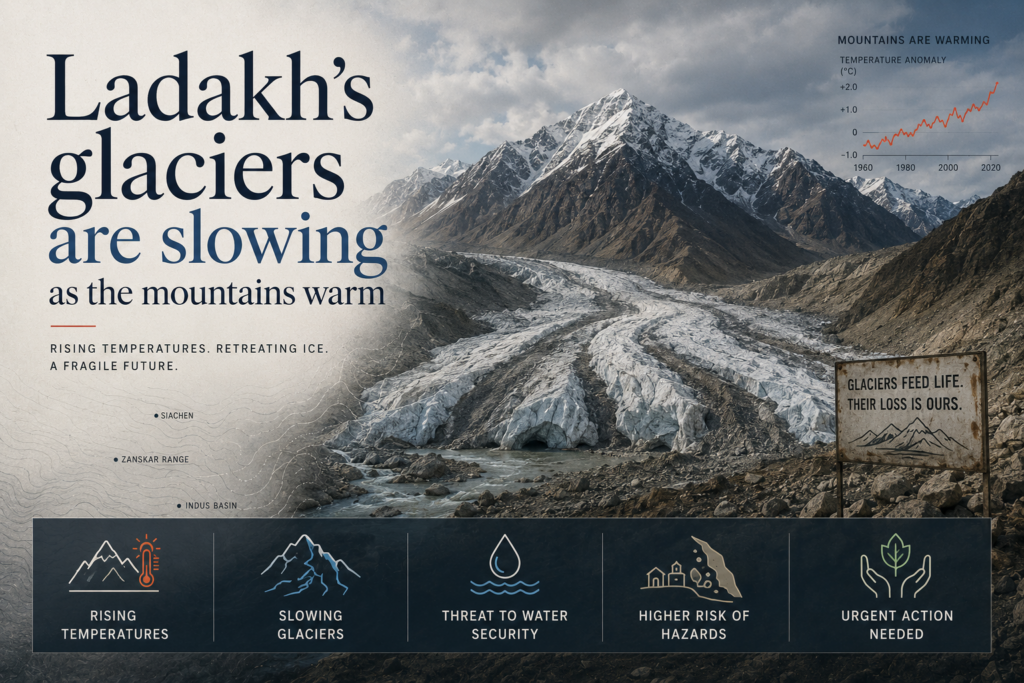
A new study in the journal The Cryosphere reports that glaciers in the Zanskar region of Ladakh are moving more slowly than they did 30 years ago, as sustained warming thins them and reduces their driving force. The slowdown carries long term implications for the Indus basin, where glacier melt sustains river flows during dry summer months.
Why are the Zanskar glaciers slowing down?
- Thinning mechanism: When a glacier loses more ice than it gains over many years it becomes thinner, and thinner ice exerts less driving force, causing it to flow more slowly.
- Warming link: The study connects mass loss, thinning and reduced flow, showing that thinning is not only a consequence of warming but also weakens the glacier’s ability to move.
- Downstream effect: Slower flow means the lower parts of a glacier receive less replenishment from higher elevations, making continued shrinkage more likely.
- Local variation: Glacier geometry, debris cover and conditions at the snout influence how quickly each glacier responds.
What is peak water?
- Definition: Peak water is the point at which increased melting from a shrinking glacier temporarily raises river runoff before the water supply begins to decline.
- Why it matters: More melting may boost flows in the near term, but once glaciers lose a substantial fraction of their stored ice, their meltwater contribution to rivers is expected to drop.
What did the study find?
- Study design: The researchers examined how glacier flow changed from 1992 to 2023 across 12 glaciers in the Zanskar Himalaya using satellite derived surface velocities.
- Velocity decline: Glaciers slowed by 2.4 metres per year per decade on average.
- Faster thinning: The pace of surface thinning increased from around 0.22 metres per year between 2000 and 2005 to around 0.57 metres per year between 2015 and 2020.
- Sample caveat: The 12 glaciers studied are representative, but the Zanskar basin hosts around 1,755 glaciers, so caution is needed before extending the findings to all of Ladakh.
What are the implications for the Indus basin?
- Summer flows: Glacier melt contributes significantly to Indus river flows during the dry summer months, so long term storage decline threatens that supply.
- Multiple dependencies: River flows also depend on snowfall, rainfall, groundwater and water management, so slowing glaciers alone will not immediately cause shortages.
- Sectors at risk: Continued thinning and slowdown signal declining long term water storage, with implications for water security, agriculture, hydropower and downstream ecosystems in coming decades.
Why do the study’s own limitations qualify its conclusions?
- Sub surface blind spot: Satellite surface velocity observations cannot directly reveal processes beneath the glacier, such as subglacial hydrology or basal sliding, which strongly influence motion.
- Data gaps: Long term field measurements of ice thickness, mass balance and bed conditions remain limited in the region, making full attribution of observed changes difficult.
- Exceptions to the trend: Some glaciers can temporarily accelerate due to increased meltwater at the bed, glacier surges, or interactions with proglacial lakes.
What does the global comparison show?
- European Alps and Alaska: Similar glacier slowdowns have been reported, driven by the same thinning and reduced driving stress mechanism.
- Canadian Arctic and Andes: These regions show comparable slowdowns linked to warming.
- Tibetan plateau: Parts of the plateau display the same dominant mechanism of thinning leading to slower flow.
- Shared lesson: Glacier slowdown is becoming widespread globally, though local glacier characteristics still shape individual behaviour.
Conclusion
The study establishes that Zanskar glaciers are not only losing mass but slowing down, with thinning reducing their capacity to move and replenish lower reaches. This points to a long term decline in stored water that will eventually reduce Indus basin flows after a phase of peak water. The findings underscore the need for sustained ground based monitoring to validate satellite data and to prepare downstream communities for shifting water availability.
Back2Basics:
Foundational Context: The Cryosphere and Himalayan Glaciers
- About: The cryosphere comprises the frozen parts of the Earth, including glaciers, snow cover, permafrost and ice, that store and release freshwater.
- Third Pole: The Hindu Kush Himalaya holds the largest ice mass outside the polar regions and is often called the Third Pole.
- Function: Himalayan glaciers act as natural reservoirs, releasing meltwater in warmer months to sustain rivers, agriculture and ecosystems in otherwise arid areas.
- Climate indicator: High altitude glaciers respond distinctly to warming, making them valuable natural indicators of environmental change.
The Zanskar Region and Indus Basin
- Location: The Zanskar region lies in Ladakh and hosts some of the largest and most extensive glaciers in the Himalaya.
- Climatic setting: Its glaciers receive most of their snowfall from mid latitude westerly disturbances during winter and sit at high altitude.
- Indus basin: The Indus rises in the Tibetan plateau and flows through Ladakh, with glacier melt feeding its dry season flows.
- Significance: The basin supports water security, agriculture and hydropower across northern India and beyond.
Key Facts about Himalayan Glacier Monitoring
- Study journal: The findings appear in the journal The Cryosphere.
- Zanskar glacier count: The basin hosts around 1,755 glaciers, of which 12 were studied.
- Observation record: The study covers more than 30 years, from 1992 to 2023.
- Peak water: A key concept describing the temporary runoff increase before long term decline.
Challenges in Glacier Conservation and Monitoring
- Data scarcity: Long term field measurements of ice thickness and mass balance are limited in high altitude terrain.
- Warming pace: Rising temperatures accelerate thinning and mass loss.
- Black carbon: Soot deposition on ice lowers reflectivity and speeds melting.
- Glacial lake hazards: Meltwater expansion raises the risk of glacial lake outburst floods.
- Downstream dependence: Millions rely on glacier fed rivers, amplifying the impact of any decline.
Way Forward
- Expand ground monitoring: Add measurements of ice thickness, mass balance and meltwater discharge to validate satellite data.
- High altitude weather stations: Install continuous observation stations to capture varied mountain climate conditions.
- Basin water planning: Prepare Indus basin water management for the eventual decline after peak water.
- Reduce black carbon: Cut regional emissions that hasten glacier melt.
- Regional cooperation: Share transboundary glacier and river data across the basin.
PYQ Relevance
[UPSC 2020] How will the melting of Himalayan glaciers have a far-reaching impact on the water resources of India?
Linkage: The PYQ directly relates to the impact of Himalayan glacier melt on India’s water resources. Zanskar glacier slowdown and thinning highlight the emerging risks to Indus basin flows, water security and long-term freshwater availability.
