Why in the news?
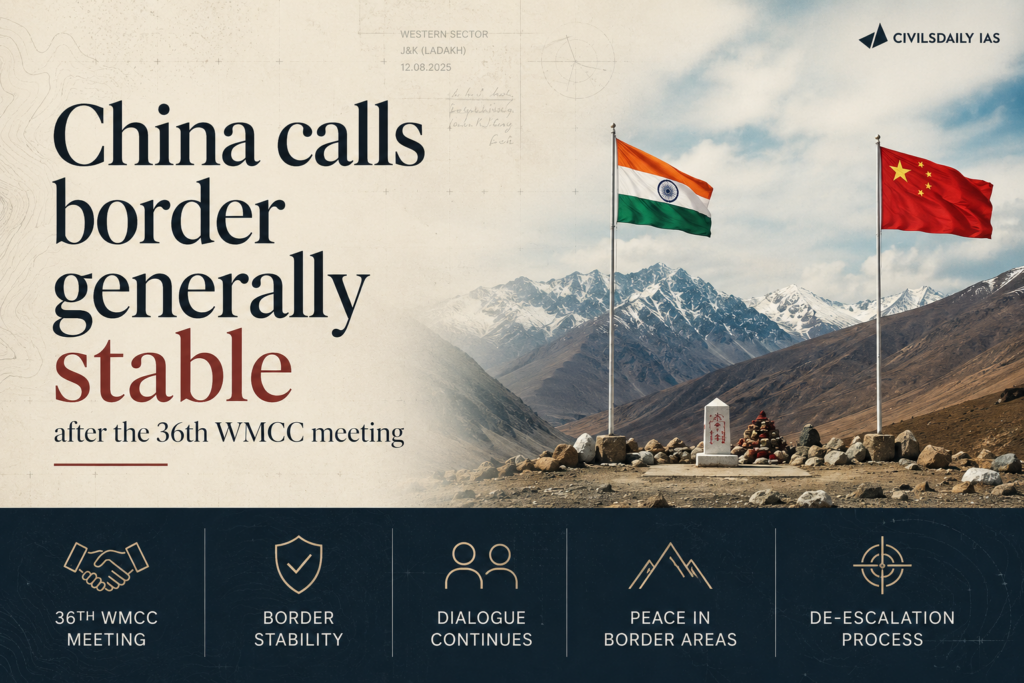
China’s Foreign Ministry described the India-China border as generally stable, responding to reports of rising tensions in Arunachal Pradesh’s eastern sector. The statement followed the 36th meeting of the Working Mechanism for Consultation and Coordination on China-India Border Affairs, held the previous week. The exchange highlights how a diplomatic and military consultation mechanism, rather than a boundary settlement, is what currently manages face-offs along an undemarcated frontier.
What is the Working Mechanism for Consultation and Coordination (WMCC) on China-India Border Affairs?
- About: The WMCC is an institutional mechanism, established in 2012, for diplomatic-level consultation and coordination on maintaining peace along the India-China border.
- Function: It provides a standing channel to communicate on border developments and defuse face-offs, and it does not itself negotiate the resolution of the boundary question.
What is the Line of Actual Control (LAC)?
- About: The LAC is the notional line separating Indian-controlled and Chinese-controlled territory, and it is neither fully demarcated nor mutually agreed on the ground.
- Consequence: Because the boundary is undemarcated, patrols from the two sides at times face off against each other in areas of overlapping claims.
What did the 36th WMCC meeting produce?
- Communication channels: The two sides agreed to maintain communication via diplomatic and military channels.
- Peace commitment: They agreed to jointly uphold peace and tranquillity in the border areas.
- Official framing: China’s Foreign Ministry described the situation as generally stable at the moment.
What triggered the current concern in the eastern sector?
- Reported crossing: Reports last week suggested that Chinese People’s Liberation Army (PLA) troops crossed the LAC at Pukar La and Ollo in the Taksing circle of Upper Subansiri.
- State-level denial: On 7 August the Arunachal Pradesh Chief Minister denied reports of an incursion and said he would verify with the Army and local bodies.
- Indian framing: India’s Ministry of External Affairs (MEA) said the maintenance of peace and tranquillity in border areas was of utmost importance, and did not deny a reported rise in tensions since late July.
- Ground posture: The Army and the Indo-Tibetan Border Police (ITBP) are positioned to dominate the border and monitor Chinese activities.
Why does the mechanism matter more than the label of stability?
- Undemarcated boundary: With no agreed line on the ground, incidents are inherent to patrolling and cannot be eliminated by declarations of stability.
- Existing protocols: Face-offs are resolved through existing mechanisms and protocols rather than through a settled boundary.
- Communication over settlement: The WMCC manages friction and keeps channels open, but it substitutes crisis management for a final resolution of the dispute.
Conclusion
The current status is that both sides publicly describe the border as generally stable and have agreed through the 36th WMCC meeting to keep diplomatic and military channels open. Reports of a PLA crossing in Upper Subansiri remain unconfirmed by officials. The next expected development is continued WMCC-level engagement and further border-area monitoring by the Army and the ITBP.
Border Management with China: About
- Length and sectors: The India-China frontier runs about 3,488 km across three sectors, the western, middle, and eastern.
- Nature: The alignment follows the LAC, which is disputed and undemarcated in several stretches.
- Institutional layers: Border affairs are handled through the WMCC at the diplomatic level and the Special Representatives mechanism at the political level.
Statutory and Agreement Framework Governing the India-China Border
- 1993 Agreement: Provided for maintaining peace and tranquillity along the LAC.
- 1996 Agreement: Established military confidence-building measures in the border areas.
- 2005 Protocol: Set modalities for implementing military confidence-building measures.
- 2012 mechanism: Created the WMCC as a standing consultation channel.
- 2013 Agreement: The Border Defence Cooperation Agreement laid down procedures to avoid escalation during face-offs.
Government Initiatives for Border Areas
- Border Area Development Programme (BADP): Funds development of villages near international borders to improve access and living conditions.
- Border Infrastructure and Management (BIM) Scheme: Supports roads, fencing, floodlighting, and observation infrastructure along the borders.
- Vibrant Villages Programme: Targets comprehensive development of border villages, including those along the northern frontier, to check outmigration.
Challenges in Border Management
- Undemarcated LAC: Differing perceptions of the line cause recurring patrol face-offs.
- Terrain and access: High-altitude terrain complicates infrastructure and rapid mobilisation.
- Infrastructure asymmetry: Faster construction on the Chinese side pressures Indian logistics.
- Grey-zone activity: Salami-slicing and forward patrolling test Indian positions below the threshold of conflict.
- Coordination: Multiple agencies guarding different stretches require tight inter-force coordination.
Way Forward
- Accelerate infrastructure: Complete border roads, tunnels, and forward connectivity to match logistics needs.
- Strengthen mechanisms: Use WMCC and Special Representatives channels consistently to de-escalate.
- Border-area development: Expand BADP, BIM, and the Vibrant Villages Programme to anchor populations.
- Surveillance: Enhance ITBP and Army monitoring with technology-based domain awareness.
“[2024 GS3 15m] India has a long and troubled border with China and Pakistan fraught with contentious issues. Examine the conflicting issues and security challenges along the border. Also give out the development being undertaken in these areas under the Border Area Development Programme (BADP) and Border Infrastructure and Management (BIM) Scheme.”
