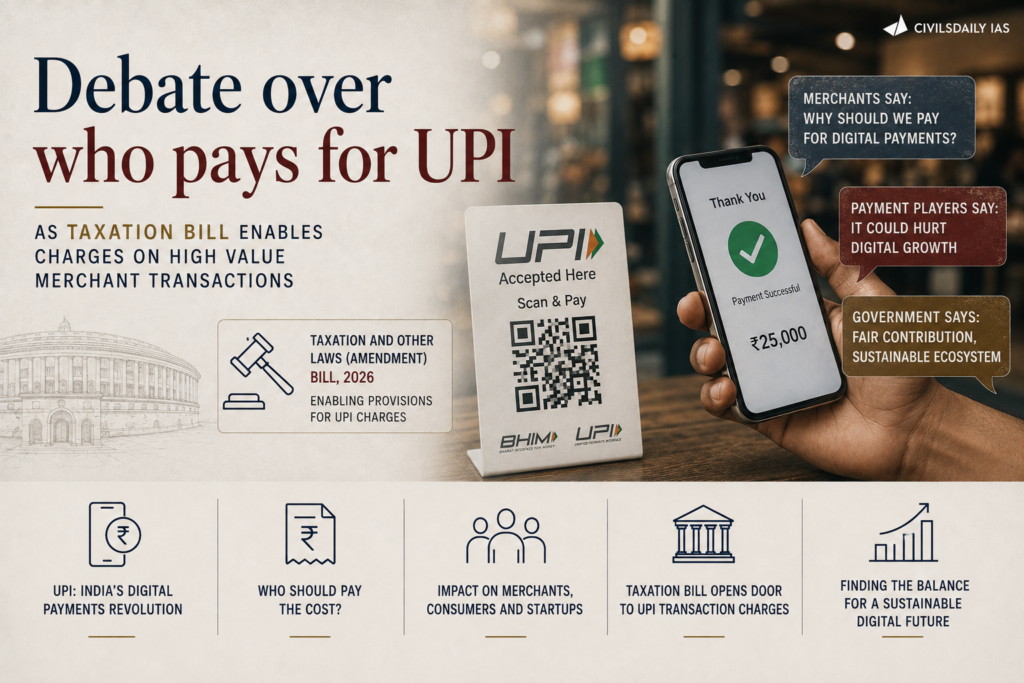
Why in the News
The Taxation and Other Laws (Amendment) Bill, 2026 proposes to allow the government to impose Merchant Discount Rate (MDR) on selected Unified Payments Interface (UPI) transactions, reviving the debate over how India’s digital payments infrastructure should be financed.
What is the Merchant Discount Rate (MDR)?
- Transaction fee: The Merchant Discount Rate (MDR) is the fee charged to merchants by banks and payment service providers for processing digital payments.
- Who pays? It is generally borne by the merchant, not the customer.
- Current position: Since January 2020, UPI and RuPay debit card transactions have zero MDR, making them free for merchants and users.
- Government support: The government has compensated service providers through incentive schemes to sustain the digital payments ecosystem.
What does the Bill propose?
- Enabling provision: The Taxation and Other Laws (Amendment) Bill, 2026 relaxes the existing restrictions on MDR.
- Selective application: It empowers the government to notify specific UPI transactions on which MDR may be levied.
- Likely scope: Discussions indicate the levy may apply to:
- Merchants with high annual turnover, and
- High value transactions above ₹2,000.
- Objective: Ensure a financially sustainable digital payments ecosystem while protecting small merchants.
Who should bear the cost of UPI?
- Government funding: Continue compensating payment providers through budgetary support.
- RBI surplus: The Reserve Bank of India’s surplus transfer could partly finance UPI infrastructure.
- Banks and payment providers: Costs may be absorbed by financial institutions.
- Merchants: Large merchants could bear MDR without affecting small businesses.
- Policy challenge: Balance financial sustainability, merchant affordability, and continued digital payment adoption.
Prelims Pointers
- Merchant Discount Rate (MDR) is the fee paid by merchants for processing digital payment transactions.
- UPI is operated by the National Payments Corporation of India (NPCI).
- NPCI is an umbrella organisation for retail payment systems in India, established by the Reserve Bank of India (RBI) and the Indian Banks’ Association (IBA).
- Zero MDR on UPI and RuPay debit card transactions has been in force since 2020.
- The RBI periodically transfers its surplus to the Central Government under the provisions of the RBI Act, 1934.
“[2025] Consider the following countries:
I. United Arab Emirates
II. France
III. Germany
IV. Singapore
V. Bangladesh
How many countries amongst the above are there other than India where international merchant payments are accepted under UPI?
(a) Only two
(b) Only three
(c) Only four
(d) All the five