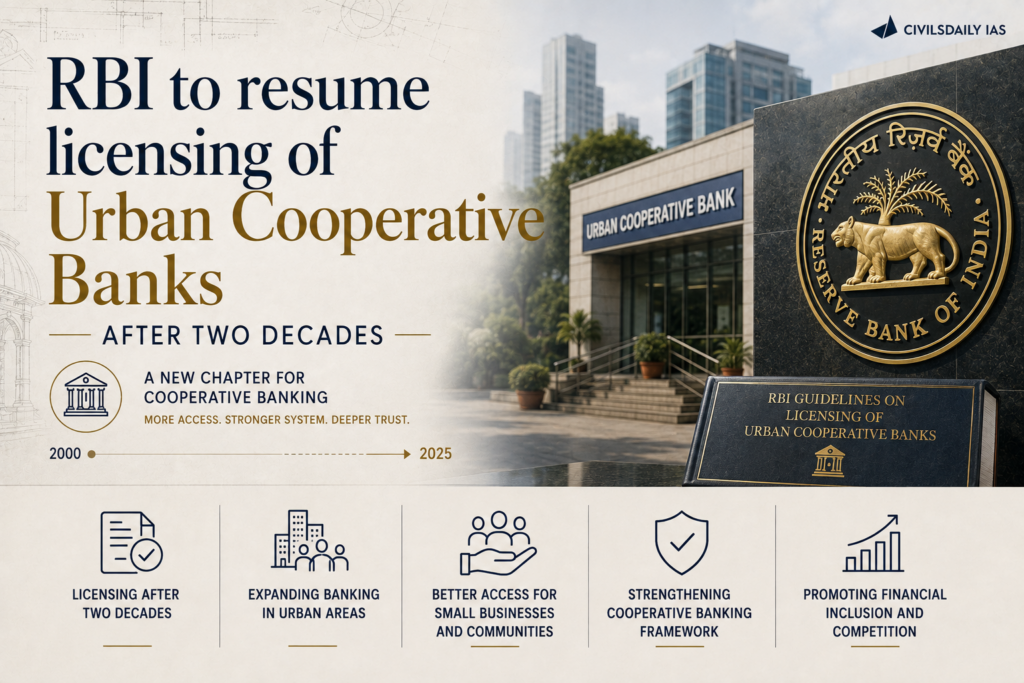
Why in the News
The Reserve Bank of India (RBI) has announced that it will resume issuing licences for new Urban Cooperative Banks (UCBs) on an on tap basis, ending a pause of more than two decades. The move follows regulatory reforms aimed at strengthening governance and supervision in the cooperative banking sector.
What is an Urban Cooperative Bank (UCB)?
- Cooperative bank: A UCB is a cooperative society that provides banking services primarily in urban and semi urban areas.
- Ownership: Owned and managed by its members on the principle of one member, one vote.
- Dual regulation:
- RBI: Banking operations, licensing, prudential norms and supervision.
- State/Central Registrar of Cooperative Societies: Management, elections and administration.
- Size: India has around 1,457 Urban Cooperative Banks.
What is RBI changing?
- On tap licensing: New UCB licences will be granted throughout the year, instead of one time licensing windows.
- Review of concentration norms: RBI will revisit concentration risk norms for rural cooperative banks.
- Interest rate framework: Plans to rationalise the interest rate framework across regulated entities for greater consistency.
Why was licensing suspended?
- Governance failures: Several UCBs suffered from weak governance, poor risk management and financial irregularities.
- Bank failures: High profile failures raised concerns about depositor protection and financial stability.
- Regulatory limitations: The dual control structure often hampered effective supervision.
Why has RBI resumed licensing?
- Stronger regulation: Amendments to the Banking Regulation Act, 1949 have enhanced RBI’s supervisory powers over cooperative banks.
- Improved governance: Regulatory reforms have strengthened oversight and accountability.
- Financial inclusion: New UCBs can expand access to affordable banking and credit in underserved urban and semi urban areas.
Prelims Pointers
- Urban Cooperative Banks (UCBs) operate mainly in urban and semi urban areas.
- They are subject to dual regulation by the RBI and the Registrar of Cooperative Societies.
- The Banking Regulation (Amendment) Act, 2020 strengthened RBI’s supervisory powers over cooperative banks.
- On tap licensing allows eligible entities to apply for banking licences at any time instead of waiting for a specific licensing window.
“[2021] With reference to ‘Urban Cooperative banks’ in India, consider the following statements:
1.They are supervised and regulated by local boards set up by the State Governments.
2.They can issue equity shares and preference shares.
3.They were brought under the purview of the Banking Regulation Act, 1949 through an Amendment in 1966.
Which of the statements given above is/are correct?
(a) 1 only
(b) 2 and 3 only
(c) 1 and 3 only
(d) 1, 2, and 3