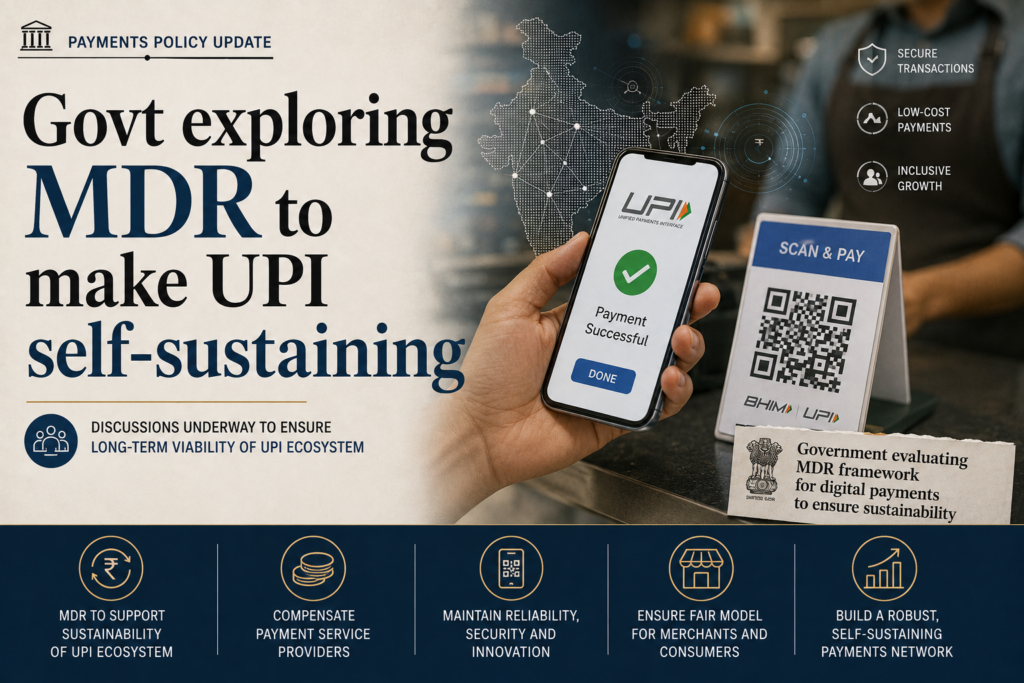
Why in the News?
The government told Parliament that the current Unified Payments Interface (UPI) model is financially unsustainable, and that it is examining two routes to make the platform self-supporting without inflating the Budget. The trigger exposes a core tension: the zero-charge design that drove mass adoption now starves the ecosystem of the revenue needed for cybersecurity, fraud prevention and network upkeep.
What is Unified Payments Interface (UPI)?
- Definition: UPI is a real-time payment system built by the National Payments Corporation of India (NPCI) and the Indian Banks’ Association that lets money move instantly between two bank accounts through a mobile app. It was launched as a pilot in April 2016 and became fully operational in August 2016.
- Scale: More than 55 crore people use UPI and 703 entities, from banks to payment service providers, facilitate its transactions. Of the 28,174 crore digital transactions recorded in 2025-26, 86% ran on UPI.
What is the Merchant Discount Rate (MDR)?
- Definition: MDR is the fee that banks, payment processors and gateways levy on a merchant for accepting a digital payment.
- Current position: MDR is charged on most debit card and all credit card transactions. UPI and RuPay debit card transactions were exempted in 2020, making them zero-cost for merchants.
What Makes Up MDR?
- Interchange fee: Money sent to the customer’s card-issuing bank.
- Network fee: Charges paid to card networks like Visa or Mastercard.
- Processor fee: Markup kept by the payment gateway or processor for handling the tech
Why is the current UPI model financially unsustainable?
- Cost recovery gap: The subsidy scheme reimbursing processors is far short of actual cost. There is a mismatch between the roughly Rs 2,000 crore allocation and the industry’s estimated operational cost of about Rs 20,700 crore a year.
- Coverage shortfall: The Standing Committee on Finance found the incentive covers merely 11% of the industry’s actual costs and 14% of potential MDR collections.
- Investment risk: The gap threatens critical spending on cybersecurity, fraud prevention and network infrastructure as volumes scale toward a projected 150 billion transactions per month.
What options is the government exploring?
- Selective MDR: Restoring MDR on certain high threshold transactions and high turnover merchants, leaving small merchant payments untouched.
- Tiered incentives: A tiered incentive structure to phase out government support over the next few years.
- Legal enabler: An amendment to the Payment and Settlement Systems Act, 2007 has already removed the bar on charging merchants a fee for receiving UPI payments.
- Industry proposal: Payment firms seek an MDR of 0.3% to 0.6% on payments above Rs 2,000 to large merchants, about 4% of person to merchant transactions but 68% of value.
Conclusion
The government has confirmed that UPI cannot indefinitely run on subsidies and is examining selective MDR and a tapering incentive structure to make it self-sustaining. The next milestone is a framework that funds the ecosystem through charges on large merchants while shielding small merchants.
[UPSC 2026] Which one of the following statements about Unified Payments Interface (UPI) and Central Bank Digital Currency (Digital Rupee) is NOT correct?
(a) UPI is a real-time payment system but Digital Rupee is akin to sovereign paper currency
(b) In case of UPI, settlement for end users happens instantly; in case of Digital Rupee, wallet balance gets transferred to another wallet
(c) UPI transactions are recorded by banks and reflected in bank statements; in case of Digital Rupee, no data is captured in bank statements
(d) In both the cases, the liability lies with the users and their respective banks.
Answer: D
