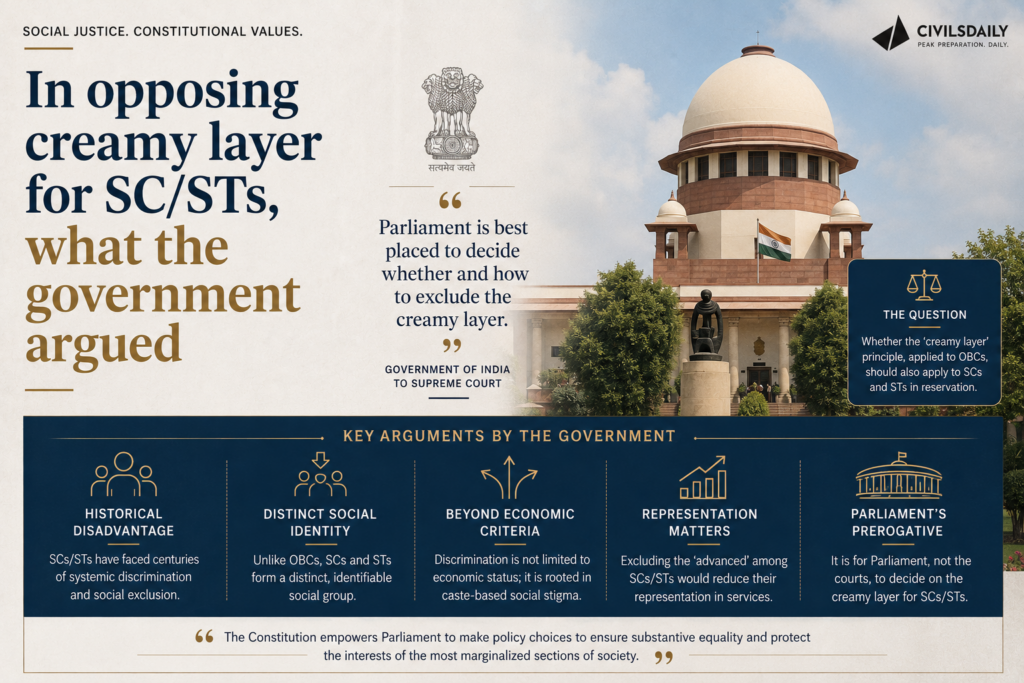
Why in the News
The Centre has filed an affidavit in the Supreme Court opposing the introduction of a “creamy layer” income filter within reservations for Scheduled Castes (SCs) and Scheduled Tribes (STs). It has argued that the historical disadvantage faced by these communities is rooted in untouchability and social exclusion, not economic backwardness, and that any change to reservation policy is for Parliament to decide, not the courts.
What is the creamy layer concept?
- Definition: The creamy layer is an income and status filter that excludes the socially and economically advanced members of a backward class from reservation benefits. Its purpose is to ensure quota benefits reach the genuinely disadvantaged within a group rather than its better-off sections.
- Origin and current scope: It was introduced by the 1992 Indra Sawhney judgment as a test for Other Backward Classes (OBCs). It has never been applied to SCs and STs.
Who does reservation currently apply to in India?
- Category-wise quota: Central reservation stands at 15 percent for SCs, 7.5 percent for STs, and 27 percent for OBCs on the non-creamy-layer principle.
- Economically Weaker Sections: A 10 percent quota for Economically Weaker Sections (EWS) applies to those outside the SC, ST, and OBC categories.
- The ceiling: The Indra Sawhney judgment fixed a 50 percent ceiling on total reservations, though the EWS quota and some State laws now exceed it.
- Creamy layer coverage: The creamy layer income exclusion currently applies only to OBCs, not to SCs or STs.
Which constitutional provisions govern reservation?
- Article 15(4): Allows the State to make special provisions for the advancement of socially and educationally backward classes, SCs, and STs.
- Article 16(4): Permits reservation in public appointments for any backward class inadequately represented in State services.
- Article 16(4A) and 16(4B): Enable reservation in promotions for SCs and STs and the carry-forward of unfilled reserved vacancies.
- Articles 341 and 342: Empower the President to notify the initial lists of SCs and STs; once notified, inclusion or exclusion can be made only by an Act of Parliament.
- Article 335: Requires that reservation claims be balanced with the maintenance of administrative efficiency.
- Articles 338 and 338A: Establish the National Commission for Scheduled Castes and the National Commission for Scheduled Tribes.
- 103rd Constitutional Amendment, 2019: Inserted Articles 15(6) and 16(6) to provide the 10 percent EWS reservation.
What did the petition seek?
- Income-based preferences: The Public Interest Litigation (PIL), filed by a politician and advocate, sought income-based preferences across all reserved categories, including OBCs and EWS.
- Elite capture argument: It argued that affluent families within the SC and ST categories monopolise reservation benefits, depriving the most marginalised of access to education and public employment.
- Reliance on the 2024 ruling: It relied on the 2024 Supreme Court judgment permitting sub-classification of SCs and STs, in which four of the seven Constitution Bench judges suggested extending the creamy layer principle to these groups.
What is sub-classification of Scheduled Castes?
- Definition: Sub-classification allows a State to divide the single SC list into sub-groups and reserve a portion of the SC quota for the most backward castes within it. The 2024 judgment upheld this power, holding SCs are not a socially homogeneous class.
Why does the government distinguish SC/ST identification from OBC identification?
- Basis of SC status: SCs face historical disadvantage stemming from the practice of untouchability, a form of social exclusion not tied to income.
- Basis of ST status: STs are identified by their distinct cultures, geographical isolation, and backwardness.
- Basis of OBC status: OBCs are identified primarily through a combination of social, educational, and economic disadvantages, which makes an economic filter relevant to them.
- Objective of SC/ST quotas: The stated aim is social equality, overcoming historical discrimination, and inclusive participation in public life, since discrimination against these groups does not occur on the basis of economic conditions.
What legal precedents did the Centre cite?
- Indra Sawhney (1992): Upheld the Mandal Commission report on OBC reservation and introduced the creamy layer test, expressly confining it to OBCs and holding it has no relevance for SCs and STs.
- E V Chinnaiah (2005): Held that even if a situation ever required excluding a creamy layer from SCs, only Parliament could take the necessary legislative steps.
- Separation of powers: The affidavit argued courts cannot direct the executive to adopt a particular policy merely because a fairer or wiser alternative exists, and the judiciary cannot substitute for the legislature in framing public policy.
Why is the demand for a creamy layer contested?
- The case for it: Affluent SC and ST families capturing quota benefits leaves the poorest within these groups without access, which undercuts the stated goal of reaching the most marginalised.
- The case against it: Caste-based discrimination and untouchability persist regardless of a family’s income, so an economic filter would exclude people who still face social stigma.
- The judicial split: The 2024 Bench itself divided, with a minority favouring the extension of the creamy layer to SCs and STs, which keeps the question legally open.
What are the major debates surrounding reservation?
- Social justice versus economic upliftment: Whether reservation is a remedy for historical social injustice or a tool for economic advancement, which decides if income can ever be a valid filter.
- The 50 percent ceiling: The Indra Sawhney cap is under pressure from State laws and the EWS quota, raising whether the ceiling is still binding.
- Sub-classification and creamy layer for SC/ST: The 2024 ruling reopened whether SCs form a homogeneous class and whether the better-off within them should be excluded.
- The empirical gap: The absence of updated caste and income data on quota beneficiaries weakens both the elite-capture claim and its rebuttal.
- EWS and reserved categories: The exclusion of SCs, STs, and OBCs from the EWS quota is debated as either fair balancing or fresh discrimination.
What are the challenges to applying a creamy layer to SC/STs?
- Persistence of untouchability: Social exclusion continues irrespective of income, so an economic test may exclude those still facing discrimination.
- Absence of reliable data: No comprehensive dataset tracks the income profile of SC and ST beneficiaries, making a fair income threshold hard to set.
- Constitutional bar on judicial rewriting: Under Articles 341 and 342, only Parliament can alter SC and ST entitlements, limiting judicial intervention.
- Risk of under-representation: An income filter could shrink the eligible pool and leave reserved seats unfilled where few qualify.
- Definitional complexity: Fixing who counts as advanced within a socially stigmatised group is contested and administratively difficult.
Conclusion
The Centre’s position is that SC and ST reservation addresses caste-based social exclusion, not poverty, so the creamy layer test built for OBCs cannot be transposed onto them, and any change is a matter for Parliament. The dispute turns on an unresolved question of whether reservation is fundamentally a social-justice remedy or an economic one. Until Parliament acts or the Supreme Court settles the 2024 split, the creamy layer will not apply to SCs and STs.
Back2Basics:
Indra Sawhney v. Union of India (1992)
- What it decided: A nine-judge Supreme Court bench upheld 27 percent OBC reservation based on the Mandal Commission report.
- Creamy layer: It introduced the creamy layer exclusion for OBCs and confined it to them.
- The ceiling: It capped total reservation at 50 percent, except in extraordinary circumstances.
- Promotions: It barred reservation in promotions, a bar later addressed through the 77th Constitutional Amendment and Article 16(4A).
Reservations in India
- About: Reservation is a form of protective discrimination that sets aside seats in education, public employment, and legislatures for historically disadvantaged groups.
- Scale: It covers SCs, STs, OBCs, and EWS across central and State institutions, with categories and percentages varying by State.
- Constitutional anchor: It flows from the equality code in Articles 14 to 16 read with the Directive Principle in Article 46, which directs the State to promote the interests of weaker sections.
Way Forward
- Generate quota data: Collect updated caste-wise and income-wise data on beneficiaries to ground policy in evidence rather than assertion.
- Respect the legislative domain: Leave changes to SC and ST entitlements to Parliament as required by Articles 341 and 342.
- Target the most backward: Use the 2024 sub-classification power to reach the poorest castes within the SC list without diluting the social-justice basis.
- Strengthen non-quota support: Expand scholarships, coaching, and infrastructure so advancement does not depend on reservation alone.
