Why in the News
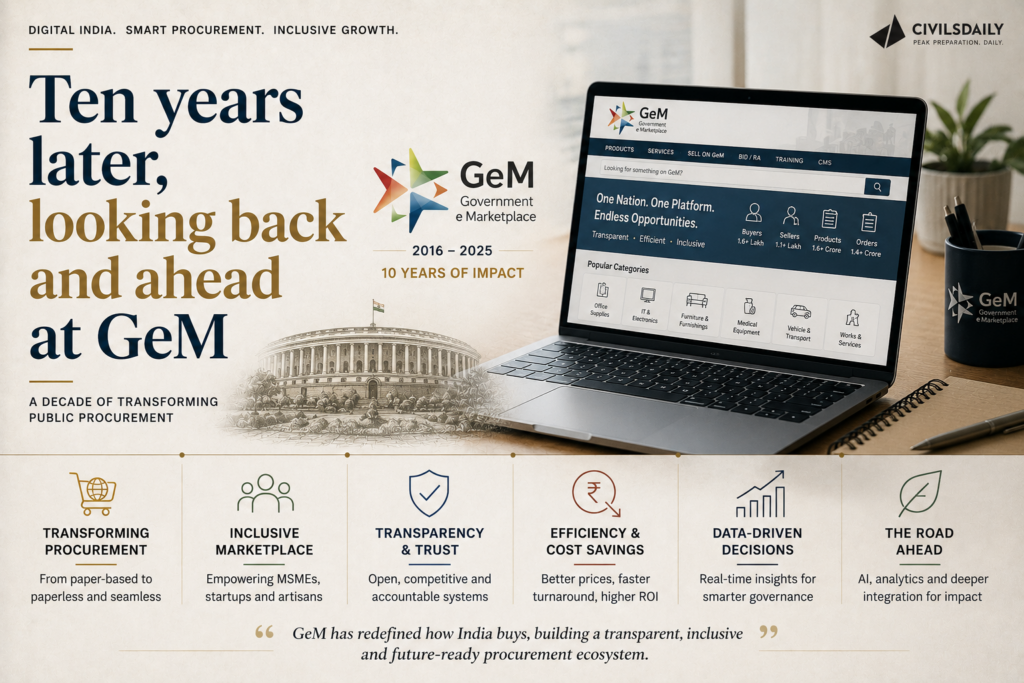
The Government e-Marketplace (GeM) completed 10 years, connecting around 1.37 lakh government buyers with 25 lakh sellers/service providers and achieving nearly ₹20 lakh crore cumulative Gross Merchandise Value (GMV).
What is GeM?
- GeM: Government e-Marketplace.
- Launched on 9 August 2016.
- A digital platform for government procurement of goods and services.
- Replaced the Directorate General of Supplies and Disposals (DGS&D).
- Integrates product discovery, bidding, contract award and payment.
How does GeM Improve Procurement?
- End-to-end digitisation: Covers the complete procurement cycle.
- Transparency: Creates an auditable digital trail.
- Reduced discretion: Limits face-to-face interaction and scope for favouritism.
- Single window: Simplifies registration and standardises procurement.
- Inclusion: Gives Micro and Small Enterprises (MSEs), start-ups and women-led firms direct access to government buyers.
What Does the Data Show?
- Cumulative GMV: About ₹20 lakh crore.
- Buyers: 1.37 lakh.
- Sellers/service providers: 25 lakh.
- Categories: 10,644 product and 350 service categories.
- MSEs: Around 60% of orders by volume and over 45% of GMV.
- Measured benefit: IIT Delhi study estimated ₹86,571.69 crore in benefits over the last three financial years through price and process efficiencies.
What Problems Does GeM Address?
- Reduces corruption and procurement discretion.
- Improves Ease of Doing Business (EoDB) for suppliers.
- Expands opportunities for MSMEs and start-ups.
- Enables faster procurement.
- Promotes competitive prices and better use of public funds.
- Supports domestic manufacturing and Atmanirbhar Bharat.
What is Public Procurement?
- Public procurement is the process through which government bodies purchase goods, works and services using public funds.
- Core principles: Transparency, Fair competition, Non-discrimination, Value for money, and Accountability
Challenges
- Quality assurance: Risk of substandard products in a large digital catalogue.
- MSME payment delays: Delayed payments affect working capital.
- Bid rigging: Cartelisation can undermine competition.
- Digital divide: Smaller sellers may lack connectivity or digital skills.
- Grievance redress: Delays in resolving quality, delivery and payment disputes.
- Cybersecurity: Concentration of procurement data increases cyber risks.
Back2Basics: GeM
- Full form: Government e-Marketplace.
- Launch: 9 August 2016.
- Nodal Ministry: Ministry of Commerce and Industry.
- Predecessor: DGS&D, Directorate General of Supplies and Disposals.
- Purpose: Transparent and efficient government procurement.
- Users: Government buyers, sellers and service providers.
- Focus: Particularly beneficial for MSMEs, start-ups and women entrepreneurs.
Government Initiatives
- Public Procurement (Preference to Make in India) Order, 2017: Preference for domestically manufactured goods.
- Public Procurement Policy for MSEs, 2012: Procurement preference for Micro and Small Enterprises.
- Vivad se Vishwas for MSMEs: Relief mechanism for eligible MSME contractual disputes.
- TReDS: Trade Receivables Discounting System, helping MSMEs obtain liquidity against receivables.
[2025, GS2, 10 marks] E-governance projects have a built-in bias towards technology and back-end integration than user-centric designs. Examine.”
