Why in the News?
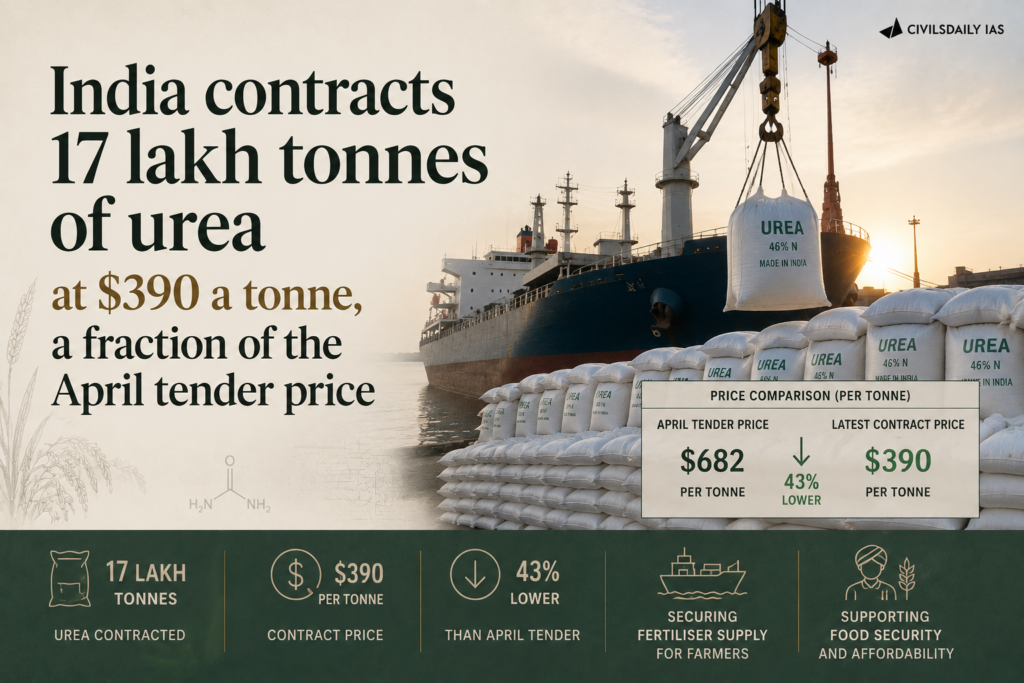
India has contracted 17 lakh tonnes (1.7 mt) of imported urea at landed prices of $390.25 to $393.65 per tonne, marking a ~58% drop from the peak rates of $935 to $959 per tonne seen in the April 2026 tender. This sharp collapse highlights how heavily India’s fertiliser subsidy bill depends on external factors, ranging from West Asian energy disruptions to Chinese inventory accumulation.
Global Urea Import Tender Mechanism
- Nominated State Agencies: Import tenders are invited by designated state-owned canalising agencies like Rashtriya Chemicals and Fertilizers (RCF) and Indian Potash Limited (IPL).
- Landed Price (CFR): Offers are quoted on a landed basis—covering both material cost and ocean freight to destination ports. This shifts shipping risk to the supplier.
- Geographical Distribution: Tenders split required tonnages between the East Coast and West Coast to optimize port discharge and domestic logistics.
- Market Signals: Bids from multiple global traders (e.g., Ameropa Group) establish the benchmark. High oversubscription indicates a loose global supply market.
Price Trajectory & Global Supply Dynamics
- April Peak ($935–$959/tonne): Driven by peak war risk premiums, high global fuel prices, and Strait of Hormuz shipping anxieties.
- May Moderation ($444.9–$449.3/tonne): Easing immediate supply shocks.
- July/August Drop ($390.25–$393.65/tonne): Triggered by:
- China’s Surplus Inventory: Domestic in-plant inventories in China surged 76% year-on-year, turning it into a major swing supplier.
- Re-routed Supplies: Iranian material reaching markets through China.
- Alternative Sourcing: Diversification of LNG feedstock by agencies like GAIL and IOC away from Hormuz transit routes toward the US, Oman, Norway, Angola, Congo, Indonesia, and Trinidad.
Current Supply & Demand Position
- Adequate Reserves: Imports reached 25.08 lakh tonnes in Q1 (April–June 2026) compared to 8.38 lakh tonnes in the previous year.
- Domestic Production: Expanded to 71.53 lakh tonnes in Q1 2026.
- Cropping Seasons Covered: Sufficient availability reported across both the ongoing Kharif (monsoon) season and upcoming Rabi (winter/spring) sowing.
Challenges in India’s Fertiliser Policy
- Subsidy Exposure: Urea sells at a statutorily controlled Maximum Retail Price (MRP), meaning any surge in landed cost directly increases the exchequer’s subsidy burden.
- Nutrient Imbalance: Controlled urea pricing versus decontrolled phosphatic and potassic nutrients encourages over-application of nitrogen (N), skewing the ideal 4:2:1 (N:P:K) ratio.
- Phosphate Vulnerability: While urea and LNG supply sources have been widened, Di-ammonium Phosphate (DAP) and raw intermediates (phosphoric acid, ammonia, sulphur) remain vulnerable to concentrated import sources and price spikes.
- Feedstock Dependence: Domestic plants remain tied to imported LNG, linking production costs directly to international gas trends.
Statutory & Regulatory Framework
- Essential Commodities Act, 1955: Empowers the Union Government to regulate production, stock limits, supply, and pricing of fertilisers.
- Fertiliser (Control) Order, 1985 & Movement Control Order, 1973: Governs quality standards, dealer registrations, and inter-state distribution.
- New Urea Policy, 2015: Promotes energy efficiency in production units and mandates 100% Neem Coating of domestic urea to prevent industrial diversion.
- Nutrient Based Subsidy (NBS) Scheme, 2010: Provides a fixed annual per-kg subsidy on N, P, K, and S for decontrolled fertilisers (DAP, MOP, Complex).
- Direct Benefit Transfer (DBT): Releases subsidies to manufacturers only after Aadhaar-authenticated point-of-sale (PoS) transactions at retail outlets.
Key Government Initiatives
- PM PRANAM: Encourages States to reduce chemical fertiliser usage by sharing the resulting subsidy savings.
- One Nation One Fertiliser: Standardises all subsidised crop nutrients under the single Bharat brand.
- Nano Urea: Liquid alternative developed by IFFCO to lower overall bulk tonnage requirements.
- Plant Revivals: Reactivation of closed units (Ramagundam, Gorakhpur, Sindri, Barauni, Talcher) to boost domestic capacity.
- Coal Gasification: Talcher plant designed to produce urea using coal gasification rather than natural gas, cutting gas import reliance.
Key Concepts
- Urea: Solid nitrogenous fertiliser (carbamide) carrying 46% Nitrogen—the highest among solid fertilisers.
- Di-ammonium Phosphate (DAP): Phosphatic fertiliser containing 18% Nitrogen and 46% Phosphorus.
- Fertiliser Association of India (FAI): Industry body (est. 1955) providing production, import, and consumption stats for supply planning.
- Muriate of Potash (MOP): Fully import-dependent nutrient; India has no commercial potash reserves.
[2020] With reference to chemical fertilizers in India, consider the following statements:
1. At present, the retail price of chemical fertilizers is market-driven and not administered by the Government.
2. Ammonia, which is an input of urea, is produced from natural gas.
3. Sulphur, which is a raw material for Phosphoric acid fertilizer, is a by-product of oil refineries.
Which of the statements given above is/are correct?
(a) 1 only
(b) 2 and 3 only
(c) 2 only
(d) 1, 2 and 3
Answer: (b)”
