💥Mains Ready By December. Smash Mains & Smash PYQ Admissions Open

GS Paper: GS3-08.Issues related to direct and indirect farm subsidies and MSP

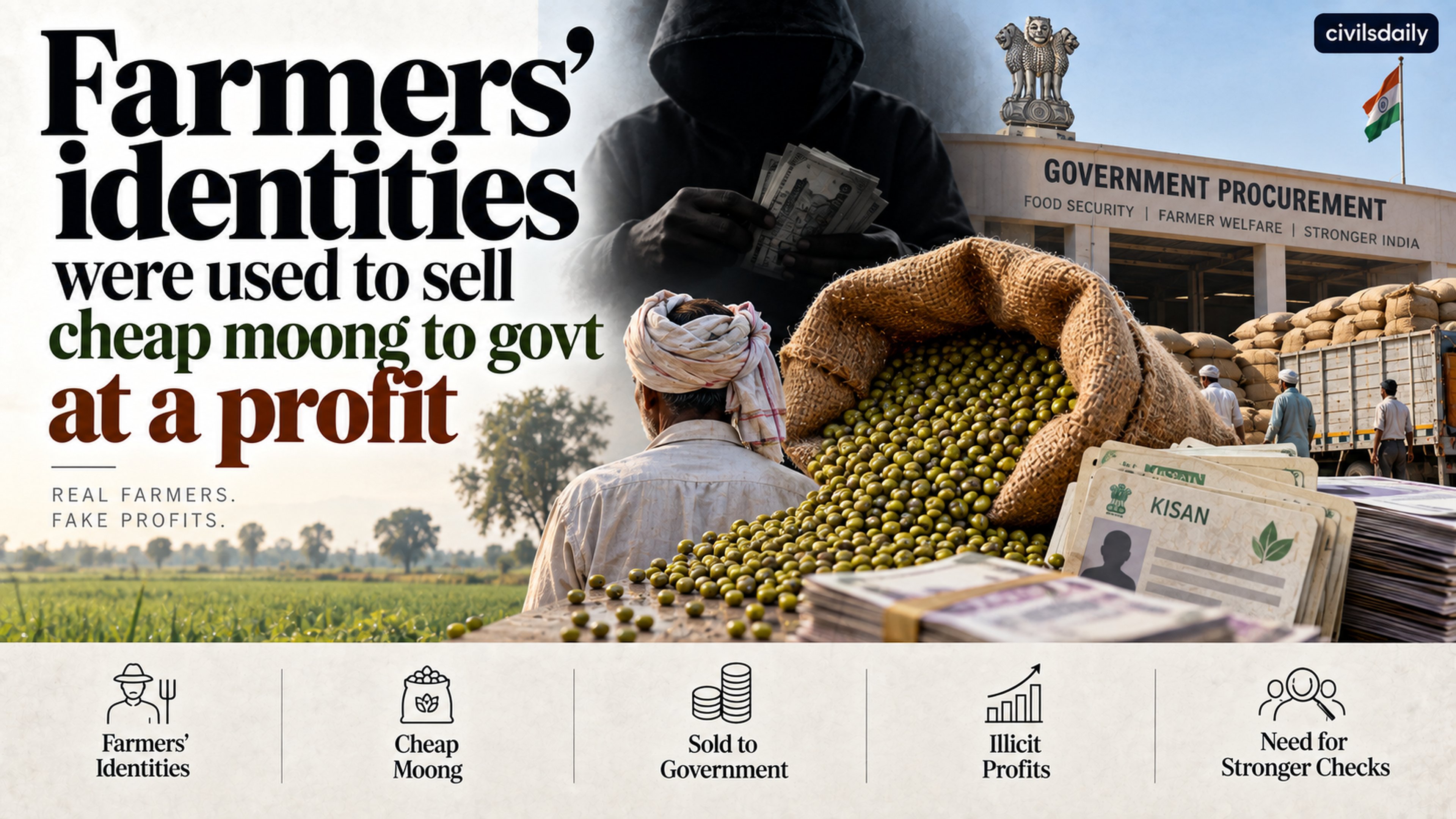
  • In MP, probe into how farmers’ identities were used to sell cheap moong to govt at a profit

    In MP, probe into how farmers’ identities were used to sell cheap moong to govt at a profit

    Why in the News

    Madhya Pradesh’s Economic Offences Wing (EOW) has booked three computer operators running procurement terminals at cooperative societies in Raisen district for an alleged moong procurement fraud. The operators are alleged to have used the land records of farmers who had never registered to sell under the support price scheme, created procurement registrations in the names of acquaintances, bought moong on the open market at low prices, and sold it to the government at the Minimum Support Price (MSP). The alleged scheme ran across three societies in Badi tehsil over two procurement seasons and netted roughly Rs 13.3 lakh. The criminal case follows two internal cooperative department inquiries. The tension is that the price floor worked exactly as designed while the registration step that decides who may claim it did not, and it has surfaced during sustained farmer protests in the State over moong procurement and MSP implementation.

    What is the Minimum Support Price and how does procurement work?

    1. Minimum Support Price: It is a price floor announced by the Centre for selected crops, so a registered grower is assured a stated rate irrespective of what the open market pays that day.
    2. Who fixes it: The Commission for Agricultural Costs and Prices recommends the level for each season and the Centre announces it.
    3. Coverage against actual purchase: The floor covers 22 crops, and assured physical procurement at scale is concentrated overwhelmingly in wheat and rice, so for other crops a declared floor binds only where an agency actually buys.
    4. The registration step: A grower must first register the land on which the crop was raised, and the produce is then weighed against that registration at a procurement centre before payment is released.

    How was the registration system allegedly turned into a trade?

    1. Operator access to land records: Every operator at a cooperative society has access to the land records of all farmers in the area that centre serves, including those who own plots but have never registered to sell through the support price scheme.
    2. Fraudulent registration: Agricultural land that no farmer had registered was allegedly registered by the accused in the names of their acquaintances, and moong was then weighed through those registrations.
    3. The purchase leg: The moong weighed at the centres was allegedly bought from local markets at a lower price, so the registration manufactured a seller who had grown nothing.
    4. How it surfaced: Farmers in the Raisen hinterland found they had apparently sold moong to the government without ever growing it, registering it or taking it to a procurement centre. Fake registrations were collected and witnesses questioned during the EOW’s complaint verification.

    What do the case figures show about the size of the margin?

    1. Dehri Kala registrations: Entries of 8.095 hectares and a further 4.532 hectares allegedly yielded 151.524 quintals procured at the 2025 support price of Rs 8,682 a quintal, a payout of Rs 13,15,531 against about Rs 4,54,572 spent acquiring the moong, a margin of Rs 8,60,959.
    2. Registration in an accused’s own name: Another operator registered 3.523 hectares in his own name and procured 42.276 quintals for Rs 3,67,040, against an estimated Rs 1,26,828 of cost, a profit of Rs 2,40,212.
    3. Bharkachh Kala registrations: Entries of 3.428 hectares yielded 41.136 quintals worth Rs 3,57,142 against an estimated Rs 1,23,408 of cost, clearing Rs 2,33,734.
    4. How the figures were built: Investigators compared the procurement receipts against prevailing mandi rates for moong of comparable quality at Bareli over the same window.

    Why did the price gap make the fraud worth running?

    1. The spread: Bareli mandi rates for moong swung from as low as Rs 1,500 a quintal to as high as Rs 8,800 depending on grade, against a fixed support price of Rs 8,558 in the 2024 to 2025 season and Rs 8,682 the following season.
    2. A fixed price against a variable one: The support price does not vary by grade while the mandi rate does, so every lot bought below the floor converts into a guaranteed margin at the procurement centre.
    3. The alternative route: The Agricultural Produce Market Committee (APMC) told investigators that the procurement route was never the only option open to the farmers whose names were used, since farmers can independently sell their produce.
    4. The political setting: The case has surfaced during sustained farmer protests in Madhya Pradesh over moong procurement and the implementation of the support price.

    Challenges to MSP procurement

    1. Identity is verified at payment, not at registration: The system checks who is paid but not whether the registered grower actually raised the crop on the registered plot. Eg. Land never registered by any farmer was allegedly registered in the names of acquaintances across three societies in Badi tehsil.
      The Fix: Tie every registration to farmer authenticated consent and to a field or satellite verified sowing record for that survey number before weighing is allowed.
    2. The operator is both data entry and gatekeeper: One terminal operator can create a registration, accept the produce and trigger the payment, so no independent step exists to fail. Eg. All three accused in Raisen ran procurement terminals at the societies where the registrations were made.
      The Fix: Separate registration, weighing and payment authorisation across three roles, with the cooperative society secretary countersigning first time registrations.
    3. Procurement concentrated in wheat and rice: For crops outside that core the floor operates in short seasonal windows with thin agency capacity, which is where leakage collects. Eg. Maize in Punjab routinely sells below its support price for want of a procurement agency.
      The Fix: Publish crop wise and district wise procurement capacity before each season so a grower knows whether the floor will actually be available.
    4. Grade based price variation invites arbitrage: A single flat support price against a wide mandi range for the same crop creates a standing incentive to buy low grade produce and present it at the centre. Eg. Bareli rates ranged from Rs 1,500 to Rs 8,800 a quintal against one fixed floor.
      The Fix: Apply published quality parameters with graded deductions at the weighing stage rather than one undifferentiated rate.
    5. Detection depends on the farmer noticing: A farmer who never intended to sell has no reason to check the procurement record, so a fraudulent entry in his name can sit undisturbed for a full season. Eg. The Raisen farmers learned of the sales only when the entries were traced back to them.
      The Fix: Send an automatic message to the registered land holder at the moment a registration is created against his survey number, not after payment.

    Conclusion

    The failure here is not in the price but in the claim on it. A floor enforced correctly at the counter is still capturable by whoever controls the record of who is entitled to walk up to it, and that record sits with the same operator who processes the transaction. The case is at the investigation stage, with three operators booked after two departmental inquiries. What to watch is whether the response stays confined to a criminal case against three terminal operators or extends to separating registration from procurement across the State’s cooperative societies.

    Back2Basics: Agricultural Produce Market Committee

    1. What it is: It is a statutory market body constituted by a State government to regulate wholesale trade in notified agricultural produce within a defined market area.
    2. Legal basis: Each State’s own Agricultural Produce Market Committee Act governs it, so market rules, fees and the list of notified commodities vary across States.
    3. What it does: It licenses traders and commission agents, runs the regulated market yard or mandi, and records the sale price and volume of each transaction.
    4. Why its record matters: The mandi rate it publishes is the reference price against which an alleged support price diversion can be measured.

    Matching Previous Year Question

    “[2018, GS3, 10 marks] What do you mean by Minimum Support Price (MSP)? How will MSP rescue the farmers from the low-income trap?”
  • Minister subsidy row: Horticulture board pauses fresh scheme applications

    Why in the News

    The National Horticulture Board has suspended acceptance of fresh applications for grant of clearance under two of its subsidy schemes for one month, with effect from 4 September 2026. The suspension follows an investigation reporting that a Minister of State in the Union Ministry of Agriculture and Farmers’ Welfare, and the wife, mother and son of a serving Secretary in the Department of Animal Husbandry and Dairying, had availed subsidy for cucumber farms under one of those schemes. The minister returned Rs 99 lakh of subsidy to the board. The government then revised the scheme guidelines, barring holders of public office from assistance and widening the definition of a family. The contest is between a subsidy designed for open, credit-linked access and an eligibility filter that was written only after the beneficiaries became public.

    What is the Scheme for Development of Commercial Horticulture through Production and Post-Harvest Management of Horticulture Produce?

    1. Purpose: The scheme promotes commercial farming of horticultural crops on a large scale, run for profit rather than for subsistence.
    2. Crops covered: It covers capsicum, cucumber and tomato, along with eight varieties of flowers including rose, lilium and chrysanthemum.
    3. Subsidy design: It offers a maximum subsidy of 50 per cent of the project cost, capped at Rs 1 crore per family.
    4. The clearance gate: A grant of clearance (GoC) from the board is mandatory before an applicant can draw the credit-linked back-ended subsidy for a project, meaning the money is released against a bank-financed project after it is completed.

    What did the investigation find?

    1. A serving minister drew the subsidy: A Minister of State in the Union Ministry of Agriculture and Farmers’ Welfare availed subsidy under the scheme for cucumber farms.
    2. A serving secretary’s relatives drew it too: The wife, mother and son of the officer currently serving as Secretary, Department of Animal Husbandry and Dairying, availed subsidy under the same scheme.
    3. The money went back: The minister returned Rs 99 lakh of subsidy to the National Horticulture Board after the report was published.

    What did the revised guidelines change?

    1. A bar on public office holders: With effect from 21 August 2026, holders of constitutional posts, serving ministers, MPs, MLAs, mayors, district panchayat chiefs and government employees cannot avail financial assistance under National Horticulture Board schemes.
    2. A wider definition of family: The term now covers the applicant’s spouse, father, mother, sons and daughters.
    3. What the old definition left open: The earlier definition covered the husband, wife and dependent minor children, so adult children and parents of the same applicant fell outside the family cap and could apply separately.

    Why has the board stopped taking fresh applications?

    1. Two schemes are covered: The suspension applies to the Scheme for Development of Commercial Horticulture through Production and Post-Harvest Management of Horticulture Produce, and to the Capital Investment Subsidy Scheme for Construction, Expansion and Modernization of Cold Storages.
    2. The stated ground is verification and system repair: The circular records that the pause is meant to allow orderly implementation of the revised guidelines, verification of pending cases and updating of the online application system.
    3. The online window is shut: The facility for submitting fresh grant of clearance applications under both schemes remains unavailable for the period of suspension.
    4. Pending cases continue: Applications submitted before the suspension began are dealt with under the revised guidelines and the board’s standing instructions.
    5. No resumption date is fixed: The board will notify the date on which receipt of fresh applications resumes.

    Challenges to the National Horticulture Board’s subsidy schemes

    1. A credit-linked back-ended subsidy favours the bankable applicant: Assistance is released only after a bank finances the project and the project is completed, which excludes an applicant with no collateral and no lending relationship. Eg. Small and marginal farmers operate more than 86 per cent of India’s holdings and receive a far smaller share of institutional agricultural credit.
      The Fix: Route a defined share of the scheme’s outlay through Farmer Producer Organisations, so smallholders reach the credit-linked component collectively.
    2. Cold storage capacity built under capital subsidy is concentrated: Capital assistance has produced capacity skewed towards a few States and towards a single commodity, leaving fruit and vegetable growers elsewhere without storage. Eg. Uttar Pradesh and West Bengal hold a large share of India’s cold storage capacity, and most of it serves potato.
      The Fix: Weight the capital subsidy towards multi-commodity chambers and ripening units in districts with an identified storage deficit.
    3. Production assistance runs ahead of post-harvest capacity: Subsidy that funds cultivation without a linked pack house, grading line or refrigerated transport leaves the added output exposed to the same losses. Eg. Fruits and vegetables record the highest post-harvest losses among agricultural commodities in the loss assessment studies commissioned for the Ministry of Food Processing Industries.
      The Fix: Make clearance for a production project conditional on a linked post-harvest component within the same sanction.

    Conclusion

    The status is a subsidy window closed by its own administrator as the eligibility test behind it is rewritten. The board has bought a month to align its online system with a definition of family and a bar on office holders that did not exist when the disputed sanctions were made. What decides whether the episode produced a repair or only a pause is the resumption notification. The test is whether the reopened application form carries an automated eligibility check against the new definition, or whether it returns to accepting a declaration and verifying it afterwards.

    Matching Previous Year Question

    “[2018, GS3, 15.0 marks] Assess the role of National Horticulture Mission (NHM) in boosting the production, productivity and income of horticulture farms. How far has it succeeded in increasing the income of farmers?”

  • Pradhan Mantri Fasal Bima Yojana crop insurance record

    Why in the News

    PIB set out the coverage and claims record of the Pradhan Mantri Fasal Bima Yojana (PMFBY). PMFBY is the national crop insurance scheme.

    Core facts

    1. What it is: PMFBY provides crop insurance against non preventable natural risks. Cover runs from pre sowing to post harvest.
    2. Coverage record: About 56.96 crore farmer applications were insured since inception.
    3. Claims paid: About Rs 1,54,469 crore was paid in claims since inception.
    4. Farmer premium: Farmers pay 2 percent for Kharif crops, 1.5 percent for Rabi crops and 5 percent for commercial and horticultural crops. The government pays the balance premium.
    5. Design principle: The scheme follows a One Nation, One Crop, One Premium approach. It removed premium capping so full admissible claims are paid.
    6. Technology: Loss assessment uses remote sensing, drones and smartphones. Key systems are YES-TECH (Yield Estimation System based on Technology) and CROPIC (Collection of Real time Observations and Photographs of Crops).

    Static Context

    1. Launch: PMFBY was launched in 2016. It replaced earlier crop insurance schemes.
    2. Voluntary since 2020: Enrolment became voluntary for all farmers from the 2020 revamp. It was earlier compulsory for loanee farmers.
    3. Delivery platform: The National Crop Insurance Portal (NCIP) digitises enrolment, premium flow and claims.
    4. Implementing ministry: The scheme is run by the Ministry of Agriculture and Farmers Welfare.

    Prelims angle

    1. Premium hook: Farmer premium is 2 percent Kharif, 1.5 percent Rabi, 5 percent commercial and horticultural. A uniform 2 percent for all crops is incorrect.
    2. Scope hook: The scheme covers post harvest losses from cyclones and unseasonal rain, and localised risks such as hailstorm and landslide.
    3. Tech hook: YES-TECH for yield estimation and CROPIC for photograph based crop verification.
    4. Year hook: Launched in 2016, voluntary since 2020.

    Mains angle

    GS3 (agricultural risk, crop insurance, subsidies). A question can ask how crop insurance protects small and marginal farmers against climate risk.

    Matching Previous Year Question

    “[2016, GS3, 12.5 marks] Give the vulnerability of Indian agriculture to vagaries of nature, discuss the need for crop insurance and bring out the salient features of the Pradhan Mantri Fasal Bima Yojana (PMFBY). [2016] With reference to ‘Pradhan Mantri Fasal Bima Yojana’, consider the following statements: 1. Under this scheme, farmers will have to pay a uniform premium of two percent for any crop they cultivate in any season of the year. 2. This scheme covers post-harvest losses arising out of cyclones and unseasonal rains. Which of the statements given above is/are correct? (a) 1 only (b) 2 only (c) Both 1 and 2 (d) Neither 1 nor 2 Answer: (b)”

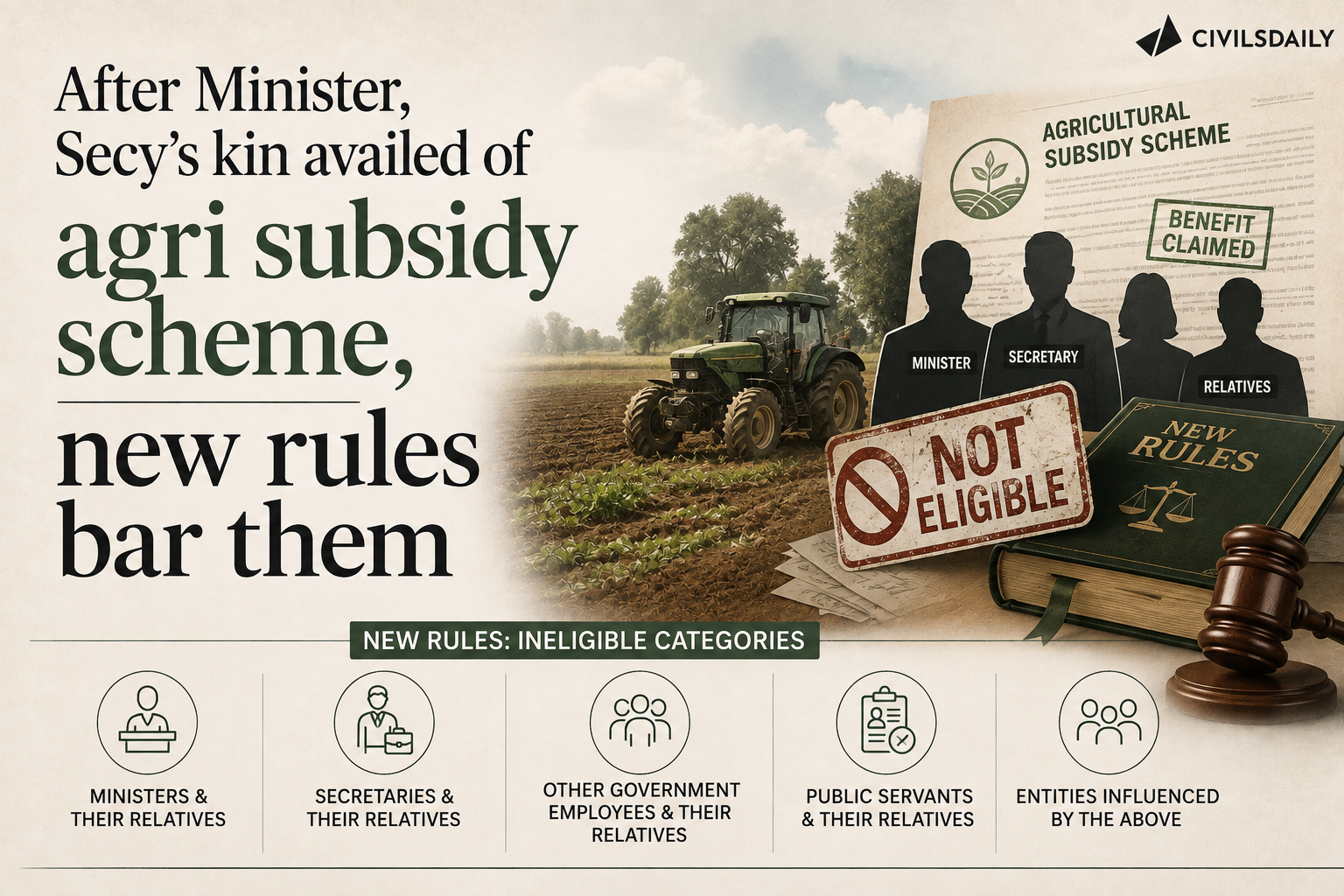
  • After Minister, Secy’s kin availed of agri subsidy scheme, new rules bar them

    After Minister, Secy’s kin availed of agri subsidy scheme, new rules bar them

    Why in the News

    The National Horticulture Board (NHB) amended the Scheme Guidelines of the Commercial Horticulture and Cold Storage Schemes on 21 August 2026, with immediate effect. The amendment bars holders of constitutional posts, serving ministers, members of legislatures, mayors, district panchayat chiefs and government employees from financial assistance under NHB schemes, and redefines ‘family’ to cover the applicant’s spouse, father, mother, sons and daughters. It follows a 27 June 2026 investigation reporting that a Union Minister of State and the kin of a serving Central government Secretary had availed subsidy for their cucumber farms. The tension is that a scheme designed to promote large scale commercial horticulture had eligibility rules loose enough to route public subsidy to the families of the officials administering the sector.

    What is the Development of Commercial Horticulture scheme?

    1. Purpose: The scheme, formally the Development of Commercial Horticulture through Production and Post-Harvest Management of Horticulture Crops, promotes commercial farming of horticultural crops on a large scale, meaning cultivation for profit rather than subsistence.
    2. Crops covered: It covers three vegetables, capsicum, cucumber and tomato, and eight varieties of flowers including rose, lilium and chrysanthemum.
    3. The assistance it offered: The scheme offered a maximum subsidy of 50 per cent of the project cost, capped per family.
    4. Who runs it: It is administered by the National Horticulture Board, an autonomous body under the Ministry of Agriculture and Farmers’ Welfare.

    Who is now barred from the subsidy?

    1. Constitutional post holders: Present holders of constitutional posts are ineligible for financial assistance under NHB schemes.
    2. Elected representatives and office bearers: Present ministers and ministers of state, members of the Lok Sabha and the Rajya Sabha, members of State Legislative Assemblies and Councils, mayors of municipal corporations and chairpersons of district panchayats are ineligible.
    3. Serving government employees: Serving employees of Central and State government ministries and departments, public sector undertakings, autonomous bodies and local bodies are ineligible, except Multi-Tasking Staff, Class-IV and Group D employees.
    4. Pensioners above a threshold: Superannuated and retired pensioners receiving a monthly pension of Rs 10,000 or more are ineligible, excluding the same Multi-Tasking Staff, Class-IV and Group D categories.
    5. Groups of farmers: A group of farmers is the fifth barred category, closing the route by which several individuals could apply jointly.
    6. A single concession: Family members of persons in the barred categories may avail one-time assistance, subject to the revised definition of family.

    How has the definition of ‘family’ changed?

    1. The new definition: For determining eligibility under NHB schemes, ‘family’ now comprises the applicant’s spouse, father, mother, sons and daughters.
    2. The definition it replaces: The old guidelines defined family as the husband, wife and dependent minor children, which left adult children and parents free to apply separately.
    3. One member per family: Only one member of a family is eligible to avail financial assistance under NHB schemes, whether individually or through a Hindu Undivided Family, a partnership or proprietorship firm, or as a director of a company.
    4. Assistance is attributed to the family: Financial assistance availed by any member of a family is treated as assistance availed by that family, and no further assistance is admissible to any other member under any NHB scheme or component.
    5. The unutilised balance is forfeited: The bar applies irrespective of any unutilised portion of the maximum admissible ceiling, and constitutes the final entitlement of the family across all NHB schemes and components.

    What else did the amendment change?

    1. The subsidy rate was cut: The subsidy component was reduced from 50 per cent to 35 per cent for beneficiaries in general category states.
    2. A higher rate for hill and North Eastern states: The rate is 45 per cent in North Eastern and Himalayan states, retaining a differential for higher cost regions.
    3. Cold storage assistance was capped: The maximum subsidy for cold storage capacity was capped at Rs 2 crore.
    4. A voluntary exit route was created: A beneficiary may, during the prescribed lock-in period, voluntarily opt out by refunding the entire subsidy amount with applicable interest, and is then discharged from the obligations and restrictions arising from the assistance.
    5. Misrepresentation now carries recovery: Suppression, misrepresentation or furnishing of incorrect information to obtain assistance renders the applicant liable for recovery of the assistance released, along with applicable interest.
    6. The stated objective: The NHB circular states the amendments are meant to rationalise financial assistance, ensure equitable distribution of benefits, prevent duplication of subsidy, and make implementation more transparent and effective.

    What prompted the amendment?

    1. The Minister’s own case: A 27 June 2026 report found that Bhagirath Choudhary, Minister of State in the Union Ministry of Agriculture and Farmers’ Welfare, availed a Rs 99 lakh subsidy for his farm in 2025 under the same scheme administered by his own ministry.
    2. The subsidy was returned: He returned the subsidy amount to the government a month later.
    3. The Secretary’s kin: The same investigation showed that the wife, son and mother of senior Indian Administrative Service officer Naresh Pal Gangwar, then serving as Secretary of the Department of Animal Husbandry and Dairying, were among the beneficiaries of the scheme.
    4. A posting was withdrawn: The government appointed that officer as Higher Education Secretary on 23 July 2026, and cancelled the appointment on 10 August 2026 before he joined.
    5. The design gap the cases exposed: Neither case required a false declaration, because the old ‘family’ definition covered only husband, wife and dependent minor children, and no category of applicant was excluded by office.

    Challenges to the National Horticulture Board subsidy scheme

    1. Verification of family relationships is self declared: The Board has no independent database linking an applicant to parents, adult children or spouse, so the widened definition depends on the applicant disclosing it. Eg. The barred cases surfaced through a newspaper investigation rather than through scheme level scrutiny. Fix. Seed applications with Aadhaar based family linkage from the ration card or land record database, so a second application from the same family is flagged automatically.
    2. Corporate structures can defeat the one-member rule: The bar covers a Hindu Undivided Family, a firm and a directorship, but not shareholding through nominees or layered entities. Eg. The revised rule lists specific vehicles rather than applying a beneficial ownership test. Fix. Apply a beneficial ownership disclosure requirement above a defined shareholding threshold, on the model used for company law filings.
    3. A lower subsidy rate deters the small grower: The reduced rate raises the own contribution needed for a poly-house or a cold store, which is harder for a one hectare holder than for a large operator. Eg. Protected cultivation and cold storage carry high fixed setup costs regardless of holding size. Fix. Retain the higher rate for small and marginal holders and Farmer Producer Organisations while applying the reduced rate to larger project sizes.
    4. Cold storage assistance concentrates geographically: Capital subsidy flows to states that already have storage clusters and applicants able to raise the balance capital. Eg. Cold storage capacity in India remains concentrated in a few states, leaving wide gaps elsewhere. Fix. Ring-fence a share of the cold storage corpus for districts with no existing capacity, appraised against a mapped storage deficit.
    5. Lock-in monitoring is weak: The new voluntary exit and recovery provisions assume the Board can track asset use through the lock-in period, which requires physical inspection capacity it does not have. Eg. The guidelines rely on the beneficiary approaching the Board rather than on periodic verification. Fix. Mandate geo-tagged and time-stamped asset verification at fixed intervals during the lock-in, released through the scheme portal.
    6. No public beneficiary register exists: Without a searchable list of who received what, the same defect can recur undetected until it is reported externally. Eg. Both the Minister’s case and the Secretary’s family’s case came to light through an outside investigation. Fix. Publish a district-wise beneficiary register with name, project and sanctioned amount, on the model of the public disclosure already used for fertiliser and food subsidy transfers.

    Conclusion

    The scheme guidelines have been amended by an NHB circular dated 21 August 2026 and apply with immediate effect, so the barred categories and the widened family definition already govern fresh applications. The amendment also cuts the subsidy rate for general category states, caps cold storage assistance at Rs 2 crore, and creates a voluntary refund route out of the scheme. The circular sets no further date or review milestone, and the operative test will be whether the widened family definition is verified at application stage rather than after the fact.

    “[2018, GS3, 15 marks] Assess the role of National Horticulture Mission (NHM) in boosting the production, productivity and income of horticulture farms. How far has it succeeded in increasing the income of farmers?”

  • Centre imposes sugar stockholding limit to rein in price increase

    Why in the News

    The Centre on 20 August 2026 imposed a stockholding limit on bulk consumers of sugar and simultaneously allowed duty free import of 10 lakh metric tonne of raw sugar till the end of October. Retail sugar prices had risen about 15 per cent in a month ahead of the festive demand peak, which has pulled a commodity the government had been steadily deregulating back under the controls of the Essential Commodities Act, 1955.

    What is a stockholding limit under the Essential Commodities Act, 1955?

    1. What it does: A stockholding limit is an order fixing the maximum quantity of a notified commodity that a specified class of trader, processor or bulk consumer may hold at one time, or the maximum period for which it may be held.
    2. The legal source: It is issued by the administering ministry under Section 3 of the Essential Commodities Act, 1955, which empowers the Centre to regulate production, supply, distribution, trade and commerce in an essential commodity.
    3. The economic purpose: By capping how long stock can sit with a buyer, the order forces held inventory back into circulation and removes the incentive to accumulate ahead of an expected price rise.
    4. Its temporary character: Such orders carry a stated duration or a stated coverage period, because a permanent cap would function as a structural restriction on trade rather than a price intervention.

    What is a Tariff Rate Quota?

    1. Definition: A Tariff Rate Quota permits a fixed quantity of a good to be imported at a reduced or zero duty within a stated period, with imports beyond that quantity attracting the normal tariff.
    2. Why it is used: It supplies a targeted volume to correct a domestic shortage without dismantling the tariff protection that the domestic industry otherwise enjoys.

    What is an Advance Authorisation?

    1. Definition: It is a scheme permitting duty free import of inputs that are physically incorporated into a product meant for export, subject to an export obligation.

    What are the Standard Input Output Norms?

    1. Definition: The Standard Input Output Norms (SION) are the notified input to output ratios that fix how much of an input may be imported duty free for a given quantity of export product.
    2. The norm for sugar: SION E-52 is the norm applicable to sugar.

    Who does the sugar stockholding order cover and what does it require?

    1. Confectioners: Confectionery manufacturers using sugar as a production input fall within the class of bulk consumers covered by the order.
    2. Soft drink manufacturers: Beverage manufacturers are the second named category of bulk consumer brought under the limit.
    3. Food processing industry: Food processing units using sugar as raw material are the third named category.
    4. Sweetmeat sellers: Sweetmeat sellers form the fourth named category in the order.
    5. Any other institutional buyer above the threshold: The order extends to any other institutional buyer consuming not less than ten metric tonne of sugar as average monthly consumption over the past one year, excluding the current month.
    6. The fifteen day rule: No bulk consumer using more than ten metric tonne of sugar per month as raw material for production, consumption or use may keep sugar in stock for any period exceeding 15 days for such consumption or use.
    7. The exemption: Government institutions are kept outside the purview of the order.

    How will compliance with the stock limit be verified?

    1. Mill level sales data: The monthly quantity of sugar sold by each sugar mill to a bulk consumer is to be verified, whether that sale was made directly or routed through dealers.
    2. Consumption determined from tax returns: The consumption of each bulk consumer is to be determined with reference to the Goods and Services Tax returns filed by the sellers or the buyers, or both.
    3. The Harmonised System of Nomenclature code: The determination uses the relevant Harmonised System of Nomenclature code applicable to sugar, which is the standardised commodity classification used in tax and customs filings.
    4. Why this mechanism matters: Verification runs off filings the buyer already makes for tax purposes rather than off a separate physical inspection regime, which removes the need for a new inspectorate to enforce the cap.

    What do the price figures show about the trigger for the order?

    1. The current level: Sugar retail prices touched Rs 5,152.44 per quintal on Thursday, 20 August 2026, on the price portal maintained by the Department of Consumer Affairs.
    2. The one month rise: That level is a 15.12 per cent rise over Rs 4,475.84 per quintal a month earlier.
    3. The one year rise: It is a 19.68 per cent rise over Rs 4,305.05 per quintal a year earlier.
    4. The rate of acceleration: Close to four fifths of the annual increase occurred within the final month of the series, which points to a short run supply and holding response rather than a slow structural rise.
    5. The seasonal context: The spike lands with the festive season approaching, when sweetmeat, confectionery and beverage demand for sugar is at its annual peak.

    Why has the Centre paired stock limits with duty free imports?

    1. A two pronged approach: The government has described the intervention as a two pronged approach, acting on domestic holding and on import supply at the same time.
    2. Stock limits address holding: The 15 day cap targets sugar already inside the country that is being held by bulk consumers rather than converted into output.
    3. Imports address volume: The Ministry of Commerce and Industry amended the import policy for raw sugar to allow 10 lakh metric tonne of duty free imports under Tariff Rate Quota till 31 October 2026, which adds physical supply that stock limits alone cannot create.
    4. The conversion option: A one time option allows conversion of Advance Authorisations already issued under SION E-52 to the Tariff Rate Quota scheme, for the quantity of raw sugar actually imported under them up to the date of the notification, subject to specified conditions.
    5. Why one instrument alone would fail: A stock limit without added supply merely redistributes a shortage across the chain, while imports without a holding cap can be absorbed into inventory instead of reaching the retail price.

    Challenges to using stock limits to control sugar prices

    1. Signalling effect on the trade: An Essential Commodities Act order signals that the Centre will intervene again, which discourages legitimate seasonal inventory building by processors. Eg. Stock limits imposed on pulses in 2015 were followed by traders shifting holdings to unregulated intermediaries rather than releasing them to the market.
    2. Enforcement rests with State machinery: The order is issued by the Centre but is enforced through State civil supplies departments whose inspection capacity varies widely. Eg. Enforcement of edible oil stock limits notified in 2021 differed sharply across States, with several reporting negligible verification.
    3. Displacement rather than release: A cap on bulk consumers does not bind mills, dealers or unregistered buyers, so stock can move down the chain instead of into consumption. Eg. The present order exempts government institutions and does not fix a limit on the mills themselves.
    4. The ethanol diversion trade off: Sugar diverted to ethanol under the blending programme reduces the quantity available for the sweetener market, and the diversion decision is taken separately from price management. Eg. Sugar diversion to ethanol has crossed 35 lakh tonne in recent seasons, which directly reduces the sugar balance sheet.
    5. Import lead time: Duty free import permission does not translate into arrivals within the price window it is meant to address, because contracting, shipping and refining take weeks. Eg. The present window closes on 31 October 2026, which leaves a narrow period for contracting and delivery ahead of the festive peak.
    6. Producer price consequences: Import liberalisation and stock caps depress mill realisations, which feeds into delayed cane payments to farmers. Eg. Cane arrears in Uttar Pradesh have historically risen in seasons when mill realisations were compressed by policy interventions.

    Conclusion

    The Centre has notified a 15 day stockholding cap on bulk sugar consumers under Section 3 of the Essential Commodities Act, 1955, and separately amended the raw sugar import policy to allow 10 lakh metric tonne of duty free import. The order stands issued and in force, with compliance to be determined from Goods and Services Tax filings using the sugar Harmonised System of Nomenclature code. The next stated milestone is 31 October 2026, when the duty free Tariff Rate Quota import window closes.

    Sugar Sector in India

    1. Scale: India is among the world's largest producers of sugar and is the largest consumer, with sugarcane occupying a large share of the country's irrigated cropped area.
    2. Producing States: Uttar Pradesh, Maharashtra and Karnataka together account for the bulk of national sugar output, with Tamil Nadu, Gujarat and Andhra Pradesh forming the second tier.
    3. Livelihood base: Around five crore sugarcane farmers and their dependants, along with workers employed in mills and ancillary units, depend on the sector.
    4. A multi point regulated commodity: The sector is regulated at the cane price, at the mill's monthly sale quantity, at the mill's minimum selling price and at the export and import margin, which makes it one of the most administered agricultural value chains in India.
    5. Cane price mechanism: The Centre fixes a Fair and Remunerative Price on the recommendation of the Commission for Agricultural Costs and Prices, and several States additionally announce a higher State Advised Price.
    6. The ethanol link: Sugar and cane juice are diverted to ethanol production under the Ethanol Blended Petrol Programme, which makes the sugar balance sheet directly sensitive to fuel blending policy.

    Laws and Rules Governing Sugar and Essential Commodities

    1. Essential Commodities Act, 1955: Empowers the Centre to control the production, supply, distribution, trade and commerce of commodities notified as essential.
    2. Section 3 is the operative provision under which stock limits, licensing and price control orders are issued.
    3. The Essential Commodities (Amendment) Act, 2020 removed cereals, pulses, oilseeds, edible oils, onion and potato from regulation except in extraordinary circumstances, and was repealed by the Farm Laws Repeal Act, 2021.
    4. Sugarcane (Control) Order, 1966: Provides for the fixation of the minimum price of sugarcane payable by producers and for cane area reservation and bonding with mills.
    5. Sugar (Control) Order, 1966: Empowers the Centre to regulate the production, sale, storage and movement of sugar by mills, including the monthly release quota.
    6. Prevention of Black-marketing and Maintenance of Supplies of Essential Commodities Act, 1980: Provides for preventive detention of persons acting in a manner prejudicial to the supply of essential commodities.
    7. Foreign Trade (Development and Regulation) Act, 1992: Provides the authority under which the Directorate General of Foreign Trade amends the import policy and administers Tariff Rate Quotas.
    8. Customs Tariff Act, 1975: Fixes the tariff rates against which a duty free quota concession operates.
    9. Food Safety and Standards Act, 2006: Governs quality and labelling standards for sugar as a food product.

    Government Initiatives for the Sugar Sector

    1. Ethanol Blended Petrol Programme: Channels surplus sugar and cane juice into fuel ethanol, giving mills an alternative revenue stream and reducing the sugar surplus that depresses domestic prices.
    2. Minimum Selling Price for mills: A floor price below which mills may not sell sugar in the domestic market, introduced to prevent distress sales from eroding the mills' capacity to pay cane dues.
    3. Fair and Remunerative Price: The statutory minimum price payable to cane growers, announced each season on the recommendation of the Commission for Agricultural Costs and Prices.
    4. Soft loan and interest subvention schemes for mills: Extended to sugar mills to clear cane price arrears and to fund ethanol distillation capacity.
    5. PM JI-VAN Yojana: Supports commercial second generation ethanol projects using agricultural residue, widening the ethanol feedstock base beyond cane.
    6. Price Monitoring Division: Maintains daily retail and wholesale price data for essential commodities on the Department of Consumer Affairs portal, which is the basis on which interventions are triggered.

    Key Facts about Sugar in India

    1. The sugar season: The Indian sugar season runs from October to September, not the financial year, which is why import and stock windows are set against October.
    2. Global position: India is the world's largest consumer of sugar and alternates with Brazil at the top of the global production table.
    3. Minimum Selling Price level: The Minimum Selling Price for mills has stood at Rs 31 per kilogram since it was last revised in February 2019.
    4. Cooperative dominance: A large share of the sugar mills in Maharashtra operate in the cooperative sector, which links the industry to State level politics.
    5. Ethanol blending milestone: India reached the 20 per cent ethanol blending level in petrol in 2025, ahead of the original 2030 target.
    6. Byproducts: Bagasse is used for cogeneration of power and press mud for biofertiliser, so a mill's revenue does not depend on sugar alone.

    Challenges in Agricultural Price Stabilisation in India

    1. Leakage and diversion in the public distribution chain: Grain and sugar released at subsidised rates are diverted into the open market before reaching the entitled household. Eg. Sugar released for the public distribution system in several States has been recovered from open market traders during civil supplies raids.
    2. Exclusion errors in beneficiary identification: Households entitled to subsidised supply are left out because the beneficiary list is anchored to an outdated population base. Eg. National Food Security Act, 2013 coverage continues to be calculated on the 2011 Census population, which excludes households added since.
    3. Storage and warehousing deficiency: Inadequate scientific storage causes physical loss between procurement and distribution, tightening supply independent of production. Eg. Foodgrain stored in cover and plinth facilities during the monsoon has repeatedly been reported as damaged in Comptroller and Auditor General audits.
    4. Regional disparity in procurement: Procurement infrastructure is concentrated in a few States, so price support reaches producers unevenly. Eg. Wheat and paddy procurement remains concentrated in Punjab, Haryana and Madhya Pradesh, leaving eastern State growers dependent on traders.
    5. Fiscal burden of the intervention: Price support, buffer carrying cost and subsidised distribution together consume a large and rising share of the food subsidy bill. Eg. The food subsidy has remained among the largest single line items in the Union Budget's revenue expenditure.
    6. The commodity price cycle: High prices in one season induce acreage expansion and a glut in the next, so annual interventions treat a cycle that policy itself reinforces. Eg. The sugar cycle in India has historically alternated between surplus years requiring export subsidy and deficit years requiring import concession.
    7. Weak monitoring data: Price intervention depends on retail price reporting from a limited set of centres, which lags the actual market. Eg. The Department of Consumer Affairs price portal draws daily quotations from a fixed set of reporting centres, which may not capture local scarcity.

    Back2Basics: Essential Commodities Act, 1955

    1. Purpose: It provides for the control of production, supply and distribution of, and trade and commerce in, commodities declared essential in the interest of the general public.
    2. Administering ministry: It is administered by the Department of Consumer Affairs and the Department of Food and Public Distribution under the Ministry of Consumer Affairs, Food and Public Distribution.
    3. The essential commodities list: The Schedule lists the commodities covered, including drugs, fertilisers, foodstuffs, hank yarn, petroleum and products, raw jute and jute textiles, and seeds of food crops.
    4. Power to amend the list: The Centre may add or remove a commodity from the Schedule in consultation with the State Governments, which allows the coverage to change without amending the Act.
    5. Section 3: Empowers the Centre to issue orders regulating or prohibiting production, supply, distribution, storage, transport and disposal of an essential commodity.
    6. Section 7: Prescribes penalties for contravention of an order made under Section 3, including imprisonment and forfeiture of the stock involved.
    7. Delegation to States: The Centre delegates enforcement powers to State Governments, which issue their own control orders and conduct inspections.

    Way Forward

    1. Attach an explicit sunset to the stock order: State the closing date of the stockholding limit in the order itself, so that a price stabilisation measure does not harden into a standing restriction on processors.
    2. Publish stock disclosure in real time: Extend the online stock declaration portal used for pulses and edible oils to sugar, so that holdings across mills, dealers and bulk consumers are visible before an intervention is needed.
    3. Coordinate ethanol diversion with the sugar balance sheet: Fix the season's ethanol diversion cap after the opening stock and expected production are known, rather than treating fuel policy and food policy as separate decisions.
    4. Move cane pricing to a revenue sharing formula: Adopt the revenue sharing approach recommended by the Rangarajan Committee so that the cane price moves with sugar and byproduct realisations instead of being fixed independently of them.
    5. Widen the price reporting base: Expand the Price Monitoring Division's reporting centres and integrate mandi level data, so intervention is triggered on a fuller picture of local scarcity.
    6. Use warehouse receipt financing: Encourage negotiable warehouse receipts so that mills can raise working capital against stored sugar without distress selling, which reduces the volatility that stock limits are later called on to correct.
    7. Time the import window to the demand peak: Align duty free import windows with the contracting and shipping lead time for raw sugar, so that permitted volume actually lands before the festive demand period.

    Matching Previous Year Question

    “[2024, GS3, 15] Elucidate the importance of buffer stocks for stabilizing agricultural prices in India. What are the challenges associated with the storage of buffer stock? Discuss.”

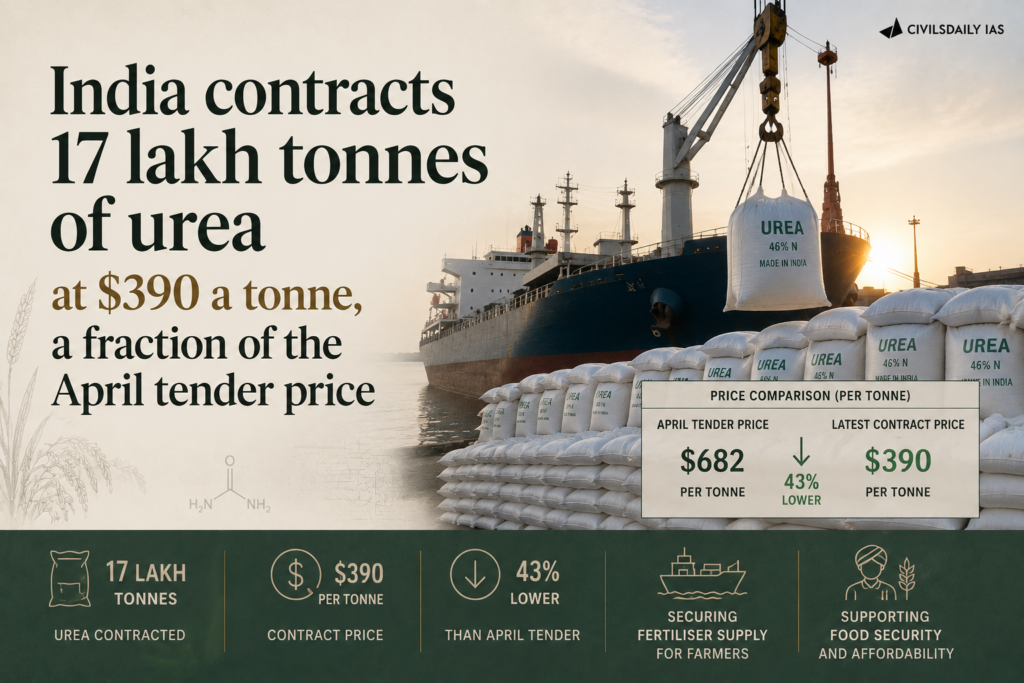
  • India contracts 17 lakh tonnes of urea at $390 a tonne, a fraction of the April tender price

    Why in the News?

    India has contracted 17 lakh tonnes (1.7 mt) of imported urea at landed prices of $390.25 to $393.65 per tonne, marking a ~58% drop from the peak rates of $935 to $959 per tonne seen in the April 2026 tender. This sharp collapse highlights how heavily India’s fertiliser subsidy bill depends on external factors, ranging from West Asian energy disruptions to Chinese inventory accumulation.

    Global Urea Import Tender Mechanism

    • Nominated State Agencies: Import tenders are invited by designated state-owned canalising agencies like Rashtriya Chemicals and Fertilizers (RCF) and Indian Potash Limited (IPL).
    • Landed Price (CFR): Offers are quoted on a landed basis—covering both material cost and ocean freight to destination ports. This shifts shipping risk to the supplier.
    • Geographical Distribution: Tenders split required tonnages between the East Coast and West Coast to optimize port discharge and domestic logistics.
    • Market Signals: Bids from multiple global traders (e.g., Ameropa Group) establish the benchmark. High oversubscription indicates a loose global supply market.

    Price Trajectory & Global Supply Dynamics

    1. April Peak ($935–$959/tonne): Driven by peak war risk premiums, high global fuel prices, and Strait of Hormuz shipping anxieties.
    2. May Moderation ($444.9–$449.3/tonne): Easing immediate supply shocks.
    3. July/August Drop ($390.25–$393.65/tonne): Triggered by:
      • China’s Surplus Inventory: Domestic in-plant inventories in China surged 76% year-on-year, turning it into a major swing supplier.
      • Re-routed Supplies: Iranian material reaching markets through China.
      • Alternative Sourcing: Diversification of LNG feedstock by agencies like GAIL and IOC away from Hormuz transit routes toward the US, Oman, Norway, Angola, Congo, Indonesia, and Trinidad.

    Current Supply & Demand Position

    • Adequate Reserves: Imports reached 25.08 lakh tonnes in Q1 (April–June 2026) compared to 8.38 lakh tonnes in the previous year.
    • Domestic Production: Expanded to 71.53 lakh tonnes in Q1 2026.
    • Cropping Seasons Covered: Sufficient availability reported across both the ongoing Kharif (monsoon) season and upcoming Rabi (winter/spring) sowing.

    Challenges in India’s Fertiliser Policy

    • Subsidy Exposure: Urea sells at a statutorily controlled Maximum Retail Price (MRP), meaning any surge in landed cost directly increases the exchequer’s subsidy burden.
    • Nutrient Imbalance: Controlled urea pricing versus decontrolled phosphatic and potassic nutrients encourages over-application of nitrogen (N), skewing the ideal 4:2:1 (N:P:K) ratio.
    • Phosphate Vulnerability: While urea and LNG supply sources have been widened, Di-ammonium Phosphate (DAP) and raw intermediates (phosphoric acid, ammonia, sulphur) remain vulnerable to concentrated import sources and price spikes.
    • Feedstock Dependence: Domestic plants remain tied to imported LNG, linking production costs directly to international gas trends.

    Statutory & Regulatory Framework

    • Essential Commodities Act, 1955: Empowers the Union Government to regulate production, stock limits, supply, and pricing of fertilisers.
    • Fertiliser (Control) Order, 1985 & Movement Control Order, 1973: Governs quality standards, dealer registrations, and inter-state distribution.
    • New Urea Policy, 2015: Promotes energy efficiency in production units and mandates 100% Neem Coating of domestic urea to prevent industrial diversion.
    • Nutrient Based Subsidy (NBS) Scheme, 2010: Provides a fixed annual per-kg subsidy on N, P, K, and S for decontrolled fertilisers (DAP, MOP, Complex).
    • Direct Benefit Transfer (DBT): Releases subsidies to manufacturers only after Aadhaar-authenticated point-of-sale (PoS) transactions at retail outlets.

    Key Government Initiatives

    • PM PRANAM: Encourages States to reduce chemical fertiliser usage by sharing the resulting subsidy savings.
    • One Nation One Fertiliser: Standardises all subsidised crop nutrients under the single Bharat brand.
    • Nano Urea: Liquid alternative developed by IFFCO to lower overall bulk tonnage requirements.
    • Plant Revivals: Reactivation of closed units (Ramagundam, Gorakhpur, Sindri, Barauni, Talcher) to boost domestic capacity.
    • Coal Gasification: Talcher plant designed to produce urea using coal gasification rather than natural gas, cutting gas import reliance.

    Key Concepts

    • Urea: Solid nitrogenous fertiliser (carbamide) carrying 46% Nitrogen—the highest among solid fertilisers.
    • Di-ammonium Phosphate (DAP): Phosphatic fertiliser containing 18% Nitrogen and 46% Phosphorus.
    • Fertiliser Association of India (FAI): Industry body (est. 1955) providing production, import, and consumption stats for supply planning.
    • Muriate of Potash (MOP): Fully import-dependent nutrient; India has no commercial potash reserves.

    [2020] With reference to chemical fertilizers in India, consider the following statements:
    1. At present, the retail price of chemical fertilizers is market-driven and not administered by the Government.
    2. Ammonia, which is an input of urea, is produced from natural gas.
    3. Sulphur, which is a raw material for Phosphoric acid fertilizer, is a by-product of oil refineries.
    Which of the statements given above is/are correct?
    (a) 1 only
    (b) 2 and 3 only
    (c) 2 only
    (d) 1, 2 and 3
    Answer: (b)”

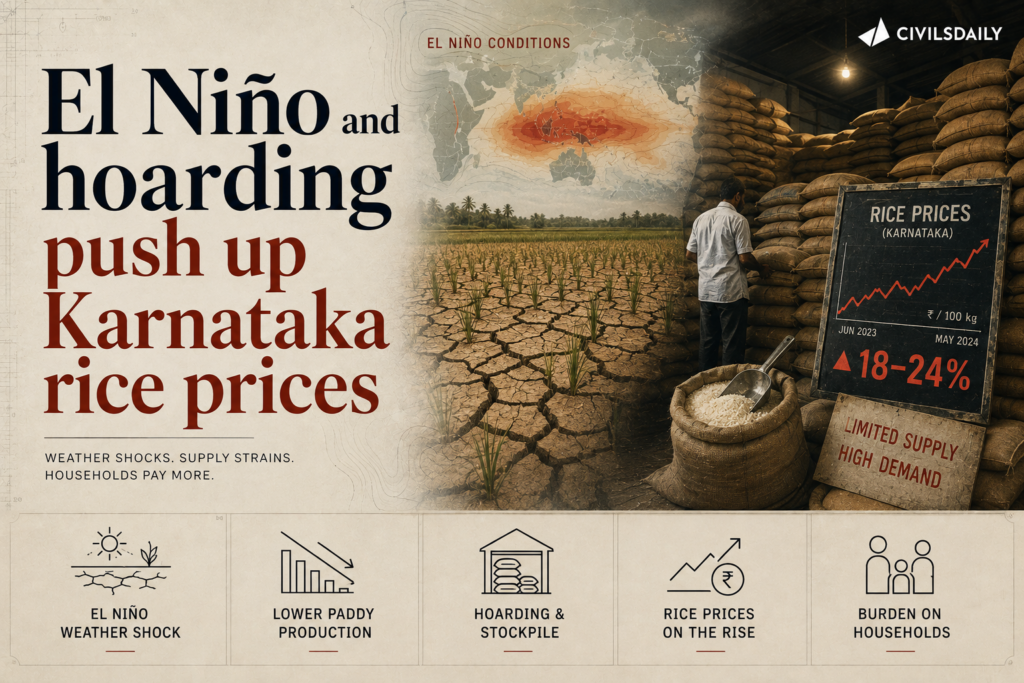
  • El Nino and hoarding push up Karnataka rice prices

    Why in the News

    Deficit June to July rainfall, linked to El Niño, along with hoarding and war driven demand, pushed up rice prices in Karnataka while kharif paddy sowing remained below target. The episode highlights the vulnerability created by water intensive paddy cultivation during drought conditions.

    What drove the shock?

    • Rainfall deficit: El Niño associated dry conditions affected monsoon rainfall.
    • Low sowing: Paddy acreage remained below the kharif target.
    • Reservoir stress: Low storage reduced irrigation availability.
    • Tungabhadra canal breach: Further disrupted water supply.

    Why is Paddy Water Intensive?

    • Conventional transplanted rice requires substantial water, particularly during crop establishment.
    • Dependence on irrigation reservoirs makes paddy cultivation vulnerable to drought and declining storage.
    • Concentration of paddy in water stressed regions can create a water-energy-food nexus problem.

    Sustainable Alternatives

    1. Direct Seeded Rice (DSR)

    • Seeds are sown directly instead of raising and transplanting seedlings.
    • Reduces water and labour requirements.
    • Avoids prolonged standing water associated with conventional transplantation.

    2. Crop Diversification

    • Shift from paddy towards relatively less water intensive crops such as jowar, bajra, pulses and oilseeds.
    • Can improve water-use efficiency and climate resilience.

    3. Micro-irrigation and Water Management

    • Efficient irrigation, laser land levelling, rainwater harvesting and improved farm water management can reduce water wastage.

    MSP Dimension

    • Paddy receives MSP support, providing farmers with a price assurance mechanism.
    • For 2026-27, the MSP for paddy (common) is ₹2,441/quintal.
    • However, assured prices can also influence farmers to continue cultivating water intensive crops even in water stressed regions.

    “[2019] With reference to the cultivation of Kharif crops in India in the last five years, consider the following statements:
    1. Area under rice cultivation is the highest.
    2. Area under the cultivation of jowar is more than that of oilseeds.
    3. Area of cotton cultivation is more than that of sugarcane.
    4. Area under sugarcane cultivation has steadily decreased.
    Which of the statements given above are correct?
    (a) 1 and 3 only
    (b) 2, 3 and 4 only
    (c) 2 and 4 only
    (d) 1, 2, 3 and 4
    Answer: (a)”

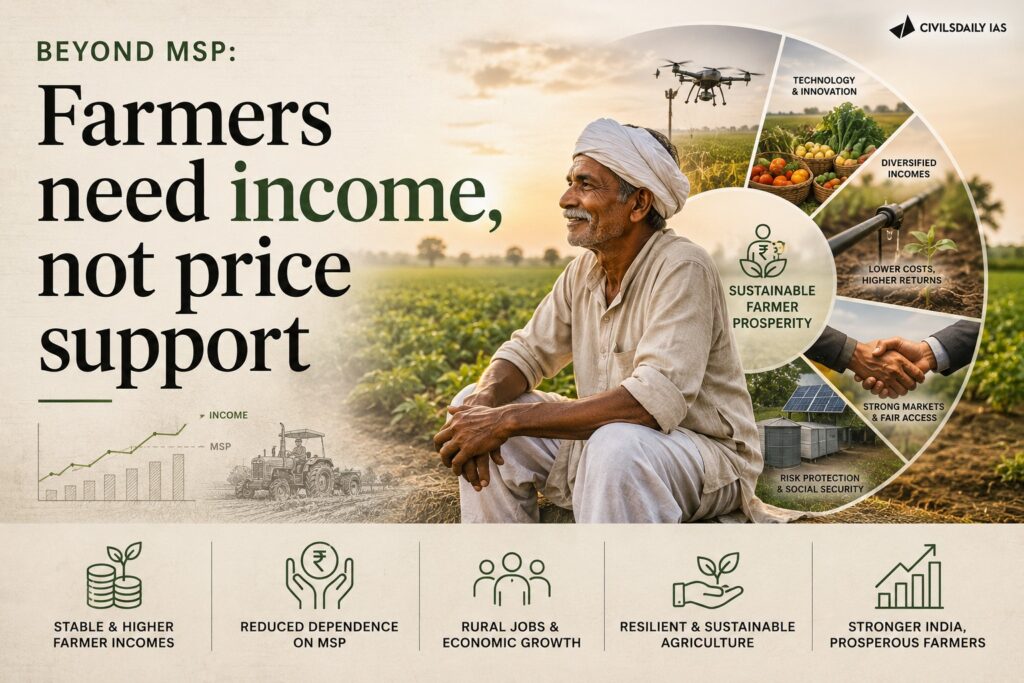
  • Beyond MSP: Farmers need income, not price support

    Why in the News

    Madhya Pradesh has raised its guaranteed procurement of summer moong at Minimum Support Price (MSP) from 25% to 60% of estimated yield, after farmers demanded the state’s declared MSP be honoured in practice, not left on paper. The concession exposes the deeper conflict between expanding price-support procurement, which is fiscally unsustainable for any state, and shifting toward direct income support that does not distort what farmers choose to grow.

    What is driving Madhya Pradesh’s decision to raise the procurement threshold?

    1. Price gap: Moong is wholesaling in mandis at about Rs 7,000 a quintal, well below the MSP of Rs 8,768 a quintal.
    2. Prior cap: The state had earlier guaranteed MSP procurement only for up to 1.2 quintals of yield per acre, since raised to 3 quintals.
    3. Unequal benefit: Farmers harvesting 6 to 8 quintals an acre, twice the state’s assessed average yield, still stand to lose the most on the extra output sold below MSP.
    4. Broader demand: The demand for MSP as a guaranteed entitlement is no longer confined to Punjab and Haryana’s wheat and rice growers. It now extends to pulses and oilseed farmers in states like Madhya Pradesh.

    Why is expanded physical procurement not a sustainable solution?

    1. Fiscal capacity: No state government, including Madhya Pradesh, has the resources to procure and stock all the moong or soyabean farmers bring for MSP sale.
    2. Existing surplus problem: Even in wheat and rice, where government agencies already hold stocks beyond the requirements of the public distribution system and welfare schemes, continued procurement adds to storage costs without matching need.
    3. Best available alternative still costly: Paying only the price difference between MSP and the market rate, rather than physically procuring the crop, is a cheaper alternative but still not a long-term sustainable solution.

    What alternative does the case for reform point to?

    1. Minimum Income Support (MIP): A per-acre direct cash transfer, described as Minimum Income Support (MIP), would guarantee farmers income without requiring the state to procure or store any crop.
    2. Market-aligned incentive: Once assured of an MIP, farmers would have the freedom to grow crops the market actually wants, rather than crops guaranteed a price floor.
    3. Complementary measures: Crop insurance and greater public investment in agricultural research and rural infrastructure are identified as the support structures that should accompany an MIP.
    4. Policy stance: Agricultural policy should complement markets rather than displace or distort them, an approach both MSP-based procurement and open-ended input subsidies have failed to deliver.

    What are the challenges to a Minimum Income Support (MIP) approach

    1. Land record dependence: A per-acre transfer requires accurate, updated land records, which many tenant farmers and sharecroppers lack access to.
    2. Moral hazard risk: A flat per-acre payment could be gamed through short-term land leasing arrangements designed solely to capture the transfer.
    3. State fiscal capacity still tested: An MIP still requires sustained budgetary commitment from state or central governments. Its affordability has not been demonstrated at the scale MSP procurement currently operates.
    4. Loss of price floor: Removing procurement-based price support exposes farmers fully to market price volatility, without the safety net an assured MSP purchase currently provides.
    5. Political resistance: Farmer groups that have organised around MSP as an entitlement may resist a transition away from procurement guarantees they have fought to expand.

    Conclusion

    Madhya Pradesh’s expanded moong procurement buys short-term calm but adds to a fiscal burden no state can sustain at scale. The alternative on the table, a per-acre Minimum Income Support transfer paired with crop insurance and rural investment, would let farmers respond to market signals instead of price guarantees, though its own implementation challenges remain unresolved.

    Back2Basics

    1. Minimum Support Price (MSP): A price floor announced by the central government for select crops, based on recommendations of the Commission for Agricultural Costs and Prices (CACP).
    2. Coverage: MSP currently covers 22 crops, but assured physical procurement at scale is concentrated overwhelmingly in wheat and rice through the Food Corporation of India (FCI) and state procurement agencies.
    3. Pulses and oilseeds: Procurement of pulses and oilseeds like moong at MSP has historically been far more limited than for cereals, leaving a wider gap between announced MSP and actual market realisation for these crops.

    Committee/Report

    1. Ashok Dalwai Committee (Doubling Farmers’ Income): Shift focus from price support to income enhancement through diversification, value addition and market reforms.
    2. Shanta Kumar Committee (2015): Recommended restricting MSP procurement and replacing it with Direct Benefit Transfers (DBTs) where feasible.

    Economic Survey

    1. Economic Survey 2016-17: Advocated replacing input subsidies with direct income transfers for better efficiency and lower market distortions.

    International Examples

    1. United States: Income support through Farm Bill programmes (Price Loss Coverage and crop insurance) rather than open-ended government procurement.
    2. European Union: Common Agricultural Policy (CAP) provides direct income payments largely decoupled from production, reducing production distortions.

    PYQ Relevance

    [UPSC 2018] What do you mean by Minimum Support Price (MSP)? How will MSP rescue the farmers from the low-income trap?

    Linkage: The PYQ tests the role of MSP in ensuring remunerative prices and improving farmers’ incomes. The article examines the limitations of MSP-based procurement and the case for Minimum Income Support (MIP) as an alternative.

  • Trouble in ‘Soy State’-The Brewing Crisis in Madhya Pradesh’s Soybean Sector

    Introduction

    Madhya Pradesh contributes nearly 60% of India’s soybean output, earning its title as the Soy State. However, falling yields, poor returns, and uncertain government support are driving young farmers away from cultivation. The state, which once symbolized India’s success in expanding oilseed production, from 300,000 hectares in the 1970s to over 12 million hectares today, is now facing a turning point. Issues surrounding MSP, seed quality, and potential soybean imports have triggered widespread concern among cultivators.

    Declining Interest in Soybean Cultivation

    1. Generational shift: Young farmers are abandoning soybean farming despite their families’ legacy due to poor income and rising costs.
    2. Low profitability: Farmers report earnings of only ₹5,000–₹6,000 per quintal, while production costs remain high due to fertilizers, diesel, and seed expenses.
    3. Falling acreage: MP’s soybean acreage fell from 5.7 million hectares in 2023 to 5.1 million hectares in 2024, marking a 10% decline.
    4. Shift to alternatives: Many farmers are switching to urad, moong, maize, or cash crops that offer higher or more stable returns.

    Why Are Farmers Losing Faith in MSP?

    1. Improper implementation: Though the Centre announced ₹4,600 per quintal as MSP, most farmers sell below it due to lack of procurement infrastructure.
    2. Ceiling price issue: The government fixed a “ceiling price” of ₹4,300 per quintal for private buyers, making market rates unprofitable for producers.
    3. Limited procurement centres: Farmers complain of delayed payments and unavailability of buyers at MSP, forcing distress sales.
    4. Mismatch with cost of cultivation: Even after MSP hikes, real income remains stagnant due to higher input costs.

    The Threat of Soybean Imports

    1. Policy uncertainty: Reports of possible U.S. soybean imports have caused panic among domestic farmers.
    2. Price depression: Imported soybean meal could reduce domestic demand, pushing prices below MSP levels.
    3. Industry divide: Processors argue that imports are needed to stabilize edible oil prices, but cultivators fear it will cripple local production.
    4. Farm unions’ protest: The Soybean Processors Association of India (SOPA) and farmers’ groups have demanded a ban on import proposals, calling it a “death blow” to the domestic industry.

    What Are the Structural Problems Behind the Soybean Crisis?

    1. Seed quality issues: Farmers allege substandard seeds, resulting in poor germination and low yields.
    2. Inadequate extension services: Absence of updated agronomic practices and low use of scientific techniques hinder productivity.
    3. High input costs: Fertilizers, pesticides, and labour costs have nearly doubled over the last five years.
    4. Climate vulnerability: Irregular rainfall and pest infestations (like girdle beetle and stem fly) have further reduced yields.
    5. Weak farmer organizations: Lack of effective cooperatives and marketing federations reduces farmers’ bargaining power.

    How Has Soybean Production Shaped India’s Agricultural Growth?

    1. Historical expansion: From 300,000 ha in the 1970s to 12 million ha today, soybean has been India’s fastest growing crop.
    2. Export potential: Soymeal exports to East Asia once contributed significantly to India’s agri-trade surplus.
    3. Edible oil dependence: Soybean accounts for nearly 35% of India’s oilseed area and plays a key role in reducing import dependency.
    4. Policy linkage: The crop was promoted under Technology Mission on Oilseeds (1986), which revolutionized oilseed cultivation patterns.

    Reviving Faith in Oilseed Farming

    1. Long term MSP assurance: A 3 year guaranteed MSP policy can restore confidence and reduce uncertainty.
    2. Seed innovation: Investment in high-yielding, pest-resistant seed varieties through ICAR and private collaboration.
    3. Market infrastructure: Expansion of procurement centres and digital payment systems to ensure fair realization.
    4. Diversification support: Incentivizing mixed cropping and integrated farming models to mitigate risk.
    5. Value chain strengthening: Promotion of domestic processing units and branding for soybean-based products.

    Conclusion

    The “Soy State” stands at a crossroads. The crisis in Madhya Pradesh reflects the larger policy dilemma of India’s agricultural system, balancing market liberalization with farmer protection. Unless structural issues like MSP implementation, seed quality, and import regulation are addressed, India risks losing self-reliance in a crop that transformed its rural economy. The need of the hour is a farmer-centric reform agenda that enhances profitability, productivity, and predictability in oilseed cultivation.

    PYQ Relevance

    [UPSC 2018] What are the major reasons for declining rice and wheat yield in the cropping system? How crop diversification is helpful to stabilise the yield of the crops in the system?

    Linkage: UPSC’s recurring theme of agriculture and crop diversification finds direct relevance here. The soybean crisis in Madhya Pradesh mirrors the same structural issues of monocropping stress, declining productivity, and need for diversified cropping systems to ensure long-term yield stability and farmer resilience.

  • All in one Agriculture needs more public spending, not just one umbrella scheme

    Why in the News?

    The Prime Minister Dhan-Dhaanya Krishi Yojana (PMDDKY) was recently approved by the Union Cabinet as a major reform initiative in the agriculture sector. It aims to converge 36 existing schemes across 11 departments to address regional disparities in agricultural productivity.

    What are the aims of PMDDKY (Prime Minister Dhan-Dhaanya Krishi Yojana)?

    • Address productivity disparities: The scheme aims to reduce inter-State and intra-State disparities in agricultural productivity.
    • Improve productivity & self-reliance: Focus on higher agricultural productivity, value addition, local livelihood creation, and increased domestic production to ensure self-sufficiency.
    • Holistic development: Enhance outcomes in agriculture and allied sectors through targeted intervention and convergence of schemes.
    • Private participation: Encourage local public-private partnerships for enhanced implementation and innovation.

    Why is scheme convergence under PMDDKY needed?

    • Eliminates Fragmentation of Efforts: Earlier, agricultural schemes like PM-KISAN, PMFBY, and Soil Health Card Scheme operated in silos. Eg: A farmer receiving income support under PM-KISAN might not be covered under insurance if PMFBY was poorly implemented in that region. Convergence ensures coordinated benefits.
    • Targets Low Productivity Districts: PMDDKY identifies 100 low-productivity districts using criteria like cropping intensity, credit flow, and yield gaps. Eg: A district with only 70% of national average yield can be provided tailored interventions by combining schemes like RKVY and Micro-Irrigation Fund.
    • Improves Resource Efficiency: Unified schemes allow for better fund utilisation, avoiding duplication of services or spending. Eg: Instead of running separate capacity-building programs under different departments, single training programs can be run using pooled funds from both Extension Services and Digital Agriculture Initiatives.
    • Ensures Uniform Implementation Standards: PMDDKY seeks national uniformity while allowing local customization. Eg: While standards for soil health management may be set centrally, implementation can be adapted to local conditions using district-specific plans.
    • Compensates for Declining Budget Share: Public investment in agriculture is falling (from 3.53% in 2021-22 to 2.51% in 2025-26 of the Central Plan outlay). Eg: Convergence helps make the most of limited resources by integrating multiple schemes under a single implementation umbrella.

    How do ‘District Plans’ aid agricultural reform?

    •  Localized Problem Solving: District Plans allow for the identification of region-specific challenges such as water scarcity, pest outbreaks, or poor seed quality. Eg: In Latur district (Maharashtra), which faces frequent droughts, the district plan prioritized micro-irrigation and watershed development, leading to improved water-use efficiency.
    • Customised Crop Diversification: District-level planning helps align cropping patterns with agro-climatic conditions and market demand, reducing monoculture dependency. Eg: In Koraput district (Odisha), known for tribal farming, the plan introduced millet promotion and value chain linkages, increasing income and nutritional security.
    • Efficient Use of Resources and Schemes: Integration of multiple schemes under district plans ensures better fund allocation, resource convergence, and monitoring. Eg: In Barabanki district (Uttar Pradesh), convergence of Soil Health Card, PM-KUSUM, and FPO promotion led to more sustainable and solar-powered farming practices.

    What challenges may hinder PMDDKY?

    • Administrative Coordination Across Departments: With 36 schemes under 11 departments converging, bureaucratic silos and lack of inter-departmental coordination can delay execution. Eg: In Jharkhand, similar convergence under NRLM and agriculture failed initially due to poor communication between the Rural Development and Agriculture departments.
    • Data Gaps and Poor Baseline Assessment: District-level planning requires granular, updated data on land use, cropping patterns, and farmer needs — often missing or outdated. Eg: In Dantewada (Chhattisgarh), poor digital records led to misallocation of subsidies under earlier agri-reform efforts.
    • Weak Local Institutions: PACS (Primary Agriculture Cooperative Societies) and local self-governments may lack the capacity to implement and monitor complex plans. Eg: In Banda district (U.P.), PACS struggled to handle seed distribution due to lack of trained staff and digital infrastructure.
    • Limited Private Sector Engagement in Remote Areas: Private partners may hesitate to invest in low-productivity districts due to poor infrastructure or lack of assured returns. Eg: In Kiphire (Nagaland), agri-businesses withdrew from a millet-processing initiative due to transport and power issues.
    • Farmer Awareness and Participation: Without sustained IEC (Information, Education, Communication) campaigns, farmers may not understand how to benefit from the converged schemes. Eg: In Barmer (Rajasthan), uptake of soil health and credit-linked schemes remained low due to lack of farmer outreach in vernacular languages.

    Way forward: 

    • Ensure Adequate and Sustained Funding: Increase the budgetary allocation for agriculture to reverse the current decline (only 2.51% of Central Plan outlay in 2023-24). Sufficient and stable funding will support better implementation of integrated District Plans.
    • Leverage Technology and Real-Time Monitoring: Implement digital dashboards for tracking the 117 indicators under PMDDKY and promote data-driven decision-making. This will help improve accountability, efficiency, and timely course corrections.

    Mains PYQ:

    [UPSC 2016] Considering the vulnerability of Indian agriculture to vagaries of nature, discuss the need for crop insurance and bring out the salient features of the Pradhan Mantri Fasal Bima Yojana (PMFBY).

    Linkage: The article explicitly states that the PMDDKY will subsume existing Central schemes like the Pradhan Mantri Fasal Bima Yojana (PMFBY). Therefore, a question about PMFBY is directly relevant to understanding a key component of this new “one umbrella scheme” approach.