Why in the News
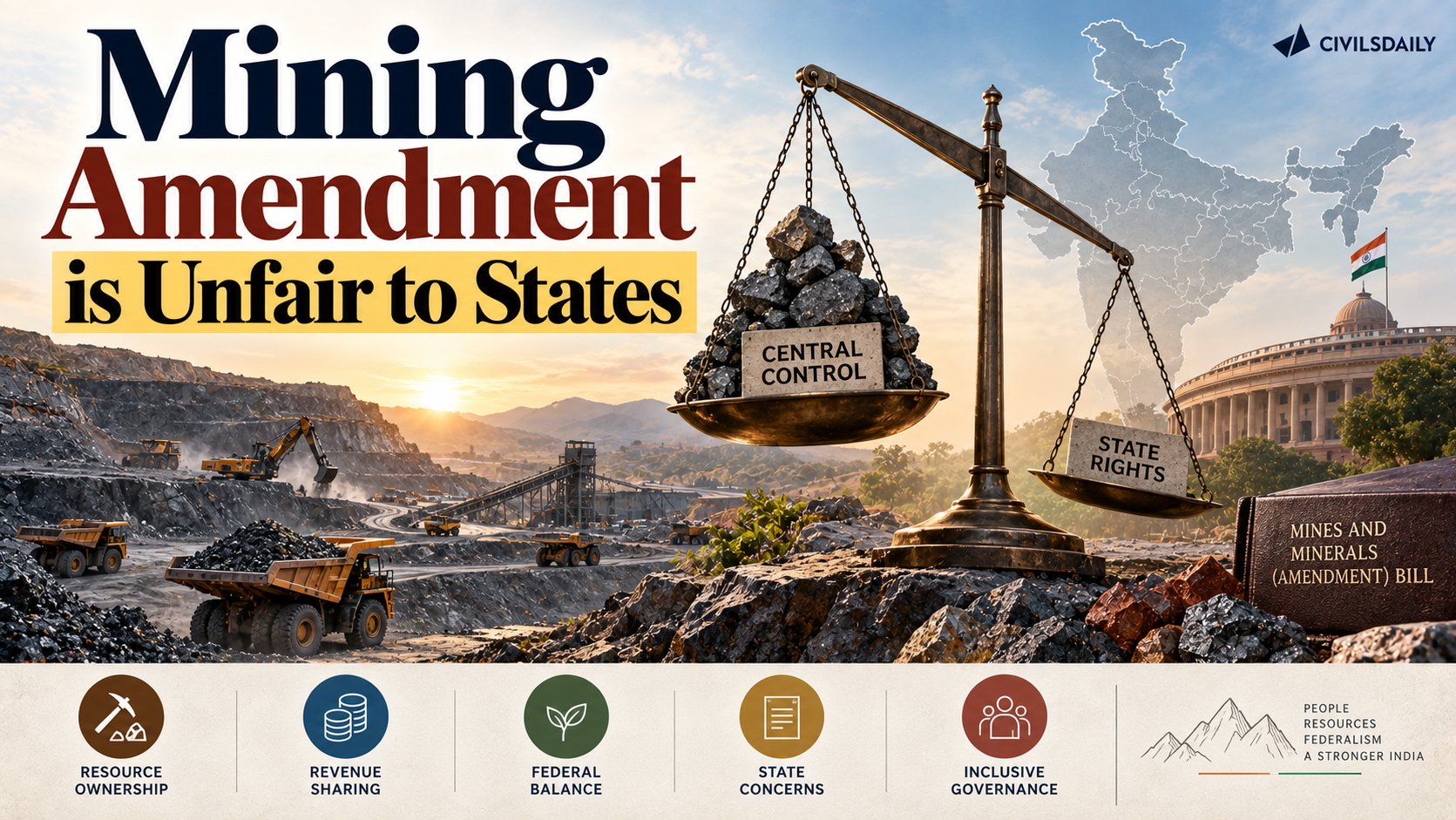
Section 9D of the Mines and Minerals (Development and Regulation) Amendment Act, 2026 restricts State governments from imposing taxes, cesses or other levies on mineral rights or mineral-bearing land, except in accordance with conditions prescribed by the Centre. The provision follows Mineral Area Development Authority vs. Steel Authority of India (2024), in which a nine-judge Bench of the Supreme Court held that royalty payable on minerals is not a tax. The same Bench recognised the States’ legislative power to tax mineral rights and held that mineral-bearing land falls within the States’ taxation power over land. The tension is that Entry 50 of the State List lets Parliament limit State taxation of mineral rights, while the new section extends its restriction to levies on mineral-bearing land, a separate power under Entry 49 of the State List. What is contested is not the revenue States receive today but the levies they may be barred from raising tomorrow.
What does Section 9D do?
- Scope of the restriction: It bars States from imposing taxes, cesses or other levies on mineral rights or on mineral-bearing land except as the Centre prescribes.
- Where the discretion sits: The conditions under which a State may levy are set by the Central government, so future State levies depend on a framework the Centre controls.
- What it does not touch: Royalty, the auction premium and the other mineral revenues States currently receive are not altered by the section.
What is the Centre’s case for a uniform levy framework?
- Predictability for investors: The stated objective is to create a predictable tax environment, prevent excessive levies and encourage long-term investment in mining.
- Project horizons: Mining projects involve enormous investment and operate over decades, so investors need assurance that financial rules will not change unpredictably from one year to the next.
- Revenue assurance offered: The Centre’s position is that 90% of mining sector revenue accrues to the States and that this will continue.
Why do mineral-rich States object?
- Uneven distribution of the resource: India’s mineral wealth is concentrated rather than spread evenly. Odisha, Jharkhand, Chhattisgarh and Karnataka hold enormous reserves of coal, iron ore and other minerals that feed industries across the country.
- Costs land on the host State: The host State handles resettlement of displaced groups, environmental damage, pressure on public infrastructure and the long-term consequences of extracting minerals that can never be replaced.
- Budgets tied to mining receipts: NITI Aayog’s Fiscal Health Index has recognised the role mining receipts play in the strong revenue mobilisation performance of Odisha and Chhattisgarh. Mining accounts for a large proportion of Odisha’s non-tax revenue.
- Higher spending needs in mineral districts: Mineral producing districts require greater public expenditure precisely because they bear the costs of mining.
- Loss of a natural advantage: A mineral-rich State ordinarily expects some ability to convert that advantage into resources for its own development, and the section substantially reduces that freedom.
What is the constitutional objection to Section 9D?
- Entry 50 and its built-in limit: The Constitution gives States the power to tax mineral rights under Entry 50 of the State List, subject to limitations Parliament may impose through laws relating to mineral development.
- Entry 49 is a separate power: The power to tax lands and buildings under Entry 49 of the State List is a distinct constitutional head and carries no equivalent parliamentary limitation clause.
- Where the section goes further: By extending the restriction to taxes or levies on mineral-bearing land, the section reaches a power Entry 50 does not authorise Parliament to limit.
- Risk to the 2024 ruling: The amendment risks rendering the impact of the nine-judge ruling nugatory, since a power the Court affirmed can be neutralised by prescription rather than by overruling.
- The question it raises: How far can a Central law dealing with mineral development restrict a State’s exclusive power to tax land is now a live constitutional question rather than a mining policy dispute.
Challenges to Section 9D
- Responsibility without fiscal capacity: A federal system cannot function where States carry obligations they have no independent means to fund. Eg. Mineral districts must fund resettlement and infrastructure repair from receipts the Centre may now condition.
The Fix: Confine the prescribed conditions to levies on mineral rights under Entry 50 and leave the Entry 49 land taxation power untouched. - Predictability purchased by narrowing State choice: Uniformity makes taxation more predictable for investors and reduces the fiscal options available to States. Eg. A State cannot design a mineral-linked levy to fund a district-specific rehabilitation programme without Central prescription.
The Fix: Set a ceiling on State mineral levies in the statute itself rather than routing each levy through Central approval, so investors get the certainty without the States losing the power. - Litigation risk over a settled question: A provision that neutralises a nine-judge ruling by executive prescription invites a fresh round of constitutional challenge. Eg. Mineral Area Development Authority vs. Steel Authority of India itself ran for decades before it was settled in 2024.
The Fix: Refer the scope of Section 9D to the Inter-State Council under Article 263 before conditions are prescribed, so the levy framework is negotiated rather than litigated. - Concentration of the burden on a few States: The section’s cost is borne almost entirely by a handful of mineral-bearing States rather than spread across the Union. Eg. Odisha, Jharkhand, Chhattisgarh and Karnataka carry the bulk of the country’s coal and iron ore output.
The Fix: Weight mineral-bearing districts explicitly in the next Finance Commission’s horizontal devolution formula, so extraction costs are recognised in transfers.
Conclusion
The minerals beneath a State’s soil serve the entire country, and the costs of extracting them are felt most directly by the people who live above them. A State that bears the infrastructural and social consequences of extraction must retain a meaningful stake in the economic value its natural resources generate. The unresolved point is whether a Central law on mineral development may condition a State’s power to tax land, a power the Constitution places under a separate entry and does not subject to parliamentary limitation. That question now sits between a statute in force and a nine-judge ruling that has not been overruled.
What is Fiscal Federalism?
- About: It is the division of taxation powers, expenditure responsibilities and transfer arrangements between the levels of government in a federation.
- Rationale: It exists because the level of government best placed to raise a tax is often not the level that must spend on the service, so the design has to close that gap without destroying accountability.
- Vertical imbalance: The Union raises a larger share of revenue than it spends directly, while States carry the larger share of expenditure obligations, and transfers bridge the difference.
- Horizontal imbalance: Revenue capacity differs sharply across States of similar need, which is why devolution formulas weight income distance, area and population rather than collections alone.
Back2Basics: NITI Aayog’s Fiscal Health Index
- What it is: A composite index published by NITI Aayog that ranks States on the quality of their public finances.
- What it measures: It scores States on sub-indices covering quality of expenditure, revenue mobilisation, fiscal prudence, debt index and debt sustainability.
- First edition: The maiden report was released in January 2025 and covered 18 major States.
- Why it matters here: It is the benchmark that records mining receipts as a driver of revenue mobilisation performance in mineral-bearing States.
Matching Previous Year Question
[2025] Examine the evolving pattern of Centre-State financial relations in the context of planned development in India. How far have the recent reforms impacted the fiscal federalism in India?