Why in the news?
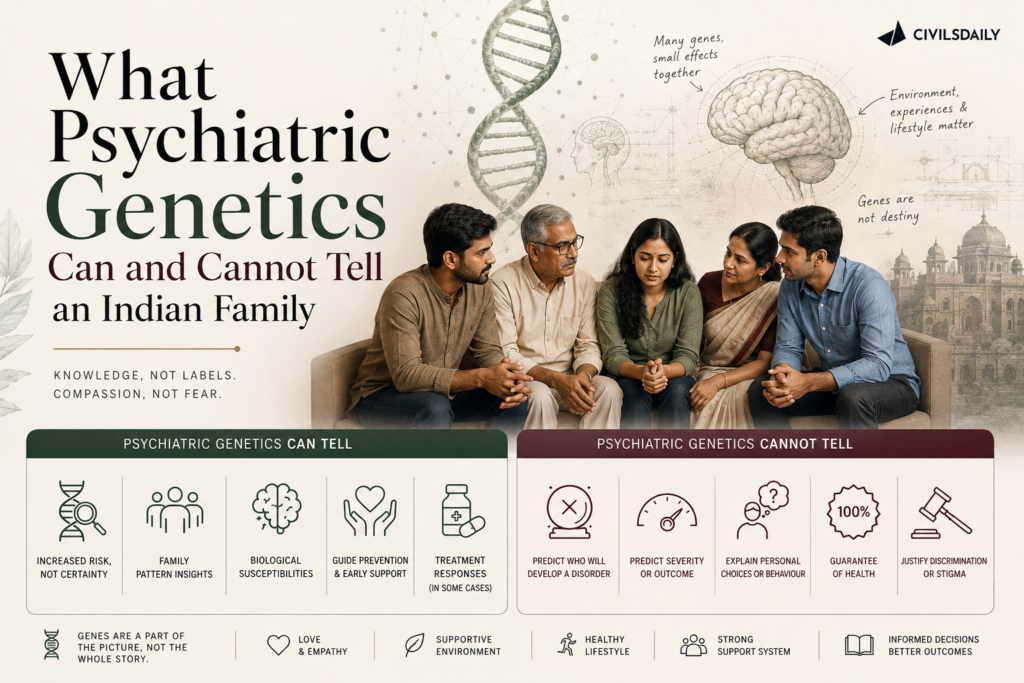
Families of patients with psychiatric illness increasingly ask whether the condition is in their blood and whether a genetic test can settle their child’s future. There is a tension between the real progress of psychiatric genetics and its limited power to predict individual outcomes, especially for Indian populations underrepresented in genomic databases. The central point is that genes load the dice but do not determine destiny.
What is a genome-wide association study (GWAS)?
- About: A GWAS compares millions of common genetic variants across very large groups of people with and without a condition, to find variants that appear more often in one group. . It compares DNA markers, most often single-nucleotide polymorphisms (SNPs, between individuals with a condition and healthy control groups.
- What it yields: It behaves like a satellite map highlighting genomic areas of interest, showing where to look for biological mechanisms rather than pinpointing a cause.
What does polygenic risk mean?
- About: In common psychiatric disorders no single gene variant has a large effect, unlike single-gene diseases such as Tay-Sachs disease or Duchenne muscular dystrophy.
- Mechanism: Risk is polygenic, emerging from the combined influence of thousands of variants together with rare genetic changes, development, environment, and chance.
What is a polygenic risk score?
- About: A polygenic risk score (PRS) compresses many small genetic effects into a single number meant to estimate a person’s inherited susceptibility.
- Limits: It cannot say whether a person will become ill, at what age, how severe it will be, or which medicine will work, because it captures only part of genetic liability.
How Polygenic Risk Works
- Many small changes: Instead of one major gene causing an illness (like in cystic fibrosis), polygenic conditions involve hundreds or thousands of tiny DNA changes called single nucleotide polymorphisms
- Adding it up: Each individual variant adds or subtracts a tiny amount of risk; a PRS totals these up to estimate your overall genetic predisposition.
- Common conditions: It applies to complex diseases like heart disease, type 2 diabetes, schizophrenia, and certain common cancers
What have the major GWAS findings shown?
- Schizophrenia: A 2022 landmark study identified associations at 287 genomic regions and pointed to genes active in neurons and synapses.
- Bipolar disorder: A large 2021 study identified 64 associated regions.
- Regulatory signals: Many signals lie in DNA that regulates when and where genes switch on, not in stretches that directly encode a protein.
- Shared risk: A December 2025 study in Nature reported that some inherited risk is shared across schizophrenia and bipolar disorder.
Why is prediction unreliable, especially in India?
- Score does not contain life: A person with a higher score may remain well while a person with a lower score may fall ill, because the score does not contain childhood adversity, sleep disruption, substance use, medical illness, or access to care.
- Expert caution: The International Society of Psychiatric Genetics has cautioned that current scores for schizophrenia, bipolar disorder, and depression are not accurate enough for routine clinical prediction.
- Ancestry bias: Genomic databases have drawn disproportionately from people of European ancestry, so scores are often less accurate in other populations.
- Indian diversity: The GenomeIndia project generated whole-genome data from 10,000 healthy, unrelated Indians across 83 population groups and documented extraordinary genetic diversity, so a score developed elsewhere cannot simply be imported.
What can genetics usefully change in the clinic today?
- Reduces blame: A mother did not cause schizophrenia by being too strict and a father did not transmit bipolar disorder through a moral failing, and biology matters.
- Avoids fatalism: Genetic vulnerability should not be converted into a verdict, and no test can declare a person safe or doomed.
- Focus on modifiable risk: The useful approach is to track early warning signs, avoid intoxicants, sleep well, seek help promptly, and focus on recovery.
- Visible risks: Many risks are visible without sequencing, such as lost sleep before a manic episode, escalating cannabis use, treatment stopped due to stigma, and distance from specialist care.
Conclusion
The central idea is that psychiatric genetics will not identify people before they fall ill, but it can replace superstition and blame with a more accurate account of vulnerability. Prediction will remain probabilistic even as datasets grow larger and more representative. The task is to keep probabilities from being misunderstood, stigmatised, or commercialised, and to involve diverse populations while protecting privacy.
Back2Basics:
GenomeIndia Project
- Convening body: Funded by the Department of Biotechnology (DBT), Government of India.
- Aim: To build a catalogue of the genetic diversity of the Indian population.
- Scale: Generated whole-genome data from 10,000 healthy, unrelated Indians across 83 population groups.
- Significance: Provides an India-specific reference against which imported genetic risk scores can be tested rather than assumed to apply.
Genomics in India: About
- Definition: Genomics studies the complete set of an organism’s DNA, including how variants relate to disease.
- Diversity: India’s population carries extraordinary genetic diversity across many groups, making a single national reference essential.
- Clinical caution: Risk scores derived from European-ancestry datasets can mislead when applied to Indian populations.
Challenges in Psychiatric Genetics
- Weak prediction: Scores cannot forecast onset, severity, or treatment response for an individual.
- Ancestry gaps: European-dominated databases reduce accuracy elsewhere.
- Commercial overreach: Enthusiasm of commerce can outrun the science.
- Privacy risk: Genomic data raises serious privacy and consent concerns.
- Stigma: Misread probabilities can label people as patients-in-waiting.
Way Forward
- Diversify datasets: Include diverse populations in genomic research.
- Community involvement: Involve clinicians and communities in deciding how data are used.
- Protect privacy: Enforce strong safeguards on genomic data.
- Integrate data: Combine genetic findings with developmental, clinical, and environmental information.
PYQ Relevance
[UPSC 2026] Which of the following statements with regard to Genome India Project is/are correct?
1. It is a part of the Human Genome Project.
2. The project is funded by the Department of Biotechnology (DBT), Government of India.
3. Its primary aim is to build a catalogue of genetic diversity of the Indian population.
(a) 1 only
(b) 2 and 3 only
(c) 1 and 2 only
(d) 1, 2 and 3
