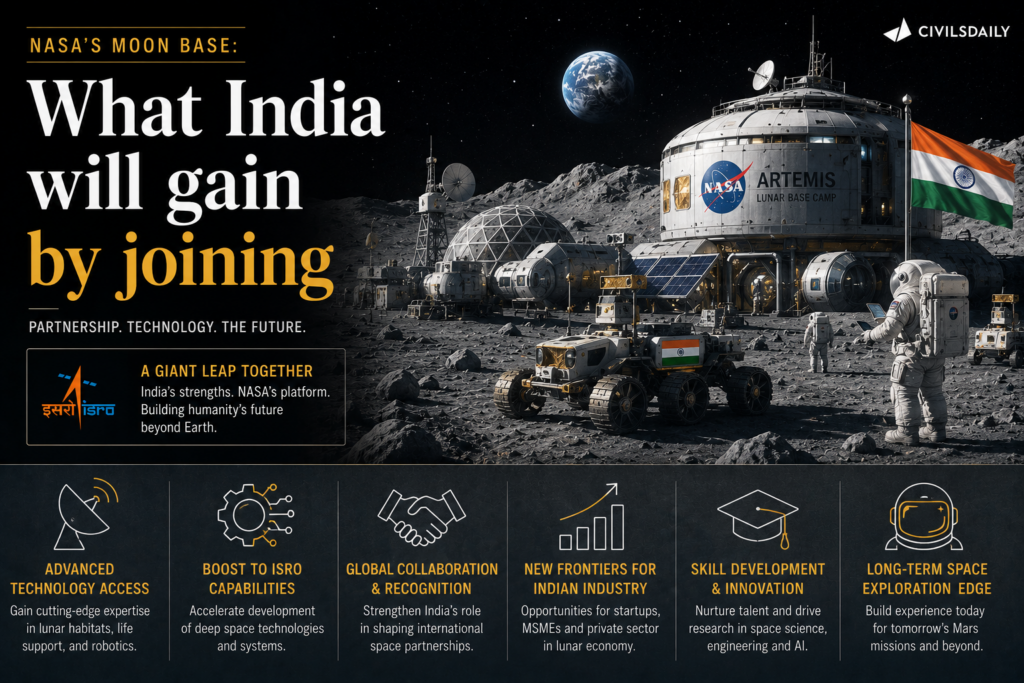
Why in the News
The National Aeronautics and Space Administration (NASA) has invited the Indian Space Research Organisation (ISRO) to join its Moon Base programme, a permanent crewed research station to be built on the Moon in stages. The invitation forces a choice between building an independent human spaceflight, space station and lunar landing capability at national cost, and acquiring the same capability faster inside a programme the United States leads. India signed the Artemis Accords in 2023 as the 27th nation, so the diplomatic ground for joining is already laid.
What is the NASA Moon Base programme?
- What it is: A permanent research station on the lunar surface that astronauts and robots can inhabit for prolonged periods.
- What it is for: It is meant to facilitate research and to allow exploration and exploitation of lunar resources.
- How it is built: The base is assembled in stages over several years, requiring repeated crewed and robotic trips to the Moon.
- Its scale: In scale and ambition it compares only with the Apollo missions, and it could be the costliest scientific project ever undertaken.
- Its engineering claim: It will possibly be the most challenging engineering exercise ever attempted by humanity.
- Its delivery model: NASA will not execute it alone and is seeking partners in both the international community and private industry.
What is the Bharat Antariksh Station?
- What it is: India’s planned indigenous space station, to be built and operated by ISRO as a crewed orbital facility.
- Why it is cited here: ISRO must hold the technology to build such infrastructure, and India is unlikely within about a decade to have a scientific ecosystem needing an entire station for its own use all year round.
What is the lunar South Pole?
- What it is: The polar region of the Moon holding permanently shadowed craters where water ice is expected to survive.
- Why it is the target: Phase One of the Moon Base programme sends robotic missions specifically to the South Pole, because water ice can be converted into drinking water, breathable oxygen and rocket propellant.
What are interoperable systems?
- What they are: Common standards and hardware interfaces that let equipment built by different countries connect and work together in space.
- What the Accords require: Signatories emphasise interoperability in fuel storage, landing structures, communications systems and power systems, which is a light obligation for ISRO because it is only beginning to develop these systems.
What is deglobalisation?
- What it is: The retreat from shared international supply chains towards national self reliance in a strategic technology.
- Where it currently applies: Semiconductors, clean energy and artificial intelligence, where supply chains and resources are controlled by a small set of actors.
What are the three phases of the Moon Base programme?
- Phase One, now to 2029: Focus on gaining reliable access to the lunar surface and building a deeper understanding of the environment.
- Phase One activity: Robotic missions will explore the lunar South Pole, demonstrate new technologies and gather the knowledge needed to guide future development.
- Phase Two, 2029 to 2032: NASA will begin deploying the first infrastructure needed to support long term operations on the Moon.
- Phase Two systems: Early power systems, cargo transportation, logistics and communications capabilities will expand the human footprint and enable increasingly complex missions.
- Phase Three, 2032 and beyond: NASA will begin assembling a permanent lunar outpost where astronauts can live and work for extended periods.
- Phase Three systems: Habitats, power systems, communications, transportation and other critical capabilities will support an enduring human presence.
Why is NASA seeking partners instead of building the base alone?
- Budget compression: NASA’s budget has been cut significantly under the current US administration, so a solo build is not affordable.
- Shift of manufacturing: Most of NASA’s hardware production now happens in the private sector rather than in house.
- Two partner pools: It is seeking collaboration both from the international community and from private industry.
- A ready pool of states: The 70 countries that signed the Artemis Accords have already signalled a willingness to join such a collaboration.
- Cost of the mission profile: Repeated crewed and robotic trips to the Moon over several years put the cost beyond a single agency’s programme line.
- Precedent: The International Space Station established that a permanent crewed facility is built and run as shared infrastructure, not as one nation’s asset.
Why can ISRO not sustain its lunar and station ambitions on its own?
- Three simultaneous programmes: ISRO is running an independent human spaceflight programme, a Moon landing programme and a full fledged space station programme in parallel.
- Capability against sustainability: Holding these capabilities is important, and running them sustainably on India’s own scientific and economic base is a separate question.
- The demand problem: India is unlikely, within about a decade, to have a scientific ecosystem hungry enough to occupy an entire space station all year round.
- The cost of lunar exploration: A separate full fledged lunar exploration programme carries costs that are prohibitive even for the world’s richest economy.
- Competing national goals: India is chasing multiple parallel goals on the path to prosperity, which limits how much can be allocated to space at the scale required.
- The shared infrastructure conclusion: The Bharat Antariksh Station will have to be shared infrastructure on the model of the International Space Station.
What does ISRO gain by joining the Moon Base programme?
- Mission management experience: Participation gives ISRO experience in planning and executing complex missions of exactly the type it intends to run itself.
- Technology leapfrog: It allows ISRO to skip development stages rather than rebuild capability that already exists elsewhere.
- The obsolescence clock: Space exploration has reached a stage where a 10 year gap in technology development can leave a nation well behind.
- Avoiding duplication: There is no economic sense in reinventing capability that a partner already holds.
- Timeline compression: Cooperation with the United States lets ISRO fast track its own project timelines and reach the frontiers of technology development.
- Spin off benefits: The collaboration can generate spin off technologies with cascading dividends across sectors beyond space.
- No exclusivity cost: Signing the Accords or joining the Moon Base effort does not prevent India from continuing its long standing space cooperation with Russia.
What do the positions of other space powers reveal about the Accords?
- Japan: A signatory and a major space faring nation, contributing habitation and pressurised rover work to the Artemis effort.
- South Korea: A signatory that has built an independent lunar capability, having placed the Danuri orbiter around the Moon in 2022.
- Israel: A signatory whose Beresheet lander attempt in 2019 made it one of the few states to have reached lunar orbit.
- European states: Several are signatories, and the European Space Agency separately supplies the service module for NASA’s Orion crew vehicle.
- Russia: Not a signatory, and it is attempting a comparable lunar effort through its own partnership.
- China: Not a signatory, and it is pursuing the same objective with Russia rather than through the Accords.
- What the split demonstrates: The absence of the two other major space powers is what gives the criticism of a US led camp its credibility.
Are the Artemis Accords a US led bloc that bypasses multilateral arrangements?
- The formal position: The Accords are a set of principles and good practices that countries agree to follow in their space activities.
- The criticism: They are increasingly seen as a US led camp writing its own rules for space exploration and the use of extraterrestrial resources, subtly bypassing international multilateral arrangements.
- What lends the criticism weight: Russia and China, the two other major space powers, are outside the grouping.
- India’s historical reluctance: India has traditionally been extremely reluctant to join any such grouping, and it still joined as an early signatory, the 27th nation, in 2023.
- The counter argument, no exclusion: Space is not adversarial at present, and a US landing on the Moon does not give it control over the area or its resources.
- The counter argument, no scarcity: The Moon is large enough and its resources abundant enough to support the efforts of all parties in the foreseeable future.
- The counter argument, no supply chain lock: There is no domination of supply chains or control over resources in space, so the deglobalisation trend seen in semiconductors, clean energy and artificial intelligence does not transfer to this case.
- The residual risk: The real exposure is technological, not geopolitical, and it is the possibility of ISRO getting locked into the US technology ecosystem to the extent of overdependence.
Challenges to India joining the Moon Base programme
- Technology ecosystem overdependence: Deep integration with one partner’s standards makes later substitution expensive. e.g. India’s dependence on Russian cryogenic engine technology in the 1990s stalled the GSLV programme for over a decade after the Missile Technology Control Regime pressure on the transfer.
- Programme discipline slipping: Collaboration can crowd out ISRO’s own milestones if targets are not separately protected. e.g. the Gaganyaan crewed flight has already moved from its original 2022 target to the later part of this decade.
- Export control friction: Dual use hardware transfers remain governed by US licensing that can be withheld. e.g. International Traffic in Arms Regulations clearances have historically delayed satellite component supplies to Indian entities.
- Budget asymmetry: India’s civil space spending is a small fraction of NASA’s, which limits its bargaining position on workshare. e.g. the Department of Space’s annual budget is of the order of Rs 13,000 crore against a NASA budget many times larger.
- Launch reliability: A partner role demands schedule certainty that India’s recent launch record does not yet demonstrate. e.g. three of the six ISRO missions in 2025 and 2026 failed to place satellites in the intended orbits.
- Balancing the Russia relationship: Deeper alignment with the Accords sits alongside a long standing space partnership that must be maintained separately. e.g. Russian support for the crew module and life support work under the Gaganyaan programme, including astronaut training at the Gagarin Cosmonaut Training Centre.
- Unsettled resource law: The Accords permit extraction and use of space resources, and that reading of the Outer Space Treaty is contested. e.g. the Moon Agreement of 1979 treats lunar resources as the common heritage of mankind and has been ratified by very few states.
- Volatile bilateral politics: The India United States relationship has been unstable in the last two years, which is a risk for a multi decade commitment. e.g. trade and tariff disputes running alongside this civil space engagement.
Conclusion
The Moon Base invitation converts an abstract question about strategic autonomy into a concrete question about economic sustainability. India can build the technology for a station and a lunar landing on its own, and it is unlikely to be able to run either sustainably at national scale, which is why joining offers a genuine leapfrog rather than a compromise. The condition that must hold is that ISRO protects its own targets and avoids locking itself into a single technology ecosystem while it collaborates.
“[2025] Consider the following space missions:
I. Axiom-4
II. SpaDeX
III. Gaganyaan
How many of the space missions given above encourage and support microgravity research?
(a) Only one
(b) Only two
(c) All the three
(d) None
