Why in the News
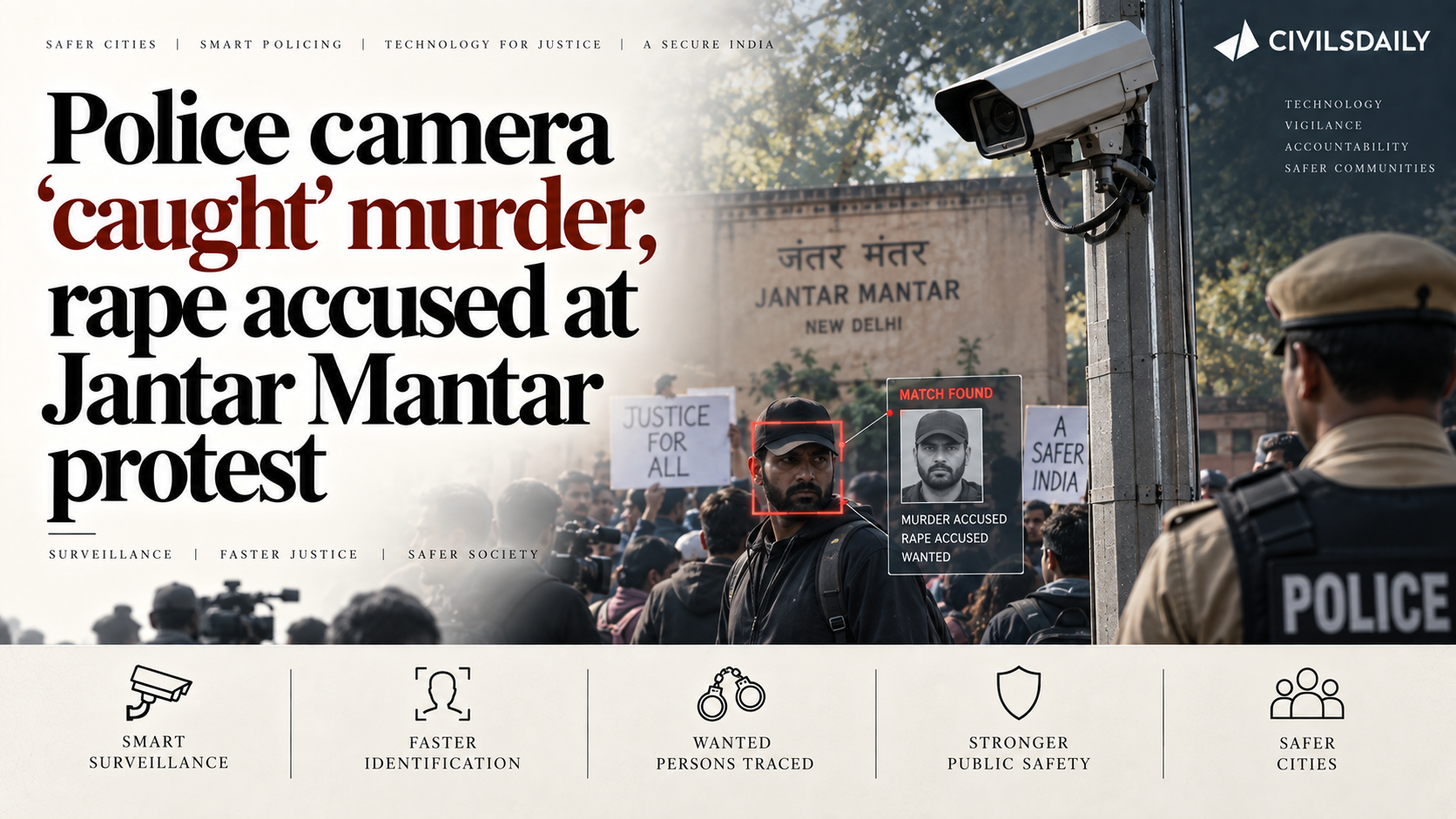
The Delhi Police has told the Supreme Court that its Facial Recognition System (FRS) spotted 2,873 people with criminal antecedents at the main protest site at Jantar Mantar between 20 and 26 July. The submission follows a Supreme Court order quashing every First Information Report (FIR) arising from the exam leak student protests.
What is the Delhi Police’s Facial Recognition System?
- What the software does: It places boxes around faces detected in a camera feed and compares them against images held in police databases.
- The threshold for a positive match: A match is treated as positive at an accuracy rate of 80 per cent, a figure the force disclosed in a 2022 reply under the Right to Information (RTI) Act, 2005.
- What it searches against: Of the 2,873 flags, 2,402 were attributed to Crime Kundli, the force’s own biometric database, and 471 to criminal records.
- What the output is not: A match is not by itself proof of identity, and performance varies with the algorithm, camera angle, lighting, image quality, masks and the database being searched.
What does the offence-wise breakdown in the affidavit show?
- The residual category is the largest by far: 1,884 of the 2,873, close to two thirds, sit under other Indian Penal Code, Bharatiya Nyaya Sanhita and special law entries rather than under any named serious offence.
- The legal status of those flagged is unstated: The affidavit does not specify whether the people identified were accused, convicts, or merely named in criminal cases.
- The database is claimed to hold only serious offenders: The affidavit states that the face and other material of only those accused facing serious offences are in the police record, and not those facing petty offences such as traffic violations.
- The geographic concentration: The North district recorded the highest count at 285, followed by Outer at 257, North West at 256, North East at 174, East at 173 and South West at 166. Railways, Crime Branch, IGI Airport, Metro and the Special Cell were among the other units listed.
What did the record check of 205 flagged individuals find?
- The sample examined: The 205 comprised 101 murder accused, 61 rape accused, 6 accused under the Protection of Children from Sexual Offences (POCSO) Act, 2012, and 37 of the 62 listed under attempt to murder.
- The finding: At least 25 of them were lodged in the Tihar, Mandoli or Rohini prison complexes at the time the system flagged them, according to police, jail and court records.
- The composition of the 25: 17 were accused in murder cases, 4 in rape cases of which 3 were under the POCSO Act, and 4 in attempt to murder cases.
- The dates of the flags: Three of the 25 were identified on 24 July, 21 on 25 July and one on 26 July, the final day of the protest.
Why does the police assurance not settle the question?
- Verification is the only safeguard on record: The stated position is that action follows only after field verification establishes that the person was in fact present at the site, and no verification standard, timeline or reporting duty accompanies that assurance.
- Verification is still pending at scale: The force has stated that further verification of the identified individuals is pending, which leaves 2,873 names on a list that a court has already permitted the government to act on.
- The accuracy threshold is an internal setting, not a legal standard: An 80 per cent match is a configuration choice inside the software, and no statute, rule or judicial direction fixes what confidence level may be relied on before a person is named.
- The error is not random noise: People held in custody were placed at a protest site by the system, which points to database and matching failure rather than to a borderline image.
Challenges to facial recognition in policing
- No statutory basis governs deployment: India has no law authorising or limiting police use of facial recognition, so procurement, matching thresholds and retention are set administratively. Eg. The Delhi Police’s 80 per cent threshold became public only through a Right to Information reply, not through a published rule.
The Fix: Require prior legislative authorisation and a published operating standard for any biometric identification system before it is deployed in a public space. - Accuracy falls sharply for some groups: Error rates in facial recognition are higher for darker skin tones, women and younger faces, so the burden of a false match is not evenly spread. Eg. The United States National Institute of Standards and Technology’s evaluation of commercial algorithms recorded higher false positive rates across demographic groups.
The Fix: Mandate a published demographic error audit of the deployed algorithm before each operational use, with results filed with the sanctioning authority. - The system was built for one purpose and used for another: A database assembled to trace missing persons or match crime scene images becomes a crowd screening tool without any fresh authorisation. Eg. The Delhi Police’s facial recognition capability was originally acquired for tracing missing children.
The Fix: Attach a statutory purpose limitation to each biometric database, so any new use requires a separate written sanction that is placed on record. - Surveillance at a protest changes who turns up: Recording and matching faces at an assembly deters lawful participation independently of any action that follows. Eg. Cameras mounted on police vans at the Jantar Mantar site were visible to those attending.
The Fix: Bar identification of participants at a lawful assembly except on a written order naming a specific cognisable offence under investigation. - There is no route to contest a match: A person flagged by the system is not told, so the error surfaces only if a journalist or a court checks the records. Eg. The 25 custodial mismatches came to light through a newspaper’s record check, not through any internal review.
The Fix: Require written notice to every individual against whom a biometric match is acted on, with a stated procedure to seek correction of the underlying record.
Conclusion
A facial match is being treated as a sufficient basis to proceed against a named list, while the force’s own position is that a match establishes nothing on its own. Both cannot hold at once. Nothing on record fixes what field verification must consist of, who performs it, or who checks that it happened. The point to watch is whether the Court requires the verification outcome for each flagged individual to be filed before any action follows.
[2024] Under which of the following Articles of the Constitution of India, has the Supreme Court of India placed the Right to Privacy?
(a) Article 15
(b) Article 16
(c) Article 19
(d) Article 21
