Why in the News
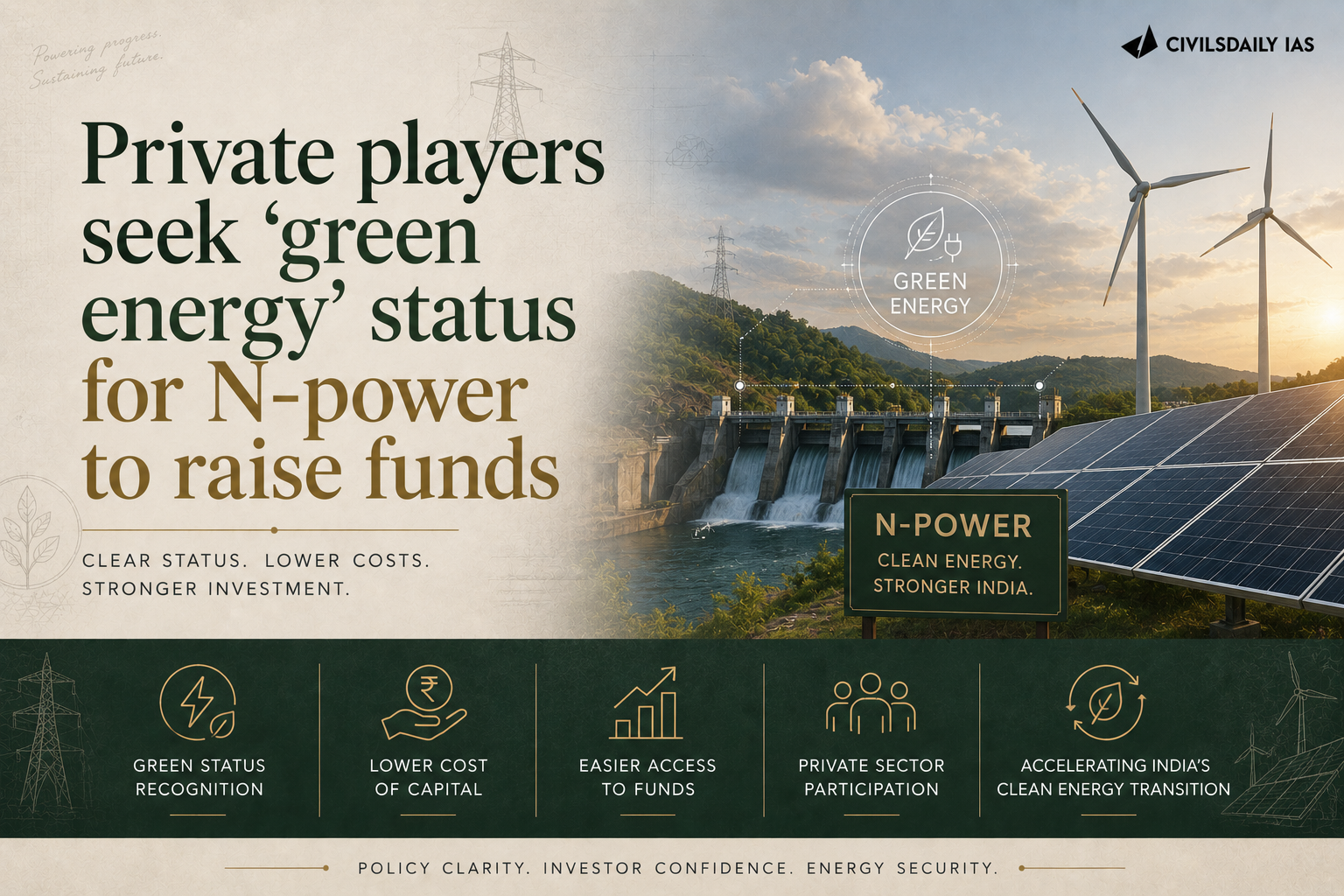
Private players have sought green energy status for nuclear power so that nuclear projects can access green bonds, green loans and blended financing. The demand was made at a stakeholder consultation held by NITI Aayog, attended by around 150 participants from 60 organisations. India opened its tightly regulated civil nuclear sector to private participation last year and targets 100 gigawatt electric (GWe) of nuclear capacity by 2047, a target that needs at least $228 billion of investment. The instruments that supply the cheapest climate capital are closed to the technology, because the Ministry of Finance’s Sovereign Green Bond Framework does not include nuclear energy.
What are India’s green finance frameworks?
- Sovereign Green Bond Framework: Maintained by the Ministry of Finance, it defines which project categories the proceeds of a sovereign green bond may be applied to, and nuclear energy is not among them.
- RBI framework for green deposits: It sets the conditions under which a bank or deposit taking institution may raise and deploy deposits labelled green.
- SEBI framework for green debt securities: It governs disclosure and use of proceeds for green bonds issued in the Indian securities market.
Why do private players want nuclear classified as green energy?
- Access to a cheaper pool of capital: Green status would open green bonds, green loans and blended financing schemes to nuclear projects, which is the specific relief sought.
- The three frameworks are the gatekeepers: Industry participants asked for a review of all three, because exclusion from any one of them closes a distinct funding channel.
- The multilateral position is already moving: The World Bank and the Asian Development Bank are reviewing their own restrictions on nuclear investments, which is the precedent cited for a domestic review.
What is the infrastructure status demand, and where does it stand?
- The demand: Private players separately suggested that nuclear power projects be accorded infrastructure status.
- The official reading: In NITI Aayog’s view nuclear power is already covered under the infrastructure framework, because the Harmonised Master List of Infrastructure Sub-sectors maintained by the Department of Economic Affairs includes electricity generation.
- What is actually being asked for: The gap is one of certainty rather than of category, and a clarification in this regard may be needed.
What else must fall into place for the 100 GWe target?
- The rules are not final: The final rules under the SHANTI Act, the statute governing the opening of the sector, are likely to be ready in the next two to three months, with stakeholder consultations on the draft rules currently underway.
- Project timelines: The gestation period of nuclear power projects in India needs to be reduced if capacity is to be added at the pace the target implies.
- Site selection is a binding constraint: Identifying sites will be a major challenge as capacity scales, and site selection committees are working with the States.
- Fuel security beyond uranium: Thorium based technologies need to be developed to strengthen India’s long term energy security.
Challenges to green energy status for nuclear power
- Taxonomies elsewhere have attached conditions rather than granting blanket inclusion: Where nuclear has been admitted to a green classification, it has come with waste and safety conditions that projects must meet continuously. Eg. The European Union’s taxonomy admitted nuclear only as a transitional activity with disposal facility and accident tolerant fuel conditions.
The Fix: Draft any Indian inclusion as a conditional category tied to disclosed waste management and decommissioning provisioning, so the label survives investor scrutiny. - Green bond investors price on verifiability, not on carbon content alone: A large share of green mandates screen out nuclear by policy, so a taxonomy change does not by itself create demand. Eg. Several sovereign and pension fund mandates exclude nuclear on exclusion lists set independently of national taxonomies.
The Fix: Pair inclusion with a certified external review of use of proceeds, so a nuclear tranche can be assessed on the same evidence as a renewable one. - Liability exposure sits ahead of the financing question: Supplier liability under India’s civil nuclear liability law has deterred private and foreign participation for over a decade. Eg. The Civil Liability for Nuclear Damage Act, 2010 gives the operator a right of recourse against the supplier, which foreign vendors have cited as a barrier.
The Fix: Settle the recourse position by statute or by a capped insurance pool before private capital is asked to price a project. - Long gestation makes debt tenors mismatch: Nuclear construction periods run well beyond the tenor of most Indian debt instruments, so refinancing risk sits with the developer. Eg. Domestic bank lending to power projects is typically structured over tenors far shorter than a nuclear build cycle.
The Fix: Create a dedicated long tenor refinancing window for nuclear projects, on the model used for other long gestation infrastructure. - Public acceptance decides sites, not policy: Land acquisition and local consent have delayed nuclear sites regardless of the financing available. Eg. Protests at Kudankulam in Tamil Nadu delayed commissioning of the plant by years.
The Fix: Build a statutory local benefit sharing entitlement into site notification, so host districts hold a stake before construction begins.
Conclusion
The nuclear expansion has moved past the question of whether private capital is allowed in and reached the question of what that capital will cost. A taxonomy is the cheapest lever the government holds, because reclassification requires no new outlay and changes the interest rate on every subsequent rupee borrowed. Two decision points are dated and worth watching: the final rules under the SHANTI Act in the next two to three months, and whether the Ministry of Finance, the RBI and SEBI open their frameworks for review together or separately.
Back2Basics: Harmonised Master List of Infrastructure Sub-sectors
- What it is: A list maintained by the Department of Economic Affairs in the Ministry of Finance that defines which activities count as infrastructure for policy purposes.
- Why the label matters: Inclusion gives a project access to infrastructure lending norms, longer tenor bank finance and easier external commercial borrowing.
- How it is organised: Activities are grouped under broad categories such as transport, energy, water and sanitation, communication and social and commercial infrastructure.
- How it changes: An institutional mechanism under the Department of Economic Affairs reviews and updates the list, with electricity generation already among the listed sub sectors.
[2018, GS3, 15 marks] With growing energy needs should India keep on expanding its nuclear energy programme? Discuss the facts and fears associated with nuclear energy.”
