Why in the News
The Union Home Minister used the Southern Zonal Council meeting at Mamallapuram to press for early resolution of water sharing disputes in the southern region, and to propose linking major rivers from the Brahmaputra to the Godavari and the Cauvery.
Why does the Pennaiyar case undercut the promise of early resolution?
- The grievance: Tamil Nadu is aggrieved over what it terms a violation of the 1892 inter State agreement by Karnataka.
- The request and the parallel litigation: Tamil Nadu asked the Centre in November 2019 to establish a tribunal. It also moved the Supreme Court with the same demand.
- Negotiation without settlement: Two negotiation committees have been formed since then and 11 meetings have been held.
- A court direction, then an extension: The Supreme Court in February directed the Centre to form the tribunal within a month, and later extended the deadline by six months. The adjudicatory body is still not in place.
- The referral suggestion: The Centre asked the court whether the Pennaiyar dispute could be referred to the Mahadayi Water Disputes Tribunal instead of constituting a new one, although there is nothing in common between the two disputes.
- The statute does not allow it: The Interstate River Water Disputes Act, 1956 does not permit such a referral.
- A second unanswered demand: The Central government has not replied to Tamil Nadu’s demand, made in March this year, for a tribunal on the Mekedatu dam project proposed by Karnataka.
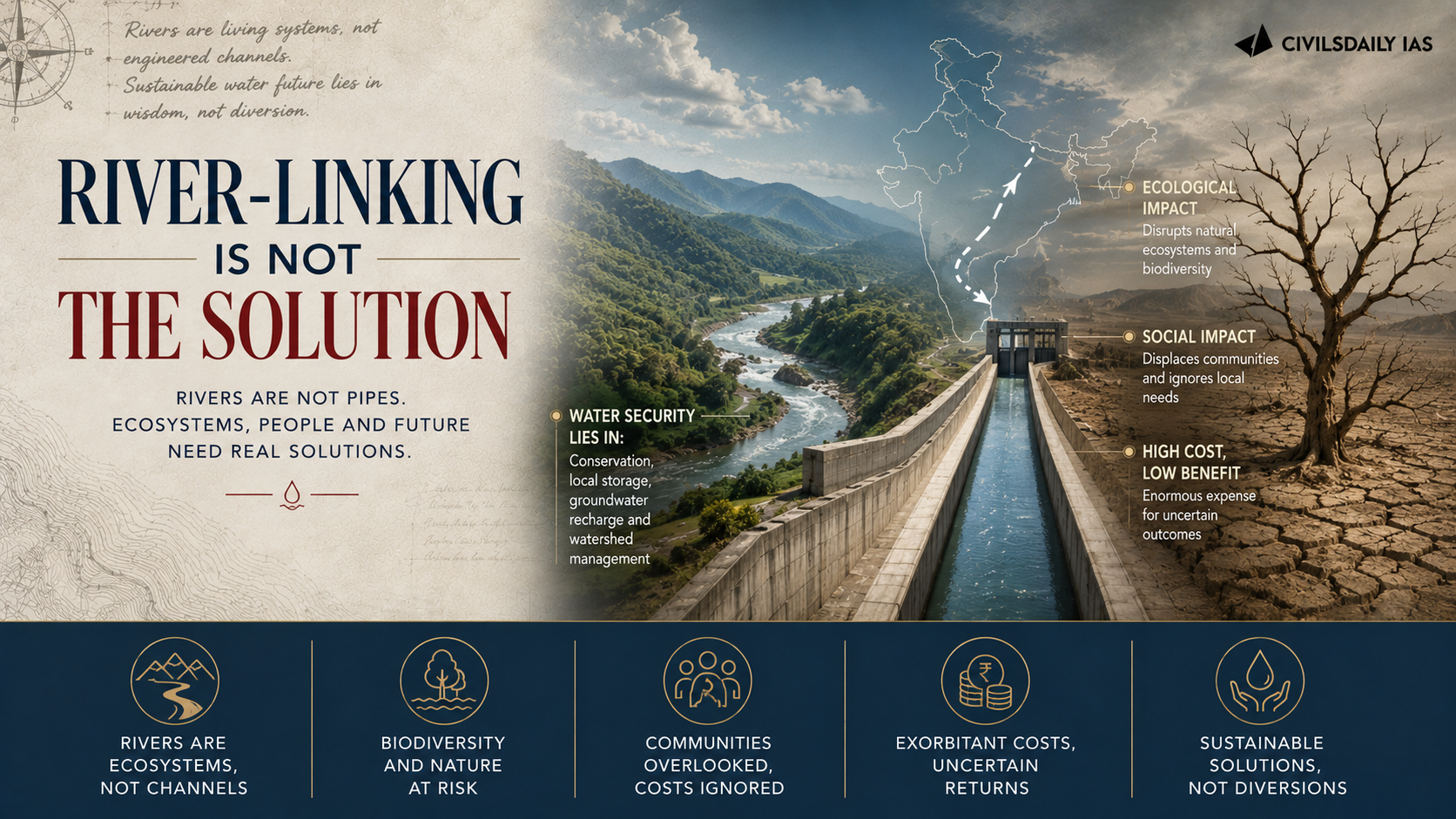
What are the objections to inter-linking?
- The proponents’ claim: Supporters of river linking, Tamil Nadu among them, hold that the intent is not to disturb the natural flow of any river but to divert a portion of surplus water.
- The claim on surplus is disputed: Many experts are not convinced, and expect that once linking is allowed, benefiting regions will demand water even in times of distress.
- The original beneficiary loses: That escalation would eventually deprive the original beneficiaries of their quota, which converts a transfer of surplus into a redistribution of entitlement.
- The ecological objection: Kerala has stoutly opposed the Pamba-Achankovil-Vaippar link proposal, on the ground that it will affect the Vembanad wetland system, into which the Pamba and Achankovil rivers drain.
- The agency’s answer: The National Water Development Agency, the central body that prepares feasibility studies for inter-basin transfer links, says it has accounted for improving the flow of rivers in lean periods.
What is the record of inter-basin transfer in India?
- A thin record over 130 years: In the last 130 odd years the country has seen only a handful of inter-basin transfer projects, most of them in south India.
- The projects treated as successes: The Mullaperiyar dam, the Parambikulam-Aliyar project, the Krishna Water Supply Project and the Indira Gandhi Canal Project are regarded as successful examples of inter-basin transfer.
- An institution without output: A Special Committee for Interlinking of Rivers was formed after 2014 and has held over two dozen meetings, without much headway.
- The one project that moved: The foundation stone for the ₹44,000 crore Ken-Betwa Link Project was laid in 2024.
- Its social cost surfaced immediately: That project has led to agitations by tribal populations in Chhatarpur.
Why is supply side expansion reaching its limit?
- Land is the binding constraint: Land is becoming scarcely available for projects of this size.
- Acquisition faces organised resistance: Resistance among people is growing when it comes to land acquisition.
- The consequence for project design: The days of implementing mega irrigation projects are almost over, which removes the delivery route the linking proposal depends on.
What does demand side management require?
- A shift in the object of policy: Governments at the Centre and in the States, and civil society, need to focus on demand side management instead of perpetually seeking supply side interventions.
- Conservation as the priority: The priority has to be conserving what is available and using it judiciously.
- A programme aimed at the farmer: A massive programme of sensitising and incentivising farmers on the optimal use of water has to be launched.
- The subsidy that drives extraction: Indiscriminate extraction of groundwater, facilitated by free electricity for agriculture in many States, is paving the way for ecological disaster and has to be curbed immediately.
Challenges to inter-basin water transfer proposals
- Surplus is asserted rather than measured: A basin is declared surplus on hydrological series that predate current withdrawal and cropping intensity, so the transferable volume is an estimate that has never been revalidated. Eg. Peninsular link proposals rest on assessments framed decades before present groundwater draft in the same basins.
The Fix: Publish a revalidated basin water budget, with the assessment year stated, before any link component is taken up for investment approval. - Himalayan links depend on flows that originate outside India: A transfer scheme drawing on the Brahmaputra is exposed to upstream storage decisions India has no treaty right to see. Eg. The Brahmaputra enters India as the Yarlung Tsangpo after a long course through Tibet.
The Fix: Make a binding upstream flow data arrangement a stated precondition before any Himalayan component of a national grid is sanctioned. - Transferred water carries a permanent energy bill: Peninsular links must lift water across watersheds, so the delivered cost includes pumping power for the life of the project. Eg. Moving water across the Eastern Ghats requires sustained lift rather than gravity flow.
The Fix: Price transferred water at its delivered cost including pumping energy, so the recipient command area faces the real cost of the supply. - Alignments run through forest and protected areas: Canal alignment and submergence take the least contested land, which in practice is forest and reserve land rather than settled farmland. Eg. The Ken-Betwa link submerges part of the Panna Tiger Reserve.
The Fix: Require a no alternative alignment finding, tested against a published route comparison, before submergence inside a protected area is cleared. - New supply changes cropping and returns the shortage: A command area that receives assured water shifts to water intensive crops, so demand rises to meet the new supply within a decade. Eg. Long canal commands in western India moved to paddy and sugarcane and developed waterlogging and salinity.
The Fix: Tie the release of transferred water to a notified crop plan and volumetric delivery through water user associations rather than to area based supply.
Conclusion
India is being offered more supply while the reason for the shortage stays untouched. A grid that moves water between basins does not change how the water is used once it arrives. The immediate decision point is the Pennaiyar tribunal, still unconstituted after a court set deadline and an extension of it. Free farm power, and the groundwater extraction it underwrites, is the variable that will decide whether any new transfer capacity is absorbed or simply exhausted.
Water Resources Management in India
- About: Water resources management covers the planning, development and management of water quantity and quality across every use, along with the institutions, infrastructure, incentives and information systems that guide it.
- The hydrological imbalance: India has an effective rainfall period of 28 to 29 days in a year, so most annual flow arrives in a short window and has to be stored or lost.
- Agriculture dominates demand: Agriculture accounts for around 89 per cent of groundwater extraction.
- The institutional home: The Ministry of Jal Shakti was formed in 2019 by integrating two earlier water related ministries.
Constitutional Framework Governing Water Resources Management
- Entry 17, State List: Places water supply, irrigation, canals, drainage, embankments and storage with the States, subject to Entry 56.
- Entry 56, Union List: Allows Parliament to regulate inter State rivers and river valleys where it declares such regulation to be in the public interest.
- Article 262: Empowers Parliament to provide for adjudication of inter State river water disputes, and to bar the jurisdiction of the courts including the Supreme Court over them.
Laws and Rules Governing Water Resources Management
- Interstate River Water Disputes Act, 1956: Provides for the constitution of a tribunal when a State’s request for adjudication cannot be settled by negotiation.
- The 2002 amendment: Fixed a one year limit for constituting a tribunal and a three year limit for the award.
- River Boards Act, 1956: Enables the Centre to set up river boards to advise on the regulation and development of an inter State river. No board has been constituted under it.
- Dam Safety Act, 2021: Establishes national and State level authorities for the surveillance, inspection and maintenance of specified dams.
Government Initiatives for Water Resources Management
- Atal Bhujal Yojana: Launched in 2019 to improve groundwater management in selected States through community participation.
- Pradhan Mantri Krishi Sinchayee Yojana: Expands assured irrigation coverage and promotes micro irrigation under the Per Drop More Crop component.
- National Water Mission: Targets integrated water resource management and a 20 per cent improvement in water use efficiency, with the Bureau of Water Use Efficiency set up under it in 2022.
Challenges in Water Resources Management
- Groundwater is extracted faster than it recharges: Assessment blocks in the north west and the south are classified as over exploited, which means annual draft exceeds annual recharge. Eg. Central Ground Water Board assessments place large parts of Punjab, Haryana and Rajasthan in that category.
The Fix: Extend community level water budgeting with metered abstraction, so a village sees its own draft against its own recharge each season. - Cropping patterns ignore local water availability: Crop choice follows assured procurement and price, not the water the region actually has. Eg. Sugarcane in Marathwada consumes a disproportionate share of a chronically drought affected region’s irrigation water.
The Fix: Link procurement or price support for water intensive crops to verified micro irrigation adoption on the same holding. - Irrigation charges recover a fraction of the cost: Water charged below the cost of delivering it removes any incentive to use less of it. Eg. Canal water rates in most States do not cover the operation and maintenance cost of the system supplying it.
The Fix: Move to volumetric supply at the outlet, billed through water user associations rather than assessed on irrigated area. - Basin data is incomplete and not shared: Allocation disputes are argued over rival estimates because no agreed real time record of flows exists. Eg. Rival State claims in southern river disputes rest on differing assessments of the same basin’s yield.
The Fix: Make real time gauge and groundwater data on one national platform the sole admissible basis for allocation claims.
Matching Previous Year Question
“[2017, GS3, 10 marks] Not many years ago, river linking was a concept but it is becoming reality in the country. Discuss the advantages of river linking and its possible impact on the environment.”
