Why in the News
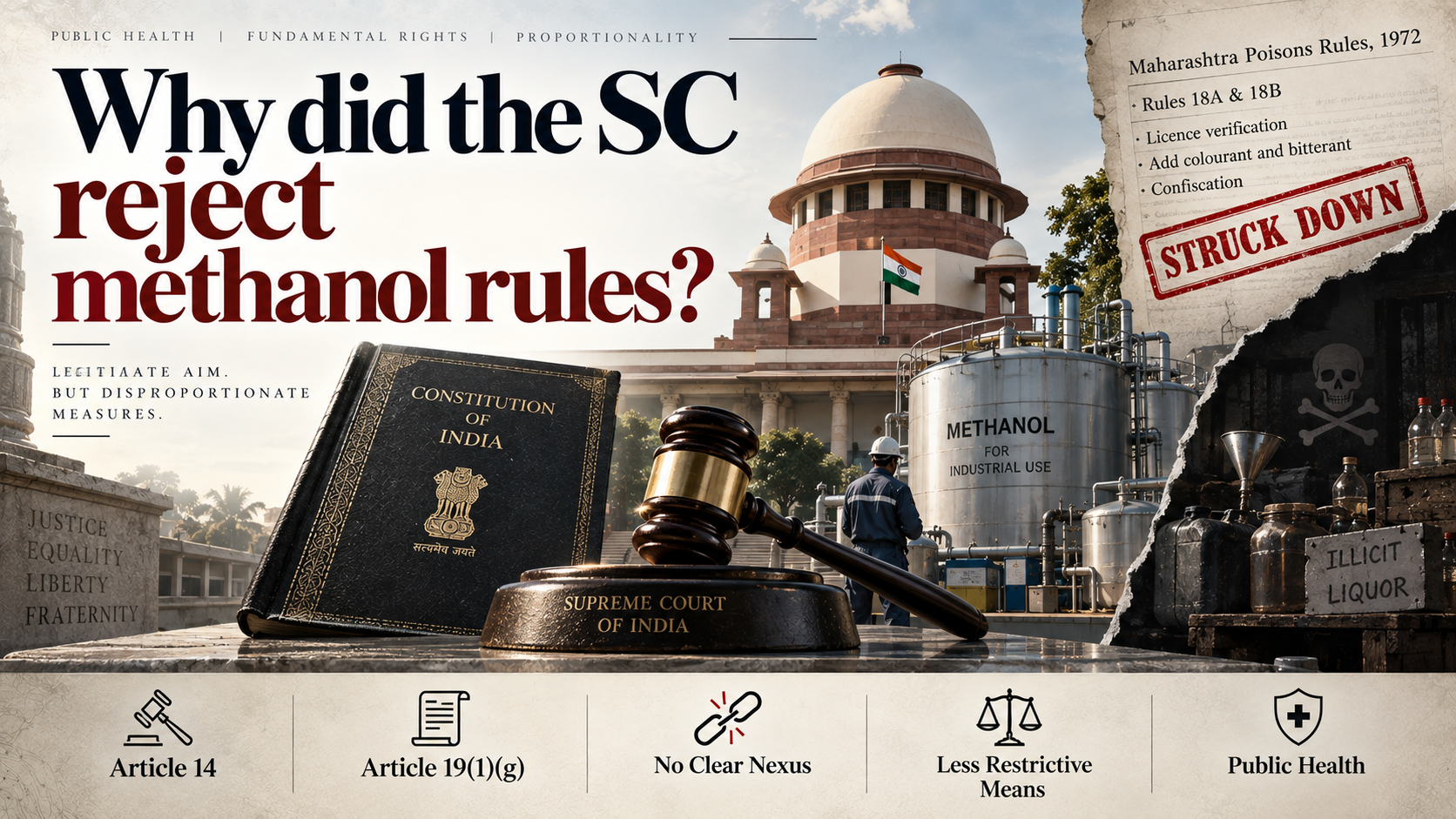
The Supreme Court has struck down Maharashtra government rules requiring methanol to be denatured with a colourant and a bitterant before sale to non drug manufacturers. A Bench including Justices J.B. Pardiwala and K. Vinod Chandran held the measures disproportionate and lacking sufficient connection with the problem they sought to address, and allowed the writ petitions filed by methanol based product manufacturers. The rules struck down are Rules 18A and 18B of the Maharashtra Poisons Rules, 1972, introduced by a 2011 amendment after a 1991 hooch tragedy in Mumbai in which around 93 people died after consuming spurious liquor containing methanol. The tension is that the State’s regulatory power over poisons was upheld while the specific measure was voided, because the misuse the rules target happens in the unregulated field and the burden of the rules falls entirely on licensed industry.
What did Rules 18A and 18B require?
- Rule 18A(1), licence verification: It required verification of a purchaser’s Form A licence before methanol could be sold.
- Rule 18A(2), mandatory additives: It required methanol sold to non drug manufacturers to be mixed with a colourant and a bitterant, so the substance would be identifiable and unpalatable.
- Rule 18B, confiscation: Any possession of methanol without a Form A licence was made liable to confiscation.
- The statutory source: The rules were framed under the Poisons Act, 1919, which permits State governments to make rules regulating the possession and sale of poisons.
Why were these controls introduced in the first place?
- The triggering tragedy: Maharashtra tightened controls on methanol after the 1991 Mumbai hooch tragedy, in which around 93 people died from spurious liquor containing methanol.
- The inquiry: A committee headed by the then Additional Director General of Police P.R. Parthasarthy was constituted to examine the causes of the tragedy and suggest measures.
- The amendment: In 2011, Maharashtra amended its Poisons Rules and introduced Rules 18A and 18B.
- The dual character of the chemical: Methanol, or methyl alcohol, is a highly toxic substance and is also a widely used industrial raw material in products including formaldehyde, paraformaldehyde, paints and resins, which is why a blanket ban was never the option on the table.
What did the two sides argue?
- The manufacturers on product integrity: Companies told the Court that colour contamination could make products unacceptable to the paint and pharmaceutical industries.
- The manufacturers on technical effect: They argued that the additives could affect catalysts and laboratory and pharmaceutical applications, so the denaturing damages legitimate use rather than merely marking the substance.
- The State on lethality: The State argued that the rules were necessary because methanol could be mixed with liquor and cause fatal poisoning.
- The State on deterrence by design: It argued that making methanol identifiable and bitter would itself help prevent misuse, so the additive was a preventive rather than a punitive measure.
On what reasoning did the Court strike each rule down?
- The constitutional question: The central question was whether Rules 18A and 18B violated Article 14, whose basic tenet is fairness in action and non arbitrariness, and Article 19(1)(g), which protects the right to carry on an occupation, trade or business.
- Rule 18A(1) fails on fit: The Court held that merely verifying a Form A licence did not establish how the purchaser would use methanol, so the restriction on legitimate industrial users was disproportionate.
- Rule 18A(2) fails on nexus: The Court held the additive requirement had no reasonable and proximate nexus with preventing the misuse of methanol in illicit liquor, and that the State failed to show the additives would prevent diversion or the manufacture of spurious liquor.
- The Court’s own formulation: It observed that the rules prescribe a framework that “does not prevent the misuse of methanol in liquor which takes place in the unregulated field”, and that even in the best case of full compliance the sub rule cannot prevent the misuse it aims at.
- Rule 18B fails on internal contradiction: Confiscation for possession without a Form A licence could conflict with lawful possession under a Form B permit and effectively render that permit redundant, so it too failed the proportionality test.
- The framework applied: Applying the proportionality framework laid down in K.S. Puttaswamy v. Union of India (2017), the Court held that preventing loss of life from methanol adulterated liquor is a legitimate aim, while the restrictions were neither suitable nor necessary to achieve it.
- The governing principle recorded: The Court noted that a policy which is irrational, lacks rational justification, or violates any constitutional, statutory or other provision of law is liable to be struck down.
What did the Court direct States to do instead?
- Enforcement across departments: States should work together through the prohibition, excise, police, transport, industries and health departments, along with non governmental organisations, to prevent illegal liquor.
- Where enforcement should sit: This includes checking State borders, stopping illegal transport, identifying places where illicit liquor is made or stored, and monitoring industrial units that may illegally supply the chemicals used.
- Licensing discipline: Licences should be granted only after proper verification and should be regularly reviewed, with suspension or cancellation for violations.
- Stock accountability: Industrial users should return unused or excess methanol and maintain proper stock and consumption records.
- Transport controls: Methanol should be transported in dedicated tankers under excise supervision and sealed in a way that prevents theft, diversion or tampering.
- Demand side and victim support: The Court called for more addiction treatment centres, support for affected families, and local counselling centres.
- The stated limit of the direction: The Court added that while it could issue directions, effective implementation ultimately depends on the police and enforcement machinery.
Challenges to controlling methanol diversion in India
- The diversion happens outside the licensed chain: Illicit liquor is made from methanol that has already left the regulated market, so a control applied at the point of lawful sale never reaches it. Eg. Hooch deaths have recurred in Tamil Nadu, Bihar and Gujarat in years when licensed methanol sale rules were already in force.
The Fix: Move to end to end electronic tracking of every methanol consignment from the manufacturer’s gate to the consuming unit, with reconciliation of stock against declared consumption. - Rules are made State by State for a chemical that moves across States: A tight regime in one State pushes sourcing to a neighbouring State with lighter controls. Eg. Methanol used in hooch tragedies has repeatedly been traced to consignments purchased outside the State where the deaths occurred.
The Fix: Frame a model set of Poisons Rules under the Poisons Act, 1919 for adoption by all States, so licensing thresholds and transport conditions do not diverge at the border. - Prohibition raises the payoff from adulteration: Where lawful liquor is banned or heavily taxed, an illicit market grows and the incentive to substitute methanol for ethanol rises with it. Eg. Bihar has recorded repeated mass poisoning episodes since prohibition was imposed in 2016.
The Fix: Pair any prohibition regime with a funded enforcement and surveillance budget and a public health reporting system for suspected poisoning clusters, rather than relying on the ban alone. - Detection capacity is thin outside major cities: Confirming methanol poisoning requires laboratory testing that district hospitals often cannot perform in time to treat. Eg. The antidote regimen depends on early confirmation, and delays convert survivable exposure into blindness or death.
The Fix: Stock fomepizole or ethanol antidote kits and rapid methanol assays at district hospitals in districts with a recorded history of illicit liquor production. - Legitimate industrial demand is large and growing: Methanol is a bulk feedstock and a candidate transport fuel, so volumes in circulation rise faster than the licensing machinery expands. Eg. The methanol blending programme promoted by NITI Aayog envisages methanol use in transport and cooking fuel.
The Fix: Tie licence capacity at the State drugs and excise departments to declared industrial consumption volumes, so inspection frequency scales with the quantity in circulation.
Conclusion
The ruling leaves the State’s power over poisons intact and removes the particular instrument it chose. What it establishes is that a restriction on a lawful trade must be shown to work against the mischief it names, and that a regulator cannot rely on the seriousness of the harm to carry a measure that cannot reach it. The next marker is whether States revise their Poisons Rules along the licensing, stock and transport lines the Court set out, or leave the existing rules untouched until the next poisoning episode.
Back2Basics
- The proportionality test: Laid down in K.S. Puttaswamy v. Union of India (2017), it is the standard for testing whether a State restriction on a fundamental right is constitutionally permissible.
- Legitimate aim: The measure must pursue a goal the Constitution permits the State to pursue, which the Court accepted here in the prevention of deaths from adulterated liquor.
- Suitability and necessity: The means chosen must be rationally connected to that aim, and there must be no less restrictive alternative that would achieve it equally well.
- Balancing: The extent of the restriction must be proportionate to the benefit secured, and the State carries the burden of demonstrating that it is.
Matching Previous Year Question
“[2013, GS2, 10 marks] Discuss Section 66A of IT Act, with reference to its alleged violation of Article 19 of the Constitution.”
