Why in the News
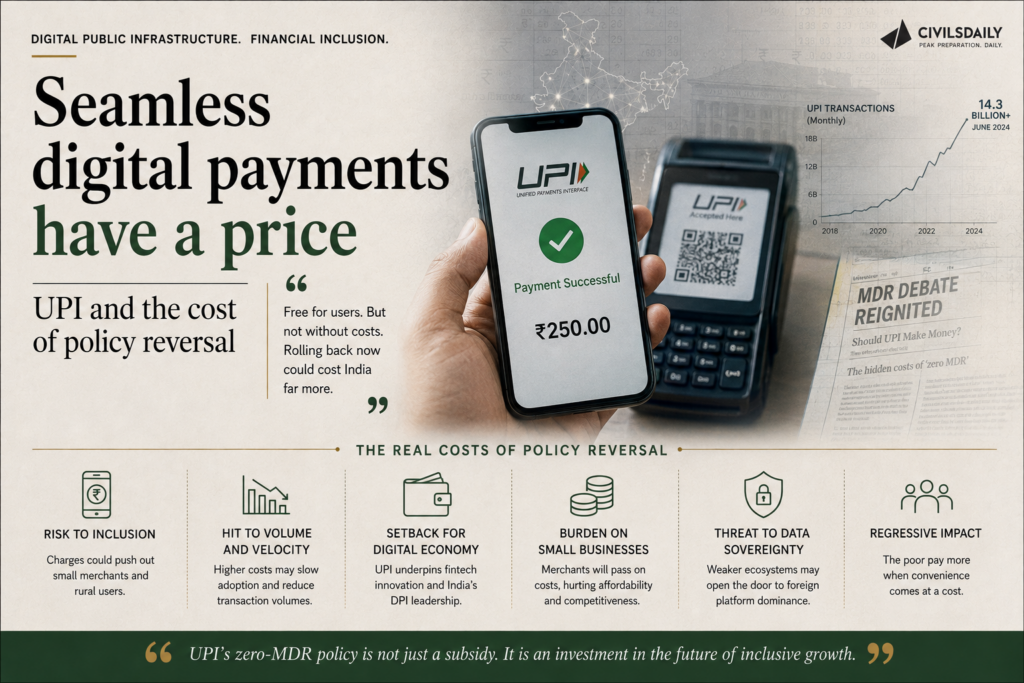
Parliament has passed the Taxation and Other Laws (Amendment) Bill, 2026, allowing a legal framework for possible charges on Unified Payments Interface (UPI) and RuPay debit card transactions. The debate centres on whether digital payments should remain free to promote inclusion or adopt a sustainable funding model.
What is UPI?
- UPI: Unified Payments Interface.
- Enables instant bank-to-bank payments through mobile applications.
- Operated by the National Payments Corporation of India (NPCI).
- Processed 23.6 billion transactions in July.
What is Merchant Discount Rate (MDR)?
- MDR: Merchant Discount Rate.
- A fee charged for processing digital payments, generally paid by merchants.
- Credit-card MDR: around 1-3%.
- Debit-card MDR: up to 0.9%.
- UPI has followed a zero-MDR regime since 2020.
What Does the 2026 Bill Do?
- Amends Section 10A of the Payment and Settlement Systems Act, 2007.
- Creates legal space for the government to notify charges on specified electronic payment modes.
- A proposed MDR of 0.25-0.5% has been discussed for UPI transactions above ₹2,000.
- This could cover about 5% of transactions by volume but around 65% by value.
- The government has stated that consumers and small merchants will not bear MDR and the final framework is yet to be decided.
Why is Zero-MDR Considered Unsustainable?
- Infrastructure costs: Huge transaction volumes require continuous investment.
- Fraud prevention: Cybersecurity and fraud-control systems require funding.
- Government support: ₹8,730 crore was provided through incentives during 2021-22 to 2024-25.
- Funding gap: This covered only a limited share of industry costs.
- Market concentration: PhonePe and Google Pay together account for around 80% of UPI transactions.
What is a Two-Sided Market?
- A platform connecting two groups whose participation reinforces each other.
- UPI: Consumers ↔ Payment platforms ↔ Merchants
- More users attract more merchants, while more merchants attract more users. Therefore, imposing a charge on one side may reduce the network effect.
Why Could MDR Affect UPI?
Arguments for charges
- Provides sustainable revenue for infrastructure.
- Supports innovation and fraud prevention.
- May attract more competitors into the UPI ecosystem.
Arguments against charges
- Could discourage merchants and consumers from using digital payments.
- Intermediaries may absorb the cost rather than pass it on.
- Could weaken India’s financial inclusion and formalisation gains.
- May encourage a shift back towards cash.
About India’s Digital Payments Ecosystem
- RBI: Reserve Bank of India, the regulator.
- NPCI: National Payments Corporation of India, operator of major retail payment rails.
- Banks and fintechs: Participate as payment service providers.
- UPI: Real-time account-to-account payment system.
- RuPay: India’s domestic card payment network.
Statutory Framework
- Payment and Settlement Systems Act, 2007: Regulates payment systems under RBI supervision.
- Section 10A: Provides the framework for charges on specified electronic payment modes.
- RBI Act, 1934: Establishes the Reserve Bank of India.
- Information Technology Act, 2000: Provides legal recognition to electronic records and authentication.
Back2Basics: NPCI
- Full form: National Payments Corporation of India.
- Established: 2008.
- Nature: Not-for-profit company.
- Promoted by: Banks under the guidance of RBI and Indian Banks’ Association (IBA).
- Key systems: UPI, RuPay, Immediate Payment Service (IMPS), FASTag and Bharat Bill Payment System (BBPS).
Government Initiatives
- UPI Incentive Scheme: Supports the cost of low-value UPI transactions.
- Digital India Programme: Expands digital infrastructure and inclusion.
- BHIM: Bharat Interface for Money, NPCI’s UPI application.
- RuPay: Domestic card network.
- JAM: Jan Dhan-Aadhaar-Mobile trinity supporting digital transfers and financial inclusion.
“[2026] Which one of the following statements about Unified Payments Interface (UPI) and Central Bank Digital Currency (Digital Rupee) is NOT correct?
(a) UPI is a real-time payment system but Digital Rupee is akin to sovereign paper currency
(b) In case of UPI, settlement for end users happens instantly; in case of Digital Rupee, wallet balance gets transferred to another wallet (no traditional settlement)
(c) UPI transactions are recorded by banks and reflected in bank statements; in case of Digital Rupee, no data is captured in bank statements
(d) In both the cases (UPI and Digital Rupee), the liability lies with the users and their respective banks
