Why in the News
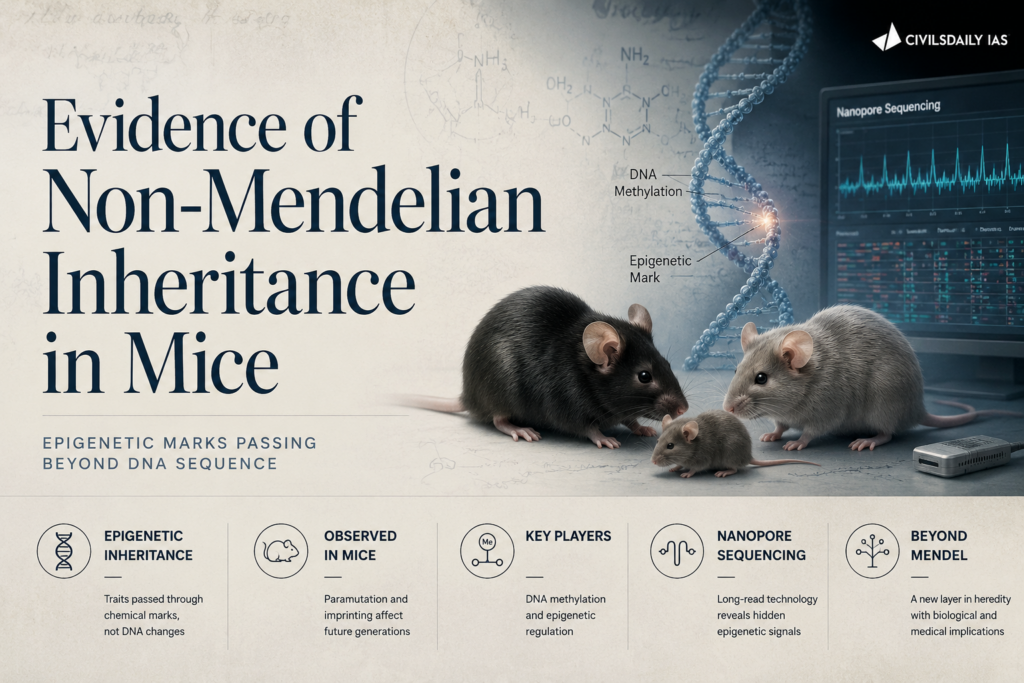
Researchers have reported evidence of non-Mendelian inheritance in mice, involving DNA methylation, genomic imprinting and paramutation. Nanopore sequencing helped detect these epigenetic marks.
What is Epigenetic Inheritance?
- Definition: Transmission of heritable changes in gene activity without altering the underlying DNA sequence.
- Major mechanism: Chemical modifications such as DNA methylation can influence whether genes are switched on or off.
- Non-Mendelian: Unlike classical Mendelian inheritance, the inherited information is not limited to changes in the DNA sequence.
- Genomic imprinting: Expression of certain genes depends on whether they are inherited from the mother or father.
- Paramutation: One allele can induce a heritable change in the expression of another allele without changing its DNA sequence.
- Nanopore sequencing: Can detect certain DNA modifications, including methylation, while sequencing DNA.
Why does it matter?
- Expands inheritance theory: Heritable information can involve regulatory/epigenetic states in addition to DNA sequence.
- Environment and inheritance: Some environmental factors can influence epigenetic states, though not every acquired epigenetic change is necessarily inherited.
- Disease relevance: Abnormal epigenetic regulation is associated with cancers and other diseases.
- Biotechnology: Advanced sequencing can help identify epigenetic modifications alongside DNA sequences.
“[2021, GS3, 15 marks] What are the research and developmental achievements in applied biotechnology? How will these achievements help to uplift the poorer sections of society?
[2021] In the context of hereditary diseases, consider the following statements:
1. Passing on mitochondrial diseases from parent to child can be prevented by mitochondrial replacement therapy either before or after in vitro fertilization of egg.
2. A child inherits mitochondrial diseases entirely from mother and not from father.
Which of the statements given above is/are correct?
[A] 1 only
[B] 2 only
[C] Both 1 and 2
[D] Neither 1 nor 2
