Why in the News
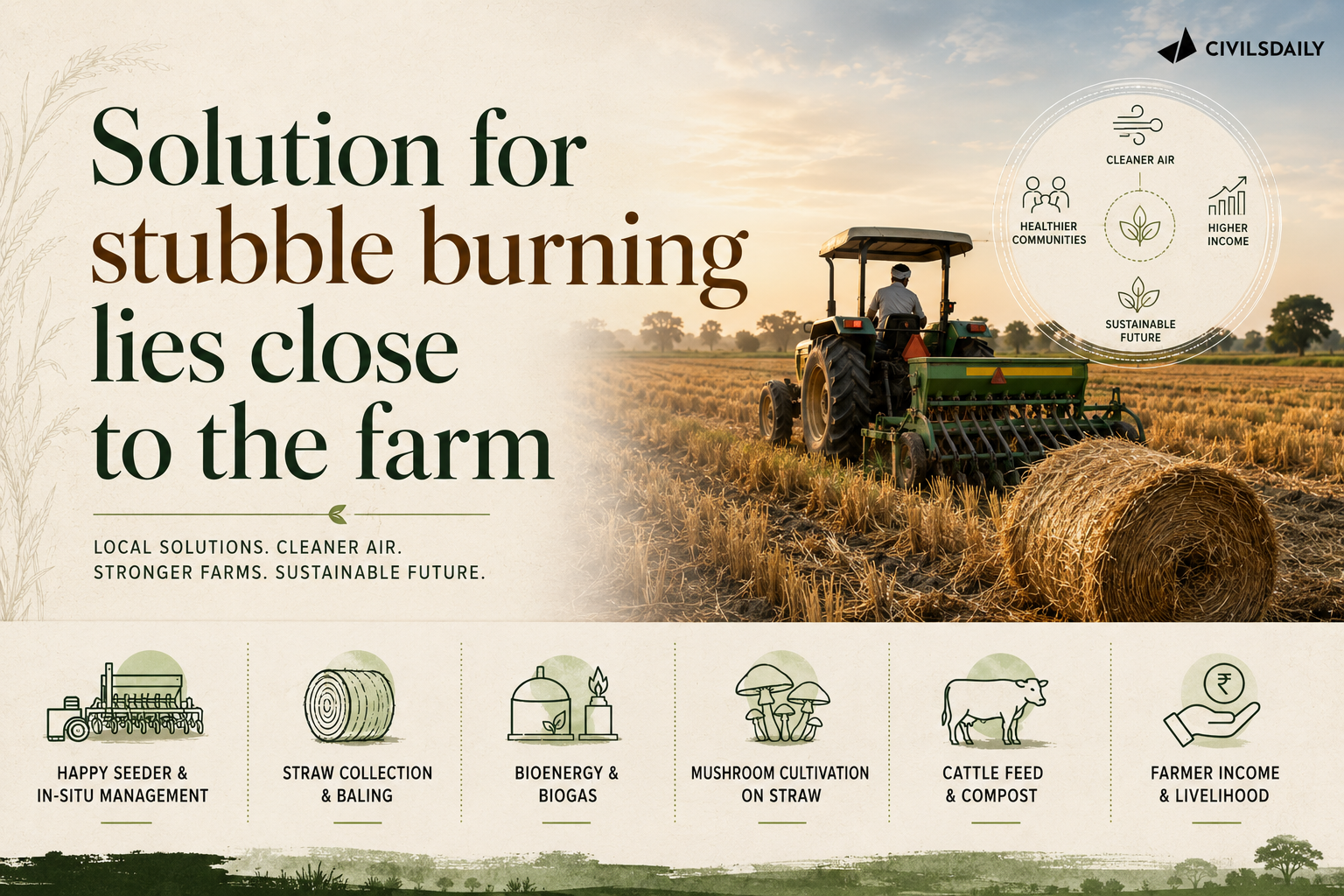
Punjab’s paddy harvesting season is approaching, reviving Delhi’s air-pollution concerns. The focus is shifting from banning stubble burning to creating profitable markets for parali and increasing farmers’ income.
What is biochar?
- Definition: Biochar is a carbon-rich material produced by heating biomass under limited oxygen, so the carbon is retained as char rather than burnt away.
- Feedstock: It can be made from crop residues such as paddy, maize, cotton and mustard stalks.
- Yield: Roughly 100 kg of dry parali yields around 30 kg of char.
- Use in soil: Applied to soil, it improves water retention and nutrient-use efficiency and locks carbon away for a century.
Why do farmers still burn after years of measures?
- Unchanged economics: Residue is bulky, the window before wheat sowing is narrow, and almost every alternative to burning carries a cost.
- Burning is quick and cheap: Alternatives involve cost, labour and uncertainty, so burning remains the rational choice at the field.
- Limits of enforcement and subsidy: Enforcement and machinery subsidies help, and behaviour changes only when the residue itself becomes valuable.
What has changed in the economics of parali?
- From a cost to a price: Farmers in several locations were paying to have straw removed. Today in parts of Punjab the same straw fetches around Rs 1.5 to 2 per kg.
- Who is buying: Demand from power plants, compressed biogas (CBG) units and pellet manufacturers is slowly creating a market for what was treated as waste.
- The new question: If parali now has value, the issue is where that value should be created and how much can remain with the farmer.
Why is biochar different from burning straw for energy?
- Carbon fate: Burning biomass as fuel recovers energy and returns much of its carbon to the atmosphere. Biochar applied to soil retains a significant share of the carbon and serves an agronomic purpose.
- Punjab’s need: The rice-wheat system is under stress from declining soil quality, intensive fertiliser use and groundwater depletion, and residue generated by the same system could improve its soils.
Where is the value created, and who captures it?
- The processing location problem: Parali has to be collected, baled, stored and transported within the narrow window before wheat sowing. Long-distance transport of a bulky, relatively low-value material quickly eats into its economics.
- Farmer as raw material supplier: The farmer supplies the raw material, and most value addition happens after the biomass leaves the village.
- The biochar irony: A farmer supplies the straw, sees it processed elsewhere and later buys back a product made from biomass originating on farms like his.
- The chakki precedent: Wheat does not travel 100 km merely because flour requires machinery. The village chakki places processing close to where the commodity is produced and consumed.
How would a village-scale biochar system work?
- Build-operate-transfer: A technology provider installs and operates the unit, trains local operators and ensures quality and emission standards. Over time the asset and the capability transfer to a farmer producer organisation (FPO), a self-help group (SHG) or a cooperative.
- Government’s role: The government provides standards, training, concessional finance and initial support rather than running thousands of units, and panchayats help with land and coordination.
- Farmer’s routine: Farmers bring straw to a nearby processing point much as they bring wheat to a flour mill. Some biochar returns to their fields and the rest is sold where markets exist.
- What changes: Raw straw travels less, value addition happens closer to the farmer, and villages are not left with subsidised machinery nobody knows how to operate.
Challenges to village-scale biochar processing
- Emissions from small kilns: A poorly run pyrolysis unit releases methane, carbon monoxide and particulate matter, and so replaces one smoke source with another. Eg. The Kon-Tiki flame curtain kiln, the low-cost design most village pilots use, has no flue gas treatment.
The Fix: Notify emission standards for small pyrolysis units under the Central Pollution Control Board and make the build-operate-transfer operator liable for them until handover. - Carbon credit verification: Biochar earns carbon removal credits only where permanence is measured, and a village unit cannot measure it alone. Eg. The Puro.earth biochar methodology requires a hydrogen to organic carbon ratio below 0.7 as the test of permanence.
The Fix: Aggregate village units under an FPO level registry with laboratory testing so that credits are pooled and sold at scale. - Paddy straw is a poor feedstock on its own: Paddy straw carries a high silica content, so its char is ash heavy and lower in fixed carbon than wood char. Eg. Rice straw ash is largely silica, and the char inherits it.
The Fix: Blend paddy straw with maize, cotton and mustard stalks across seasons so that a unit runs year round on a better mix. - Competition from existing straw buyers: A village unit competes for the same straw as large plants that already pay for it. Eg. The Verbio compressed biogas plant at Lehragaga in Sangrur, Punjab, consumes about one lakh tonnes of paddy straw a year.
The Fix: Site biochar units in blocks beyond the collection radius of existing CBG and pellet plants, using the State’s straw balance map. - Window mismatch: Straw arrives in three weeks and a unit needs feedstock for months. Eg. Punjab’s paddy harvest runs through late October and wheat sowing closes by mid-November.
The Fix: Subsidise baling and covered storage at the processing point under the crop residue scheme so that processing continues after the window closes.
Conclusion
The policy question on parali has moved from stopping a practice to locating a market, and the location decides who captures the value. Village-scale processing answers that question only if quality, emissions and offtake are secured before the technology provider exits. The next window is the October to November harvest. Whether any State pairs its residue management subsidies with village-level processing points is the thing to watch.
Stubble Burning in India
- What it is: Stubble burning is the practice of setting fire to the straw residue left in fields after harvest, especially paddy, to clear the land quickly for the next sowing.
- Where and when: It is concentrated in Punjab, Haryana, Uttar Pradesh and the National Capital Region during the post-monsoon October to November window.
- Why it happens: The narrow gap between paddy harvest and wheat sowing pushes farmers toward the cheapest and fastest clearing method.
- Scale: Punjab alone generates about 20 million tonnes of paddy straw a year.
Challenges in Stubble Burning
- Episodic air pollution: Burning sharply aggravates the Air Quality Index across the Indo-Gangetic Plain within days. Eg. In December 2025 Delhi’s AQI crossed 500 and over 150 flights were delayed.
The Fix: Front-load machine deployment in the fortnight before harvest with block-level fire targets monitored by satellite. - Soil degradation: Burning destroys beneficial soil microbes, nitrogen and organic carbon. Eg. Each tonne of burnt paddy straw loses about 5.5 kg of nitrogen, 2.3 kg of phosphorus and 25 kg of potassium.
The Fix: Pay a per-acre incentive for in-situ incorporation with Happy Seeder or Super Seeder, verified by satellite. - Meteorological trap: Winter temperature inversions and calm winds prevent dispersal and compound the damage. Eg. Delhi invoked Stage IV of the Graded Response Action Plan in November 2024 when the AQI crossed 450.
The Fix: Time enforcement and straw collection to the weeks before inversions set in rather than to the pollution peak. - Paddy-centric cropping in a water-stressed region: Free farm power and assured procurement lock Punjab into paddy. Eg. About three fourths of Punjab’s groundwater assessment units are over-exploited as per the Central Ground Water Board.
The Fix: Offer a per-hectare diversification incentive for maize and pulses with assured procurement so that the residue problem shrinks at source. - Penalty without a price: Enforcement fines farmers who have no cheaper alternative. Eg. Environmental compensation for burning was doubled in November 2024 to Rs 5,000 for under two acres, Rs 10,000 for two to five acres and Rs 30,000 above five acres.
The Fix: Pair the penalty with a guaranteed straw purchase price at the block level so that not burning is the cheaper option.
“[2025, GS3, 10 marks] What is Carbon Capture, Utilization and Storage (CCUS)? What is the potential role of CCUS in tackling climate change?”
