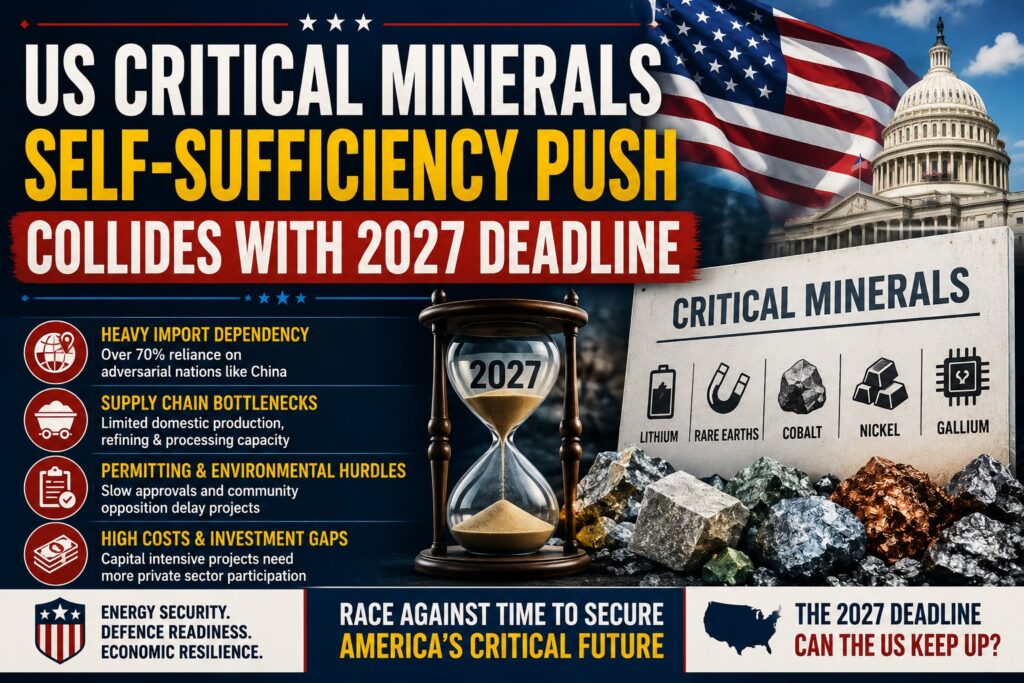
Why in News
The United States is facing challenges in achieving self-sufficiency in defence critical minerals before its January 2027 target. The effort is complicated by China’s dominance, which accounts for over 80% of global critical minerals refining capacity.
Project Vault (United States)
- Project Vault is a US initiative to build a Strategic Critical Minerals Reserve and reduce dependence on Chinese supply chains.
- It aims to stockpile critical minerals, expand domestic mining and refining, and secure supplies for defence, semiconductors, clean energy and advanced manufacturing.
- The initiative is supported by up to US$12 billion through government financing and private investment.
- It complements broader US efforts to establish resilient supply chains with trusted partner countries and strengthen strategic mineral security.
Why China Dominates
- Controls a large share of mining, refining and processing capacity.
- Built an integrated mine-to-manufacturing supply chain over several decades.
- Benefits from state support, advanced processing technology and economies of scale.
- Has previously used export restrictions as a strategic tool in geopolitical disputes.
[2026] Which of the following statements about Rare Earth Elements (REEs) and Critical Minerals is/are correct?
1. Modern technological innovations including Artificial Intelligence, robotics and space exploration extensively utilise Rare Earth Elements (REEs).
2. China has the highest share in mining of REEs followed by India.
3. The Government of India launched the National Critical Mineral Mission (NCMM) in 2025 to establish a robust framework for self-reliance in the critical mineral sector.
4. Rare Earth Elements are a set of 13 metallic elements.
(a) 1 and 3 only (b) 3 only (c) 1, 3 and 4 (d) 1, 2 and 4
