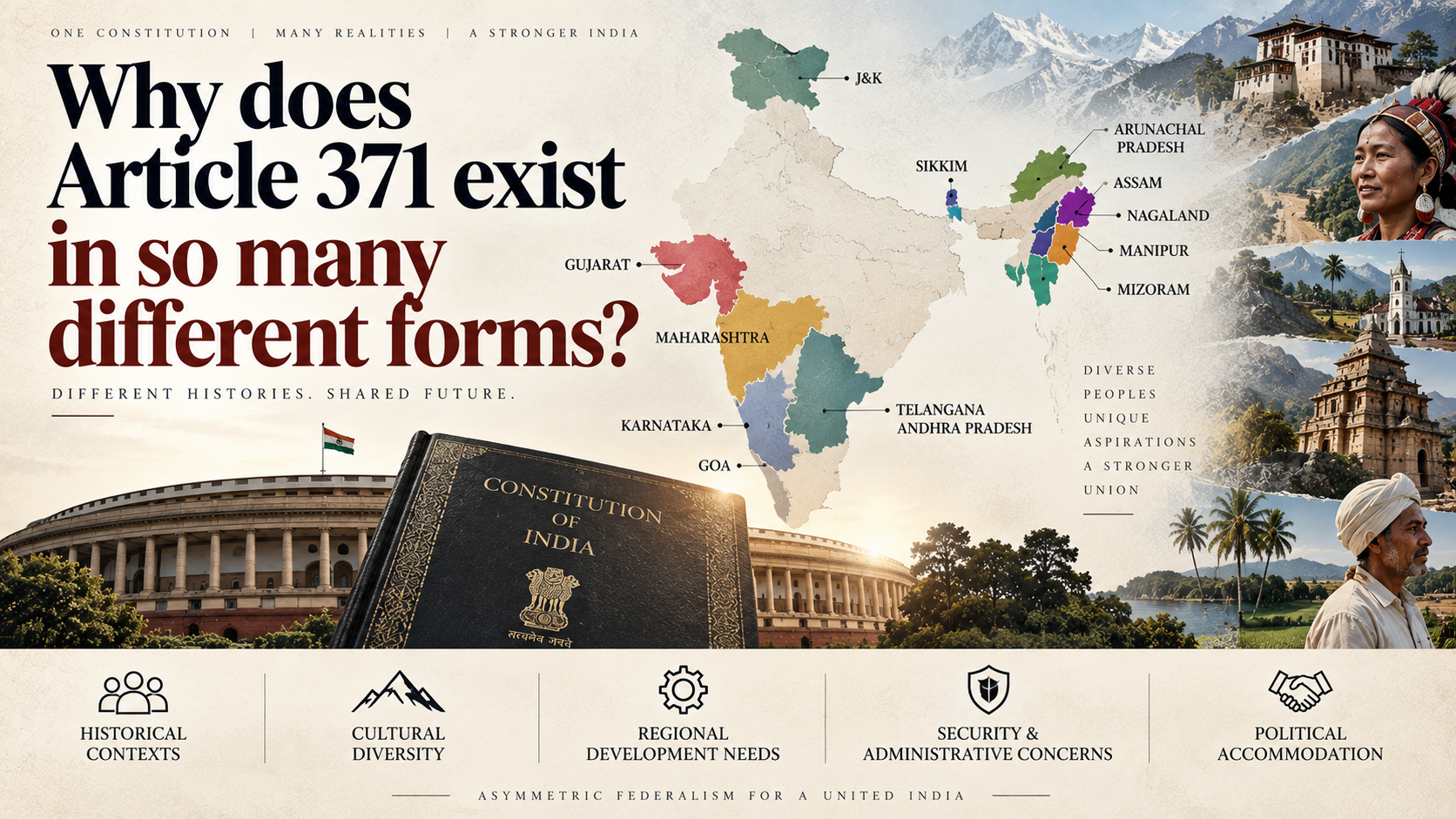
Why in the News
The Centre has proposed inserting a new provision, Article 371K, in the Constitution to give special constitutional safeguards to Ladakh. The proposal follows an “in-principle understanding” reached between the Ministry of Home Affairs and representatives of the Apex Body, Leh (ABL) and the Kargil Democratic Alliance (KDA). That understanding is to create a directly elected Union Territory level body carrying legislative, executive, financial and planning powers. The tension is that every existing Article 371 provision was written for a State, while Ladakh is a Union Territory with no legislature at all, so the proposed clause has to create the institution before it can protect it.
What is Article 371?
- The original purpose: Article 371 was not written to protect the Northeast or tribal regions. It was a transitional provision for Central supervision over the Part B States, the former princely territories that acceded to India under different historical and administrative circumstances.
- The Part B classification: The Constitution classified Hyderabad, Mysore, Jammu and Kashmir, Rajasthan and others separately as Part B States, because the framers were concerned about newly integrated territories functioning immediately within the same framework as the former British provinces.
- What it actually did: Adopted in 1950, it placed the governments of the Part B States under the general control of the President for 10 years, or for such longer or shorter period as Parliament might prescribe.
- How it disappeared: The States Reorganisation Act and the Seventh Constitutional Amendment of 1956 abolished the Part A, Part B and Part C classification. The original Article 371 vanished with it, and Parliament replaced it with a provision for equitable development of Vidarbha, Marathwada, Saurashtra and Kutch in Maharashtra and Gujarat.
Why did a transitional clause become the constitutional home for special protection?
- Flexibility as a design choice: India’s constitutional system was built to accommodate regions whose historical circumstances, social structures or political demands differed from the rest of the country.
- Bespoke rather than uniform: Parliament repeatedly created individually negotiated arrangements under the same Article number, so the 371 series is a set of separate bargains and not a single doctrine of autonomy.
- The trigger is always political settlement: Each insertion followed an accord, a formula or a reorganisation, which is why no two clauses protect the same thing or work the same way.
- The number is a container, not a principle: A clause under Article 371 can mean customary law protection in one State and a minimum Assembly size in another, so the label carries no fixed content.
What does each State specific provision actually protect?
- Nagaland, Article 371A: Inserted by the 13th Amendment Act, 1962 following the 16-Point Agreement of 1960. It protects Naga religious and social practices, customary law and procedure, and ownership and transfer of land and its resources.
- Assam, Article 371B: Inserted by the 22nd Amendment Act, 1969. It allows the President to create a committee within the Assam Legislative Assembly of members elected from the tribal areas covered by the Sixth Schedule, giving protected tribal areas a distinct voice.
- Manipur, Article 371C: Inserted by the 27th Amendment Act, 1971, ahead of Manipur becoming a full State in 1972. It provides a special Assembly committee of members elected from the hill areas, with the Governor responsible for reporting to the President on their administration.
- Andhra Pradesh and Telangana, Article 371D: Inserted by the 32nd Amendment Act, 1973 after the Six-Point Formula of 1973, and substituted by the Andhra Pradesh Reorganisation Act, 2014. It provides equitable opportunities in education and public employment across regions of the State.
- Sikkim, Article 371F: Inserted by the 36th Amendment Act, 1975. It was essentially a transition instrument for the integration of the erstwhile independent State, which became India’s 22nd State after a referendum.
- Mizoram, Article 371G: Inserted by the 53rd Amendment Act, 1986 following the 1986 Mizo Peace Accord. Parliamentary laws on Mizo religious and social practices, customary law and procedure, customary administration of justice, and land ownership do not apply unless the Mizoram Assembly agrees.
- Arunachal Pradesh, Article 371H: Inserted by the 55th Amendment Act, 1986 ahead of statehood in 1987. It gives the Governor a special responsibility for law and order, which is the opposite of the autonomy model used elsewhere.
- Goa, Article 371I: Inserted by the 56th Amendment Act, 1987. It is comparatively modest and simply requires the Goa Legislative Assembly to have at least 30 members.
- Karnataka, Article 371J: Inserted by the 98th Amendment Act, 2012 for the Hyderabad-Karnataka region, now Kalyana Karnataka. It addresses regional backwardness through a development board, equitable allocation of funds, and opportunities in public employment and education.
Why does Ladakh’s demand not fit any existing 371 provision?
- A Union Territory without a legislature: Every existing clause operates on a State that already has an Assembly. The proposed Article 371K would apply to a Union Territory that has none, so it has to create the elected body rather than qualify one.
- The subject list sought: The Ministry of Home Affairs has said the body would have legislative powers over land, culture and language, forests, environment and natural resources, along with other subjects reserved for the Union Territory under Article 240.
- Law and order runs the other way: Article 371H gives the Governor special responsibility for law and order in Arunachal Pradesh. Ladakh’s leaders are seeking the opposite, which is control over law and order by the elected body.
- Land protection borrows a different model: The land protection sought resembles the design of Articles 371A and 371G, under which certain Parliamentary laws on land and customary practices do not apply automatically.
What will decide whether Article 371K is strong or symbolic?
- The weak version: A provision that merely creates an elected body and lists the subjects it may legislate on would offer relatively limited protection.
- The demonstrated failure case: Hill tribes in Manipur have argued that Article 371C has failed to deliver on its promise of meaningful autonomy and protection, so a committee based design is not evidence that protection follows.
- The strong version: A clause protecting the elected body’s control over land, natural resources, recruitment and administration would be considerably stronger.
- The strongest version: Placing law and order and the bureaucracy under the elected executive would make the Ladakh head of government more powerful than the Jammu and Kashmir Chief Minister.
Challenges to the proposed Article 371K
- Special provisions are read down by courts over time: A protective clause survives on paper while its practical scope narrows through litigation on which Parliamentary laws it actually excludes. Eg. Article 371A’s protection over land and resources has been repeatedly tested against Central directives in the petroleum and mining sectors in Nagaland.
The Fix: Enumerate in the clause itself the Union List and Concurrent List entries that will not apply automatically, rather than leaving the exclusion to interpretation. - Legislative power without fiscal capacity is nominal: An elected body can legislate on land and forests and still depend entirely on Central transfers for every scheme it runs. Eg. The Hyderabad-Karnataka development board under Article 371J operates on annual State allocations rather than an assured statutory share.
The Fix: Attach a statutory minimum devolution to the Ladakh body, computed on a formula, so its legislative competence is matched by a predictable resource base. - A committee model can be captured by the majority region: Where a special committee sits inside a larger Assembly, the protected region can be outvoted on everything the committee does not exclusively own. Eg. The hill areas committee under Article 371C in Manipur has been the standing grievance of the hill districts against the Imphal Valley.
The Fix: Give the Ladakh body exclusive rather than advisory competence over the named subjects, so its decisions do not require ratification by a wider chamber. - Two subregions with divergent demands: Leh and Kargil have historically sought different constitutional outcomes, and a single body can reproduce that contest instead of settling it. Eg. The Ladakh Autonomous Hill Development Councils were created separately for Leh in 1995 and Kargil in 2003.
The Fix: Fix a seat and revenue sharing formula between the two districts inside the constitutional provision, rather than leaving it to the body’s own rules of business. - Law and order transfer is the hardest concession to obtain: The Centre has consistently retained police and public order in Union Territories, and Ladakh sits on a live boundary with China. Eg. Delhi’s elected government has no control over the police despite having a legislature since 1993.
The Fix: Create a staged transfer, with a Ladakh police service raised under the elected executive for civil policing while border and internal security remain with the Centre.
Conclusion
Article 371 has never been a single guarantee, and its nine surviving clauses were each written to close a specific political settlement. The Ladakh proposal is the first attempt to use that Article to build a legislature where none exists, which makes it a constitutional innovation rather than an extension. What to watch is whether the final text of Article 371K lists exclusive subjects and places law and order under the elected executive, or stops at creating a body and naming what it may discuss.
Back2Basics
- Article 240: It empowers the President to make regulations for the peace, progress and good government of certain Union Territories, including Ladakh.
- Force of law: A regulation made under Article 240 has the same force and effect as an Act of Parliament, and may repeal or amend a law made by Parliament as it applies to that Union Territory.
- Why it matters here: The subjects reserved to Ladakh under Article 240 are the pool from which the proposed elected body’s legislative competence would be drawn.
- Its limit: The power belongs to the President, so a Union Territory governed under it has no democratic legislature of its own unless one is separately created.
Matching Previous Year Question
“[2013, GS2, 10 marks] Recent directives from Ministry of Petroleum and Natural Gas are perceived by the `Nagas’ as a threat to override the exceptional status enjoyed by the State. Discuss in light of Article 371A of the Indian Constitution.”
