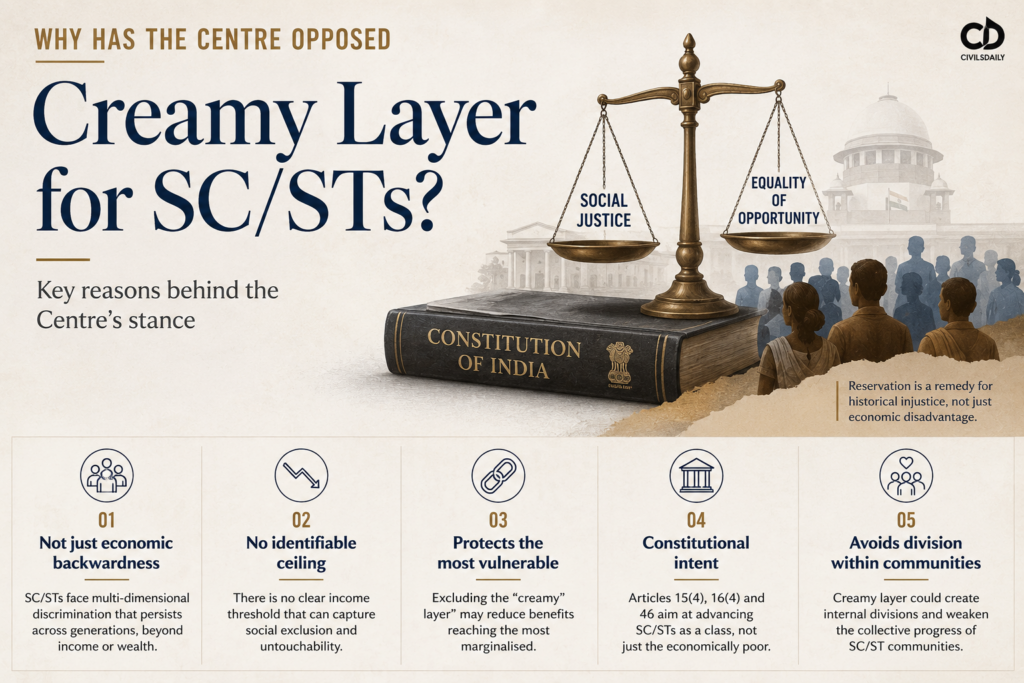
Why in the News
The Union government reiterated before the Supreme Court that the creamy layer exclusion does not apply to Scheduled Caste and Scheduled Tribe classification. The position runs against a separate opinion in the 2024 sub categorisation ruling that urged the Court to consider extending the exclusion. The tension is between the constitutional premise that Scheduled Caste and Scheduled Tribe disadvantage is social rather than economic, and evidence that reservation benefits concentrate within a few advanced sub groups.
What is the creamy layer?
- About: The creamy layer is the economically and socially advanced section within a reserved category, excluded from reservation benefits so that the quota reaches the genuinely disadvantaged.
- Origin: The exclusion was mandated for Other Backward Classes in Indra Sawhney vs Union of India (1992).
- Mechanism: Exclusion operates through an income and status ceiling, currently Rs 8 lakh of annual family income for Other Backward Classes, alongside constitutional post and service rank criteria.
- Point of dispute: The doctrine has never been extended to Scheduled Castes and Scheduled Tribes, whose identification rests on untouchability and social exclusion rather than income.
Current Status of Reservation in India
- Category shares: Scheduled Castes hold 15 per cent, Scheduled Tribes 7.5 per cent, and Other Backward Classes 27 per cent subject to the creamy layer exclusion.
- Economically Weaker Sections: A further 10 per cent applies to those outside the reserved categories, introduced by the 103rd Constitutional Amendment.
- Ceiling position: The 50 per cent ceiling set in Indra Sawhney stands, and the Economically Weaker Sections quota was upheld in 2022 as sitting outside it.
- Sub categorisation: States may sub categorise within the Scheduled Caste and Scheduled Tribe lists after the 2024 ruling, but exclusion of individuals remains barred.
- Central practice: The only central use of sub categorisation within the Scheduled Tribe quota is in Eklavya Model Residential Schools, which reserve minimum representation for Particularly Vulnerable Tribal Groups.
Constitutional Provisions Related to Reservation
- Article 15(4) and 15(5): Permit special provisions for the advancement of socially and educationally backward classes, Scheduled Castes and Scheduled Tribes, including in educational institutions.
- Article 16(4): Permits reservation in appointments for any backward class not adequately represented in state services.
- Article 16(4A): Permits reservation in promotion with consequential seniority for Scheduled Castes and Scheduled Tribes.
- Article 335: Requires that claims of Scheduled Castes and Scheduled Tribes be considered consistently with the maintenance of administrative efficiency.
- Article 341 and Article 342: Empower the President to specify the Scheduled Castes and Scheduled Tribes for each state, with Parliament alone able to include or exclude from the list.
- 103rd Constitutional Amendment, 2019: Inserted Articles 15(6) and 16(6) creating the Economically Weaker Sections quota.
What did the Davinder Singh ruling actually decide?
- Sub categorisation permitted: A seven judge Bench in August 2024 held that states may sub categorise within the Scheduled Caste and Scheduled Tribe lists to give preference to the most backward within them.
- Homogeneity rejected: The Bench held that Scheduled Castes are not a homogeneous class, which is the premise sub categorisation rests on.
- The separate opinion: One judge wrote separately that the creamy layer principle applied to Other Backward Classes in Indra Sawhney should be considered for Scheduled Castes and Scheduled Tribes.
- Status of that view: The separate opinion did not create a binding direction, which is the gap the current litigation is testing.
What is the government’s stated objection?
- Parliamentary competence: The power to include or exclude any community or individual from the Scheduled Caste and Scheduled Tribe lists rests solely with Parliament under Articles 341 and 342.
- Precedent claim: No binding judicial precedent has ever mandated a creamy layer for Scheduled Castes and Scheduled Tribes.
- Process objection: Any change should follow a holistic review and an empirical study, and should not arrive through judicial direction.
- Basis of identification: Scheduled Caste status derives from the disability of untouchability, which income does not extinguish.
Major debates surrounding creamy layer extension
- Social versus economic disadvantage: Whether caste based exclusion persists after income rises is the empirical question the entire dispute turns on.
- Benefit capture: Sub categorisation was permitted precisely because a few advanced sub groups were found to be capturing a disproportionate share of the quota.
- Consistency argument: The Economically Weaker Sections quota already applies an income exclusion, which is the same logic being resisted for Scheduled Castes.
- Institutional route: Whether the change should come from Parliament under Article 341, from the executive, or from judicial interpretation.
- Empirical gap: The Justice G Rohini Commission, set up in 2017 to examine Other Backward Classes sub categorisation, submitted its report three years ago and it remains unpublished.
- Political mobilisation: The Reservation Hatao Andolan, an online movement with over five million followers, demands replacing caste based reservation with income based reservation.
Challenges to reservation policy design
- Absence of current data: Caste wise socio economic data has not been published in usable form since 1931 for most categories. e.g. the Socio Economic and Caste Census of 2011 whose caste data was never released.
- Ceiling pressure: State legislations repeatedly breach the 50 per cent ceiling and are struck down. e.g. the Maratha reservation law set aside by the Supreme Court in 2021.
- Backlog vacancies: Reserved posts remain unfilled while the quota is nominally in force. e.g. the recurring backlog vacancies reported in central government establishments.
- Promotion quota litigation: The requirement to demonstrate inadequacy of representation before reserving in promotion generates continuous litigation. e.g. the Jarnail Singh line of cases refining the M Nagaraj test.
- Sub categorisation without data: States may now sub categorise but lack the empirical base to defend a specific split. e.g. the unpublished Rohini Commission report on Other Backward Classes sub categorisation.
- Private sector exclusion: Reservation does not extend to private employment, which now accounts for most new job creation. e.g. the repeated but unlegislated demand for reservation in the private sector.
Conclusion
The dispute is not about whether advanced sub groups capture a disproportionate share of the Scheduled Caste quota, which the 2024 ruling accepted, but about who may act on that finding and on what evidence. The government’s position keeps the exclusion power with Parliament under Article 341 and makes the missing empirical study the precondition for any change. The next milestone is the Supreme Court’s decision on whether the creamy layer question survives as a live issue after the government’s stand.
Back2Basics: Justice G Rohini Commission
- Constituted in October 2017 under Article 340 to examine sub categorisation of Other Backward Classes.
- Mandated to examine the uneven distribution of reservation benefits among castes within the central Other Backward Classes list.
- Also tasked with working out a scientific approach for sub categorisation and correcting errors in the central list.
- Received repeated extensions and submitted its report to the President in July 2023.
- The report has not been made public or acted upon, which is central to the current debate on evidence.
Way Forward
- Publish the empirical base: Release caste wise socio economic data and the Rohini Commission report so any exclusion rests on evidence rather than assertion.
- Legislate rather than litigate: Settle the exclusion question through Parliament under Article 341, which the government itself identifies as the competent authority.
- Complete sub categorisation frameworks: Give states a model methodology for defensible sub categorisation after the 2024 ruling.
- Fill backlog vacancies: Address unfilled reserved posts, since unused quota undercuts arguments on both sides of the debate.
- Track outcomes, not intake: Report reservation performance through completion, retention and promotion data, not through admission and appointment counts alone.
“[2026] Consider the following statements about provisions pertaining to SC/STs in India:
1. Provisions for Tribal Areas in Assam, Meghalaya, Tripura and Mizoram are in the Fifth Schedule.
2. Some tribes of India are entitled to exemption from paying Income Tax on certain incomes.
3. The Constitution provides for reservation of seats in Panchayats for women belonging to SCs and STs.
(a) There are two correct statements, that include statement 2
(b) There are two correct statements, that are statements 1 and 3
(c) There is only one correct statement
(d) All three statements are correct
