Why in the News
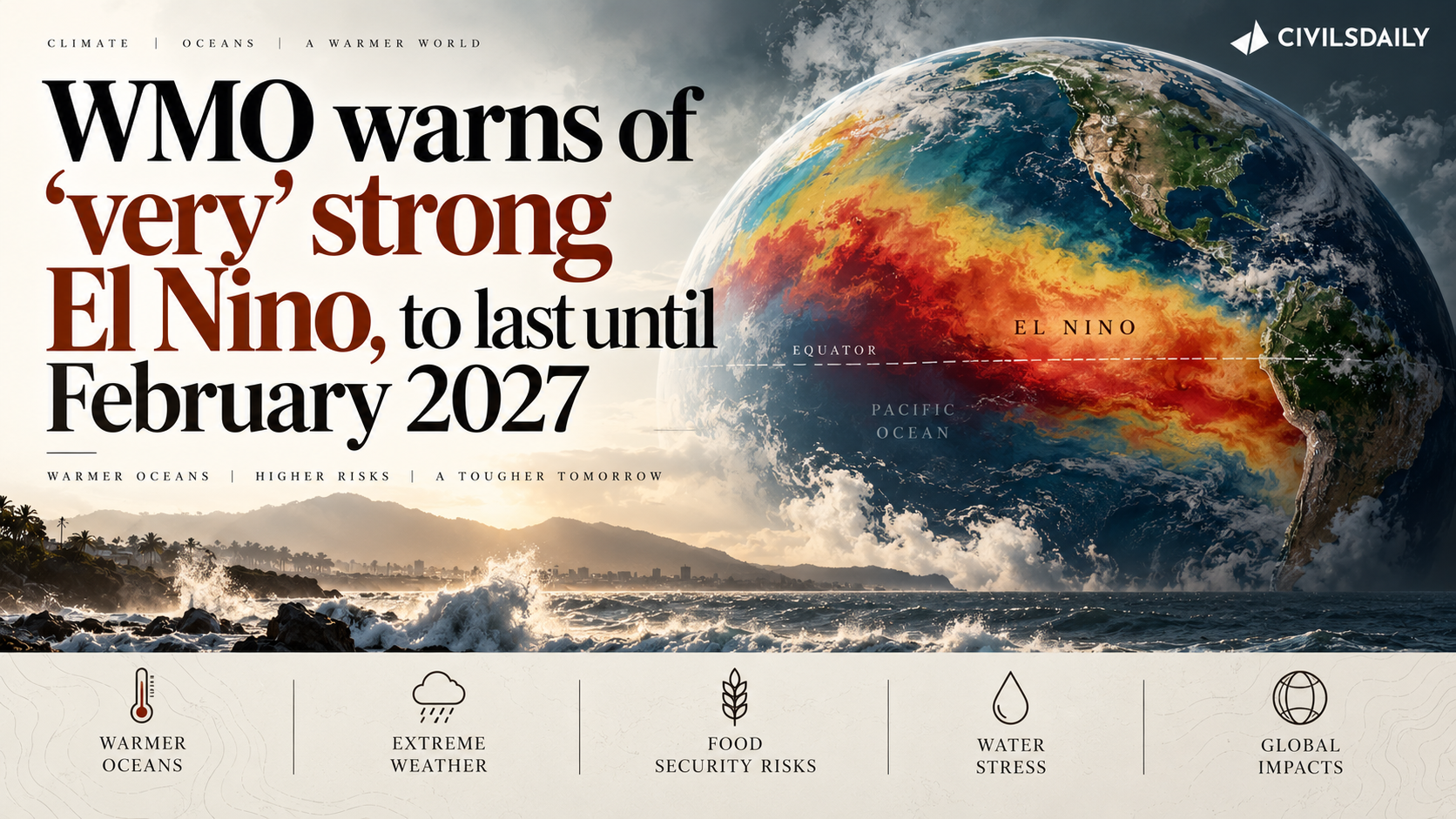
The World Meteorological Organization (WMO) has warned of an impending very strong El Nino that is expected to strengthen and last until February 2027. Its Secretary General stated that El Nino is firmly established and has the potential to deliver a massive blow to communities and economies across the world.
How does El Nino work?
- The mechanism: El Nino is a periodic warming of sea surface temperatures in the equatorial and eastern Pacific Ocean, caused by a weakening of the trade winds.
- Why it travels: The warming moves the region where heat and moisture rise into the atmosphere, which alters temperature and rainfall patterns far from the Pacific.
- Its rhythm: The phenomenon recurs every two to seven years and a single event lasts up to about twelve months.
- What it produces: It is known to trigger heatwaves, wet spells and extreme temperatures.
How strong is this event, and how is that graded?
- The index used: Intensity is determined by the sea surface temperature averaged over three months in the Nino 3.4 region along the equatorial Pacific Ocean.
- The readings so far: The index surpassed 1.5 degrees Celsius above normal during May to July and crossed 2 degrees Celsius above normal in July.
- The persistence forecast: The likelihood of El Nino continuing through February 2027 is put at close to 100 percent, the first time the agency has forecast an event at that degree of certainty.
- A possible record: Exceptionally warm Pacific temperatures make this potentially the strongest El Nino since monitoring began.
What does it mean for India this season?
- The monsoon largely escaped: The India Meteorological Department (IMD) confirmed that rainfall in the later half of August came under the influence of the developing El Nino. With three fourths of the season over, the monsoon has largely escaped it.
- A countervailing signal: A positive phase of the Indian Ocean Dipole is expected to develop during September to November, with a seasonal mean value of 0.9 degrees Celsius.
- Why the offset matters: A positive Dipole strengthens rainfall over the Indian region and can therefore work against El Nino’s drying influence.
- The offset is not assured: The Dipole swung briefly towards the positive phase in late August and then returned to neutral.
What is the WMO doing about it?
- A mobilisation without precedent in the agency: The Secretary General described this as the largest mobilisation with National Meteorological and Hydrological Services in the WMO’s fifty year history.
- Why those agencies: National meteorological services are the bodies that convert a global seasonal outlook into forecasts and warnings people can act on.
- Impacts are already visible: Droughts and floods are already causing disruption, and the agency expects these to intensify as the event strengthens.
- The recent record: Europe recorded one of its hottest summers in recent decades this year, and August brought record temperatures in many parts of the globe.
Challenges to acting on an El Nino warning
- A seasonal outlook is not a local forecast: El Nino shifts the odds of dry conditions across a season and cannot say what a particular district receives in a particular week. Eg. The 2023 monsoon closed about 6 percent below normal for India as a whole, and several subdivisions still recorded surplus rain.
The Fix: Issue impact based forecasts at district level that translate the seasonal outlook into expected effects on sowing dates, reservoir filling and power demand. - The Indian Ocean modifies the Pacific signal: El Nino’s effect on the Indian monsoon depends on the state of the Indian Ocean, so an El Nino year is not automatically a drought year. Eg. The 1997 event was among the strongest recorded and the Indian monsoon that year was normal.
The Fix: Publish the El Nino and Dipole outlooks as one combined regional signal rather than as two separate advisories a user has to reconcile. - Warnings stop short of the last mile: Early warning coverage remains uneven for small farmers and fishing communities who cannot act on a technical bulletin. Eg. The United Nations Early Warnings for All initiative exists because a large share of the world’s population is still not covered by any early warning system.
The Fix: Route advisories through State agriculture extension and fisheries departments in local languages, tied to one specific recommended action. - Reservoirs are operated on inflows, not on forecasts: Storage decisions respond to water already received, so a deficit is managed only after it has appeared. Eg. Southern region reservoirs stood far below their ten year average through the summer of 2024, after the previous year’s deficient monsoon.
The Fix: Write seasonal forecasts into reservoir rule curves so storage is conserved in advance of a forecast dry season. - The consequences outlast the monsoon: El Nino affects the rabi season and global crops, so the exposure continues well after the Indian monsoon withdraws. Eg. India restricted rice exports during the 2023 El Nino year on domestic supply concerns.
The Fix: Set buffer stock and import cover decisions against the forecast horizon rather than against the harvest just completed.
Conclusion
The forecast has settled the question of whether the event arrives and left open only what is done before it peaks. India’s monsoon has escaped this season, so the exposure shifts to the rabi crop, to reservoir storage and to the summer that follows. The marker to watch is whether the Indian Ocean Dipole holds its positive phase long enough to blunt the Pacific signal over the region.
Back2Basics: Indian Ocean Dipole
- What it is: The Indian Ocean Dipole is the difference in sea surface temperature between the western and the eastern parts of the tropical Indian Ocean.
- Positive phase: The western Indian Ocean is warmer than the eastern part near Indonesia, which favours stronger rainfall over the Indian subcontinent and East Africa.
- Negative phase: The eastern part is warmer, which suppresses rainfall over India and shifts it towards Indonesia and Australia.
- How it is tracked: It is measured as the Dipole Mode Index, the temperature gradient between the two poles of the ocean.
[2017] With reference to ‘Indian Ocean Dipole (IOD)’ sometimes mentioned in the news while forecasting Indian monsoon, which of the following statements is/are correct?
1. IOD phenomenon is characterized by a difference in sea surface temperature between tropical Western Indian Ocean and tropical Eastern Pacific Ocean.
2. An IOD phenomenon can influence an El Nino’s impact on the monsoon.
Select the correct answer using the code given below:
(a) 1 only
(b) 2 only
(c) Both 1 and 2
(d) Neither 1 nor 2
