đŸ’„Join UPSC 2027,2028 Mentorship (July Batch) + XFactor Notes & Microthemes PDF

Subject: Ethics

  • What is meant by public interest? What are the principles and procedures to be followed by the civil servants in public interest?

    Public interest is a broad, dynamic concept that refers to the welfare, well-being, and general good of the community as a whole and prioritizing collective benefits over individual or sectional advantages.

    “A public official is a fiduciary of the public’s interest.” – Paul H. Douglas

    Principles to be Followed in Public Interest

    Maxim of utilitarianism – “greatest happiness of greatest number”

    Selflessness- Prioritizing public gain over personal material benefits.

    Integrity- Absolute consistency between one’s values and actions.

    Objectivity- Making decisions based solely on merit, facts, and evidence. Eg- E. Sreedharan in awarding delhi metro projects

    Accountability- Being answerable for the consequences of administrative decisions. Eg- Lal Bahadur Shastri resigning as Railway Minister following a major train accident.

    Openness (Transparency)- Proactively sharing information to foster public trust. Eg- U. Sagayam (IAS) – 1st IAS office to declare his personal assets

    Impartiality- Acting without bias toward any caste, creed, or political affiliation. Eg- T. N. Seshan as CEC

    Empathy and Compassion- Sensitivity toward the plight of the marginalized. Eg- Prashant Nair’s “Operation Sulaimani” – Use of crowdsourced coupons to feed hunger

    Commitment to Public Service- Viewing the job as a “mission”. Eg- Dr. Rajendra Bharud (IAS) setting up an oxygen plant in tribal Nandurbar before the second COVID wave

    Leadership- Leading by example to uphold ethical standards. Eg- S.R. Sankaran – “an ideal people’s IAS officer” remained unmarried for service of nation

    Courage of Conviction- Eg- Durga Shakti Nagpal (IAS) taking a firm stand against the powerful sand mining mafia in Noida.

    Procedures to be Followed in Public Interest

    Adherence to code of conduct and code of ethics

    Adherence to the Rule of Law- Every decision must be rooted in constitutional or statutory authority

    Due Process in Procurement- Eg- using GeM-Government e-Marketplace.

    Public Consultation- Eg- “Gram Sabhas” or “Jan Sunwais” before major projects

    Grievance Redressal Mechanisms- Eg- CPGRAMS

    Recusal from Conflict of Interest

    Evidence-Based Policy Making- Eg- GATI Shakti mission

    These principles and procedures ensure that governance is not only efficient but ethical, humane and resilient.

  • The Right to Information Act is not all about citizens’ empowerment alone, it essentially redefines the concept of accountability. Discuss.

    The RTI Act, 2005, is celebrated as the “Sunshine Legislation” aims to promote “informed citizenry” and transform bureaucratic culture from “secrecy and command” to “transparency and answerability.”

    RTI as a Tool for Citizen Empowerment

    Rights based approach

    Voice to voiceless

    Informed political participation

    Protection of Human Rights (RTI on custodial deaths or condition of prisons)

    Bridge to Other Rights (Right to food under NFSA)

    RTI redefining accountability

    From vertical to horizontal accountability – direct accountability to citizens.

    Ending “Bureaucratic Anonymity”- Eg- RTI makes file notings public, ensuring accountability of specific officers taking decisions.

    From discretionary secrecy to mandatory disclosure – reverses the presumption of secrecy to presumption of openness. Eg- Adarsh Housing Scam exposure

    From reactive to proactive accountability – Section 4 mandates suo motu disclosure, making accountability continuous.

    From procedural to outcome accountability – Citizens question not just rules but results.

    From internal audit to social audit – People become auditors of governance. Eg- MKSS in Rajasthan used Jan Sunwai to expose fake work entries in MGNREGA.

    From elite oversight to mass oversight – Every citizen becomes a watchdog.

    From episodic scrutiny to real-time scrutiny – Continuous public monitoring through RTI queries.

    From moral accountability to legal accountability – Failure to disclose invites penalties.

    From opacity-based power to transparency-based legitimacy – Authority now depends on openness. Eg- 2G Spectrum and Coal Scams exposure

    Issues

    Over 4 lakh appeals are pending.

    Chronic Vacancies in Commissions

    Clash with OSA and DPDP Act

    Legislative Dilution (2019 Amendment)

    Safety and Threats to Activists (over 150 activists killed)

    Poor Record Management

    To ensure that the RTI Act does not become a “dead letter” law, the focus must shift from mere legal compliance to a culture of proactive transparency.

  • What is meant by conflict of interest? Illustrate with examples, the difference between the actual and potential conflicts of interest.

    In public administration, a Conflict of Interest (COI) is a situation where the private interests of a public official clash with their professional duties and responsibilities.

    Manifestation of conflict of interest

    Financial Investments in companies regulated by one’s own department.

    Family Ties (Nepotism). Eg- Chanda Kochhar Case

    Post-Employment Ambitions (Revolving Door). Eg- “Amakudari” in Japan

    Gifts and Hospitality

    Outside Directorships

    Personal Biases

    Secondary Employment. Eg- Moonlighting

    Property Interests

    Actual vs. Potential Conflict of Interest

    Ways to Prevent Conflict of Interest

    Mandatory Disclosure of Assets (2nd ARC)

    Cooling-off Period

    Code of Ethics and office of Ethics Commissioner

    Institutionalized “Conflict of Interest” Registers

    Integrity Pacts

    In a democracy, the appearance of integrity is as important as integrity itself. Moving from a culture of secrecy to a culture of disclosure, can help maintain public trust in governance.

  • Distinguish between “Code of ethics” and “Code of conduct” with suitable examples.

    A Code of Ethics is a set of moral values guiding behaviour, while a Code of Conduct prescribes specific rules regulating actions.

    Difference between code of conduct and code of ethics

    Significance of “Code of Ethics” and “Code of Conduct”

    Promote Integrity & Accountability

    Strengthen Public Trust

    Guide Ethical Decision Making

    Prevent Corruption

    Improve Professional Discipline

    Support Good Governance

    Together, Code of Ethics and Code of Conduct create morally responsible, disciplined, and accountable institutions essential for ethical governance.

  • Explain the process of resolving ethical dilemmas in Public Administration.

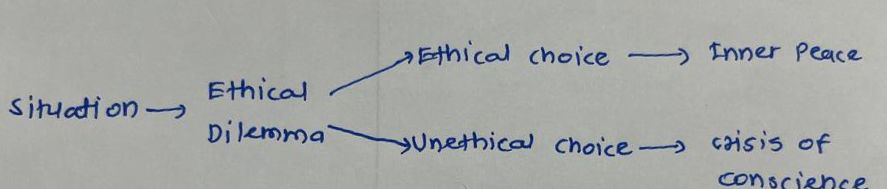
    An ethical dilemma in public administration occurs when a public official is faced with a choice between two or more competing values or interests.

    Ethical Dilemmas in Civil Services

    Development vs. Displacement- Narmada Bachao Andolan (Medha Patkar vs. State).

    Confidentiality vs. Transparency- Whistleblowing

    Political Pressure vs. Neutrality

    Freedom of Speech vs. Public Order

    Environment vs. Livelihood

    Efficiency vs. Equity

    Personal Ethics vs. Professional Duty

    Loyalty vs. Truth

    Process of Resolving Ethical Dilemmas

    Identification of the Ethical Issue – clearly define the conflicting values and recognize the stakes for all parties involved is the primary step.

    Information Gathering – collect all relevant data, consult subject matter experts, and understand the ground reality of the situation.

    Analyzing the Legal Framework – The decision must first pass the test of Legality.

    Applying Ethical Frameworks for evaluating options

    Utilitarianism- Which choice brings the “greatest good for the greatest number”?

    Deontology- What is my absolute “Duty” as a public servant?

    Social Justice (Rawls)- Does this decision benefit the “least advantaged” member of society?

    The “middle path” to balance the extremes.

    Assess the impact of various options on different stakeholders.

    Final Decision and Review – After choosing the most ethical path, the official should implement the decision and monitor its impact for course correction.

    Resolving ethical dilemmas is an exercise in Constitutional Morality. Under Mahatma Gandhi’s Talisman, the ultimate resolution of any dilemma lies in whether the decision empowers the weakest.

  • State the three basic values, universal in nature, in the context of civil services and bring out their importance.

    “The purpose of power is to serve, not to rule.” To adhere to this ethos, civil servants must imbibe certain universal values of ‘Ethical Governance.’

    Three basic values and their importance

    Integrity (Honesty and probity in conduct) – Acting truthfully, transparently and consistently with moral and legal standards.

    Importance-

    Prevents corruption and misuse of public office.

    Builds citizens’ trust in institutions.

    Protects fairness in decision-making.

    Strengthens legitimacy of the state.

    Illustration- Sanjiv Chaturvedi (IFS) exposed corruption in AIIMS despite facing harassment.

    Impartiality (Fairness and non-discrimination) – Treating all individuals and groups equally, without bias based on identity, status or political affiliation.

    Upholds equality before law.

    Prevents favouritism and discrimination.

    Stability during Political Transitions

    Impartial officer acts as a trusted mediator in conflict resolution

    Illustration- T.N. Seshan, as CEC, enforcing MCC in fair manner.

    Accountability – Being answerable for decisions and taking responsibility for consequences.

    Importance-

    Feedback Loop- facilitates a two-way communication between state and citizens

    Improves transparency and performance.

    Enables democratic control over bureaucracy.

    Promotes ethical and careful decision-making.

    Illustration – Ashwini Vaishnaw took moral responsibility after the Odisha train accident by personally overseeing relief and restoration.

    Other values (Nolan Principles)

    Selflessness

    Objectivity

    Openness

    Leadership

    Commitment to constitutional morality

    Probity

    Empathy and Compassion

    Anonymity

    These values ensure that “Steel Frame” does not rust or bend under the weight of corruption and bias.

  • In looking for people to hire, you look for three qualities: integrity, intelligence and energy. And if they do not have the first, the other two will you. – Warren Buffett. What do you understand by this statement in the present-day scenario? Explain.

    Intelligence + Energy – Integrity = DANGER .

    Integrity + Intelligence – Energy = STAGNATION

    Integrity + Energy – Intelligence = INEFFICIENCY

    All Three Combined = SUSTAINABLE LEADERSHIP.

    Consequences of Intelligence and Energy Without Integrity

    Sophisticated Fraud- A smart individual can bypass internal controls and audit trails. Eg- Bernie Madoff running ponzi scheme.

    High energy without integrity leads to “winning at any cost,” resulting in a toxic “cut-throat” culture that destroys team morale.

    Reputational damage- Eg- manipulation of financial data to show “paper profits,” in Enron case

    Erosion of Stakeholder Trust – Eg- The NSE Co-location Case (Chitra Ramkrishna).

    Systemic Exploitation by finding loopholes in laws or company policies. Eg- Nirav Modi – PNB Fraud

    Corrosive Leadership- “If ethics are poor at the top, that behavior is copied down through the organization.” – Robert Noyce (Intel Co-founder)

    Legal risks- Eg- Subrata Roy’s (Sahara India) massive “shadow banking” empire

    The “Smart Criminal” Effect- intelligent and high energy do the wrong things faster and higher in scale. Eg- Harshad Metha

    On the other hand, integrity ensures

    Moral Courage- Eg- Satyendra Dubey

    Integrity builds a reputation and trust.. Eg- Metro man E. Sreedharan

    Gives moral authority to lead. Eg- Captain Vikram Batra leading from the front in Kargil War.

    Integrity helps in objective decision making. Eg- T. N. Session as CEC

    Ensures adherence to Gandhian “Trusteeship principle”

    Integrity is not an optional virtue but a necessary safeguard for ethical corporate governance

  • Anger and intolerance are the enemies of correct understanding. -Mahatma Gandhi

    Anger overwhelms reason and pushes individuals into impulsive reactions, while intolerance closes the mind to alternative perspectives. Together, they prevent people from seeing reality objectively

    Key Values Involved

    Ahimsa (Non-violence)

    Empathy

    Rationality

    Humility

    At the individual level, anger disrupts rational thinking and leads to poor personal decisions. Similarly, intolerance towards different opinions prevents individuals from learning, adapting and growing. Eg-

    At the social level, collective anger and intolerance fuel polarization, violence and breakdown of harmony. It destroying social trust and shared identity. Eg- Delhi Riots of 2020

    At the administrative level, anger and intolerance lead to arbitrary governance and injustice. In contrast, calmness and tolerance lead to fair assessment of situations, grievance redressal, and upholding constitutional morality.

    At the national level, intolerance manifests as exclusionary politics and suppression of dissent, weakening democracy and undermining national unity. Eg- civil unrest in france and rising anti-immigration sentiments in Europe.

    At the global level, anger and intolerance between nations escalate conflicts and prevent peaceful resolution. Eg- Russia-Ukraine War.

    At the corporate level, a leader who reacts with anger creates a “culture of fear” where employees hide mistakes instead of explaining them. This impact psychological safety among employees.

    In judiciary, Judges must be free from “anger and intolerance” to ensure a fairness and objectivity in judgments.

    In technological domain, anger and intolerance lead to formation of Echo Chambers impacting mental health and stability. Eg- cyberbullying.

    Gandhi reminds us that wisdom grows in calm minds and open hearts. Only by mastering anger and embracing tolerance can societies achieve justice, peace and true understanding.