Why in the News
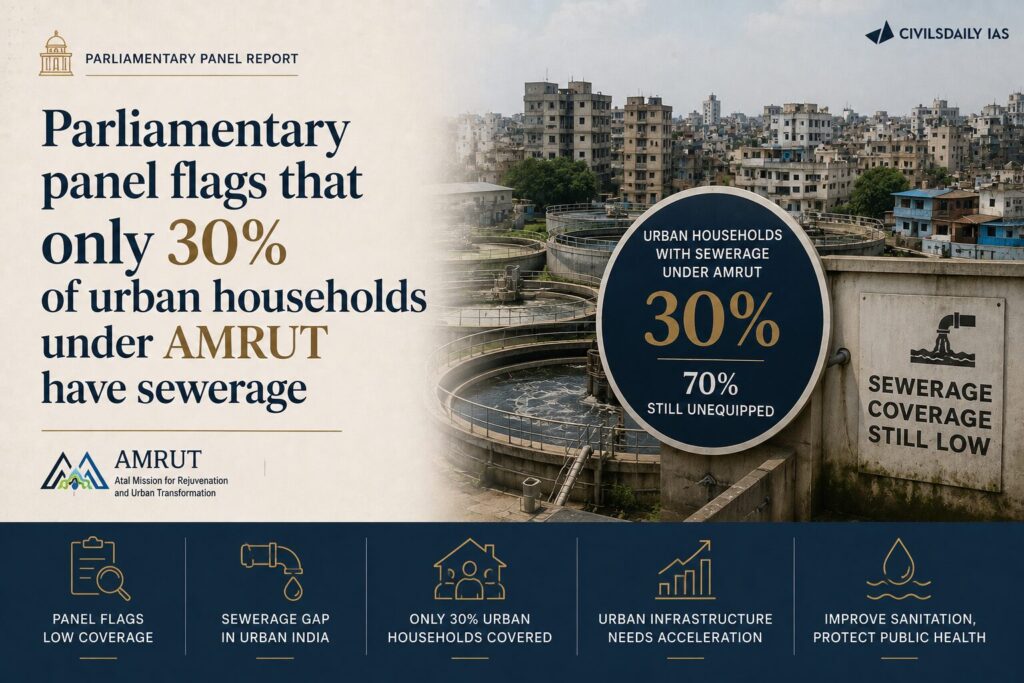
The Parliamentary Standing Committee on Housing and Urban Affairs reported that only about 30% of urban households under the Atal Mission for Rejuvenation and Urban Transformation (AMRUT) have a sewerage connection. It flagged slow progress and inter state gaps in sanitation infrastructure.
What is AMRUT?
- Flagship civic scheme: AMRUT is the Union government’s flagship urban civic infrastructure mission, providing water supply, sewerage, septage, stormwater drains and green spaces.
- Two phases: AMRUT (2015 to 2021) covered 500 cities, and AMRUT 2.0 (from 2021) covers all statutory towns with a focus on universal water and sewerage coverage.
What did the parliamentary panel find?
- Low sewerage coverage: Of 11.32 crore urban households, only 3.44 crore had sewerage connections and 2.84 crore relied on septage systems, per the City Water Balance Plans (2025).
- Inter state variation: Madhya Pradesh, Tamil Nadu, West Bengal, Odisha, Jharkhand and Bihar depend more on septage than on sewer networks.
- Network gap: Of 59,261 km of approved sewer network, only 27,418 km has been laid so far.
Why does the sewerage gap persist?
- Small share of projects: Of 8,743 projects approved under AMRUT 2.0, only 594 (about 6.79%) relate to sewerage and septage management.
- Slow completion: Only 104 of those 594 sewerage projects (17.51%) are complete, while 398 (67%) remain under implementation.
- Funds pending: Only Rs 22,762 crore of the Rs 66,059 crore committed as central assistance has been released.
What did the committee recommend?
- Database and audit: The Ministry should build a database of existing sewer networks, functional status and household connectivity gaps and carry out periodic assessments.
- End manual cleaning: Manual cleaning of sewers and septic tanks should be eliminated.
Challenges to urban sanitation delivery
- Weak urban local bodies: Municipal bodies often lack the finances and technical staff to build and operate sewage treatment plants.
- Trunk versus last mile: Laying trunk sewer lines without household connections leaves treatment capacity underused.
- Cost recovery: User charges for sewerage are politically difficult, so operation and maintenance is chronically underfunded.
- Land and legacy: Retrofitting sewer networks into dense, unplanned settlements is slow and expensive.
- Faecal sludge gap: Cities dependent on septic tanks lack faecal sludge treatment plants, so untreated waste re enters water bodies.
AMRUT
- Launched in 2015 by the Ministry of Housing and Urban Affairs.
- Aims at universal household water supply and sewerage or septage coverage in urban areas.
- AMRUT 2.0, launched in 2021, targets all statutory towns and water body rejuvenation.
- Beneficiaries are urban households, with a stated focus on the urban poor.
[2022] Consider the following statements
1. The India Sanitation Coalition is a platform to promote sustainable sanitation and is funded by the Government of India and the World Health Organization.
2. The National Institute of Urban Affairs is an apex body of the Ministry of Housing and Urban Affairs in Government of India and provides innovative solutions to address the challenges of Urban India.
Which of the statements given above is/are correct?
[A] 1 only
[B] 2 only
[C] Both 1 and 2
[D] Neither 1 nor 2